The affair currently involving the Trump administration and the Holy See is, on closer inspection, nothing new. Rather, it forms part of a pattern already seen, already tested and already widely exposed. The same was already evident in the false reports circulated around the visit of the President of the French Republic, Emmanuel Macron, to Pope Leo XIV, when a story entirely devoid of corroboration, put together without the slightest rigour in verification and relayed by people who wrongfully arrogate to themselves the title of journalists, was used to lend credibility to the idea of a wholly imaginary rift with the Holy See. Today that very same script reappears: the protagonists have changed, the intention has not.
In the Macron case, the mechanism had been set out clearly by Silere non possum: from an anonymous tweet posted on social media, a supposed source was arbitrarily derived, without even the elementary duty of contacting the parties concerned, until a falsehood useful only for fuelling media conflict was elevated into an established fact. In that episode, a very specific degeneration of public discourse was already laid bare: not an occasional mistake, not carelessness born of haste, but a deliberate determination to manufacture a case artificially. And indeed that whole construction collapsed in the face of one unequivocal fact: on 2 April, the Director of the Holy See Press Office had officially confirmed that Pope Leo XIV would receive Emmanuel Macron at the Vatican on 10 April, that is to say this very morning. The few readers of these buffoons, who drag themselves from one newsroom to another in search of a legitimacy they do not possess, are so steeped in nonsense, distortions and propaganda that they no longer even remember the fake news which these self-styled journalists had peddled, with insufferable swagger, as sensational “scoops”.
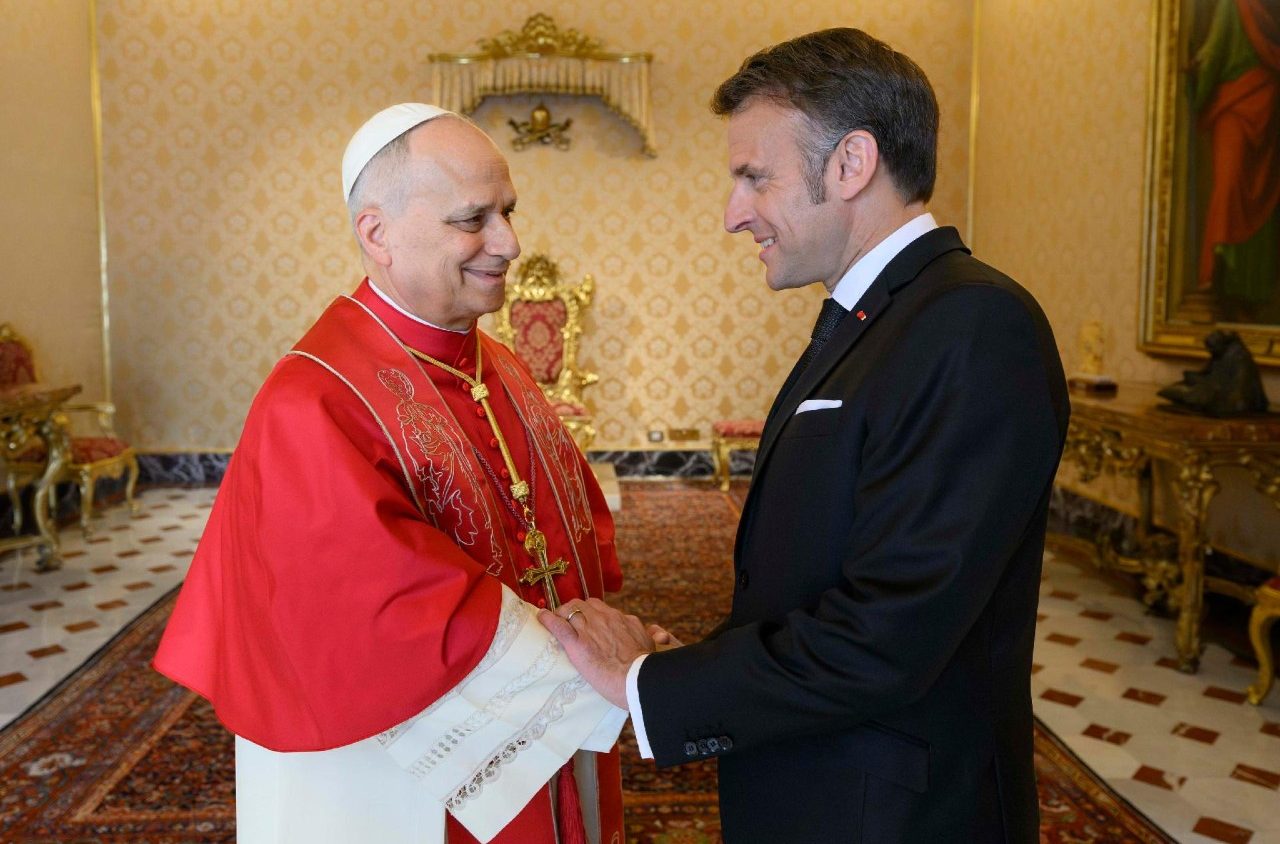 © Vatican Media
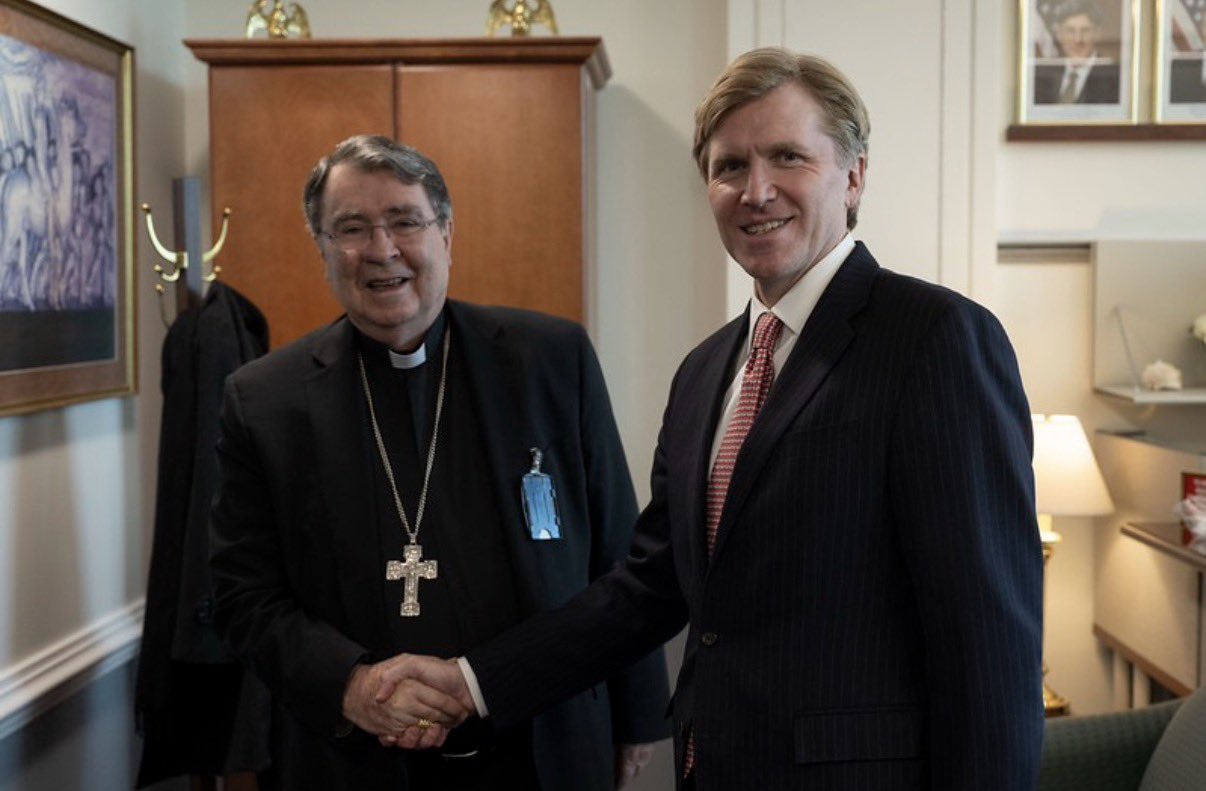
 In today’s controversy over relations between the Trump administration and the Holy See, the very same pattern re-emerges with striking punctuality: rumours inflated until they become “background briefings”, insinuations presented as proof, hypotheses casually turned into convenient truths. Yet the reference to the “Avignon papacy”, the portrayal of an almost final confrontation between the Pentagon and the Holy See, and the notion of direct political pressure being brought to bear on the Pope were denied, one after another, by the facts and by official statements. This very morning the Holy See Press Office stated: “As confirmed by His Eminence Cardinal Christophe Pierre, former Apostolic Nuncio to the United States, his meeting with Mr Elbridge Andrew Colby formed part of the ordinary mission of the Pontifical Representative and provided an opportunity for an exchange of views on matters of mutual interest. The narrative offered by certain media outlets regarding that meeting does not correspond to the truth in any way.”
Moving in the same direction were the words of Ambassador Brian Burch, who said that he had spoken with Cardinal Christophe Pierre and wrote on X: “I was pleased to speak today with His Eminence, Cardinal Christophe Pierre. As expected, he confirmed that recent media characterizations of his meeting with Undersecretary Colby are ‘fabrications’ that were ‘just invented.’ Given the intelligence and seriousness of Mr. Colby, I was likewise not suprised when His Eminence acknowledged there were no threats of any kind in the meeting. ‘It was a frank and cordial meeting that took place two months ago.’ Threat of Avignon? ‘None.’”
The point, then, is not to determine which version may be more useful to one political side or the other; rather, it is to observe how, in this case too, the public sphere was immediately occupied by partisan and hypertrophic narratives, constructed not in order to understand a diplomatic episode, but to bend it into an instrument of ideological struggle. On the Right and on the Left alike, the Pope is continually dragged into a conflict that is not his own. When it is convenient to portray him as hostile to a Western leader, every word and every gesture is exaggerated. When it is convenient to present him as a humiliated, intimidated or politically aligned interlocutor, reality is forced until it becomes unrecognisable. The political camp fanning the flames may change, but the technique remains the same: take a partial fact, distort it, insert it into a partisan script, and use the Holy See as material for propaganda.
The problem is that, in this way, the very nature of the Pope’s words is altered.Leo XIV, even in recent days at Castel Gandolfo, spoke in terms that precede and transcend the contingencies of party politics. Faced with the threat directed against the entire Iranian people, he said that it was “truly unacceptable”, and added that it was indeed a matter of international law, but, more profoundly still, a moral question concerning the good of a people in its entirety. In the same address he called for peace to be sought, for war to be rejected, for a return to the negotiating table, and he reminded his listeners that attacks on civilian infrastructure violate international law. Here the decisive point becomes clear: the Pope does not speak in order to provide ammunition to one side or another. He speaks to the moral conscience of peoples and governments.
 © Department of War
This is precisely what many cannot tolerate. A moral word, authentic like that spoken by Prevost, escapes the binary logic of political polemic. It cannot be reduced to the language of election campaigns, opposing fronts or digital partisans. That is why it is systematically manipulated. There are those who insist on reading every audience as an investiture, every diplomatic tension as a declaration of war, every papal appeal as an assist given to one side against the other. It is an infantile way, and at the same time a highly self-interested way, of treating the Holy See: it is invoked when it seems useful, and delegitimised when it refuses to be used. In reality, the Pope receives everyone and engages in dialogue with everyone, including those who do not share, or share only in part, his vision. After all, what politician or public figure could ever be taken as fully coinciding with our own thinking in every one of his positions? None. And yet, within the Church, an approach has now taken root that is as crude as it is misleading: reducing everything to a binary, schematic and impoverished alternative in which one is merely either “for” or “against”.
The tragedy, however, also concerns journalism. These operations do not circulate on their own. They require pens, microphones, social media profiles, and people willing to renounce the elementary rules of the profession. In the Macroncase, something even worse was seen: not journalists, but people who merely lay claim to that title, occupying the public sphere with the tone of accredited professionals while possessing neither method nor responsibility. In the Trump-Vatican case, the risk is identical: lending oneself to a war of narratives in which verification comes afterwards, if it comes at all, and in the meantime the damage has already been done.
Those who practise the profession of information seriously, and not as a narcissistic pastime or as a surrogate for a power they do not possess, ought first of all to preserve one elementary duty: to distinguish what is established from what is artificially constructed, what is a document from what is mere suggestion, what belongs to the language of diplomacy from what has been deformed and dragged into domestic political conflict. Too often, however, one sees the reverse procedure: people do not begin with the facts in order to understand them, but from the political alignment of the newspaper for which they write, and then gather only those fragments capable of confirming a thesis already decided in advance. In this way, the Vatican becomes a field to be occupied symbolically. And the Pope, instead of being heard in the radical seriousness of his mission, is reduced to a walk-on part in someone else’s theatre.
Marco Felipe Perfetti
Direttore Silere non possum