Solesmes - In a Church that for decades has continued to bear the wounds of the liturgical conflict that followed the Second Vatican Council, Dom Geoffroy Kemlin, Abbot of Solesmes, has put forward a proposal intended to place ecclesial unity back at the centre.
In a letter sent to Pope Leo XIV, the monk addresses one of the most sensitive issues in contemporary Catholic life: the relationship between Paul VI’s reformed Missal and the older rite, which still remains a point of reference for many communities attached to the Latin liturgical tradition. The interview that follows arises from this initiative and sets out its motives, substance and implications. Kemlin speaks from concrete experience acquired within the Congregation of Solesmes, where monasteries celebrating according to the two uses of the Roman rite live side by side. His reflection touches on theological, pastoral and disciplinary questions, without avoiding comparison with Traditionis custodes and the path previously traced by Benedict XVI. What emerges is an attempt to indicate a way forward which, in the abbot’s view, may help the Church move beyond a confrontation that over time has become a source of suffering and division.
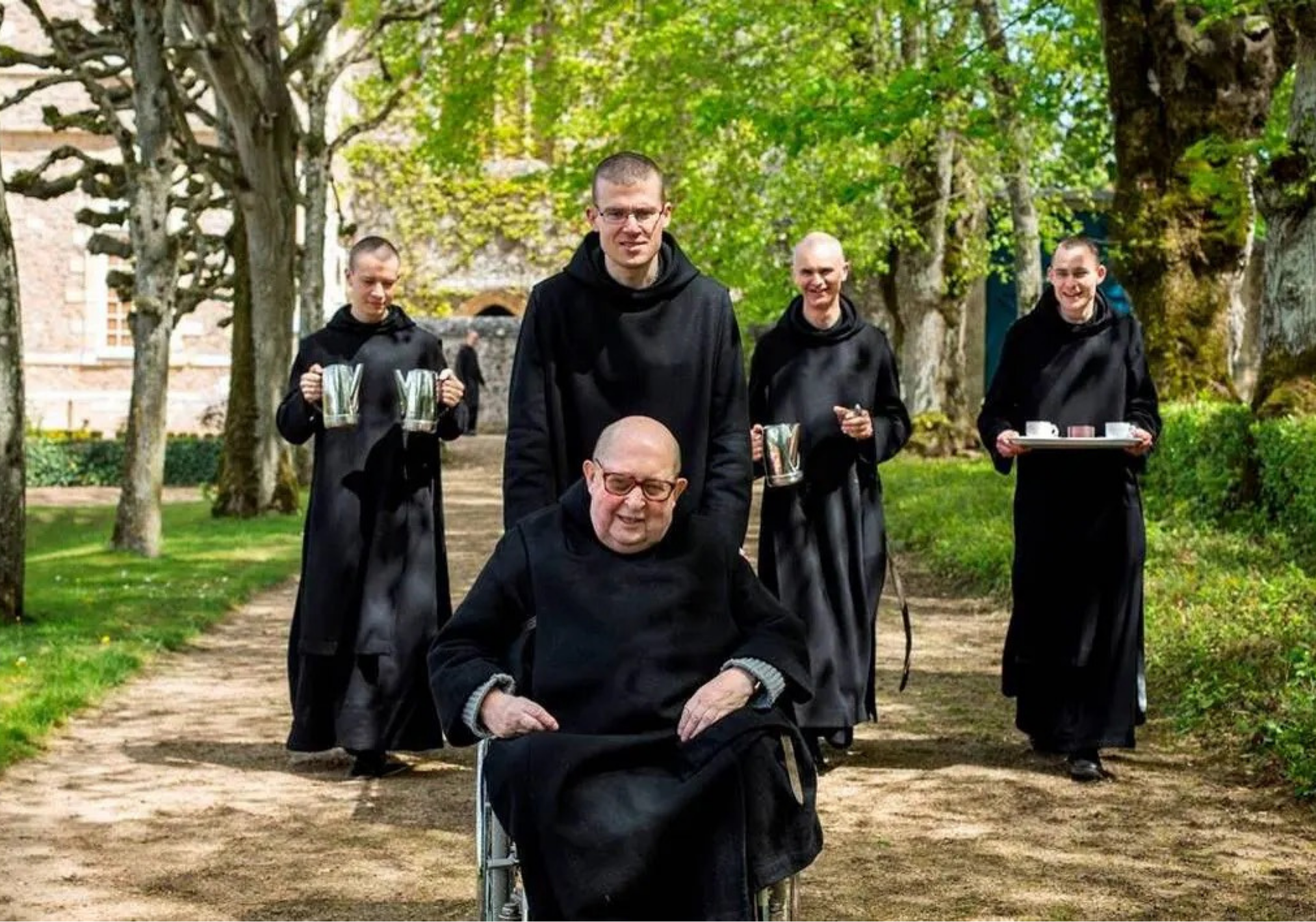
The antagonism between Catholics attached to the ancient Latin rite and supporters of the new Missal of Vatican II dates back to the early 1970s. Why did you write to the Pope now?
I had the opportunity to concelebrate with Pope Leo at Sant’Anselmo, the Benedictine abbey in Rome, in November. The Abbot Primate had invited the Holy Father for the 125th anniversary of the dedication of the church. And he accepted. At the end of Holy Mass, I was introduced to the Pope as Abbot of Solesmes. He then exclaimed, “Ah! Solesmes!”, showing that he knew who we were. I immediately felt the desire to write to him in order to share with him certain matters that had long been close to my heart regarding the liturgical situation in France and in the universal Church.
Why does the question of liturgical unity affect you so deeply?
In our Congregation of Solesmes we have monasteries that celebrate according to both rites, the old and the new. I have personally lived this reality in the course of my own journey. I entered Fontgombault Abbey at the age of 20, where Mass is celebrated according to the ancient Missal of Saint Pius V, before arriving at Solesmes, where the monks celebrate Mass, in Latin, according to the reform of Vatican II. I have lived this question in a very personal, very intimate way. So when I see divisions on this issue, I suffer because of it. The liturgy is meant to foster unity in the Church, not to divide us. That is why I wanted to share with the Holy Father, modestly, a proposal for trying to move forward on this matter.
In this letter you write: “The time has come to work for a true return to unity.” Do you think the disagreements have gone too far?
Every antagonism in the Church causes us suffering. We are members of the Body of Christ. Our witness is to show the world that we are united. Yet this unity is not uniformity. Pope Francis stressed this repeatedly.
In practical terms, your proposal would involve revising Paul VI’s Order of Mass, that is, the ordinary of the Mass, which includes the prayers and the unchanging parts of the Roman rite. Why?
I believe that each Catholic sensibility must be willing to take a step towards the other. In this way, divisions could be reduced and that unity, which is so important, could be recovered. What I am proposing is an inclusive path: incorporating the older rite into the current Roman Missal. This would make it possible to bring the different ways of celebrating together within a single whole.
Which specific parts of the Mass could be modified?
The priest could simply choose to incorporate elements of the ancient Missal that are no longer found in Paul VI’s Missal. I am thinking, for example, of the prayers at the foot of the altar, or the ancient offertory, which was reformed.
Would that not risk creating further confusion among the faithful?
There would certainly have to be a framework to define. The liturgy belongs to the Church, so it is for the Holy See to decide in this matter. I nevertheless believe that this solution is possible, because the liturgical reform preserved many elements in common with the ancient Missal. It would simply involve adding certain options.
So the ancient Missal of Saint Pius V, to which traditional communities have remained attached, would also in some way be modified?
Indeed. If the older rite were incorporated into the current Missal, this would open up new possibilities. For example, Mass could be celebrated according to the ancient rite but in the language of the country and no longer only in Latin. This would also make it possible for the priest to use the new Eucharistic Prayers and the new Prefaces. Lastly, I am thinking of the cycle of readings: the current Lectionary called for by Vatican II is far richer than the old one. There would be a real biblical enrichment for the faithful. All this would enrich the older rite.
What are the advantages of this scenario for the everyday life of the Church and of Catholics?
This proposal largely accommodates the legitimate aspirations of the faithful and of priests, without in any way diminishing the authority either of the Pope or of the bishops. It would therefore make it possible to respect the prerogatives of each. I do not see how tensions could remain, since each person would celebrate according to his own sensibility while still doing what the Church asks. In addition, the liturgical calendar would also be unified.
Your proposal is rooted in a particular context, that of the Congregation of Solesmes. In what way has the legacy of Dom Guéranger guided you?
Dom Guéranger worked for the return of the dioceses of France to the Roman Missal, and therefore for liturgical unity. It was by following in his footsteps that I wrote to the Holy Father. Moreover, at Solesmes we implemented the reform of Vatican II in a way rooted in tradition, preserving Latin and Gregorian chant. It is possible to implement the liturgical reform without understanding it as a rupture, but rather as continuity.
In the end, what are the differences compared with the Motu proprio of Benedict XVI, which had broadened the possibilities of celebrating according to the ancient Missal?
The aim of Benedict XVI was to show the importance of the ancient liturgy for the Church: it is a sacred heritage that must not be abandoned. But the Motu proprio of 2007 allowed the use of the ancient Missal alongside the new one, which did not reduce the differences. Here, by contrast, there would be a single Missal for a single body of faithful.
Does your idea not run counter to Traditionis custodes, the Motu proprio promulgated by Pope Francis in 2021?
No, I do not think so. The aim of Pope Francis, through this text, was precisely to put an end to divisions. The situation quite clearly caused him suffering. This proposal, by contrast, could enable us to achieve the unity that everyone desires, while at the same time welcoming the diversity of the Church.
Do you think that young Catholics today look at this liturgical dispute differently? Those aged between 18 and 35 and the newly baptised, for example, seem much more at ease with the matter.
Yes, certainly. One can see today how easily they move from one rite to another, with no difficulty in welcoming one another. Most of them pray with the same ease at Paray-le-Monial, at Taizé or on the Chartres pilgrimage. It is a fine example given to us for softening our hearts. I would add that, within the Congregation of Solesmes, we already live this liturgical diversity. It is lived in peace and unity. When the abbots of Fontgombault or Triors come to Solesmes, they celebrate according to the Missal of Vatican II. And vice versa: when I go to them, I celebrate Mass according to the ancient rite. This unity already exists in seed form within our congregation. We must share this grace so that it may become a grace for the whole Church.
What do you now expect from the Church, from the Dicastery for Divine Worship, or from the bishops?
My letter to the Pope is obviously only a suggestion. I am well aware that it still needs to be refined and made more precise. I hope that the bishops will continue to reflect on this matter and themselves make proposals so that the Church may recover the much-desired unity.