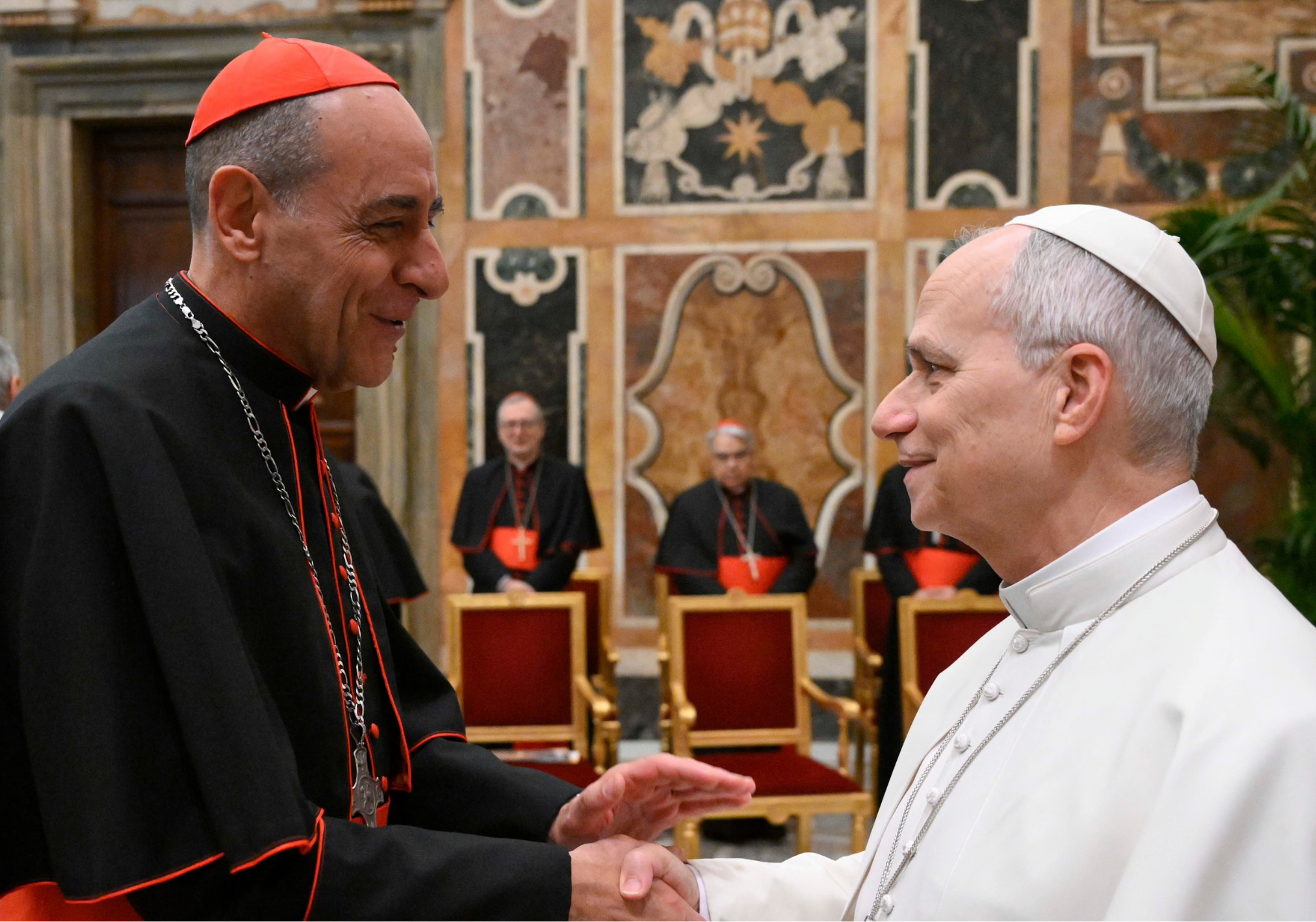
The Dicastery for the Doctrine of the Faith is working on a wide-ranging document devoted to one of the most keenly felt questions facing the contemporary Church: how faith is transmitted today. The news was disclosed by Cardinal Víctor Manuel Fernández, Prefect of the former Holy Office, who specified that the text is still being drafted and is being prepared in collaboration with the Dicastery for Evangelisation.
An initiative from the ground up
Unlike many Vatican documents, this one did not originate behind a desk. The decisive impulse came from the bishops themselves: during their ad limina visits to Rome, episcopates from across the world repeatedly expressed the same concern, asking for a specific study of the problem and of the possible ways to address it. From there, the process developed through successive stages. The cardinals and bishops who are members of the Dicastery were consulted in two monthly meetings, the so-called Feria IV. At the first meeting, the need for the document was confirmed and a dialogue began which Fernández described as fruitful; consultations with experts were then launched and an initial draft was prepared, which now forms the basis of the text under discussion. With further ad limina visits, the issue broadened still further, until at a second Feria IV it was decided to open a very wide consultation, extended to all episcopal conferences, numerous specialists and research centres.
The response was substantial. Many episcopal conferences have already sent opinions and materials, and the Dicastery said it was surprised both by the quantity and by the length of the contributions received, expecting that it will take a considerable amount of time to read and make proper use of all this material.
The root: the legacy of Evangelii Gaudium
The document’s origin lies partly in the apostolic exhortation Evangelii Gaudium, signed by Pope Francis on 24 November 2013 at the close of the Year of Faith: a text which Pope Leo XIV has said, including before the cardinals, he wishes to promote and implement. This reference is not incidental. Evangelii Gaudium itself arose from a reflection on the transmission of the faith: it gathered the work of the XIII Ordinary General Assembly of the Synod of Bishops, held from 7 to 28 October 2012 on the theme The New Evangelisation for the Transmission of the Christian Faith. It is useful to reread some of its underlying insights, because they shed light on the direction in which the new text now being prepared is moving.
The exhortation identifies three distinct settings in which the transmission of the faith is at stake. First, there is ordinary pastoral ministry, directed towards those who regularly take part in the life of the community and those who retain a sincere faith even without often taking part in worship. Then there is the sphere of baptised persons who do not live the demands of Baptism, who do not have a heartfelt sense of belonging to the Church and no longer experience the consolation of faith. Finally, there is proclamation to those who do not know Jesus Christ or have always rejected him - many of whom, the document observes, nevertheless seek God secretly, even in countries of ancient Christian tradition. In all three cases, one principle applies, which Francis explicitly takes from Benedict XVI: the Church grows not by proselytism, but by attraction. Against this background, the exhortation also records the concrete difficulties involved in transmission. In recent decades, Francis writes, there has been a real rupture in the generational transmission of the faith among the Catholic people: more parents are not having their children baptised and are not teaching them to pray, a certain exodus towards other faith communities is growing, and many feel disappointed and cease to identify with the Catholic tradition. Among the causes identified are the lack of spaces for dialogue within the family, the influence of the media, relativistic subjectivism, consumerism, and insufficient pastoral care for the poorest. The family itself - described as the fundamental cell of society and the place where parents transmit the faith to their children - is presented as being marked by a deep cultural crisis.
Alongside this diagnosis, Evangelii Gaudium sets out a method. The transmission of the faith cannot be reduced to doctrinal formation or to the repetition of fixed formulas: it must focus on what is essential, on the kerygma, the first and qualitatively principal proclamation of the saving love of God in Christ, dead and risen. For that proclamation to be effective, it must be inculturated: Christianity does not possess a single cultural model, and faith cannot be confined within the boundaries of one particular culture. Hence the document’s attention to popular piety as an authentic missionary expression of the People of God, and the idea that every baptised person is a “missionary disciple”, an active subject and not merely a recipient of evangelisation.
A deliberately universal perspective
It is precisely this sensitivity to inculturation that the new document intends to carry through fully. Fernández stressed that the breadth of the consultation ensures a genuinely universal perspective, capable of embracing a great variety of viewpoints and of bringing out the marked regional differences in the way this challenge is lived. The Prefect illustrated this with concrete examples: “One need only consider that even among Muslim-majority countries, the bishops’ perspectives on this issue vary considerably. The pastoral experience of the episcopates of North Africa is not the same as that of Mali; the perspective of Turkey is not the same as that of Pakistan. In Europe, Poland is not like Germany, and Italy is not like England. In Latin America, Argentina is not like Colombia, and Brazil is not like Peru.”
For this reason, he insisted, preparing a text today on the transmission of the faith requires moving beyond a European or Italian framework and drawing on the breadth, variety and richness of the universal Church. The consequence at the level of content is openly stated: the document will not be able to offer single recipes or solutions valid for everyone, but will have to recognise the complexity of the problem and propose paths capable, in some way, of inspiring all. It is an approach closely reminiscent of the “sound decentralisation” and the valuing of local episcopates already called for by Evangelii Gaudium.
The coming months
The cardinal observed that it is good news that the theme has aroused such interest, and precisely for this reason the Dicastery does not consider it appropriate to disperse its efforts on other fronts: for a certain period, he explained, it will also be necessary to concentrate on the reception of the forthcoming encyclical - the first of Pope Leo XIV, devoted mainly to the theme of artificial intelligence, which will be signed and made public shortly. Fernández finally clarified that the text on the transmission of the faith is currently the only major document in preparation at the Dicastery, which nevertheless remains engaged in highly demanding daily work. The thread linking the 2013 exhortation to the text now in progress therefore appears clear: the same question - how to communicate the faith today in a plural and rapidly changing world - brought back to an answer that rejects a universal formula and instead chooses to listen to the Church in its many faces.
s.R.P.
Silere non possum