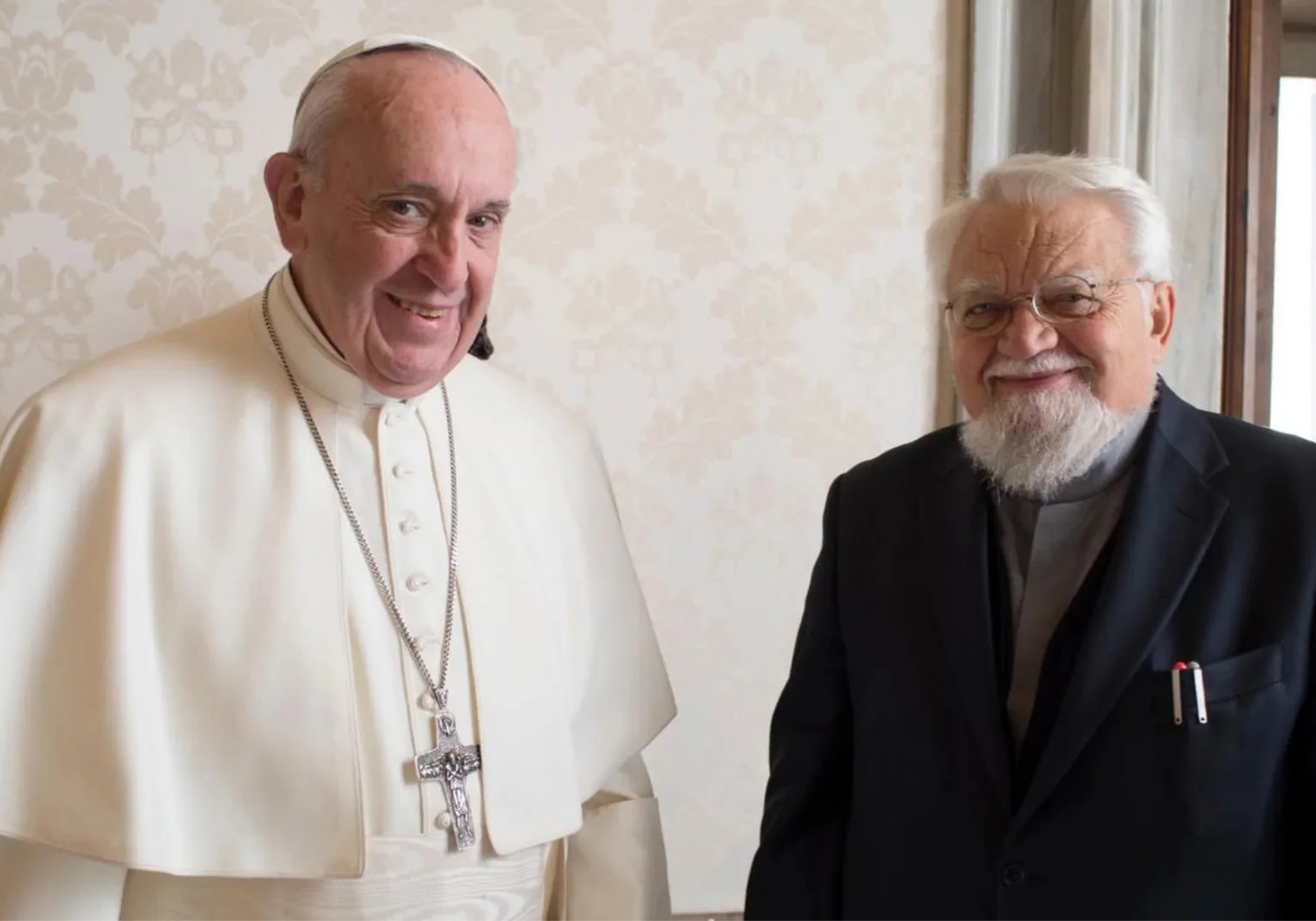
Rome - In recent hours Enzo Bianchi has returned, in the pages of “Vita Pastorale”, to the question of liturgical peace in the Church. This is not the first time: it is a concern the founder of Bose has been voicing for years. He had already done so during the pontificate of Pope Francis, including in the pages of Repubblica, and today he restates it with calm. Bianchi is in no way an expression of traditionalism; indeed, during the years of Benedict XVI’s pontificate he unfairly attacked him more than once - an attitude which, I am convinced, he regrets today. These are words that do not come from someone nostalgic for the Vetus Ordo, and that is why they carry weight.
His reflections are all directed towards unity: a unity that Bianchi has always sought in forms and ways one may well not share, yet which remain noble in their intention. Nor should it be forgotten that, before the disgraceful defamatory structure built against him by his own community - and dismantled document by document by Silere non possum - Enzo Bianchi was the face of the ecumenism of the Church of Rome. And on the liturgical terrain he left a concrete mark, with schemas that are still used today in seminaries and communities. One may not appreciate them, one may legitimately prefer something else: but it cannot be maintained that they were not a serious and important attempt which helped, and still helps, the prayer of many. And let us not forget: what Bianchi is saying is nothing other than what Pope Leo XIV has already said on several occasions.
What Enzo Bianchi says
His text is an appeal for “pax eucharistica”: no surrender, no doctrinal concession, but a request for a climate of reciprocal welcome between those who celebrate according to the rite reformed by the Council and those who remain attached to the Vetus Ordo, under explicit conditions that are anything but indulgent. As almost always happens, Andrea Grillo’s jab promptly arrived - the self-proclaimed liturgist and know-it-all - who, in his usual register, insults, attacks and mocks anyone who does not think as he does.
In the Church today, in short, it is no longer possible to say anything: not about women, not about the priesthood, and least of all about the liturgy - because the boomer from Savona will duly arrive to attack you from the heights of his illustrious little Facebook page, or from certain sites run by certain priests who have bankrupted not only the publishing ventures they managed, but their entire order. It vaguely recalls the attitude of certain repressed types who cultivate a genuine fetish for everything published by certain newspapers that have become their obsession: and they are obsessed with them precisely because they know full well they cannot have what they would like.
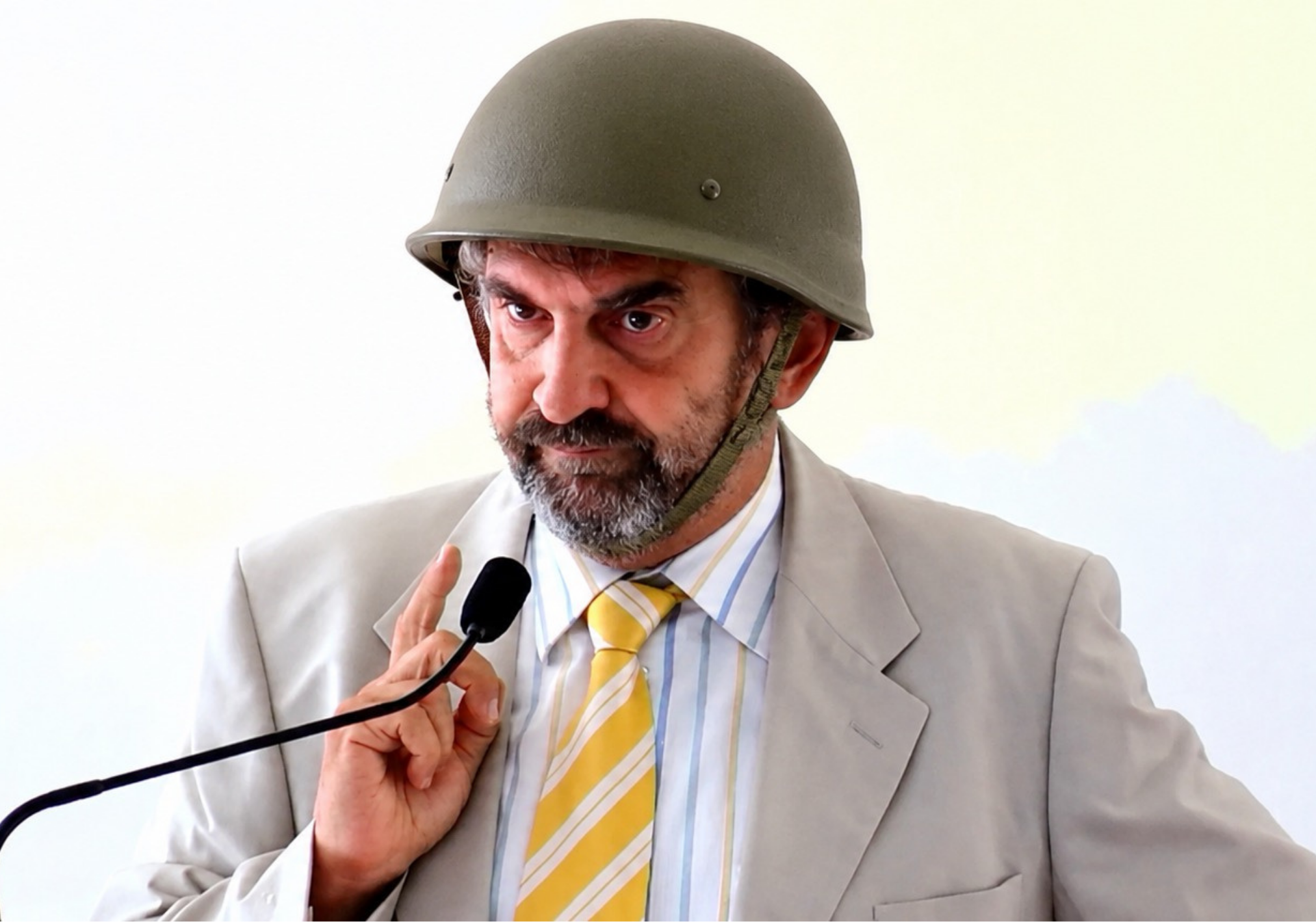
It is worth saying this openly, because it is part of the problem: Grillo is known for a way of arguing that easily slips from substantive objection into personal attack. It can already be seen in the title - “Enzo Bianchi apologist of the old rite” - and even more in the body of the text, where the interlocutor’s position is disqualified before it is even discussed: too “monastic”, too “limited”, too “selective”. And it can be seen, above all, in the comments on his own article, where Grillo responds to those who raise documented objections by accusing them of lying. Calling someone else’s thesis a “lie” is not an argument; but this is well known: Grillo is incapable and does not have the tools to argue. Having cleared the ground of the method, let us come to the substance. Because it is in the substance that Grillo’s position shows its most serious crack.
The ad personam argument: “it is only a monastic view”
Grillo’s first move is to reduce Bianchi’s reflection to a partisan point of view: only traditionalists and monks would be asking for “peace”, whereas for everyone else the problem would be the opposite - a liturgy that is too dull, too irrelevant. It is a skilful observation, but logically it is a fallacy: instead of refuting the thesis - is liturgical peace desirable? under what conditions? - it disqualifies its origin: who is asking for it, and from what perspective. The fact that an argument comes from a monk makes it neither true nor false: it is assessed for what it says, not for the place from which it is written. He did the same when he attacked the Abbot of Fontgombault. In the interview given to Silere non possum, Grillo thought it wise to go after both the abbot and the director. Perfetti, whom Grillo hates worse than the devil because he made public the accounts through which the Pontifical Athenaeum Sant’Anselmo pays his salary. This too, as usual, should give you a yardstick for judgement. We are not speaking here of serious people, but of problematic figures who, as it happens, find space where exactly? In the Catholic Church. What a novelty.
But there is more. Bianchi’s concern, not different in substance from that of Abbot Pateau, is not a cloistered obsession at all: it is the very line of Pope Leo XIV today. The letter that Cardinal Parolin sent, in the name of Leo XIV, to the French bishops gathered in Lourdes on 18 March 2026 asks precisely for “a gaze that may allow people sincerely attached to the Vetus Ordo to be generously included”. Bianchi is not expressing a monastic whim: he is saying, in his own words, what the Secretariat of State writes in the name of the Pope. Grillo knows this, and disposes of it with a quip: for a diplomat it is possible to say “one thing together with its opposite”. It is an elegant way of not responding to an official document: one insinuates that the author does not think what he signs, instead of grappling with what he has written. And then, frankly, it matters little whether Parolin personally agrees with what he writes: the only certain thing is that this is the Pope’s will.
The either-or Bianchi never posed
Here lies the heart of the problem, and it is a question of mentality before it is a question of liturgy. Bianchi proposes a genuinely Catholic interpretation in the etymological sense of the term: καθολικός, according to the whole, aimed at including, at keeping within, at leaving no one outside. Grillo, faced with the same question, sees only an either-or: “if one wants to admit the old rite in general terms, one must put the Second Vatican Council in the attic”; and conversely, “if one wants to walk along the path of Vatican II, one cannot admit the use of the old rite”. Either here, or there. “Are saying yes and saying no equivalent?”, he presses, as though every mediation were by definition a logical contradiction. But the either-or is a category that the Church, by her very nature, almost never espouses. Her entire dogmatic history is made of both-and: true God and true man, grace and freedom, Scripture and Tradition, unity and diversity. The attempt to reduce a pastoral question to a fork in the road with no third way is precisely what the magisterium has always refused to do. And here there is a contradiction that concerns Grillo closely. Because on almost every other front he is the first to invoke openness, welcome, overcoming rigidities: the diaconate and priesthood for women, relations with non-Catholics, inclusion of those on the margins - always, on everything, the register is that of also, of widening, of not excluding. Then, however, when it comes to the Vetus Ordo, openness suddenly evaporates and only binary logic remains, the closed door, the either-or. The question is inevitable: why does inclusion apply to everyone except the faithful attached to the ancient rite? Why there, and only there, does the category suddenly become exclusion? What have these people done to the well-known “screamer of Camaldoli”?
Bianchi asks practitioners of the Vetus Ordo, at the same time: to recognise the validity of the four Eucharistic Prayers and of the Ordo of Paul VI; to concelebrate at the Chrism Mass with the bishop; not to despise the reformed liturgies; and to accept the dogmatic constitutions of the Council, Sacrosanctum Concilium included. There is no “putting the Council in the attic”: there is a request for reciprocity in which recognition of Vatican II is an explicit and non-negotiable condition. One may discuss whether that reciprocity is practicable in concrete terms; one cannot honestly say that it is self-contradictory, because Bianchi does not deny the Council at all - indeed, he sets it as the price of entry. Which is exactly what Cardinal Fernández does. And here allow me a gloss. The traditionalist wing continues to attack him, claiming that he would not be the right person to conduct these assessments with the Fraternity. It targets him with nicknames and little jokes that are always sexual in tone - a fixation of those whose lives are clearly unresolved. But it is precisely this that reveals how much more that wing is committed to treating a subject such as homosexuality politically than to the truths of faith and of the liturgy. Besides, wanting to insert the question of homosexuality into a profession of faith honestly makes one wonder where certain figures studied. And let us not forget that we are speaking of environments in which homosexuality is anything but absent: it would be enough, quite simply, to acknowledge it.
These are the same traditionalists who instrumentalise Joseph Ratzinger, who - were he today at the head of the Dicastery for the Doctrine of the Faith - would not only have done the same, but would also have been more severe towards them.
The fact of Solesmes that Grillo does not refute
Bianchi does not merely put forward a thesis: he brings a concrete fact. And faced with the fact, Grillo skims over it with surprising ease. The founder of Bose gives the example of the Congregation of Solesmes, where monasteries that celebrate the reformed rite coexist with communities that celebrate the Vetus Ordo, and where the abbots of the one concelebrate in the rite of Paul VI with the others, and vice versa. “And in the Order there is peace, there is no tension.” It is not a wish: it is a fact, already in place, and moreover in full acceptance and implementation of the Council.
What does Grillo reply? That monks possess the “rule”, which would offer them a unity superior to the liturgy itself, such as to make even different rites bearable to them; parishes and dioceses, lacking that rule, could not allow themselves this. But this is an observation, not a refutation. Bianchi’s question was not “why do monks manage it?”, but rather “what does the fact that they manage it demonstrate?”. And what it demonstrates is simple: that ritual coexistence, in full adherence to Vatican II, is not a logical contradiction - because it already exists, in practice, before everyone’s eyes. Faced with a fact, Grillo does not oppose another fact: he opposes an abstract distinction. It is the most elegant way not to answer. There is more, and it is what betrays the true nature of the objection. It is not true at all that the rule, in itself, unifies on terrain such as the liturgy: and this is precisely what reveals how much Grillo speaks of realities - the monastic and the parish - of which he has no direct experience. The history of orders and congregations is, if anything, dotted with examples that prove the exact opposite: it is precisely on these issues that conflict lurks within communities, sometimes more bitterly than elsewhere. The “rule” is not a sedative that extinguishes divisions; it never has been.
The heart of the matter: what Benedict XVI really wrote
Let us come to the point at which Grillo overturns historical truth. In his article, and even more in the comments, he maintains that there exists a single and continuous line - John XXIII, Paul VI, John Paul II, Francis - according to which one form of the Roman rite “replaces” the previous one, and that he is merely repeating what all these pontiffs have “said exactly”. When someone reminds him of Benedict XVI, he dismisses the matter as “a Ratzingerian sophism”.
Here the texts must be taken in hand. In the Letter to the Bishops accompanying the motu proprio Summorum Pontificum, of 7 July 2007, Benedict XVI writes - as Pope, in a magisterial act - that the Missal of 1962 “was never juridically abrogated and, consequently, in principle, remained always permitted”, and that it is not appropriate to speak of the two missals “as if they were two Rites”, since it is rather a matter of “a twofold use of one and the same Rite”. This is not the opinion of a boomer who defines himself as a liturgist, nor a “sophism”: it is the word of a reigning Pontiff in an official document. Whoever points this out is not writing any “lie”: he is quoting Benedict XVI literally. Defining the exact quotation of a Pope as “sophism” in order to save one’s own thesis is precisely that methodological vice which renders the debate sterile. And it is what makes everything Grillo has always said inconsistent. But Grillo’s real error is not being wrong about Ratzinger. It is pretending there is a concord between pontiffs that recent history disproves. The linear continuity Grillo depicts simply does not exist, and it is not a traditionalist who disproves it: it is the magisterium itself. Summorum Pontificum (2007) states that there exist simultaneously two expressions of the lex orandi of the Roman rite, the ordinary and the extraordinary. Traditionis Custodes (2021) declares the exact opposite: that the books of Paul VI and John Paul II are “the unique expression of the lex orandi of the Roman Rite”, and abrogates the previous concessions. They are two Popes, and they say opposite things on the same point.
And Francis does not do this by arguing why what preceded him did not work. We are not saying that he could not do it: he could, and it was within his powers. We are saying something else, and something more serious: when one intervenes to affirm the opposite of what one’s predecessor established, one must explain why and how the change is being made. It is a requirement of reason before it is one of governance. And it is a way of proceeding already seen elsewhere under Bergoglio’s authoritarian pontificate: in Praedicate Evangelium the question of the power of lay people is introduced without clarifying why the Code provides otherwise, nor how the question can now change. The problem, mark this, is not the direction of the change: it is change asserted and not justified. Let one thing, however, be clear above all: the liturgy does not depend on the sympathies or preferences of pontiffs. It is a reality far greater than they are - and precisely for this reason it deserves to be touched only with explicit reasons, never by authority alone. It is legitimate to hold - as Grillo does - that the binding position today is that of Francis: it is the latest legislative act, and it is in force. But then let it be said like this: “today the discipline of Traditionis Custodes is in force”. What is not honest is to maintain that all the Popes, from John XXIII to today, have “said exactly the same thing”, and that whoever cites Benedict XVI is lying or engaging in sophistry. It is false, and demonstrably so: between 2007 and 2021 the pontifical magisterium said, on the very same point, first one thing and then its opposite. Denying this discontinuity in order to accuse the adversary of “intransigence” in reverse - that is, of laxity - is the real intellectual impropriety of this exchange
Bianchi does not speak as a canonist, but as a believer
It is true: when Bianchi writes that the lex orandi he lives today is “the same” as the one he practised from 1949 to 1971, Grillo replies that no, it is the same Mass but with two different leges orandi, and that using that rite today is not equivalent to using it licitly then. On the level of current canon law, it must be acknowledged, there is indeed a difference between the licit use of yesterday and the discipline of today. But here too Grillo confuses the planes. Bianchi is not advancing a juridical claim - “the rite is permitted today as it was then” - he is making a spiritual and theological one: that the faith lived in that liturgy is the same faith he lives now. And it is exactly what Grillo “grants” with one hand - “no one doubts that you lived in the Catholic faith” - only to take it away with the other, branding as a “clear distortion” what is in fact an entirely legitimate distinction between the level of discipline and that of faith. That the lex credendi is not purely and simply identified with one rite is not a heresy: it is a principle the Church herself applies every time she recognises, in different rites, the same faith.
When arguments are lacking
One may disagree with Enzo Bianchi. One may reiterate that the discipline of Traditionis Custodes is the one currently in force, although it must be clear that it will not have a long life, given that Leo XIV wants to take up this question and favour liturgical peace. These are all respectable positions, and those who hold them do not need to raise their voices in order to do so. What does not stand up is the method: defining a journalist as “ignorant”, “nostalgic”, someone who supposedly writes “panegyrics”; dismissing a monk by speaking of “clumsy attempts to turn things upside down”. These are judgements which, moreover, fall far from the truth, considering that the director of Silere non possum is anything but “nostalgic” or “traditionalist”. But so be it: try having a serious discussion with certain psychiatric cases. Today you are a traditionalist, tomorrow you are a modernist. Depending on how they wake up. In the end, the problem is always the same: when arguments are lacking, one moves to the label, the caricature, the insult. And in this way one thinks the matter has been closed. It is not acceptable to disqualify the interlocutor before discussing him, to skirt around his facts with abstract distinctions and, above all, to rewrite the history of the recent magisterium as a straight line when, on this very point, it has been a broken line. Bianchi closes his text as an elderly man who sees monasteries closing and churches emptying, and who asks that we no longer divide ourselves “not in order to be stronger, but in order to be more faithful to the Gospel”. One may answer him with an argument. He deserves that. What he does not deserve - he, and before him the truth of the facts - is to be met, in place of an argument, with a label. From whom, then? From some sorry character disappointed with life who insults everyone on Facebook? No thanks.
And then, of course, imagine him letting slip the opportunity to attack someone who never invited him to Bose to speak about liturgy, preferring people far more prepared, serious and balanced than he is. The question that the Pontifical Athenaeum Sant’Anselmo and the Dicastery for Culture continue to evade is simple: how is it possible that a person of this kind is still teaching in a pontifical university? The “divisive” ones, apparently, are always the others. Never the person who insults anyone who does not conform to his ill-defined “modernism”.
fr.M.G.
Silere non possum