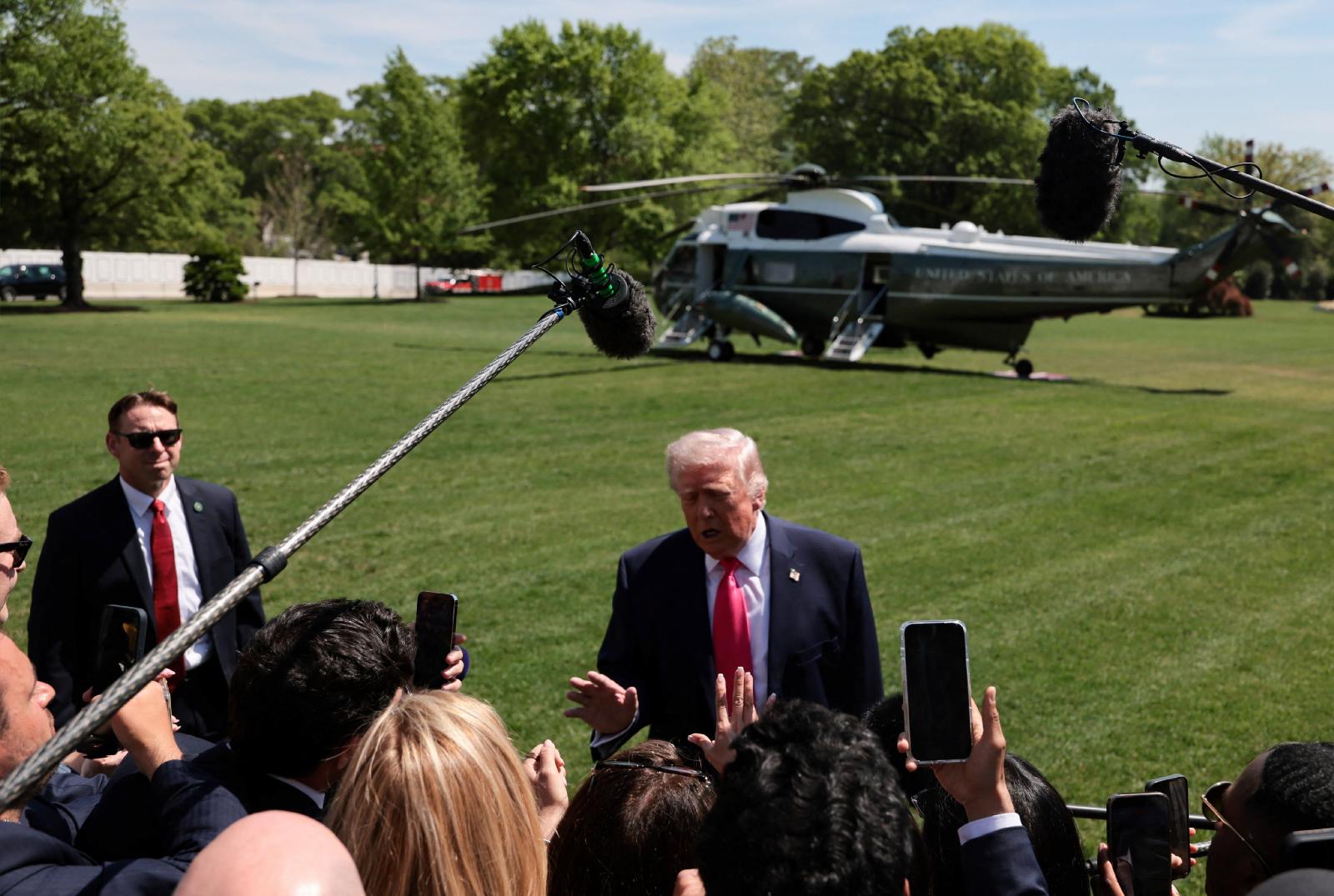
Vatican City - When Pope Leo said that Iran must not be wiped out, he was doing exactly what one expects from a spiritual leader: invoking the dignity of human life, calling for diplomacy instead of annihilation, and reminding us that behind every people there are millions of innocent human beings. It is an ancient appeal, just like the Gospel that Prevost has chosen to serve for years. Donald Trump’s response was immediate and, above all, repetitive. In recent weeks, while the Pope was in Africa, he had already accused him of supporting Iran’s nuclear programme. He repeated it in the past few hours, unchecked, with the same smug certainty of someone who knows that all he has to do is throw mud: some of it will always stick.
Because this is the mechanism: these figures - and Trump is only the most visible tip of a much wider iceberg - do not argue, do not prove, do not seek the truth. They throw. They know they will never have to prove what they claim, because in the age of fragmented attention the correction always arrives late, always lower down, always shared far less than the accusation. In three seconds, a humanitarian position became a hostile act. An appeal for peace was turned into complicity with the enemy. Leo and the Church have never said anything of the kind. It does not matter: the puppet was already standing, and the puppet burned perfectly.
Pope Leo’s response
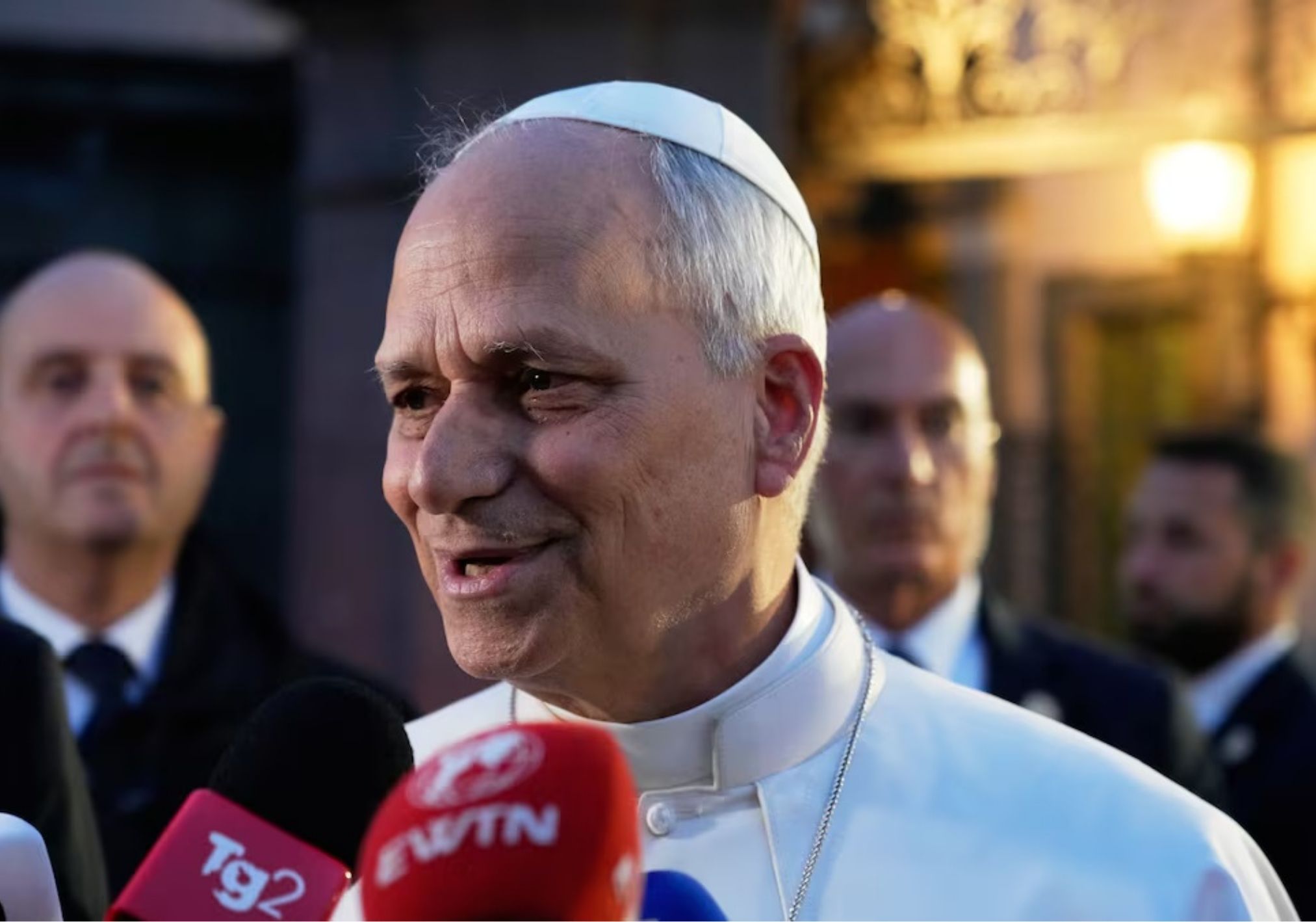
Faced with this instrumentalisation, Pope Leo responded with an evangelical clarity that deserves to be quoted in full: “The mission of the Church is to proclaim the Gospel, to preach peace. If someone wants to criticise me for proclaiming the Gospel, let him do so with the truth. The Church has spoken for years against all nuclear weapons, so there is no doubt there. I simply hope to be listened to for the value of the word of God. I have already spoken from the very first moment I was elected.” - Pope Leo XIV
Three elements stand out in this response. First: the assertion of the mission: to proclaim the Gospel, to preach peace. Second: the ethical challenge addressed to the accuser: “let him do so with the truth”. Third: the reminder of the historical coherence of the Magisterium against nuclear weapons, which makes the falsification even more evident.
The strawman: attacking what the other person never said
In rhetoric and in the psychology of communication, this technique is called the strawman. The mechanism is simple and ancient: one takes the opponent’s position, distorts it, exaggerates it to the point of absurdity or shifts it onto completely different ground, and then attacks that falsified version. It is much easier to knock down a straw puppet than to confront a real argument.
The master and the disciples
Do you want a concrete example? Do you want to see this technique in action, practised by Donald Trump’s devotees in an ecclesial sauce? A charming Barbapapa, a few months ago, published a defamatory article against a priest of Communion and Liberation - prompted, needless to say, by Davide Prosperi, who told him what to write and how to write it. So far, ordinary administration. After some time, however, Silere non possum published a documented article, with evidence in hand, showing point by point that what had been written was false. The Barbapapa’s response? A new article in which Silere non possum was accused of “promoting homosexuality among the clergy”. Exactly. It is the very same move Donald Trump made with the Pope. Identical. And it is no coincidence that these psycho-blogs recognise one another precisely through this method - and praise Trump, certainly not the Pope. Because there is a difference worth explaining, even to those less accustomed to elementary logic. One thing is to say that nobody should concern themselves with other people’s “underwear” - priests’ or lay people’s - and that homosexuality cannot be used as slander to eliminate opponents and defame people. Quite another thing, radically different, is to be “promoters of a sexual orientation among the clergy”.
As for the Barbapapa, who seems extraordinarily well versed in the subject, we await with curiosity his explanation of how, in practical terms, one “promotes” a sexual orientation - so that at least we can learn too. The strawman works because it exploits a structural weakness in public communication: most people do not have direct access to the original words, spoken in full, in their context. They hear the answer, not the question. They see the attack, not what is being attacked. And this is exactly why Silere non possum, from its birth, has chosen to stake everything on original documents, videos, audio, complete transcripts - not reworkings stitched and cut according to what is convenient. Our reader reads everything, and accesses the source directly. Without intermediaries deciding what to show and what to hide. Because otherwise precisely this happens: those who rely on the mainstream press end up hearing what Trump says, not what the Pope said. To this structural weakness are then added complementary techniques that complete the mechanism. The first is malicious reduction to absurdity: the other person’s position is pushed towards an extreme conclusion they never supported, in order to make it seem ridiculous or dangerous. The second is hostile framing: the message is reframed within a completely different context, so that the public perceives it through a lens already distorted. The third is the projection of malevolent intent: the opponent is attributed dark intentions, hidden interests, complicity with evil - things he never thought, but which are now sewn onto him. The final result is a process in three precise stages: decontextualise, falsify, accuse. The opponent is not defeated with arguments. He is constructed as an enemy, and then demolished.
Truth as foundation
What makes this technique particularly serious in a religious context is that it is not a procedural impropriety or a rhetorical flaw: it is a theological and moral contradiction of the very foundations of the Christian tradition. The Christian tradition does not regard truth as one value among many, an accessory virtue to be practised when convenient. It embodies it at its centre: Christ himself defines himself as “the way, the truth and the life” (Jn 14:6), and this identification leaves no room for ambiguity. It means that lying about another person’s position, building a puppet in his place and attacking it, is not merely intellectual dishonesty: it is a form of betrayal of what the Christian faith is in its essence. The Gospel offers no discounts on this point. “Let your word be ‘Yes, Yes’ or ‘No, No’; anything more comes from the evil one” - frankness, precision, fidelity to the words of others are not optional communicative styles. They are moral demands. And the promise that “the truth will set you free” presupposes an active commitment to it: one cannot invoke evangelical freedom while simultaneously constructing accusations on false foundations.
The Decalogue is just as clear. “You shall not bear false witness against your neighbour” is not a rule devised for courtrooms. It is a safeguard of the dignity of the person: the recognition that every human being has the right to be judged for what he has really said and done, not for the puppet someone else has built in his place. To attribute to Leo XIV the desire to arm Iran with an atomic bomb is not a polemical exaggeration: it is false witness in the most precise and ancient sense of the term.
The philosophical tradition that nourished Christian thought stated the same with equal clarity. Aristotle drew a clear distinction between legitimate persuasion - founded on argument, credibility and honest emotion - and sophistic manipulation, which distorts the terms of debate in order to win without having to face reality. The strawman is exactly the technique used by the sophists and exposed by Socrates as a betrayal of the search for truth: one wins not by refuting the opponent, but by replacing him with a more convenient caricature. Cicero, in De Officiis, added that falsifying another person’s position - even without formally telling a lie - is a form of dishonesty that corrodes the fabric of civil life, because fidelity in words is the foundation on which any form of coexistence rests. And on the specific question of peace and disarmament, Trump’s falsification is even more glaring because it clashes not only with the words of a single pontiff but with an entire coherent and decades-long magisterial tradition. Saint John XXIII, in Pacem in Terris, already condemned the nuclear arms race as an urgent moral imperative. The Second Vatican Council, in Gaudium et Spes, declared any act of war aimed at the indiscriminate destruction of entire cities to be a crime against God and man. Saint John Paul II, in Hiroshima, proclaimed that war is not inevitable and peace is possible. Pope Francis, in Nagasaki, went so far as to declare immoral not only the use but the mere possession of nuclear weapons. Leo XIV is not improvising a new or inconvenient position: he is simply continuing to speak with the voice of his Church. Whoever accuses him of wanting the bomb for Iran is not distorting the words of one man: he is contradicting a magisterium that has lasted for sixty years.
Not only politics: this also happens in the Church
It would, however, be far too convenient to dismiss all this as a vice exclusive to American populist politics. Anyone who knows the internal life of the Church knows that this method has deep roots here too, and that it is practised very effectively by those ecclesial circles which, not by chance, share with Trump much more than a method: a worldview, a catalogue of enemies, the aesthetics of permanent war. Certain Catholic circles, whether traditionalist or modernist - because the labels change but the method is identical - have turned the strawman into an almost pastoral instrument. A theologian who proposes a reflection is not discussed: he is quoted out of context, his words are isolated from the reasoning that supports them, he is attributed a heresy he has never professed, and finally he is presented to the public as a danger to the faith. The mechanism is identical to Trump’s with Leo XIV: an enemy is constructed, attacked, and the assumption is made that few will go and verify the original sources.
Leo XIV himself is subjected to this treatment systematically within the Church. The mechanism is always the same; only the pretext changes. Every word about dialogue becomes relativism. Every gesture of mercy becomes doctrinal laxity. Every opening becomes betrayal. If the Pope shows welcome towards those attached to a rite, he is a traitor to the Council; if he wears “a cufflink”, he is a disguised traditionalist clinging to liturgical appearances. It does not matter what he actually does: there is always someone ready to reinterpret it, deform it, and build a trial around it. They do not respond to the real Pope, to what he has actually said or done. They construct an imaginary pope, sew onto him the most inconvenient or ridiculous positions according to the objective, and then hurl themselves against him. It is easier. And, above all, it is more effective. Saint Augustine, in De Mendacio, identified lying as a perversion of the intellect that betrays man’s deep vocation to truth. The falsification of another person’s words is not a different opinion, it is not an alternative reading: it is a precise moral act, with a precise responsibility - even before God.
Why it is effective - and why it is dishonest
The strength of this technique lies in a brutal asymmetry. Constructing a strawman takes a second. Dismantling it takes an hour. In the time it takes the victim to defend himself, explain, reconstruct the context, the public has already become bored or changed channel. The lie has already completed its circuit. And cognitive research documents well the effect that follows: the human brain tends to remember the accusation far more than the correction. Whoever is accused of wanting the atomic bomb in Iran’s hands carries that stain even after the rebuttal has arrived, clear and documented. This is why the technique is used systematically by those who know they would lose on the level of arguments.
The courage to call it by its name
In the face of all this, a precise rebuttal is not enough. Something more exact is needed: to name the mechanism, to expose it for what it is. To say aloud that it is not a mistake, not an exaggeration, not a partial reading: it is a deliberate falsification. Leo XIV does this with a sentence worth more than many analyses: “If someone wants to criticise me for proclaiming the Gospel, let him do so with the truth.” It is not a defence. It is an ethical challenge addressed directly to the accuser. It is the appeal to that minimum level of intellectual honesty without which there is no debate, no exchange, not even authentic disagreement - only propaganda. And it is what we too, in our small way, have been saying for several years. Criticism is always legitimate, but on the arguments, not on the fetishes and obsessions of the various keyboard lions.
Responsibility, in the end, also lies with those who read and those who listen. Learning to recognise the strawman when one sees it. Always asking whether that is really what the other person said, or whether someone has built a more convenient version to attack. The difference between debate and propaganda lies exactly there: in respect - or betrayal - of another person’s words.
fr.E.R.
Silere non possum