Saint-Maurice – On the Solemnity of Saint Joseph, 19 March, the territorial abbey of Saint-Maurice witnessed one of the most significant moments in its recent history: the abbatial blessing of Canon Alexandre Ineichen, the 96th abbot of the community.
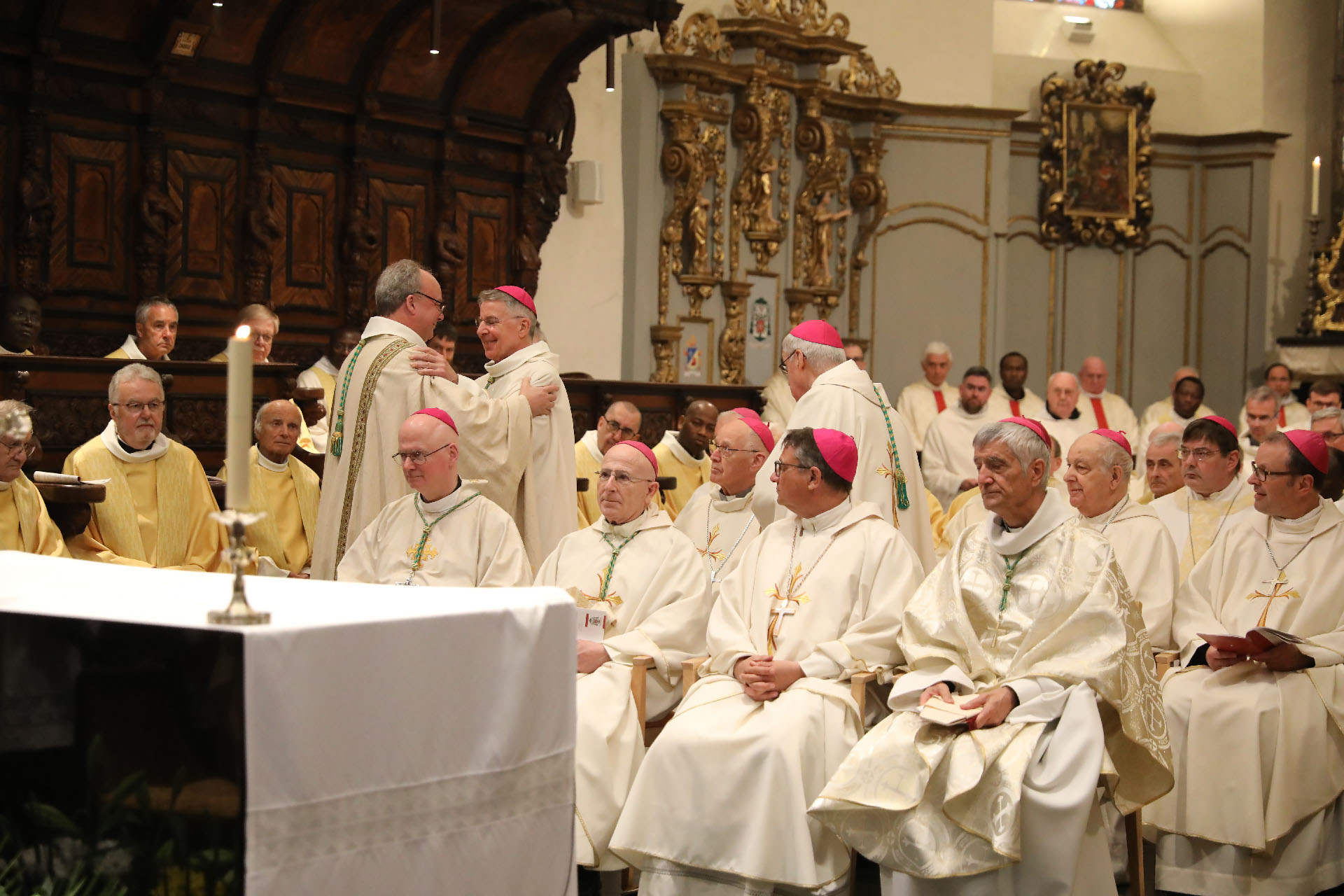
The celebration, presided over by the Apostolic Nuncio to Switzerland, H.E. Archbishop Martin Krebs, took place in a packed basilica, reflecting broad and attentive participation not only from the local ecclesial community but also from civil and religious institutions across the country. Concelebrating alongside the Nuncio were Charles Morerod, O.P., Bishop of Lausanne, Geneva and Fribourg, and Jean-Marie Lovey, C.R.B., Bishop of Sion. Among those present were representatives of the Swiss Bishops’ Conference, clergy, and cantonal authorities.
The event takes place within a context in which the Abbey of Saint Maurice of Agaunum has, in recent years, been involved in accusations directed at the former abbot, later shown to be unfounded, set against a broader climate marked by a growing number of challenges directed towards the clergy.
 © Bernard Hallet
The abbatial blessing
The celebration was also conceived as a moment of reconciliation and communion around the canons, now called to begin a new phase. In his homily, Archbishop Krebs offered a key to interpreting the event, recalling the dynamic nature of the Christian life: “The book of our lives is written day by day, in trust in God.” The election and blessing of the new abbot were presented as a stage in the ecclesial journey, not only for Saint-Maurice but for the entire Church in Switzerland.
The rite follows its own liturgical structure, rich in symbols, which in certain respects recalls that of an episcopal consecration, while not conferring episcopal ordination. The first moment was the call: the prior attested before the Nuncio the validity of Ineichen’s election by the community, carried out according to the constitutions of the Canons Regular of the Swiss Congregation of Saint Maurice of Agaunum. This was followed by the reading of the “mandate of the Pope”, by which Pope Leo XIV confirmed the election, authorising the new abbot to assume his office as ordinary of a territorial abbey, a canonical reality equivalent to a diocese. The abbatial blessing marks the moment in which he officially receives the spiritual authority to guide the community.
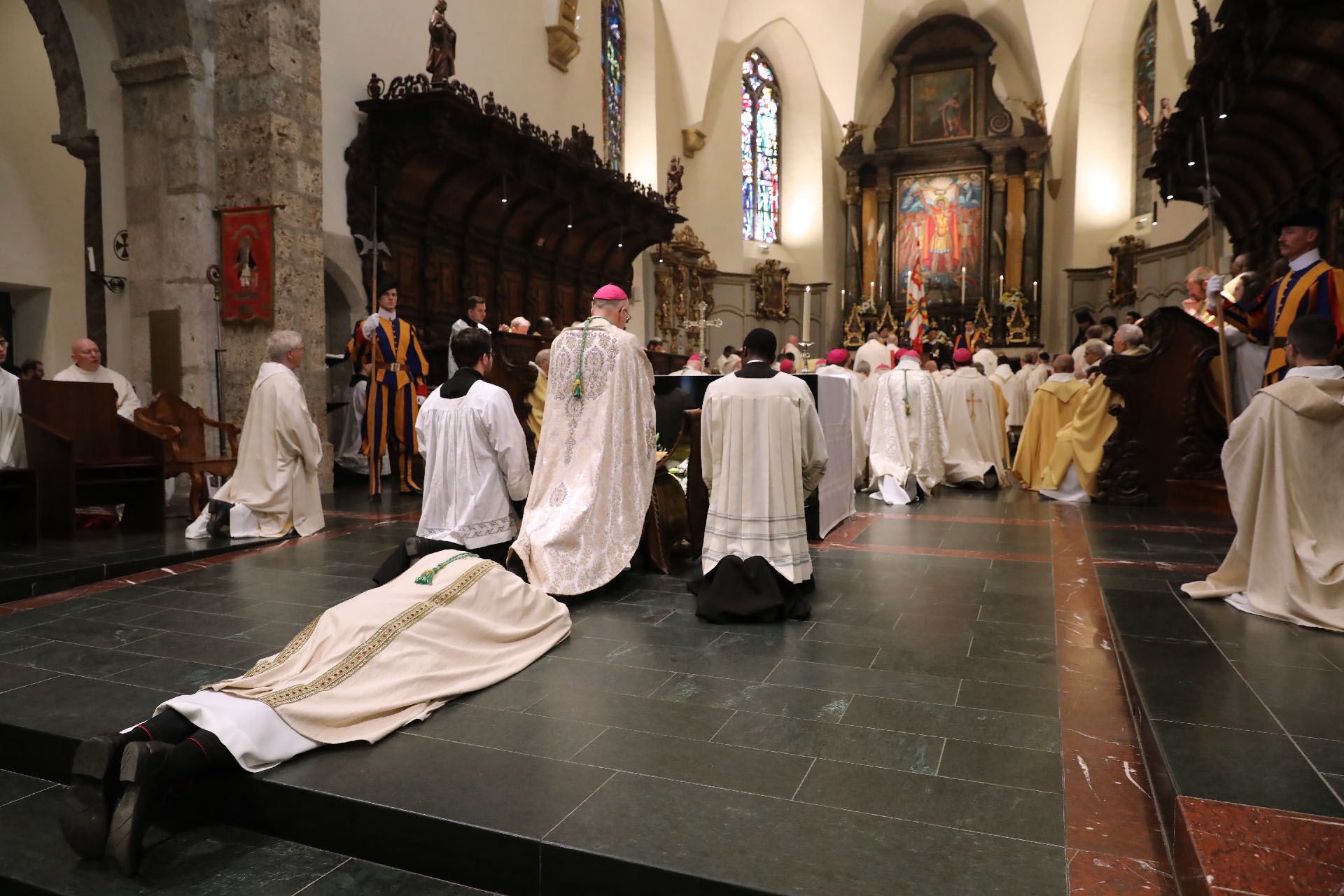
Ineichen was then invited by the Nuncio to undertake a series of commitments outlining the profile of his ministry: fidelity to the Rule of Saint Augustine, responsibility in guiding his confreres, attentiveness to the People of God, stewardship of the monastery’s goods, communion with the Church and with the Pope, and the search for the “lost sheep.” The new abbot then prostrated himself before the altar, while the assembly chanted the Litany of the Saints, invoking Saint Maurice, the martyrs of Agaunum, and the saints of the Christian tradition. The subsequent prayer of blessingevoked a model of governance marked by service, discernment, and fraternal charity.
 © Bernard Hallet
Insignia and the meaning of the ministry
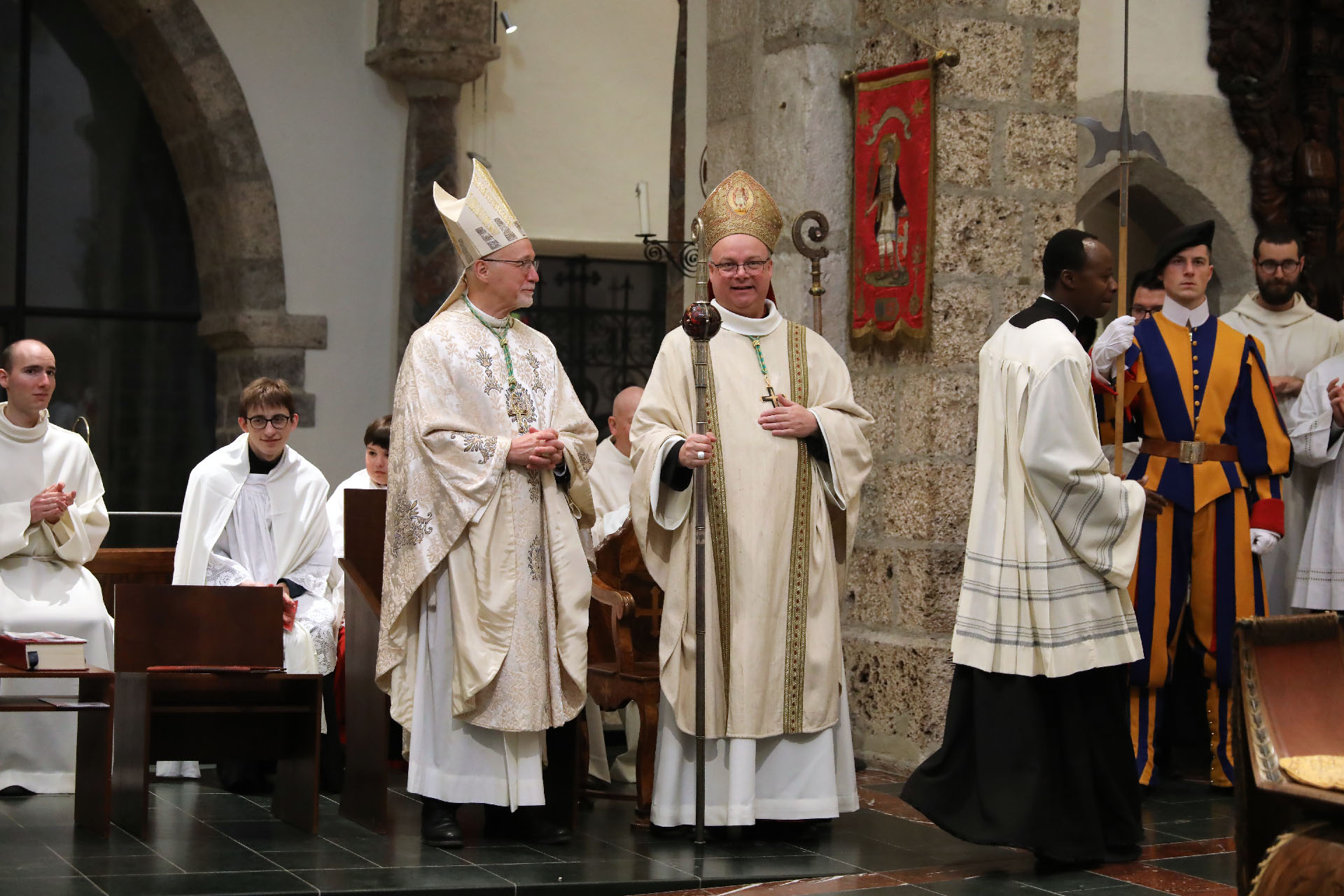
At the central moment of the rite, the new abbot received the insignia of his office. The handing over of the Rule of Saint Augustine recalls the normative and spiritual reference for community life. The ring, worn on the right hand, expresses the bond of fidelity; the mitre and the crozier indicate the responsibility of governance. As a territorial abbot, Ineichen exercises a form of jurisdiction which associates him, in certain respects, with the episcopal ministry, as also reflected in his participation in the Swiss Bishops’ Conference. The liturgy concluded with the singing of the Te Deum. The new abbot has chosen as his episcopal motto the Pauline expression “Insta opportune importune”, taken from the Second Letter to Timothy, which recalls readiness in proclamation and witness.
A particularly significant moment was the tribute paid to the abbot emeritus Jean Scarcella, who in recent years has been the target of a shameful defamatory campaign, as the choir performed a Sanctus composed by him. At the conclusion of the presentation of the Constitutions, Ineichen embraced him and expressed his gratitude.
 © Bernard Hallet
A new chapter for the abbey
The abbatial blessing marked the conclusion of the appointment process, initiated with the election by the 24 canons and confirmed by the Pope on 31 October. Ineichen, aged 58 and originally from Bern, brings extensive experience within the community: he entered in 1988, was ordained a priest in 1994, and served as a teacher and, for nineteen years, as rector of the Lycée-Collège of Saint-Maurice.
The new abbot has indicated as priorities a path oriented towards trust, unity, and authenticity. The day concluded in a more informal atmosphere, with a communal gathering in the college courtyard, where canons, bishops, priests and faithful came together for a reception and shared meal.
fr. L.V.
Silere non possum