Vatican City — Canon 1734 of the Code of Canon Law gives anyone who considers themselves harmed by a decree the right to ask its author to revoke or amend it within ten useful days of receiving notification. This is the so-called remonstratio, the mandatory preliminary step before a hierarchical recourse can be lodged. It was under this canon that, on 11 July 2026, the Society of Saint Pius X submitted a petition to the Dicastery for the Doctrine of the Faith against the decree of 2 July declaring the latae sententiae excommunication of the consecrating bishop, the co-consecrator and the four priests consecrated at Écône on 1 July.
The communiqué issued by the General House in Menzingen on 13 July states that the request “has the effect of suspending the execution of the decree, in accordance with canon 1353” and that the Society intends to act “in a spirit of respect for ecclesiastical authority”.
Those words have caused considerable irritation not only within the former Holy Office, but also among many Catholic faithful, who have been left to watch the Society’s modus operandi with a mixture of pity and anger. This succession of actions and statements appears to lack any genuine logical coherence and once again exposes, within pathological traditionalism, the deep divide between what is professed and what is actually done.
The latest in the succession of communiqués issued over recent months therefore deserves to be examined word by word. It comes, after all, from the very organisation whose Superior General had described the same sanctions as “objectively unjust and invalid” only ten days earlier.
Anyone who regards an act as invalid does not ask for it to be amended: they regard it as null and void. Anyone who files a remonstratio, by contrast, acknowledges through that very act that the decree exists, produces legal effects and was issued by an authority with the power to revoke it. The two positions cannot be maintained at the same time. The fact that Menzingen has adopted both within the space of a week says a great deal about the true nature of this move.
It is the same pattern already seen with figures such as Fr Giorgio Maria Farè: first they deny that an authority has the power to impose a sanction, then they lodge an appeal before that very authority. The contradiction is as obvious as it is revealing. It is a recurrent feature of circles that challenge ecclesiastical institutions when they find themselves on the receiving end of their decisions, only to recognise those same institutions immediately when they hope to secure a favourable outcome.
Over recent months, the Society of Saint Pius X has taken this logic to its most grotesque conclusions, pursuing an aggressive and relentless communications strategy designed to keep itself at the centre of attention. At Écône, they have understood that confrontation with Rome guarantees publicity. For days, the Society dominated the front pages of the international press, attracting renewed attention, new adherents and, inevitably, new donations. Now that the spotlight has faded, it is multiplying communiqués, provocations and contradictions in an attempt to switch it back on. What once purported to be a doctrinal battle increasingly resembles a strategy for media survival.
The chronology of a rupture foretold
To understand the recourse, it is necessary to retrace the six months that preceded it. On 2 February 2026, during the taking of the cassock at the seminary in Flavigny-sur-Ozerain, Fr Davide Pagliarani announced the decision to proceed with new episcopal consecrations on 1 July, invoking “the objective state of grave necessity in which souls find themselves”. The decision followed two letters sent to Leo XIV from August 2025 onwards, a request for an audience that was never granted and a response from the Holy See that the Society deemed unsatisfactory.
Prevost chose his course carefully. It prevented the Society of Saint Pius X from turning a possible papal audience into a propaganda opportunity while compelling it to deal with the authorities whom he himself had decided to retain in office. Foremost among them was the Cardinal Prefect of the Dicastery for the Doctrine of the Faith, a regular target of those traditionalist circles, which continue to direct insults and wholly unfounded accusations against him.
On 12 February, Cardinal Víctor Manuel Fernández received Pagliarani and proposed “a path of specifically theological dialogue” intended “to highlight the minimum requirements for full communion”, on condition that the consecrations were suspended immediately. On 18 February, Ash Wednesday, the Superior General rejected the proposal in a letter signed by the entire General Council. The reasoning was as follows: we already know that agreement is impossible; the interpretative framework of the Council has already been settled; the threat of sanctions means that the dialogue cannot be free.
The letter also contained a passage that would later prove significant. Defining the criteria for membership of the Church, Pagliarani wrote, “does not belong to us”, because that responsibility rests with the Magisterium. In an annex, the Society challenged the very foundation of canon 375 §2 and, with it, the teaching of Lumen gentium on the relationship between episcopal consecration and jurisdiction, describing it as “not traditional” and lacking “any solid foundation”.
A series of doctrinal documents followed throughout the spring: the “Declaration of Catholic Faith” addressed to Leo XIV on 14 May, and then, on 24 June, a comprehensive profession of faith in 154 points, delivered to the Pope and to every cardinal on the eve of the Consistory.
On 29 June, Pope Leo XIV made an impassioned appeal: “I pray for you, because to tear the seamless garment of Christ is a sin of extreme gravity. May the Lord enlighten your consciences and awaken your hearts. With a sorrowful yet hopeful heart, I feel it is my duty, through the authority received from Christ, to ask you to desist from your intended act. I entrust these intentions to the Immaculate Heart of Mary, Mother of Good Counsel.”
Pagliarani replied the following day from Écône. What was most striking was the way he turned the Pope’s own image against him. Leo XIV had spoken of tearing Christ’s seamless garment. The Superior General reversed the metaphor and claimed it for the Society: it was the Society, he wrote, that believed it had the “very duty” to “do everything possible to mend Christ’s seamless garment, torn by forces and pressures incompatible with a truly Catholic spirit”.
The approaching consecrations, therefore, were not presented as the cause of the tear. The crisis within the Church was. The man preparing to disobey the Pope cast himself as the tailor.
The tone was filial, almost affectionate. Pagliarani said that he had been “deeply touched” by the Pope’s paternal solicitude, insisted that his intention to serve the Church was “in no way feigned”, and denied any desire to separate from Rome. On the contrary, the Society wished to serve her “by means that are extraordinary, as one would assist a mother in distress who requires particular help”.
He asked only one thing of the Pope: time. “May I therefore filially ask Your Holiness to take the time necessary for that discernment,” he wrote, recalling that “the Holy See has shown itself capable of understanding very complex situations and of allowing time for discernment”.
It was a remarkable request, made twenty-four hours before a date that the Society itself had fixed unilaterally five months earlier and had never called into question. In that letter, Rome was asked to grant the time that the Society had refused to grant itself.
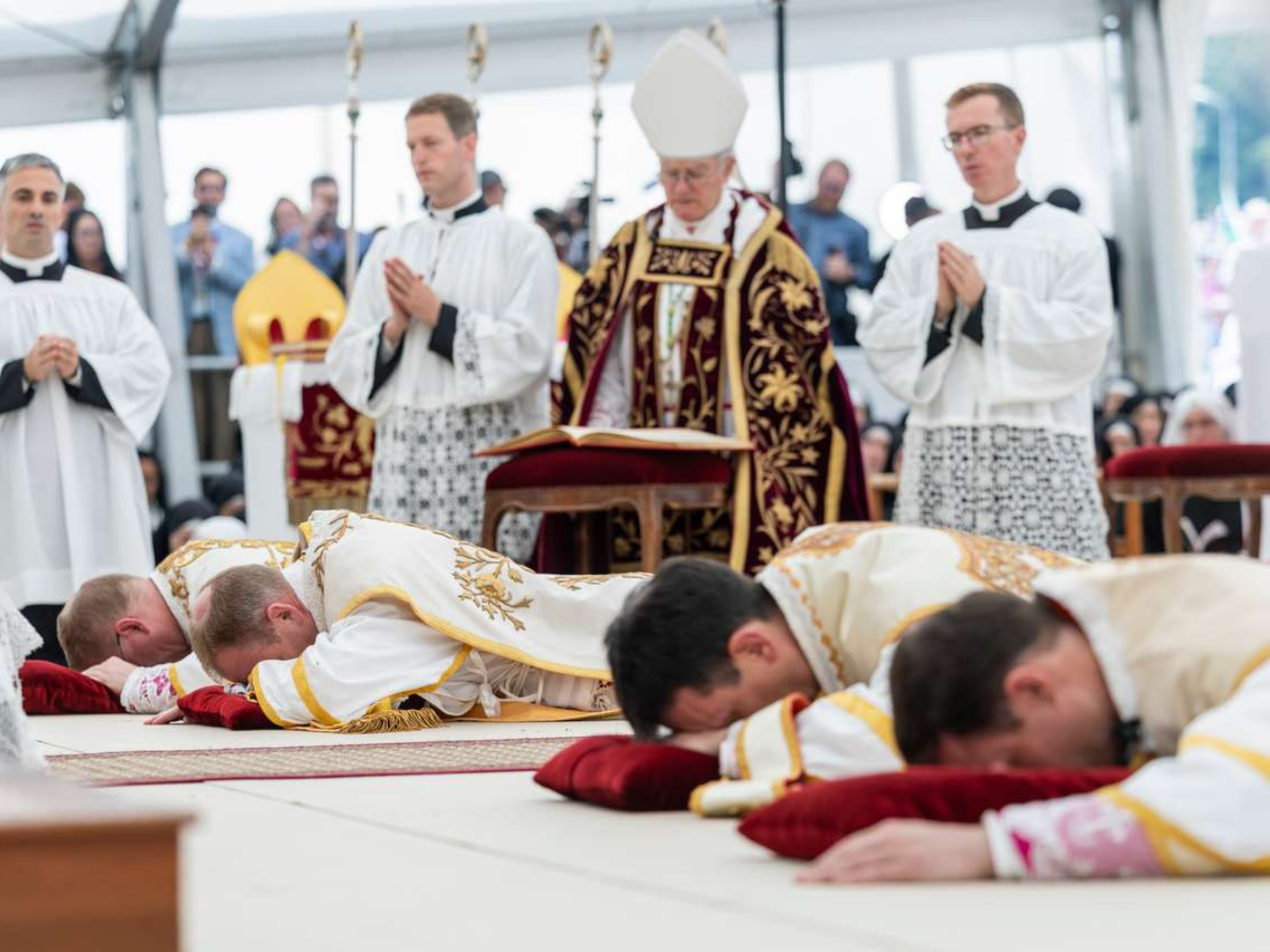
Twenty-four hours later, on 1 July, at Écône, Bishop Alfonso de Galarreta, assisted by Bernard Fellay as co-consecrator, consecrated four priests: Pascal Schreiber, Michael Goldade, Michel Poinsinet de Sivry and Marc Hanappier.
Rome responded within twenty-four hours. The decree of the Dicastery, dated 2 July and signed by Prefect Fernández and the Secretaries of its two sections, declared that the consecrating bishop and those consecrated had incurred ipso facto the excommunications reserved to the Apostolic See under canons 1387 and 1364 §1. It also declared that Fellay, having publicly adhered to the schismatic act as co-consecrator, had incurred the excommunication prescribed by canon 1364 §1. Clergy and lay faithful were warned not to adhere to the schism.
On 3 July, Pagliarani replied to Leo XIV with his letter of the bread and the stone, built around Luke 11: the sanctions were “objectively unjust and invalid”, but would be received without “bitterness or revolt”; “For us, nothing has changed, and nothing ever will change.” Eight days later came the recourse.
A recourse against an act it says is null and void
This is the first and most obvious contradiction. Administrative law provides two possible courses of action: if an act is invalid, it is disregarded or a declaration of nullity is sought; if it is valid but unjust, it is challenged so that it may be amended. The Society has chosen the second course while continuing to proclaim the first.
Nor is the contradiction merely rhetorical. The suspensive effect claimed by Menzingen exists only within the canonical system currently in force: the 1983 Code as amended in 2021. One cannot invoke the procedural protection offered by a legal system while simultaneously declaring its decisions invalid whenever they prove unfavourable. Either the Code is binding, in which case canon 1387 prohibiting the consecrations was also binding; or it is not binding, in which case canon 1353 suspends nothing.
The second inconsistency concerns the Code itself. On 18 February, the Society wrote that canon law is now “used not to confirm in the faith, but to distance people from it”, while the annex to the same letter sought to demolish canon 375 §2 as a product of the Council. Five months later, the same Society is citing canons 1734 and 1353 of that very Code with notarial precision. Conciliar law is apparently without foundation when it defines schism, but fully valid when it offers procedural safeguards. Canon law à la carte.
The third inconsistency is perhaps the most subtle. If defining the criteria for communion “does not belong to us” because it is the task of the Magisterium, as the Society maintained in February, then the Dicastery’s judgement that this communion has been broken is precisely an exercise of the competence that the Society itself claimed to recognise. Asking for that judgement to be “corrected” amounts to demanding that the authority correct itself in the one area that had just been reserved to it.
Canonical analysis: what the recourse actually suspends
Although the formal time limits for lodging the recourse appear to have been observed, the claims made by the Society in its communiqué require closer examination. In particular, the technical basis for the suspensive effect is more complex than the communiqué suggests.
Canon 1353 provides that an appeal or recourse against decrees imposing or declaring a penalty has a suspensive effect. Canon 1736 §1 further grants the preliminary petition the same effect in cases where the subsequent hierarchical recourse suspends the execution of the measure.
On this point, therefore, the combined effect of the two provisions supports the Society’s position: as matters currently stand, the execution of the decree must be regarded as suspended.
What this means, however, must be clearly understood. The excommunication under canon 1387 is latae sententiae: it was incurred ipso facto at the very moment of the consecration on 1 July, before and independently of any decree. The Dicastery’s measure is declaratory, not constitutive. It formally establishes the existence of a penalty already incurred and adds the aggravated effects that canon 1331 §2 attaches to a declared excommunication, including the invalidity of acts of governance.
The suspension of execution may therefore freeze those aggravated effects and the enforceable consequences of the declaration. It does not affect — and cannot affect — the latae sententiae censure itself, which continues to bind in conscience and in the external forum within the limits laid down by canon 1331 §1.
Put simply, the recourse suspends the decree, not the excommunication. To present canon 1353 as a general moratorium on the sanctions, as a hasty reading of the communiqué might lead the faithful to believe, is canonically incorrect.
On the substance of the case, two lines of defence can be anticipated, and they are the same as those advanced in 1988.
The first is a state of necessity. Canons 1323 no. 4 and 1324 §1 no. 5 exempt from punishment, or provide for a reduced penalty, where a person acts under grave necessity, while canon 1324 §3 excludes a latae sententiae penalty where a mitigating circumstance is present.
The second is the alleged absence of animus schismaticus. Since a consecration without a pontifical mandate does not confer jurisdiction, it is argued, it would not in itself constitute a refusal of submission to the Supreme Pontiff within the meaning of canon 751.
Both arguments were considered and rejected in 1988. The motu proprio Ecclesia Dei afflicta found the invocation of necessity to be unfounded and classified the act as schismatic because it involved disobedience to the Roman Pontiff in a matter of the utmost gravity for the unity of the Church.
There is no apparent new element that could now lead the same Dicastery, under a Pontiff who personally followed the matter until the eve of the consecrations, to reach the opposite conclusion.
A further point, often overlooked, must also be added. Even if the classification of schism under canon 1364 were to fall away, the excommunication under canon 1387 would remain intact, because it punishes the material act of an episcopal consecration without a pontifical mandate. That act is public, documented and proudly acknowledged by the Society itself. No recourse can alter that fact.
The only favourable precedent within the Lefebvrist milieu does not help Menzingen. In 1993, the then Congregation for the Doctrine of the Faith upheld the appeal of six Catholics in Hawaii who had been excommunicated by their bishop for adhering to the schism, finding that formal adherence had not been proved. That case concerned laypeople and the need to prove a subjective element. This case concerns the consecrating bishops and those consecrated: the very men who carried out the act and openly acknowledge having done so.
The course ahead — and the final barrier
The Dicastery now has thirty days in which to respond under canon 1735. Silence is deemed to constitute rejection for the purposes of a subsequent hierarchical recourse, which must be lodged within fifteen useful days.
At this point, however, the available route narrows almost to nothing. There is no intermediate hierarchical superior above a Dicastery: above it stands only the Pope. The ordinary route is a contentious-administrative recourse to the Apostolic Signatura within sixty days, but its scope is limited. The Signatura considers only violations of law in procedendo or in decernendo; it does not reconsider the merits of the decision.
It is difficult to envisage procedural defects in a three-paragraph decree that merely declares latae sententiae penalties expressly prescribed by law for publicly known acts.
The decisive variable remains one that the recourse itself will force the authorities to clarify: the extent of papal involvement in the decree. If Leo XIV approved it in forma specifica, thereby making it his own, every recourse is definitively barred. Canon 333 §3 excludes any appeal or recourse against a judgement or decree of the Roman Pontiff, and the First See is judged by no one.
The publication of the decree on the Holy See’s website and the nature of the matter, which is reserved to the Apostolic See, make this possibility far from theoretical. In that event, the Dicastery could answer the remonstratio in a single line: approved in forma specifica.
What, then, is the point?
If the legal prospects are virtually non-existent, the communications objective has already been achieved. The recourse allows Menzingen to accomplish three things.
First, it can tell its faithful, shaken by the word excommunication, that “the execution of the decree is suspended”: a technically correct and pastorally reassuring formula, even though it does not mean what it appears to mean.
Second, it can build a record portraying itself as the respectful party that exhausted every internal remedy, useful one day before the judgement of history and, Écône hopes, before a future and more sympathetic pontificate.
Third, it can gain time, the resource the Society has managed most skilfully since 1988.
The paradox remains, and no communiqué can make it disappear. On 1 July, the Society consecrated four bishops on the grounds that the needs of souls entitled it to dispense with Rome’s mandate. On 11 July, that same Society submitted a petition, within the time limits and in the form prescribed by the Code it contests, placing it on Cardinal Fernández’s desk and asking Rome to correct its judgement.
Ten days separate the two acts. The first declares that Rome’s authority may be bypassed whenever necessity demands it. The second implores that same authority to reconsider, citing its Code canon by canon.
It cannot be both ways. Either Rome has the authority to judge the Society, in which case it did so on 2 July; or it does not, in which case there is nothing to challenge.
Menzingen has chosen not to choose. The law, unlike rhetoric, admits no middle ground.
Fr L.B. and S.V.
Silere non possum