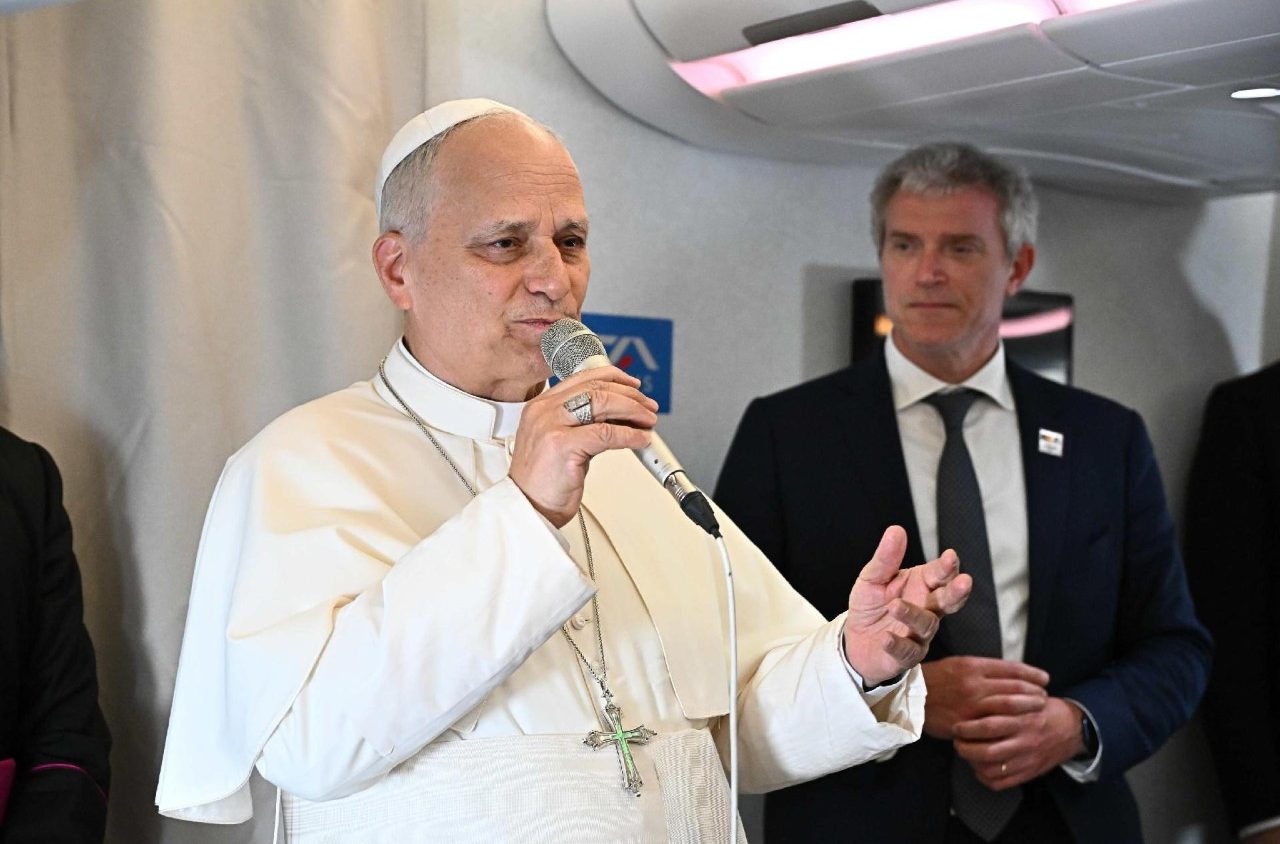
Luanda - For the second time since the beginning of his pontificate, Pope Leo XIV has felt the need to address the journalists travelling with him with a warning about the proper handling of information. It happened this morning on the flight from Yaoundé to Luanda, in Angola, the next stage of his apostolic journey across the African continent. Having taken leave of Cameroon with words of gratitude and affection for the Cameroonian people, the Pontiff greeted the reporters on board with kindness.
A journey “interpreted” instead of reported
At the heart of the Pope’s criticism lies a tendency that anyone who practises this profession honestly knows all too well: imposing one’s own interpretative framework onto the gestures and words of others, until their meaning is distorted. It becomes a system when a journalist stops serving the truth and starts serving the editorial line. That is how the rather unedifying spectacle of recent days can be explained: the paper aligned with the Right intent on defending Trump, the paper aligned with the Left intent on using the Pope against Trump. Two mirror-image distortions, two forms of the same vice. And the very fact that there are newspapers of the “Right” and of the “Left”, rather than papers simply faithful to the facts, says a great deal about the state of the profession, especially in Italy.
Leo XIV illustrated the point with a concrete example, presented to the very journalists seated on the aircraft: the address he gave at the Prayer Meeting for Peace had been written two weeks before the President of the United States made any comment about him. Yet, with a logic that bears all the hallmarks of bad faith, that text was recast as a direct reply, almost as though it were a diplomatic exchange at a distance with the White House. The Pope explained this with that note of disappointment reserved for things one had hoped never to have to spell out. And the most serious part is that those on that aircraft already knew it. Those who are accredited, whether journalists or pretenders, know perfectly well the timescales involved in preparing papal speeches: they know that a text of that kind is not written the night before, they know it cannot be a reply to remarks made the previous day. Anyone who wrote otherwise did so in full awareness, deliberately opting for instrumentalisation. It was an editorial choice before it was even a journalistic one: those pieces were commissioned by editors drawn to the logic of the click, the headline that inflames, the controversy that pulls readers in just as social media drags users from one provocation to the next. The result is a kind of journalism that thinks like a keyboard lion – noisy, reactive, devoid of memory – and ends up doing the same damage.
“Much of what has been written since then,” Leo XIV said, “has been more commentary on commentary trying to interpret what has been said.” A chain of reconstructions which, link by link, moved further and further away from reality. He also made clear that rebutting the statements of the American leader “is not in my interest at all”.
It is not the first time
What happened today is not an isolated episode. Leo XIV had already had to correct the course of media coverage on an earlier occasion in his pontificate, and that too happened on an aeroplane. Some colleagues had thought they could explain to their readers what the Pope thought: not on the basis of what the Pope had said, but on the basis of how he had said it, or even how he looked while saying it. It was an exercise bordering on the surreal, which Leo XIV dismantled with that calm firmness reserved for things hardly worth answering, but which risk becoming a method if they are left unanswered. And the Pontiff is aware that, unfortunately, this has long been the method of these so-called “accredited” figures.
The heart of the journey: pastor, not protagonist
The Pope was keen to place back at the centre the true meaning of his African pilgrimage, which began in Algeria under the sign of Saint Augustine - “a beautiful monument with the map of Africa and the Saint at the centre”, blessed at the Catholic University of Yaoundé – and is now continuing towards Angola. It is a pastoral journey, Leo XIVinsisted: “I primarily come to Africa as a pastor, as the head of the Catholic Church, to be with, to celebrate with, to encourage and accompany all of the Catholics throughout Africa.” He also recalled the meeting with a group of Cameroonian imams, in continuity with the interreligious dialogue fostered by his predecessor: fraternity, mutual understanding, the building of peace. Themes that have nothing to do with long-distance exchanges with world political leaders, and which instead risk being obscured every time the media narrative veers into geopolitical gossip.
Tribute to bilingual Cameroon
A journalist from Cameroon’s national television eased the mood at the end by asking the Pope for a few words in French, recalling the bilingual nature of the country. Leo XIV responded with genuine warmth, thanking the Cameroonian people for “the wonderful welcome, the great enthusiasm and the joy of the people”. That enthusiasm, he said, “was absolutely fantastic”: the experience of a community of faith rediscovering together the beauty of being followers of Jesus Christ. It was a simple moment, almost a family one, which for an instant restored the journey to its truest dimension. The one the Pope would evidently like to see reported with greater fidelity.
L.V.
Silere non possum