What is the tall, two-pointed headpiece that a bishop wears during certain parts of the Mass? It is called a mitre, and it is one of the most recognisable insignia of the Catholic episcopate. Its shape, the way it is worn and even the moments at which it must be removed are all governed by a centuries-old tradition, gradually codified by the liturgy.
The mitre is neither a mere ornament nor simply a mark of status. It signifies the bishop’s ministry as pastor of a particular Church and guardian of the apostolic faith. It may also be worn by certain abbots and by other prelates upon whom this right has expressly been conferred.
What does the word ‘mitre’ mean?
The word mitre comes from the Greek mítra, a term originally used for a band, headband or ornament worn around the head. The same linguistic root gave its name to the stiff, two-pointed liturgical headpiece that, in the Latin tradition, came to be associated with bishops.
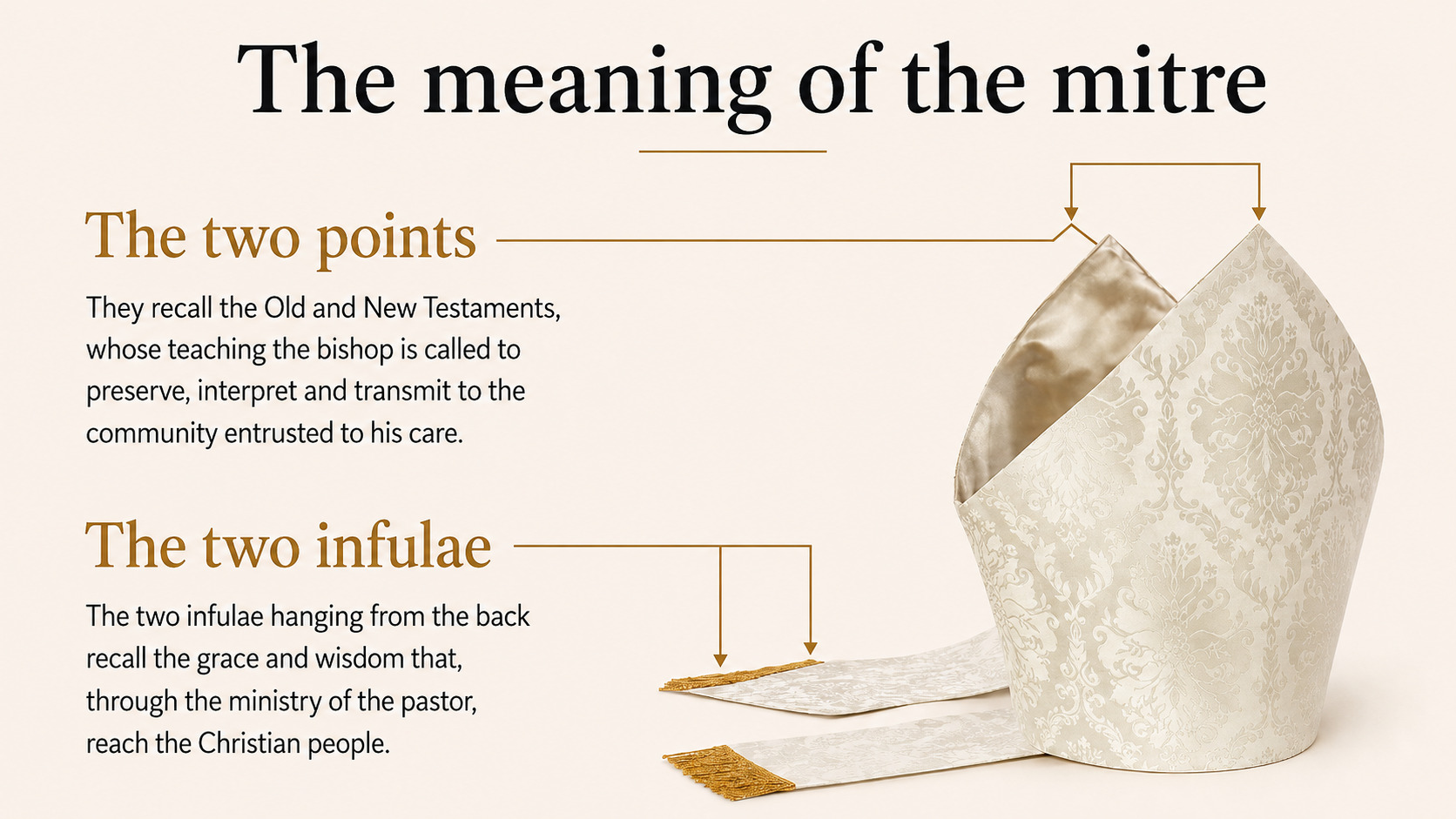
The mitre is made up of two stiffened pieces of fabric, generally pentagonal in shape and joined at the sides. The upper part ends in two points, one at the front and one at the back, traditionally known as the cornua. From the back hang two strips of fabric, known as infulae or lappets, often finished with fringes.
The origins of the mitre
The history of the mitre is closely connected with that of the papal tiara. The headpiece from which both are believed to have developed did not originally belong to the liturgy. It was already being worn by the pope in the eighth century during processions and solemn ceremonies held outside churches.
The mitre was adopted by bishops only gradually. The earliest literary references to bishops wearing a liturgical headpiece date from the eleventh century. It is mentioned, among others, by Saint Peter Damian, Saint Bernard of Clairvaux and Hugh of Fleury. These written sources are accompanied by iconographic evidence, including the illustrations found in the Exultet Roll of Bari Cathedral. The use of the mitre spread progressively throughout the Latin episcopate and became general in the second half of the twelfth century. Its shape also changed during this period. Initially more rounded and dome-like, it gradually acquired the flattened, two-pointed profile by which it is still recognised today. Over the centuries, the mitre varied considerably in height, rigidity and richness of decoration. Some medieval mitres were relatively low, while later periods favoured taller and more richly ornamented designs.
The different types of mitre
The liturgical tradition historically distinguished between three principal types of mitre, each used according to the solemnity of the celebration. The precious mitre was decorated with embroidery, stones, pearls and gold or silver appliqué. It was worn at the most solemn celebrations and for certain blessings. The auriphrygiate mitre was generally made of white silk and adorned with gold embroidery, but without the gems and more elaborate decoration characteristic of the precious mitre. The simple mitre, made of white linen or silk and without ornamentation, was used chiefly for penitential celebrations, funerals and other rites marked by greater sobriety.
This threefold classification belongs chiefly to the liturgical discipline in force before the reform that followed the Second Vatican Council. The present norms have simplified the use of episcopal insignia and essentially distinguish between a simple mitre and an ornamented mitre, to be chosen according to the character of the celebration.
The symbolic meaning of the mitre
Over the centuries, the mitre has been invested with a wealth of symbolic meanings. Its two points have been interpreted as a reference to the Old and New Testaments, whose teaching the bishop is called to preserve, interpret and transmit to the community entrusted to his care. The two infulae hanging from the back have been associated with the grace and wisdom that reach the Christian people through the ministry of their pastor. Other interpretations have seen them as a reference to the spirit and the letter of Scripture, or to the two commandments to love God and one’s neighbour.
These interpretations derive chiefly from medieval catechesis and liturgical reflection. They do not constitute a dogmatic definition, but they show how Christian tradition sought to give spiritual meaning even to the form of the vestments and insignia used in worship. Above all, the mitre expresses the ministry of the bishop, who is called to teach, sanctify and govern the portion of the People of God entrusted to his care. Its significance therefore derives from the episcopal office with which it is associated, rather than from the richness of the materials from which it is made.
When does the bishop wear the mitre?
A bishop does not wear the mitre throughout the entire celebration. The Ceremonial of Bishops, the liturgical book governing rites presided over by bishops, specifies when it may be worn and when it must be removed. The bishop ordinarily wears the mitre during the entrance procession, while seated at the cathedra, during the homily, when addressing the people on certain occasions, when giving solemn blessings and during the concluding procession. He removes it during prayers addressed directly to God, while listening to the Gospel and during the Eucharistic Prayer. Nor does he wear it when performing gestures of particular veneration or adoration. During the pontificate of Francis, bishops increasingly adopted the practice of removing the mitre before the homily, in imitation of the style followed by Bergoglio at celebrations over which he presided. This practice, however, sits uneasily with the meaning traditionally attached to the insignia: it is precisely during the homily, when the bishop publicly exercises his ministry as teacher and interpreter of the Word, that wearing the mitre is especially appropriate.
When visibly exercising his ministry as teacher and pastor, the bishop wears the mitre. When listening to the Gospel or addressing God in prayer, he removes it. The gesture shows that the bishop, too, remains a disciple of the Word and a servant of the mystery he celebrates.
Liturgical reform and the simplification of the mitre
Before the Second Vatican Council, the system of pontifical vestments and insignia was particularly elaborate. In addition to the mitre, a bishop could wear liturgical gloves, known as chirothecae, as well as liturgical stockings and sandals, together with other items that were later abandoned or made optional.
The instruction Pontificales ritus, promulgated on 21 June 1968 by the Sacred Congregation of Rites, substantially simplified episcopal celebrations. Among its provisions, it established that a bishop should use only one mitre during the same liturgical celebration, eliminating the frequent changes required by the previous ceremonial.
The reform sought to make the significance of episcopal insignia clearer, reducing purely ornamental elements and placing greater emphasis on the bishop’s liturgical and pastoral service.
What is the difference between the mitre and the tiara?
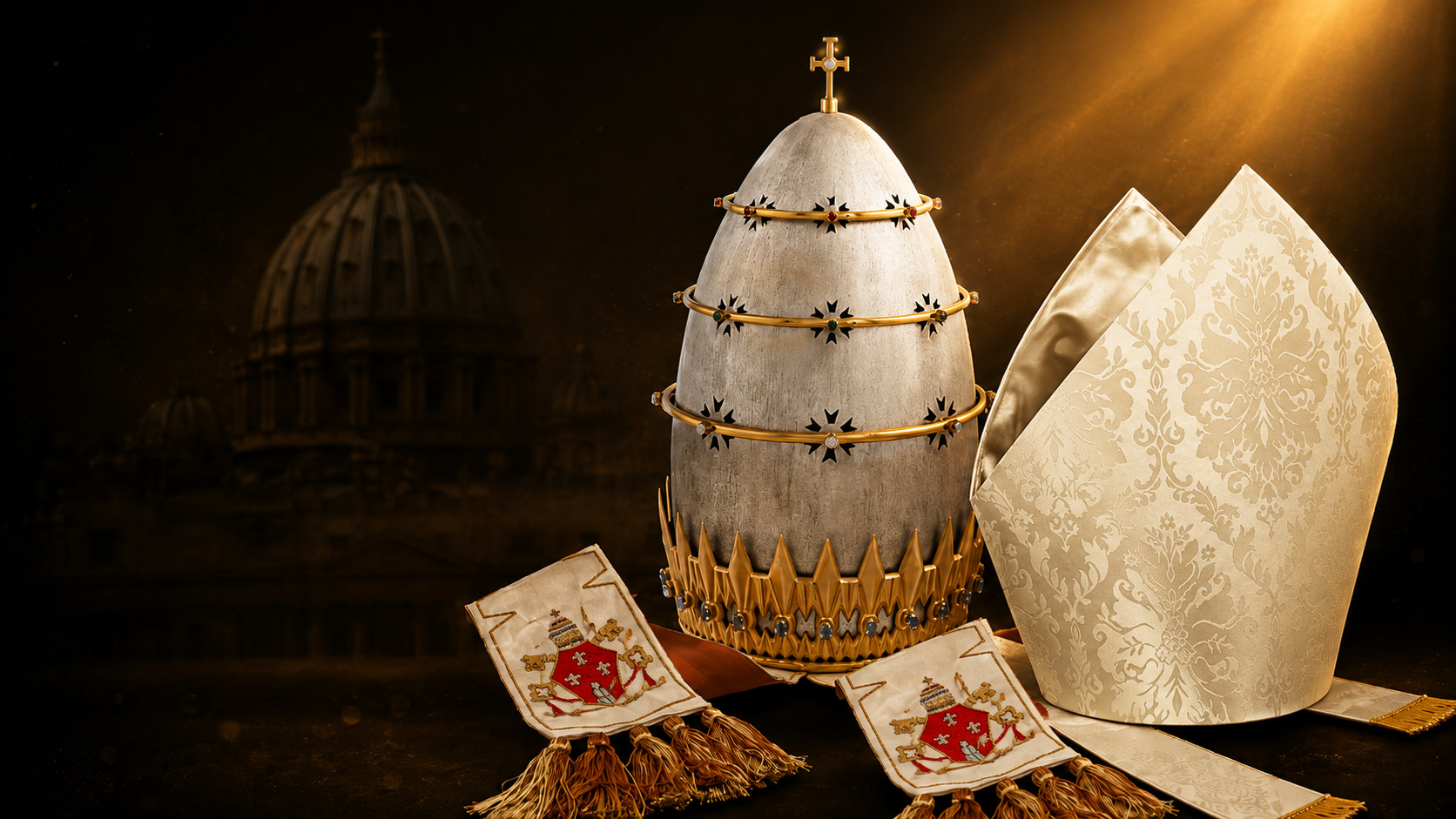
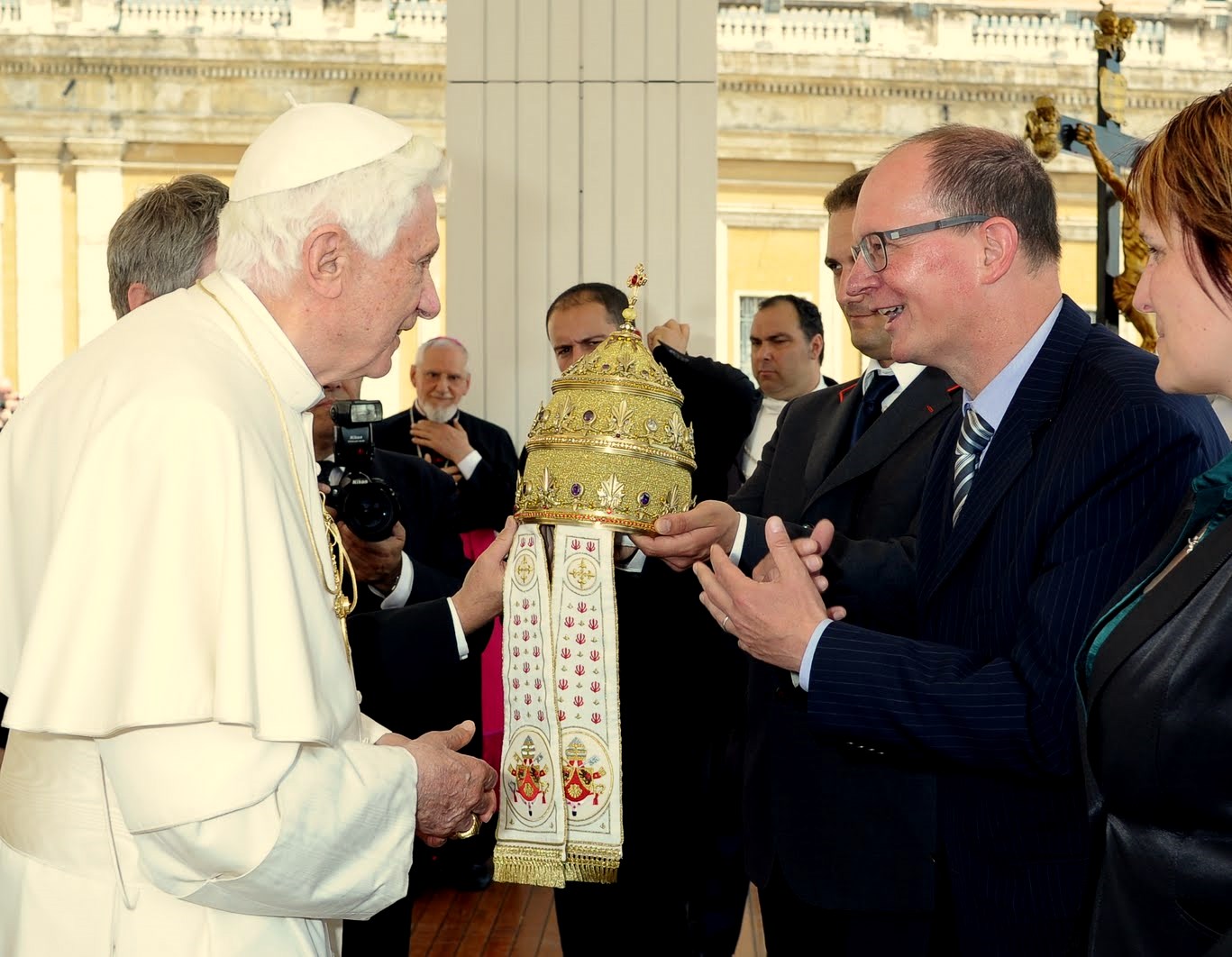
The mitre should not be confused with the papal tiara, also known as the triple tiara. The latter was a headpiece surmounted by three crowns and was used during certain ceremonies connected with the Roman pontificate that were not strictly liturgical. Over the centuries, the tiara became a symbol of papal authority. Paul VI discontinued its use in 1964, during the Second Vatican Council, and directed that it be devoted to charitable purposes as a sign of renunciation and concern for the poor.
In 2005, Benedict XVI chose not to include the triple tiara in his papal coat of arms. In its place, he adopted a mitre decorated with three horizontal gold bands joined by a vertical line, preserving a symbolic reference to the three crowns of the papal tradition. Pope Francis and Leo XIV have also retained the mitre in their coats of arms. The mitre is therefore a liturgical insignia that remains in use. The tiara, by contrast, belongs to the history of papal ceremonial and, although it has never been formally abolished, is no longer worn by popes.
Who may wear the mitre?
The right to wear the mitre belongs first and foremost to bishops. It is therefore worn by diocesan bishops, auxiliary bishops, coadjutor bishops and other prelates who have received episcopal ordination, in accordance with the norms of the liturgy. It may also be worn by abbots. In this case, the mitre expresses the particular responsibility of governance exercised by the abbot within the monastic community, without conferring upon him the sacramental character proper to episcopal ordination.
Headpieces known as mitres are also found in the Anglican Communion and the Eastern Christian Churches. Their form may, however, differ considerably from the Latin model. In the Byzantine tradition, for example, the mitre often has a rounded form resembling a crown or dome and is sometimes surmounted by a cross. The mitre thus remains one of the most visible signs of episcopal liturgy. Its history spans the Middle Ages, changes in ceremonial practice and contemporary liturgical reform. Its shape may immediately catch the eye, but its meaning points to the task entrusted to the bishop: to preserve the faith, proclaim the Word and guide the Christian community.