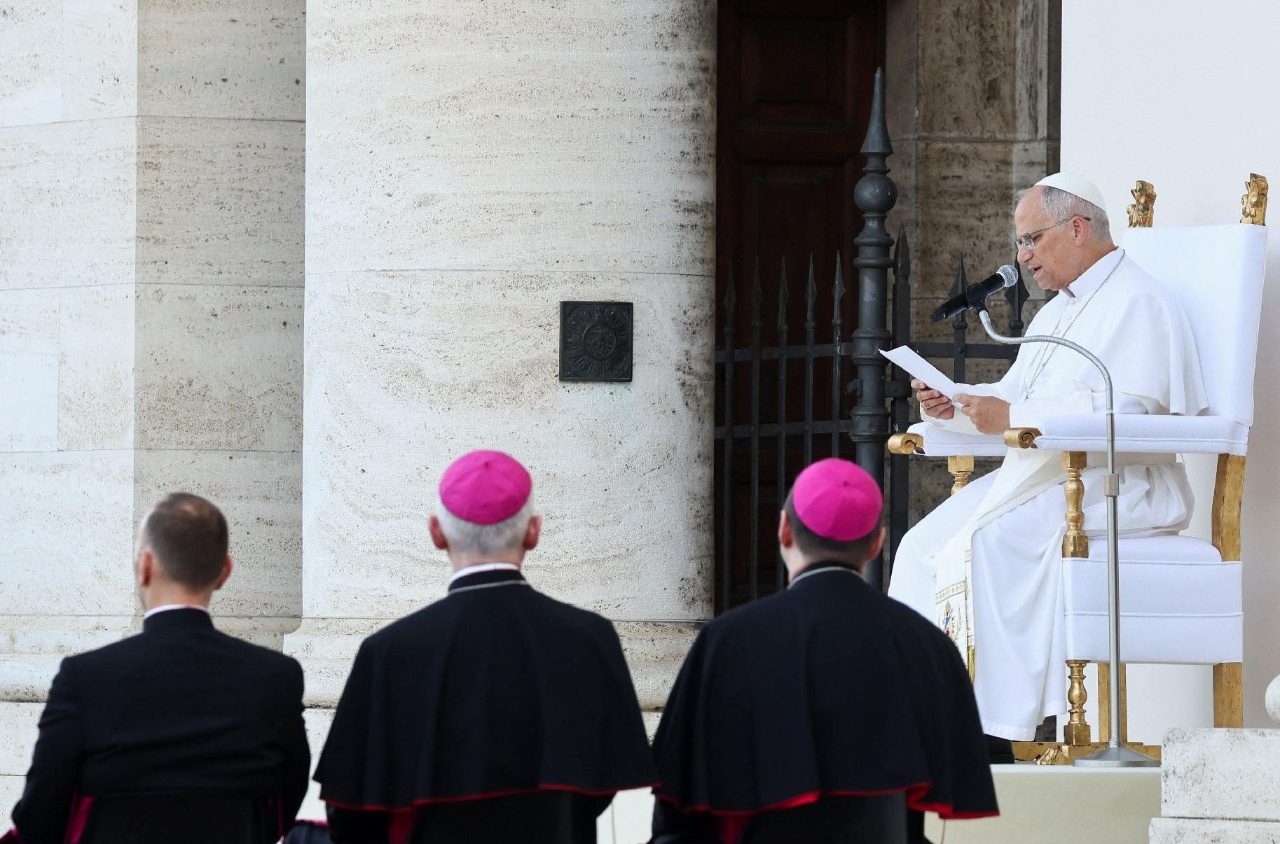
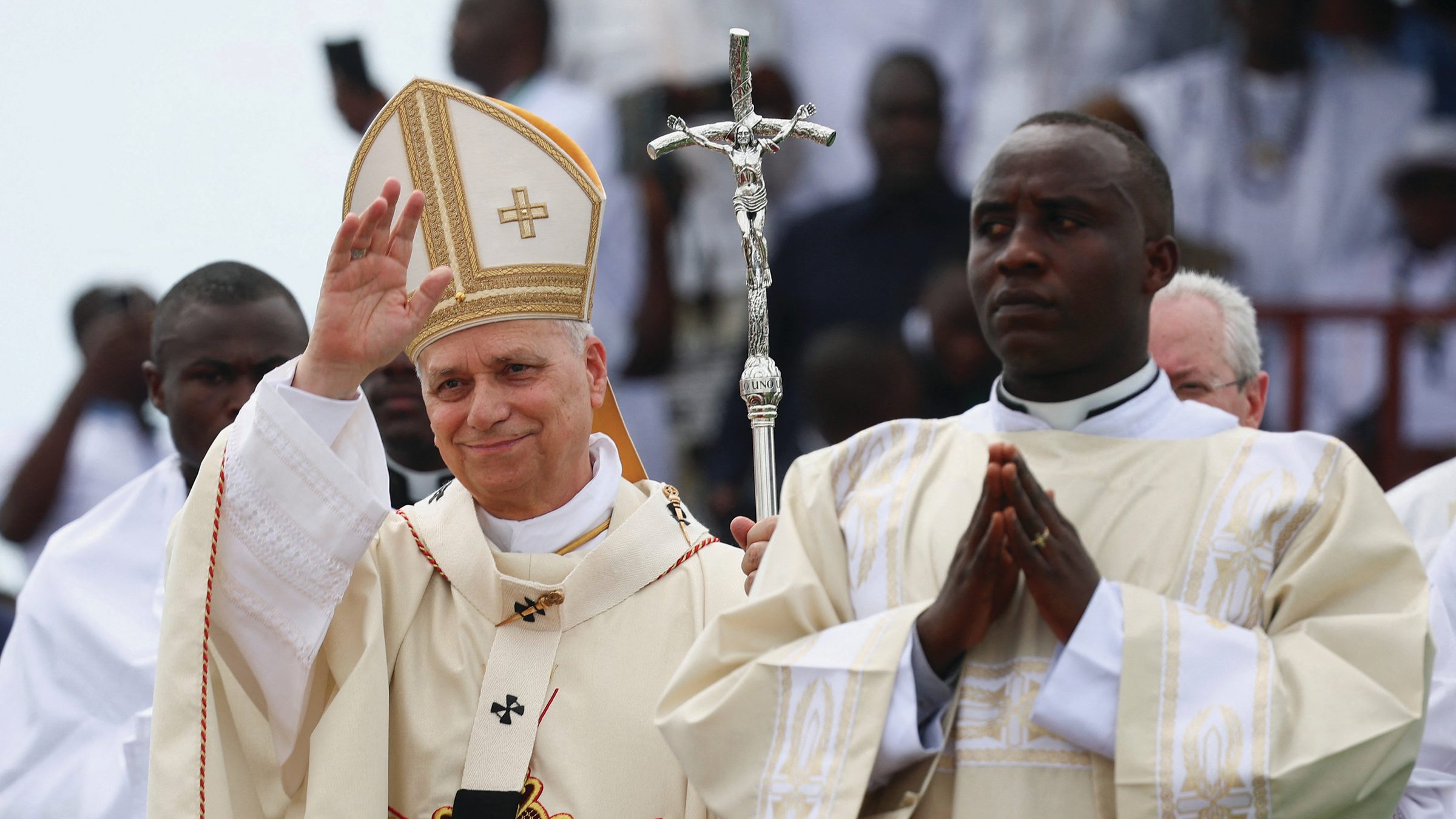
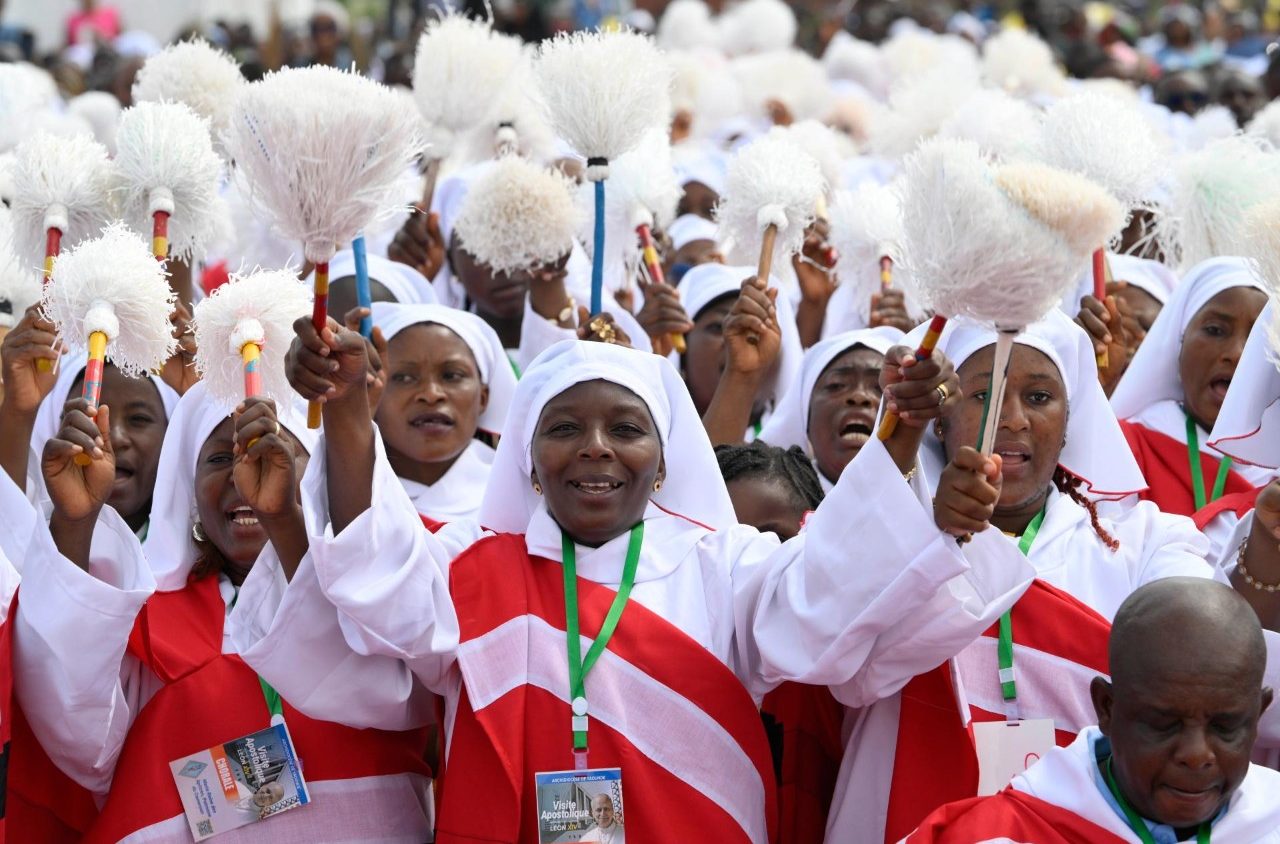
Yaoundé - Pope Leo XIV's visit to Cameroon, from 15 to 18 April, drew to a close with the celebration of a Pontifical Mass at Yaoundé military airbase, before a packed congregation. Concelebrating with the Holy Father were the Bishops of Cameroon and neighbouring countries, together with more than 200 priests. Among those present were the President of the Republic of Cameroon, ninety-three-year-old Paul Biya, members of the government, civil and military authorities, and a vast crowd of faithful, estimated at 30,000, who had gathered to celebrate one last time with the Holy Father at the end of a visit that proved a resounding success.
In just three days the Pontiff visited three different regions of Cameroon, touching upon as many ecclesiastical provinces: a feat that the sitting President has not matched in 42 years, and one that made the event all the more memorable. Following a tight schedule, Leo XIV moved from one region to another celebrating Masses, visiting orphanages, hospitals and universities, and meeting with Bishops, civil authorities and members of the diplomatic corps. Everywhere he delivered messages of peace, forcefully renewing his appeal for peace and justice, as he himself had announced aboard the papal plane before take-off.
The homily: "Jesus is with us, always"
During the Holy Mass, which lasted an hour and a half, Pope Leo opened his homily with a greeting of peace: "Dear brothers and sisters, peace be with you! The peace of Christ, whose presence illuminates our path and calms life's storms." He went on to recall the Gospel passage: "As we heard in the Gospel, faith does not spare us from tumult and tribulations. At times, it can seem that fear has the upper hand. However, we know that even in these moments, Jesus does not abandon us, just as he did not abandon the disciples on the Sea of Galilee." Addressing the Cameroonian faithful, the Pontiff recalled the Church's historic journey: "Throughout the ages, the Church has navigated many storms and 'strong winds'. We too can identify with the feelings of fear and doubt experienced by the disciples while crossing the lake of Tiberias. Such is our experience in moments when we seem to be sinking, overcome by adverse forces, when everything appears bleak and we feel alone and weak."
"Jesus is with us always, stronger than any power of evil," Leo XIV assured. "In every storm, he comes to us and repeats: 'I am here with you: do not be afraid.' This is why we can get up again after every fall, not allowing ourselves to be stopped by any tempest. Rather, we go forward always with courage and trust."
The Holy Father then called on Cameroonians to nurture a spirit of the common good and equity: "No one must be left alone to confront life's adversities. For this reason, every community has the obligation to create and sustain structures of solidarity and mutual aid in which, when faced with crises - be they social, political, medical or economic - everyone can give and receive assistance according to their own capacity and needs." Pope Leo thus urged the faithful to resist all that threatens the unity of the country, placing human dignity first: "At times, family and societal life require the courage to change mindsets and structures, so that the dignity of the human person may always remain the primary focus and so that inequality and marginalisation may be overcome." "After all, God who became man identified himself with the least, and this makes the preferential care for the poor a fundamental part of our Christian identity," the Holy Father added.
In the closing passage of his homily, Leo XIV offered words of encouragement to the local Church: "Even in the midst of difficulties, let us continue to make space for Jesus, allowing him to enlighten and renew us every day by his presence. The Church in Cameroon is alive, young, blessed with gifts and enthusiasm, energetic in its variety and magnificent in its harmony. With the help of the Virgin Mary, our Mother, may your joyful presence continue to blossom." At the end of the celebration, the Holy Father wished to thank the Cameroonian people and all those who had worked to organise the journey, as well as for the happy moments shared together: "I renew my appreciation for the Civil Authorities and all those who helped prepare and organise this trip. Thank you to everyone, especially the sick, the elderly and the nuns who offered their prayers. People of God living and journeying in Cameroon, do not be afraid! Remain firmly united to Christ our Lord! With the power of his Spirit, you will be the salt and light of this land! Thank you very much!" The Mass concluded with gifts presented to the Holy Father by the Archbishop of Yaoundé, Most Rev. Jean Mbarga.
The voice of the People of God
At the end of the celebration, Silere non possum gathered the impressions of some Cameroonian faithful on the Holy Father's visit. "We are leaving with a sentiment of satisfaction and hope that our prayers raised during this Mass will be answered for each and every Cameroonian, for peace in our country, in our hearts," a visibly moved man confided to us. Beside him, a woman in her fifties could not hide her emotion: "It's my first time in my life I am participating in such an event. For three days I have been out following the Pope. He has come to give us peace, and I'm going back home very satisfied." The Pontiff's message was grasped with particular intensity by a faithful member of the Catholic Women Association (CWA), who summed up its heart with clarity: "The Pope's message all over has been the same: peace, peace, peace, national unity. We should contribute in our own way to the well-being of our nation, work for peace, contribute to our nation-building, keep violence aside. No matter our differences, we should know that we are one." A similar tone came from another woman, who wished to share her gratitude: "Peace, the love for our fellow citizen, to serve and not serve oneself… my joy is enormous. The Holy Pope brought what we were expecting and hoping for, that peace which we do long for in our country. I am going back home so fulfilled." The younger generations, too, experienced the day with awareness. A boy of just sixteen was able to read the visit as a clear sign: "This visit is remarkable and we hope that the choice of the Holy Father to come to Cameroon was not accidental. As it ends, we are hoping that corruption and tribalism should end, so that we can live in a country united, in solidarity and in the peace of Christ."
Archbishop Nkea: "Now it is up to us"
Taking stock of the visit while speaking to the media after Mass was Most Rev. Andrew Fuanya Nkea, Archbishop of Bamenda and President of the National Episcopal Conference of Cameroon: "When the Pope comes, it's an event which is not as important as the aftermath of the event. He gave many messages and speeches, he has come and gone. What next is very important: we need to sit and digest those messages, and then see what it takes to implement them."
The prelate then dwelt in particular on the message the Pontiff had delivered in his own archdiocese: "In Bamenda the Pope spoke about peace now, not tomorrow. We have to start reflecting concretely on this message: if the time of peace is now, how do we make that 'now' happen? We have to really set up committees to study how to implement these words of the Pope and see how we can make this peace a reality."
A task, the Archbishop concluded, that calls upon every actor in the civil and ecclesial fabric: "How do we dialogue with the separatists in the bush, to be able to see how to dialogue with the government? These are things that we, of civil society and the Church, have to do to make sure that the words of the Pope don't get wasted."
Emmanuel Patrick Tan
Silere non possum