Vatican City - With the appointment of Bishop Luis Marín de San Martín, O.S.A. as Almoner of His Holiness and Prefect of the Dicastery for the Service of Charity, Leo XIV is entrusting the office that most directly embodies the Pope’s charity within the Curia to a religious who, in recent years, has worked at the heart of ecclesial processes as Under-Secretary of the General Secretariat of the Synod. The promotion is accompanied by the conferral of the dignity of archbishop and already points to the prospect of the cardinalate, which will in all likelihood come at the new Pontiff’s first consistory.
The relationship of friendship, esteem and closeness between the fellow Augustinians Marín de San Martín and Prevost is well known in Vatican circles. It was precisely this closeness that immediately fuelled resentment within the General Secretariat of the Synod, especially in the area associated with Cardinal Mario Grech. In Malta, where his ecclesial profile has undergone very marked changes over the past twenty years, Grech has been nicknamed by some “Kamaleont”, chameleon. Under Benedict XVI he appeared as a bishop close to the more traditional positions; during Francis’ pontificate he became one of the most recognisable faces of synodality and one of the principal interpreters of the Church’s new phase. Today, however, his influence appears to have diminished significantly and he is one of the many who have “disappeared from the scene”, as one prelate puts it. Even the documents of the study groups, presented for months as steps capable of profoundly affecting the life of the Church, are now being described in much more cautious terms, as simple material for reflection and working tools.
An Augustinian religious
Born in Madrid on 21 August 1961, Luis Marín de San Martín entered the Order of Saint Augustine in 1982, made his solemn vows in 1985 and was ordained priest on 4 June 1988. After ordination he obtained a doctorate in Sacred Theology at the Pontifical Comillas University in Madrid. His formation therefore combines Augustinian religious rootedness, academic work and experience of internal governance within the Order.
His path developed in different but coherent settings: he served as formator at the Tagaste major seminary in Los Negrales, provincial councillor of the Order, prior of the monastery of Santa María de La Vid, and then professor of theology in the Augustinian centres of Los Negrales, San Lorenzo de El Escorial and Valladolid. From 2004 he was also a visiting lecturer at the Faculty of Theology of Northern Spain in Burgos. To this must be added posts of weight within the Augustinian family: general archivist, assistant general of the Augustinians and president of the Institute of Augustinian Spirituality. The move into the more strictly curial sphere came in 2021, when he was appointed by Pope Francis titular bishop of Suliana and under-secretary of the Synod of Bishops. On 11 April of that same year he received episcopal ordination in Almudena Cathedral in Madrid. From that moment, his name became linked to the workshop of synodality, one of the most sensitive dossiers in contemporary ecclesial life.
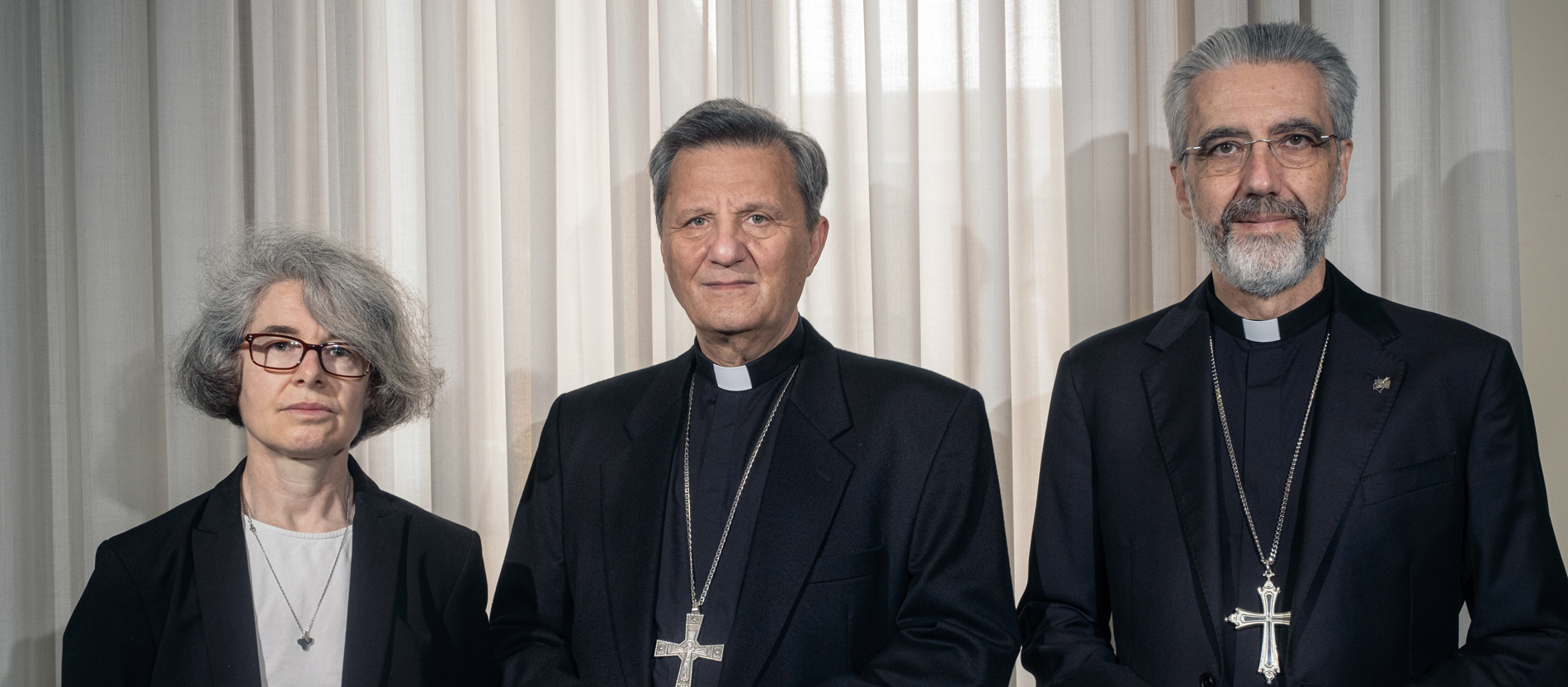
Once he arrived in Via della Conciliazione, his appointment immediately caused discontent in the religious Nathalie Becquart, who began complaining that Bishop Luis Marín de San Martín had a larger office than hers, suggesting that she considered herself disadvantaged because she was a woman and not a bishop.
An important appointment
With this appointment Leo XIV continues his work of reassembling the Roman Curia. He is doing so calmly, thoughtfully, with the seriousness of a man who does not improvise and who carefully weighs the people he calls to work with him. In just 143 days, Francis chose Master of Ceremonies Konrad Krajewski as Almoner, with the evident aim of removing Guido Pozzo and relegating him, without any red hat, to the leadership of the Pontifical Commission Ecclesia Dei, a body he had already decided to close. He succeeded in bringing about that suppression on 17 January 2019. A decision that Leo XIV will in all likelihood have to reconsider, also in the light of what is happening with the Priestly Fraternity of Saint Pius X, since that Commission had been established precisely by the will of Saint John Paul II, with the specific intention of fostering dialogue and safeguarding ecclesial communion.
Prevost, by contrast, took 308 days to choose a man close to him, a person he trusts, a religious of his own Order with whom he shared many moments at the Augustinianum. This detail too confirms Prevost’s method: to weigh, to consult, to reflect even on decisions that might appear more immediate and almost natural. The season of government driven by impulse has therefore come to an end. His appointment to the Apostolic Almonry suggests the Pope’s desire to entrust an important office to a trusted man, while at the same time removing him from an entirely useless function within the Secretariat of the Synod, where he moreover risked being progressively sidelined precisely because he was regarded as “a trusted man of the Pope”.
What is the Dicastery for Charity?
The Dicastery for the Service of Charity, terminology introduced by the apostolic constitution Praedicate Evangelium, is the Apostolic Almonry and is defined as a “special expression of mercy”. Its mission begins from the option for the poor, the vulnerable and the excluded, and consists in carrying out works of assistance and aid, in any part of the world, in the name of the Roman Pontiff. In cases of particular indigence or other necessity, it is the Pope himself who personally orders the assistance to be provided.
Praedicate Evangelium specifies that the Dicastery, under the leadership of the Prefect, that is, the Almoner of His Holiness, makes concrete the Pope’s concern and closeness towards those living in conditions of need, marginalisation or poverty, and also intervenes in grave disasters. It is also competent to receive, seek and solicit donations intended for the Pontiff’s charitable works. The Almoner also retains the faculty of granting the Apostolic Blessing by means of the famous authenticated parchment certificates. The proceeds from these parchments are all devoted to the Pontiff’s charity.
There is also an element that says much about the weight of this office. The constitution desired by Francis establishes that, during the vacant See, while the heads of curial institutions cease from office, the Almoner of His Holiness is one of the very few figures who continues in the exercise of charitable works, remaining under the authority of the College of Cardinals until the election of the new Pontiff. It is an exceptional continuity, reserved to an office that the Pope considers essential even in the passage from one pontificate to another.
Leo XIV, therefore, is today placing Luis Marín de San Martín at a crucial point, entrusting this office to a trusted man from his own religious family, formed in the school of Saint Augustine.
Fr.C.S.
Silere non possum