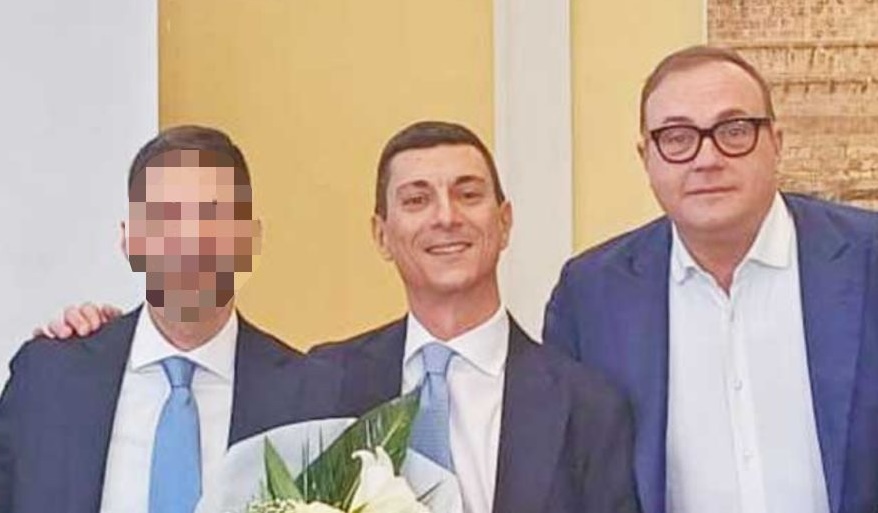
Civitavecchia – For some time now — in fact, for years — Silere non possum has been the target of an obscure figure who decided to carve out a place for himself in the Vatican blogosphere after being pushed out of a number of other circles. First, as spokesman for Gianfranco Fini, a position from which he was removed; later, through right-wing political circles, as Vice-President of Corecom Marche, an office he lost following an extremely serious scandal.
Francesco Capozza calls a woman who died by suicide a “cow”
Everyone will remember the tragic case of Tiziana Cantone, which came to national attention in September 2016. Cantone had begun a relationship with Sergio Di Palo, around ten years her senior, and the two briefly lived together in 2015. From November 2014 onwards, Tiziana had consensual sexual relations with other men, which were filmed on six occasions and circulated by Cantone herself via WhatsApp. One video in particular, uploaded to a pornographic website on 25 April 2015, went viral over the following months. A remark made by Cantone — «stai facendo un video? Bravo!» (“Are you making a video? Well done!”) — became an internet meme and was subsequently printed on T-shirts and various other items of merchandise. The unwanted publicity drove Tiziana into isolation and led her to give up her job. On 13 July 2015, she applied to the Court of Aversa to have the videos removed from websites and search engines. In November 2015, Cantone applied to change her surname to Tiziana Giglio, adopting her mother’s surname. The request was assessed favourably by the Carabinieri command in Castello di Cisterna in January 2016 and approved by the Prefect of Naples in July that year.
Despite changing her surname and moving several times to different parts of Italy, her attempt to regain anonymity proved enormously difficult. The legal action she brought to secure the right to be forgotten resulted in the partial removal of the videos from numerous websites, but because of procedural mistakes made by her lawyer, Cantone was ordered to pay more than €20,000 in legal costs. By then suffering from severe depression, Tiziana attempted suicide several times before tragically taking her own life on 13 September 2016, hanging herself in the basement of an aunt’s home where she had taken refuge.
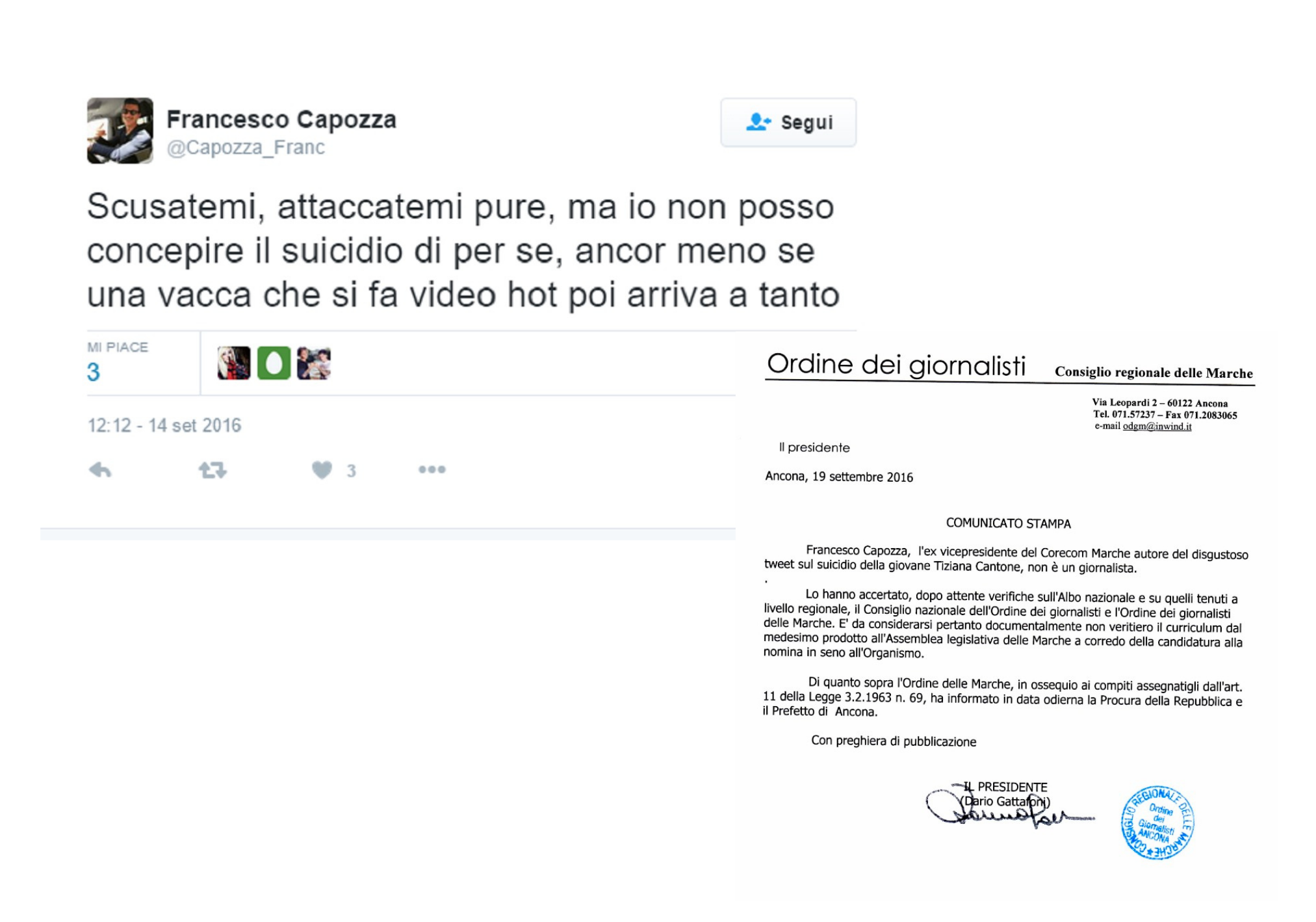
And yet, from his Twitter account, the then Vice-President of Corecom Marche, Francesco Capozza, wrote: «Scusatemi, attaccatemi pure, ma io non posso concepire il suicidio di per sé, ancor meno se una vacca che si fa video hot poi arriva a tanto» (“Forgive me, attack me if you like, but I cannot understand suicide in itself, still less when a cow who makes sex videos ends up going that far”).
Those were extraordinarily serious words, and they caused an uproar. Because that is how things work in Italy: memories are short, and serious misconduct, insults, defamation and false accusations are punished only when they attract enough media attention to make inaction impossible.
Today we are forced to return to this affair, given that Francesco Capozza has numerous criminal proceedings pending against him, yet no one has intervened over what he has been doing for years to Silere non possum and its editor-in-chief.
How the obsession began
After trying to make his way into various organisations — including the Einaudi Foundation, where he was apparently taken on for a few days on a trial basis only to be dismissed almost immediately, to the point that Andrea Cangini reportedly said he did not even want to hear Capozza’s name mentioned again — Francesco Capozza eventually landed at Alessandro Sallusti’s newspaper Libero, where he remained only briefly.
From that point onwards, however, he began writing about Vatican affairs despite not being a journalist. We are talking about someone who has spent his life moving through political circles working in “communications” and who has nothing whatsoever to do with the Vatican. He does, however, have a particular fixation with lace and frills, as well as old-fashioned videos. He has repeatedly been quoted by “lace-and-frills” blogs which publish hundreds upon hundreds of insults against «sodomiti» (“sodomites”) — indeed, one such blog was even shut down — while at the same time quoting and celebrating a man who is in a civil union with another man.
As our readers know, Silere non possum has fought to reaffirm a principle concerning the intimate sphere of the individual, and we have repeatedly stressed that discussing the sexual orientation and sexuality of priests is entirely inappropriate, un-Christian and still less compatible with professional or journalistic ethics. We have been clear about that.
It is equally obvious, however — and Italian and international case law recognises this as well — that when individuals or blogs set themselves up as champions of the fight against homosexuality and gay priests, only then to republish and praise a homosexual man in a civil union — who even describes himself as «sposato» (“married”), despite merely being in a civil union — something plainly does not add up, and there is a public interest in exposing the hypocrisy of such dynamics.
These are the same circles that erupted when Silere non possum simply drew attention to a video published by Vatican News in which Marco Agostini referred to cardinals as «culattoni» (“poofs”). Just consider what we are talking about. And Capozza, despite being in a civil union himself, feels entitled to discuss the sexual orientation of priests and laypeople and to refer to them using female nicknames. But we will come to that.
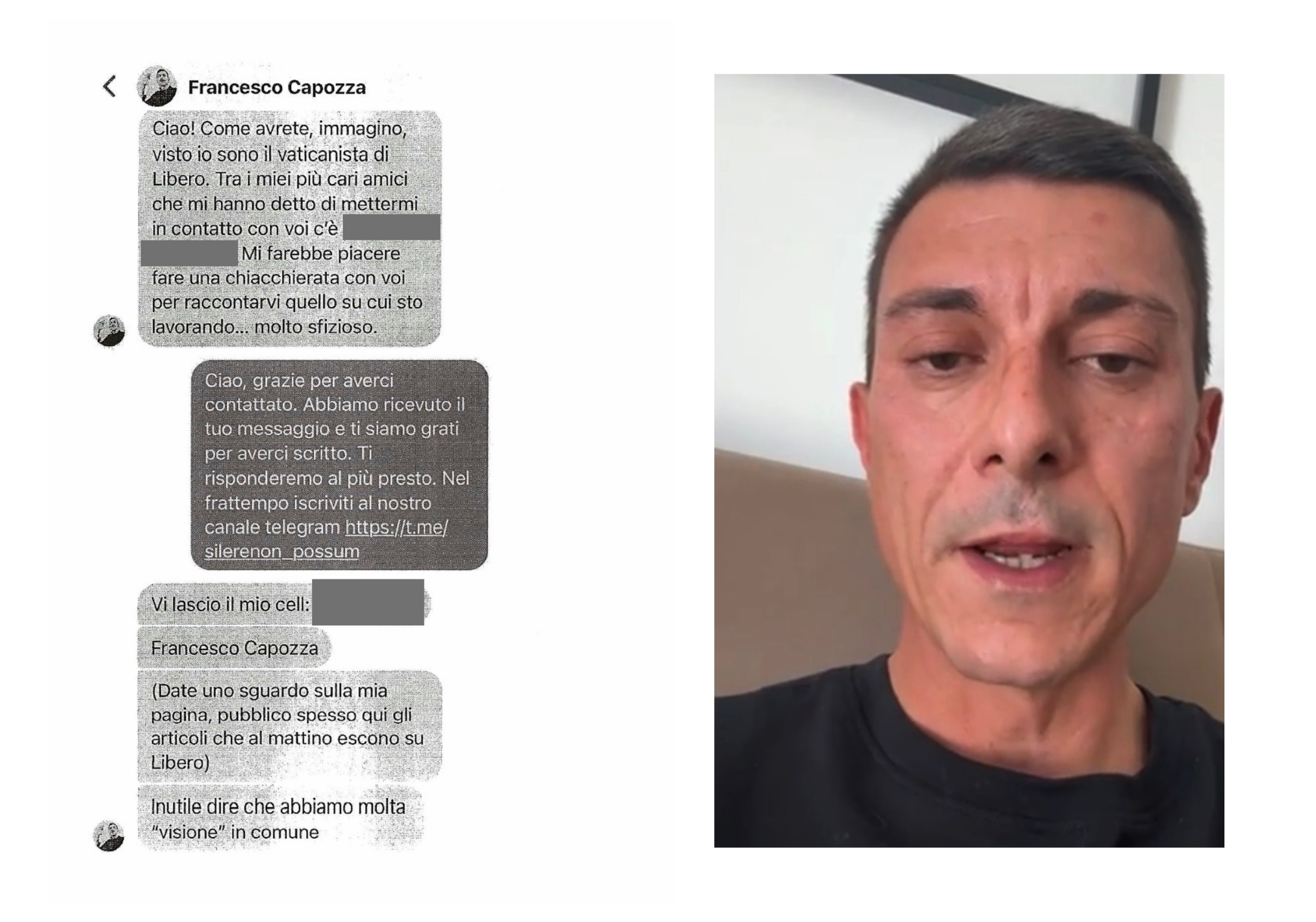
The attempted approach in 2022
What not everyone knows, however, is that in 2022 Francesco Capozza — who today insults Silere non possum virtually every other day — attempted to ingratiate himself with Silere non possum by sending a Facebook message to the editorial office.
He asked to be contacted, hinted that he was working on «qualcosa di molto sfizioso» (“something rather juicy”), and suggested «una chiacchierata» (“a chat”). In that message, naturally, he also boasted of a «grande amicizia» (“close friendship”) with someone connected with the Vatican: a claim that, after the appropriate checks, proved to be entirely false.
That message — which in any event we only read some time later, given the volume of correspondence we receive every day — received no reply: internal checks had made the true nature of the individual abundantly clear.
And, as invariably happens in certain circles — the very circles which Capozza and the crank blogs that republish him insult every day, despite being fully part of them themselves — once he had been ignored, what did he choose to do?
He began operating within an association, of which he is now the principal operative, and which spends every day attempting to attack its “competitors”.
The method, essentially, is: «Non ti posso avere? Allora ti distruggo» (“If I can’t have you, then I’ll destroy you”).
And Capozza has said as much repeatedly. He has openly declared that he would get rid of Marco Perfetti, that he would destroy him, that he would wipe him out.
That is precisely how he began to behave. He published the victim’s place of residence and personal and family documents; he went to his home in person to establish where he lived; he turned up outside the registered office of Silere non possum; he began following every organisation connected with Silere non possum; and he began writing to and contacting numerous people in an attempt to build himself a network of allies whom he could use against the publication.
Every day, whatever article appeared on Silere non possum, Capozza responded with an uninterrupted stream of insults, insinuations, defamatory claims and false accusations, dragging priests, bishops and cardinals into it in turn. For months he has talked about our sources, first at the Dicastery for Divine Worship and then in the Secretariat of State, targeting one person and then another according to his mood.
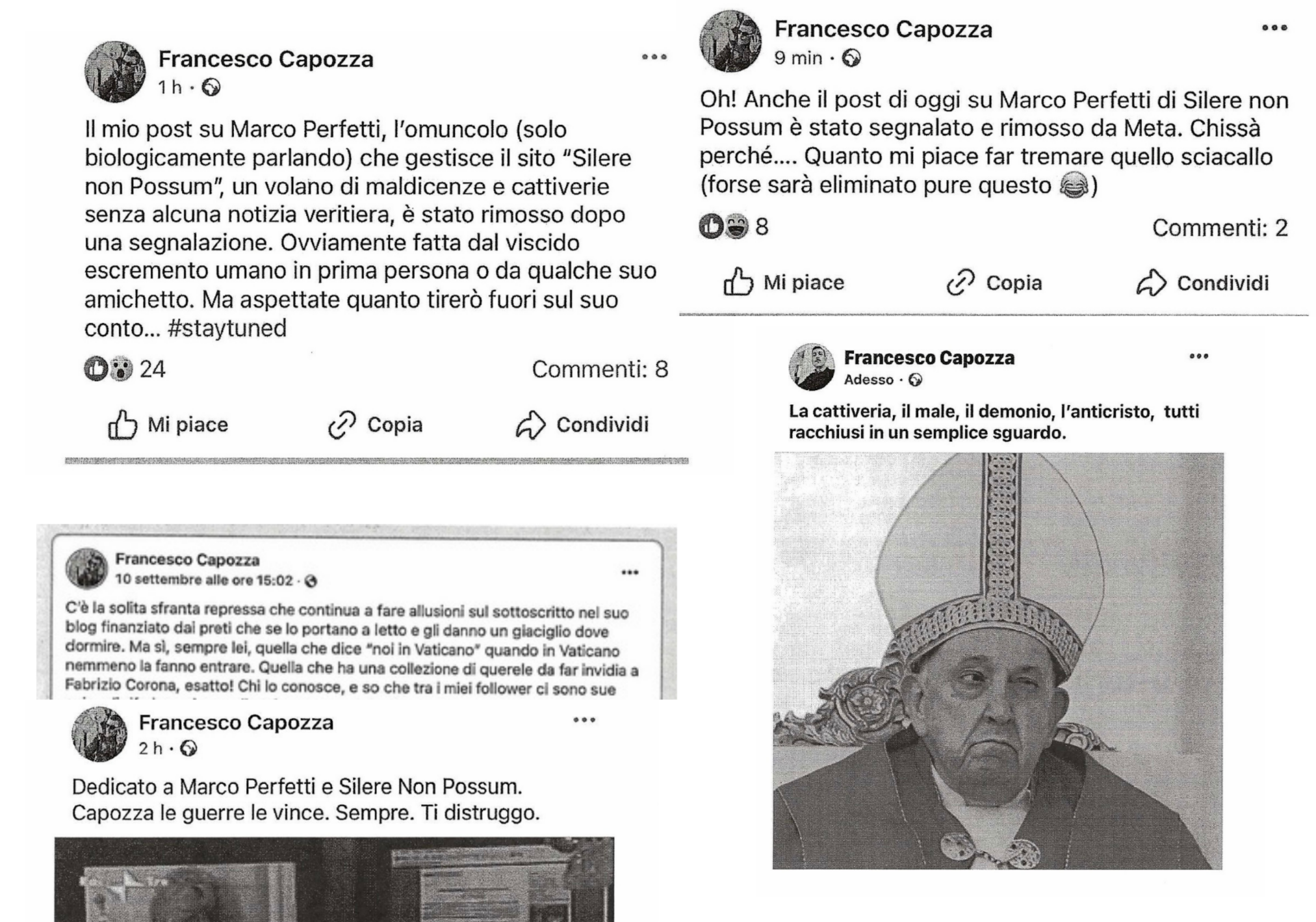
Capozza, after all, belongs to that very specific category of individuals whose widespread presence both on the fringes and at the heart of the Church we have, unfortunately, repeatedly denounced over the years: people who constantly talk about sex and homosexuality and who attribute to priests and bishops behaviour which, in reality, appears to relate only to themselves — in this instance, to a man in a civil union with another man.
In this TikTok livestream, Capozza can be heard referring to Father Enzo Fortunato in sexual and markedly homophobic terms, before going on to defame the head of a well-known atelier by repeating nothing more than gossip.
This, moreover, is only a small part of a lengthy livestream during which Capozza goes so far as to openly accuse Cardinal Angelo Bagnasco of having breached the secrecy of the Conclave with him, to make entirely false allegations against a priest, and even to drag Cardinal Marcello Semeraro into the discussion.
The method of projection: turning the accusations around
What has prompted us to write this article today — and what we will return to — is precisely his tendency to boast and to threaten to publish or write things. This is the aspect that concerns us most, given that he moves around ecclesiastical figures who, as we saw in the Santa Maria Maggiore affair, appear particularly exposed to this kind of behaviour.
This is therefore not merely about protecting our reputation — a concern which obviously matters to us, even though our readers have by now learnt to recognise when certain obsessed individuals speak out of envy and spread poison without ever proving anything.
It also gives a fairly clear picture of how Francesco Capozza operates: he speaks, publishes and writes solely on the basis of whatever he hears and picks up from the gossip of whichever person happens to let him get close.
He never proves what he claims, which is precisely why, over the years, he has advanced a huge number of theories that have subsequently been disproved. The latest concerns Macron and Pope Leo XIV, but there are countless examples.
And, like the most obsessive individuals, what does he do? He projects.
At various times, Capozza claims that Silere non possum does not pay taxes; that Silere non possum is not a properly registered newspaper; that Silere non possum publishes nothing but gossip and unsubstantiated claims; that Silere non possum publishes forged documents; that Silere non possum is «plurindagata» (“the subject of multiple criminal investigations”); that Silere non possum even asks people for money; and finally that Silere non possum «scapperebbe» (“runs away”) and cannot be found.
Every one of those assertions, when directed at Silere non possum, is completely false; and paradoxically, each corresponds to conduct that can instead be documented in relation to Capozza himself.
Let us take them in order.
As for money, it is worth remembering that every newspaper survives through the support of its subscribers and that, unlike the newspapers Capozza writes for, we receive no state subsidies. The only person in this affair facing pending criminal proceedings on an accusation that he extorted money is Francesco Capozza.
The numerous videos and posts collected, moreover, show that it is Capozza who is familiar with this modus operandi: threats and blackmail. And we will now see how conduct of this kind, potentially criminal in nature, emerges in no fewer than two proceedings.
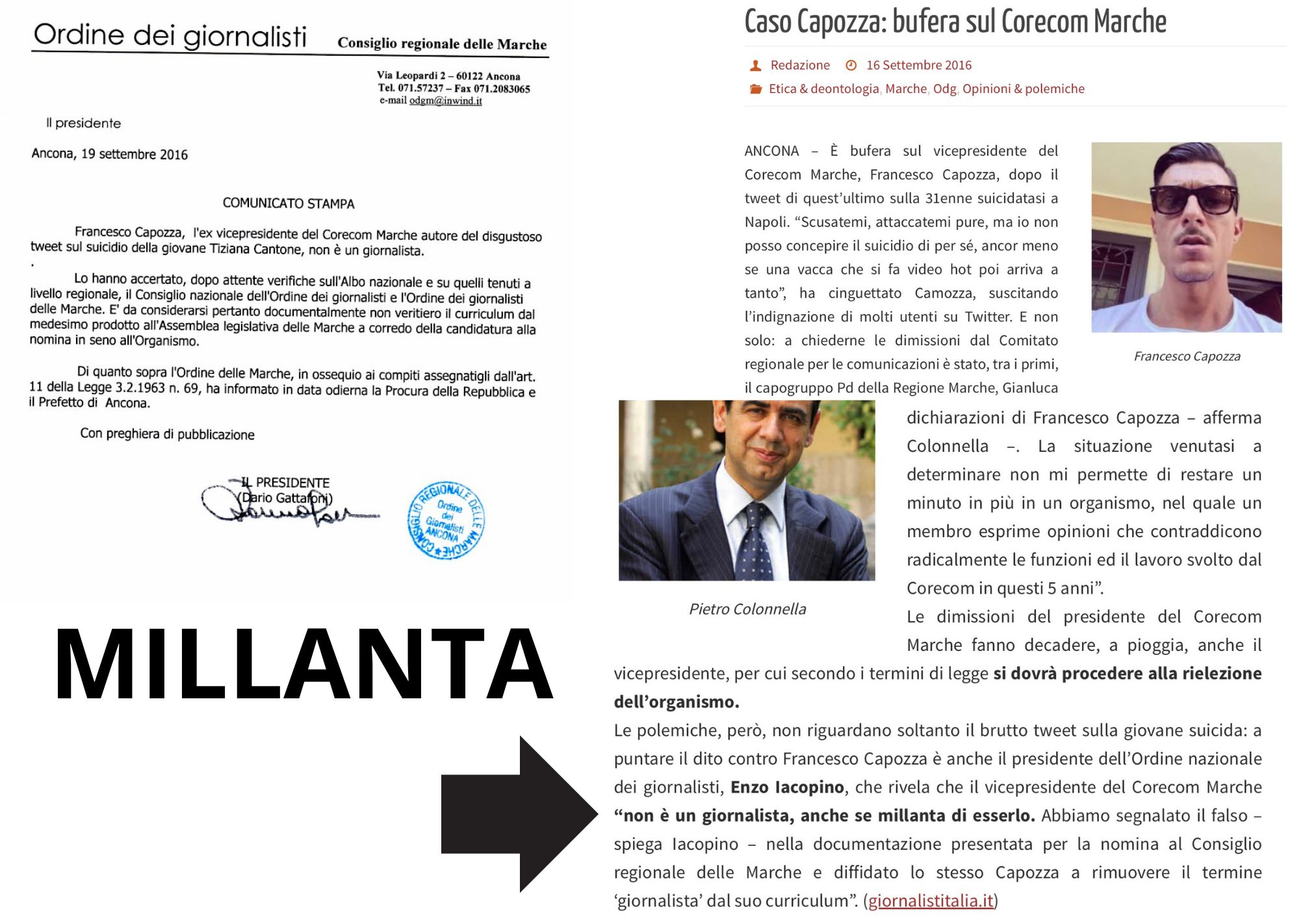
As for the status of the publication, Silere non possum is a duly registered newspaper, whose editor-in-chief is a journalist and publisher. Francesco Capozza, by contrast, has been reported by the Italian Order of Journalists for falsely claiming to be a journalist, including on the CV he submitted to the Marche Region.
As for the alleged criminal proceedings involving Silere non possum, the case brought against Silere non possum was initiated by Capozza’s “friend” and “colleague”, Franca Giansoldati. We have already demonstrated that it is entirely unfounded and that, on the contrary, it exposes what we describe as a genuine criminal association involving Giansoldati, Capozza & others.
Silere non possum, moreover, has never published a single forged document and — unlike Capozza — always backs up what it says with documentary evidence.
The person actually facing criminal proceedings is Francesco Capozza, who is repeatedly appearing before the courts in Rome and Civitavecchia.
In front of his small circle of followers, who listen to him and cheer him on, he claims that only one case is open against him, the one involving Genoveffa Ciferri, when in reality there are several, involving offences far more serious than defamation.
Finally, as for supposedly “not making oneself available”, the reality is exactly the opposite of what he claims. Silere non possum, as a newspaper, has a registered office, publicly available contact details and legal counsel. It is Capozza who, according to the case files, has proved difficult for the police to locate.
In criminal proceedings brought against him by a former boyfriend for extortion, persecutory acts and stalking, the police took more than a year to find him because he was recorded as «irreperibile» (“untraceable”).
In other words, every accusation he directs at others is — documentary evidence in hand — a mirror image of his own conduct.
It is, in fact, a well-established strategy, to which we will return at length in the second instalment of our investigation, Il Patto Sporco (The Dirty Pact).

Francesco Capozza on trial for extortion
There is, in fact, a common thread, and it is this: Francesco Capozza is on trial for extortion. That is not something Silere non possum is simply alleging; it is established by documents from criminal proceedings in our possession.
His inclination towards this style of conduct can also be seen in some of the material he himself has published online, in which he discusses journalistic activity in threatening terms — «vedrete cosa pubblicherò» (“you’ll see what I publish”). More importantly, there is an actual case before the courts in Rome — in which he was questioned on Thursday, 23 April 2026 and described himself as a journalist (sic!) — in which a former boyfriend reported him and prosecutors sought to have him committed for trial for «estorsione», «atti persecutori» and «stalking» (“extortion”, “persecutory acts” and “stalking”).
The proceedings are currently moving at an absurdly slow pace and were started late because, according to the case file, Capozza was «irreperibile» (“untraceable”). Capozza will of course have every opportunity to prove his innocence, because everyone is innocent until finally convicted — even if Capozza himself does not appear to understand that principle, given how freely he attributes criminal guilt to everyone except himself.
The fact remains, however, that chats and audio recordings exist which indicate that he extorted money from his former partner by threatening to make his homosexuality public.
Threats against neighbours in Civitavecchia
As we have repeatedly explained, including in the first instalment of our investigation, people of this kind — who develop a genuine obsession with another person — sooner or later end up giving themselves away. We are not talking here about journalistic investigations of the kind conducted by Silere non possum, but about a genuine obsession consisting of insults, threats, persecutory conduct and outright stalking behaviour which, over time, becomes concretely dangerous.
Hundreds of posts written by Francesco Capozza are now on record in which he grossly insults Marco Felipe Perfetti, editor-in-chief of Silere non possum. And when, as in this case, one is dealing with someone who has previously faced extremely serious allegations — similar to those concerning conduct Capozza himself is accused of having directed at former partners — the potential danger becomes even clearer. The inertia of the State in the face of all this has become intolerable, and requires a public response aimed at forcing those responsible to explain why the Italian judiciary and police continue, stubbornly, to do nothing.
Faeces thrown at neighbours and threats while claiming to be a journalist
In Civitavecchia, Capozza was reported to the authorities for seriously insulting and threatening two local residents. He is alleged to have smeared faeces on their car, thrown faeces into their garden and repeatedly threatened them. During the same period, the same neighbours found that their car had been scratched, while Capozza — according to documents held by the Public Prosecutor’s Office — accompanied his threats with phrases such as «sono giornalista» (“I’m a journalist”) and «adesso vedrete» (“now you’ll see”).
This has been his way of operating for years, and all of it has taken place amid the complete silence of the police, the judiciary and the Order of Journalists.
The latter, in particular, has received numerous reports and has never responded to them, once again confirming its nature as a self-regarding lobby. The two residents of Civitavecchia — the city where Capozza lives, and which he openly says he lives in on his social-media profiles, beginning with Facebook — have produced audio, video and photographic evidence. Capozza, who has already received a criminal penalty order, will naturally defend himself in court and seek to establish that he had nothing whatsoever to do with the alleged acts. The photographs, audio recordings and videos nevertheless remain.
Since Silere non possum always proves what it says and does not simply repeat hearsay — unlike the self-styled “journalist” from Il Tempo, who, since he is not actually a journalist, is not bound by any journalistic code of ethics — we publish below the complaints filed by the two residents of Civitavecchia, who have for some time been living in fear because the Capozza method is simple: he picks a target and then never lets go. That is exactly what he has done with Silere non possum.
A risk to the hierarchy
The mechanism is always the same. Capozza repeatedly throws out claims such as «in Vaticano non ci mette piede, è segnalato alla Gendarmeria» (“he can’t set foot in the Vatican; he’s been flagged to the Gendarmerie”), with the obvious aim of provoking the person being targeted into responding. The target, in trying to disprove the false claim, inevitably ends up exposing himself, breaching confidentiality agreements and making public details of his private life which have no genuine informational value whatsoever.
It is a dynamic not dissimilar to that adopted by another associate of this clique — whom we will discuss later — who used to throw out provocations such as «perché non fa un video nei giardini vaticani?» (“why doesn’t he make a video in the Vatican Gardens?”).
These are, evidently, statements capable of affecting only the former seminarian who was expelled from seminary — the one who writes privately and gets angry because no one pays him any attention — whereas people who genuinely know the Vatican simply do not take such things seriously. If they happen to read them, they smile, knowing perfectly well that absolutely nothing may be recorded in the Vatican without authorisation, on pain of serious consequences and genuine removal from the premises.
The difference in method is precisely this.
When Silere non possum wrote, for example, that Giovanni Castiglia had been barred from the Vatican, we proved it with an official document, signed both by the Gendarmerie and by Castiglia himself. We are a newspaper, not people who falsely claim titles after having been challenged by the Order. Francesco Capozza, by contrast, claims that other people have been barred but cannot produce a shred of evidence. It should also be made clear that claims of this kind — such as boasting that he was a friend of Edgar Peña Parra and that he had arranged for other people to be barred from the Vatican (just imagine the scene: some nobody claiming he can have someone barred!) — send the hierarchy absolutely furious, because they help portray the institutions of the Holy See in the worst possible light.
And sensible people quite rightly ask: why should Silere non possum not be allowed into the Vatican? What offence would supposedly have been committed? None. There are no criminal proceedings in the Vatican against Silere non possum. The only attempt in the past was brought by Angelo Chiorazzo, but in that case it became clear that he himself was falsely claiming a title in order to lodge a complaint in the Vatican: a title which, in fact, he did not hold. There are no other proceedings. There is therefore no legal basis for preventing a journalist from entering the Vatican. Why, then, should entry be denied? Because the journalist is inconvenient? What is this, North Korea?
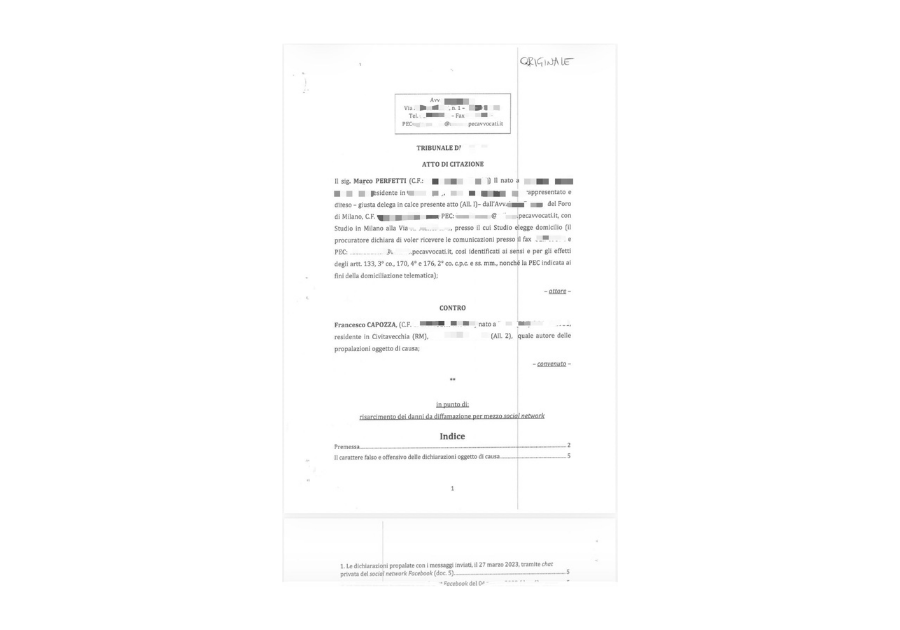
The Capozza method: Silere non possum takes the bogus title-claimer to court
It should be remembered that Capozza, since he is not a journalist, enjoys no journalistic protection for his sources.
Added to this is a well-established habit of his: that of «esporre al pubblico ludibrio e a rischi» (“exposing people to public ridicule and risk”) — to use an expression unfamiliar to him, rather than the considerably harsher language that routinely appears in his own vocabulary — anyone who tells him anything, even when what they tell him is false.
That is precisely what happened with three individuals who, despite knowing neither Silere non possum, its editorial staff nor its editor-in-chief, told Capozza a series of falsehoods, driven by resentment and bitterness because they had failed to get what they wanted.
Rather than checking what he had been told, Capozza thought it appropriate to publish the nonsense they had fed him and even passed all their identifying details on to Silere non possum, exposing them publicly.
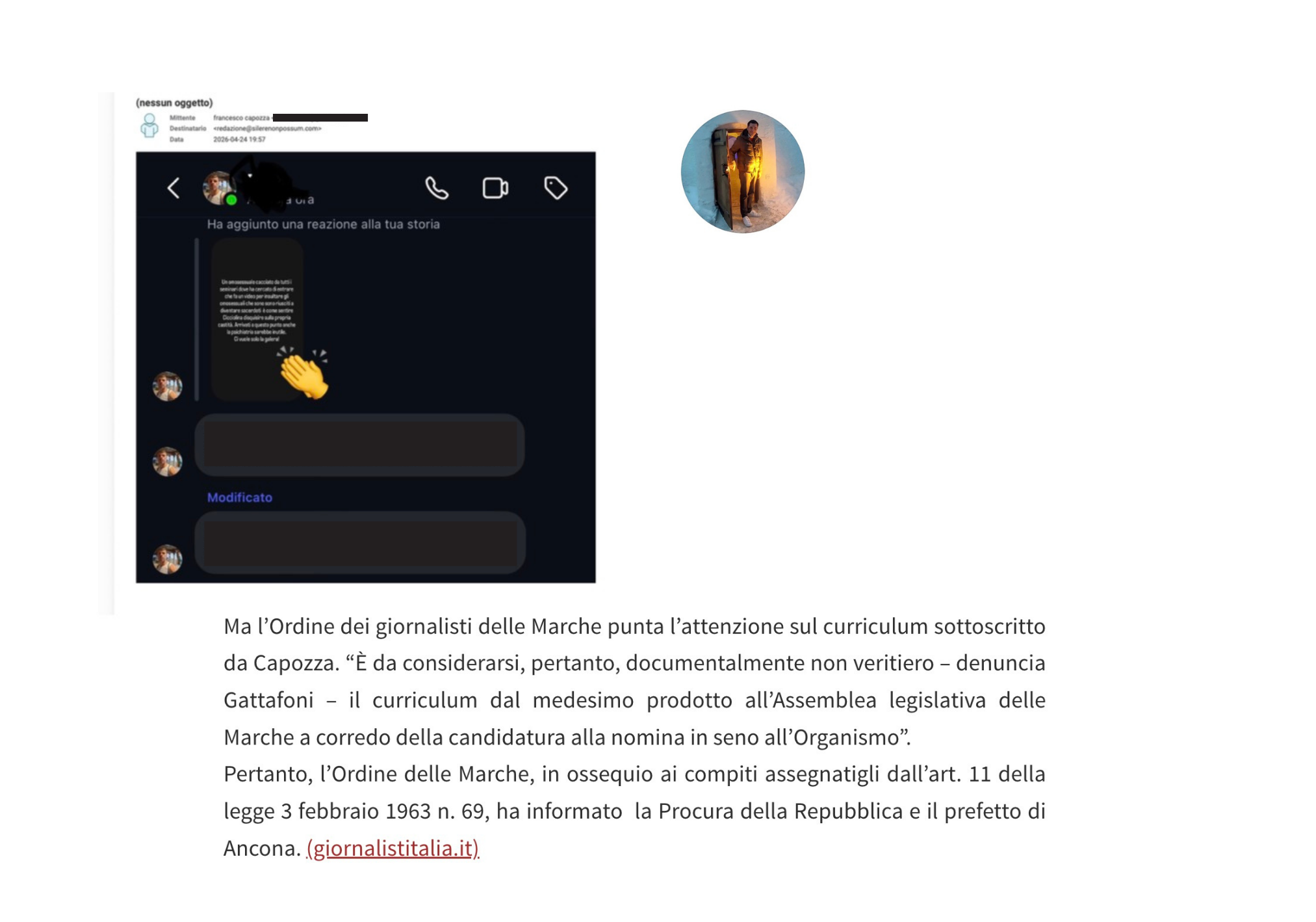
All that remains for us is to take note of this, having already reported those directly concerned over the statements they made. Alongside the further complaints that will be filed, there is another front: all those repressed individuals who write privately to Capozza from far-flung Italian dioceses where they have caused a series of problems which, before long, we will find ourselves discussing. Capozza will in fact be required to identify them one by one in court, since he cannot invoke any privilege protecting the confidentiality of journalistic sources — a protection to which he is plainly not entitled, since he is not a journalist. Let this serve as a warning to anyone who approaches him believing that anonymity will protect them.
First, sooner or later, he himself will have to answer before the judicial authorities for what he says and disseminates; and alongside him, anyone who protects or attempts to shield him will also have to answer for it. Secondly, he is so unreliable that he even ends up exposing his own sources. And in this case, “sooner or later” means much sooner rather than later. Because while the Public Prosecutor’s Office and the Postal Police have shown themselves to be seriously inactive over what this individual has been doing, civil proceedings, though hardly fast, at least follow a reasonably predictable timetable. It is precisely for that reason that Silere non possum has brought civil proceedings against the “non-journalist” Francesco Capozza, seeking specific damages in respect of each individual defamatory post he has published about us. That claim is being reassessed upwards by the day. And we did so reluctantly.
Throughout all these years, Silere non possum has never devoted a single article to Francesco Capozza, nor has it ever paid him any attention. He is, after all, an obscure individual who, despite the very high opinion he has of himself, represents no one. For that reason too, even in the face of the invective of recent years, we had chosen to let it go, aware that we were dealing with one of those people who chase publicity — including, and perhaps especially, negative publicity — and who, in order to obtain it, would be prepared to do anything. It is no coincidence that he is close to circles linked to the current government. Now, however, enough is enough. And if the State will not behave like a State, we are forced to protect our own reputation, while at the same time warning the many public figures whom Capozza repeatedly describes as his «amico», «confidente», «fidatissimo» (“friend”, “confidant”, “closest and most trusted ally”), so that they know who Francesco Capozza really is and what he does.
Among them, for example, is Cardinal Angelo Bagnasco, whom Capozza presents as one of his «fidatissimi» (“most trusted confidants”) and whom, in TikTok livestreams, he openly accuses of having breached the secrecy of the Conclave. Then there is Archbishop Georg Gänswein, who — according to Capozza — supposedly even acted on his behalf by looking for information about Silere non possum. All claims which those directly concerned, of course, deny.Then there are Edgar Peña Parra, Gerhard Ludwig Müller, Raymond Burke, and many others. All supposedly “his friends”. These are, of course, people — some of them — who granted him an interview because he introduces himself, as indeed he legitimately can, as «colui che scrive di Vaticano per il quotidiano Il Tempo» (“the person who writes about the Vatican for the newspaper Il Tempo”). Nothing more. The problem is that he introduces himself to them as a journalist despite not being one.
None of these people has any personal or confidential relationship with him. And once again the mechanism of projection reappears. While Capozza accuses Silere non possum of «millantare accessi» (“boasting about access”) — something we have never done, not even in relation to institutions to which, plainly and by virtue of our work, we necessarily have access — in reality he merely attributes to us what he himself habitually does: describing himself as the “friend” and “loyal ally” of every “powerful person”, only to write and spread the worst possible things about those same people whenever the opportunity arises.
At this point, another matter should be clarified. Contrary to what Capozza falsely claimed in recent hours, he did not take us to court — and one might in any event wonder on what basis he could have done so, given that we had never dignified him with any attention. We are the ones who sued him.
The evidence is the writ of summons we published above, which unequivocally disproves what he has been circulating. What Capozza describes as «le diffide» (“the legal notices”) is, in reality, nothing more than a single specious lawyer’s letter. His lawyers — it should be remembered — not only failed to attend the mandatory mediation required by law before any civil defamation proceedings, despite having been properly summoned, but after choosing not to attend they sent a rambling letter in which they demanded a series of explanations concerning the professional life of the editor-in-chief of Silere non possum.
Francesco Capozza is entitled to none of those explanations, both because he represents no one and because all the information in question is already publicly available. His statement, «vedremo se quella merda umana si presenterà in tribunale» (“we’ll see whether that piece of shit turns up in court”), is therefore yet another projection. The person who avoids the courts is him. It is also completely false that no reply was given to that letter, as he has publicly claimed — a letter which, moreover, is the only one we actually received, contrary to what Capozza would have people believe. A detailed reply was in fact sent, and it was immediately followed by the civil action against the “non-journalist”. We publish that documentation as well, demonstrating that Capozza habitually lies even to his small number of devoted followers.
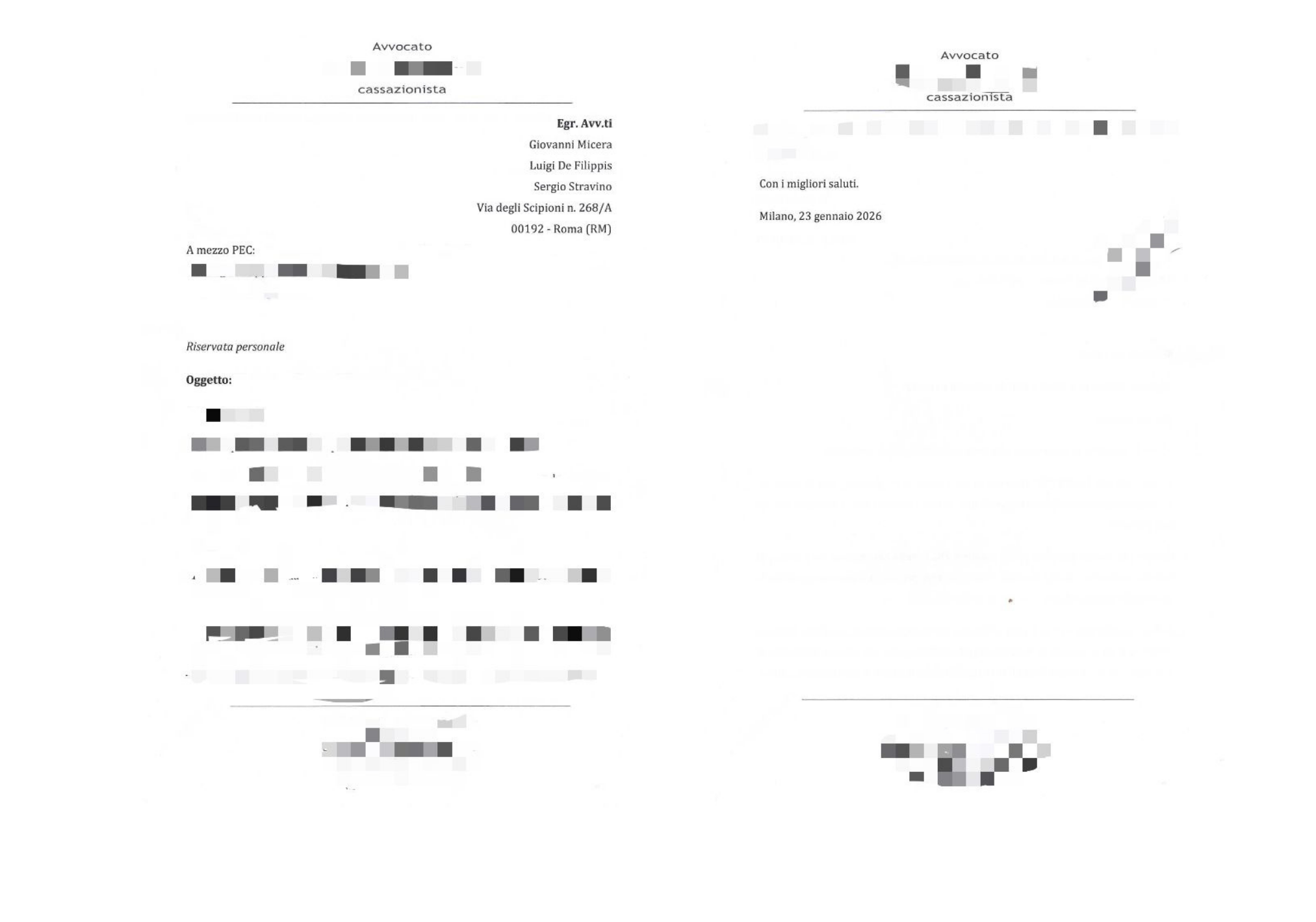
We appreciate that, for someone who speaks of a «reato penale» (“criminal crime”), certain concepts may be difficult to grasp; but when a letter is clearly marked «riservata e personale» (“private and personal”), that document cannot be made public. It is a basic point which, unfortunately, even some illiterate bishops failed to learn at Via Aurelia 468. We are not habitual criminals, unlike someone else who apparently has no problem publishing even the private addresses of relatives protected by privacy legislation. We are required to comply with the ethical standards imposed by law on journalists because, unlike certain others, we actually are journalists. Threats and personal feuds We are talking about a figure who, as should now be clear, follows no rational logic. His Facebook profile is littered with posts in which Pope Francis is subjected to extraordinarily serious insults: at various times he calls him a «demonio» (“demon”), an «apostata» (“apostate”), and other expressions of that kind. Needless to say, this is something very different from criticising decisions made during a pontificate.
But we are talking about someone who does not attend any parish community and has no sacramental life. Within the world of Vatican correspondents, moreover, Capozza is regarded with open distrust, and he has fallen out with numerous colleagues. These are the very colleagues whom, paradoxically, he rushes to defend whenever Silere non possum writes about them. But this too follows a very specific criminal logic: to ingratiate himself with people scrutinised in Silere non possuminvestigations so that he can later use them as a personal shield.
In short, the people he threatened yesterday are the people he defends today. The common thread, however, is always there, and it is entirely personal: this is precisely what closely links him to Franca Giansoldati and others. Capozza, in other words, writes and acts solely for personal ends.
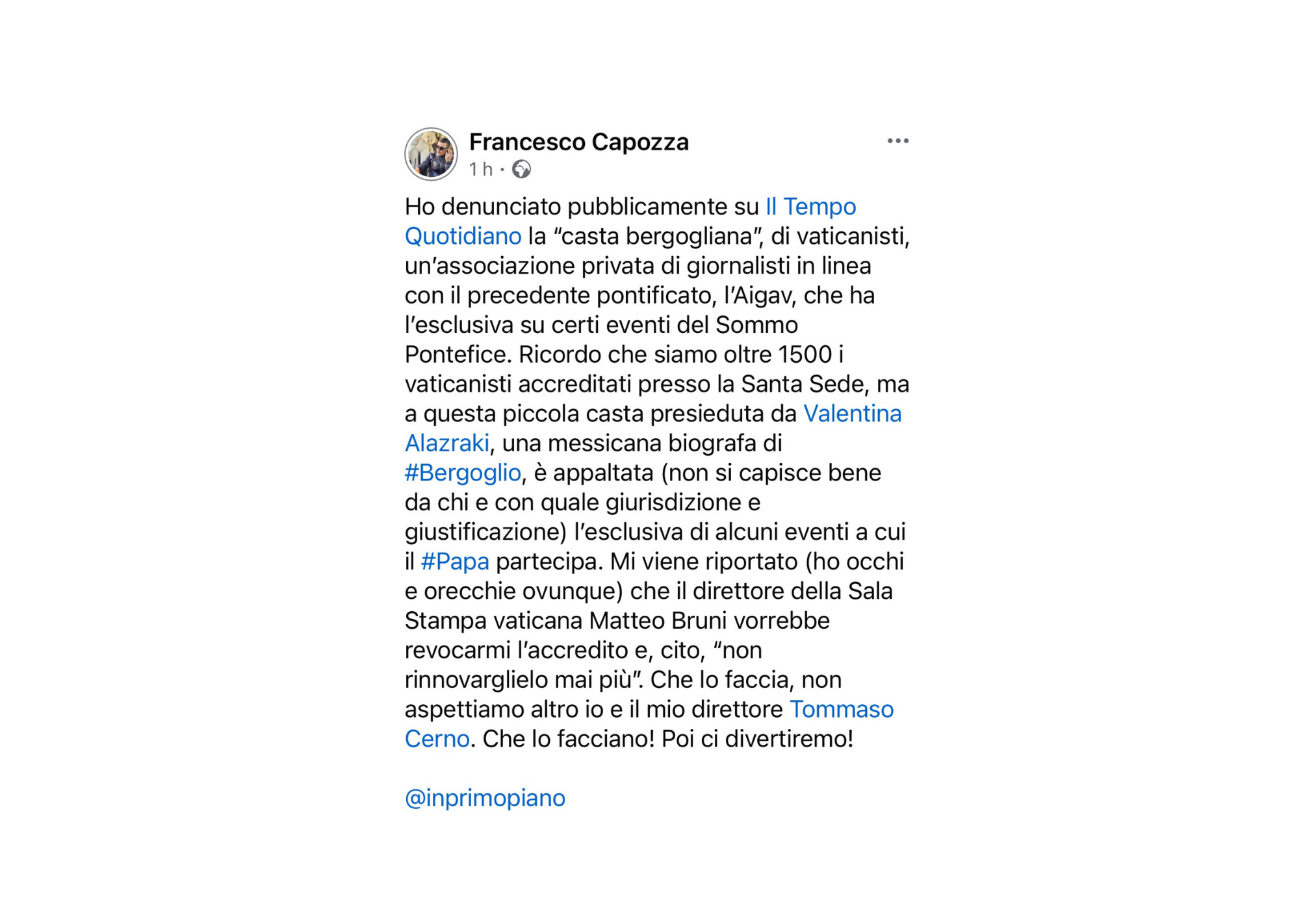
When, in May last year, he was not admitted among those who were to stand in the front row to kiss the newly elected Pope’s ring, and when shortly afterwards he was not admitted to an event at Castel Gandolfo, articles under his byline promptly appeared in Il Tempo denouncing the existence of a group of Vatican correspondents «fedelissimi a Bergoglio» (“utterly loyal to Bergoglio”). And after writing the most vicious things — which, let us be clear, were written purely out of spite, because had the AIGAV group included him he would have kept quiet about the entire matter — he even went so far as to publish posts of a plainly intimidating nature directed at Matteo Bruni, implying that if his accreditation were withdrawn, «avrebbero visto» (“they would see what happened”). And in those same threats he also dragged in Tommaso Cerno, former editor of Il Tempo and, let us remember, the man who hired him after Alessandro Sallusti’s disastrous experience with this individual at Libero. Threats, then, whose meaning could hardly be clearer: «se mi togliete l’accredito, vedrete che cosa sono in grado di fare» (“if you take away my accreditation, you’ll see what I’m capable of”).
A modus operandi of this kind is entirely unacceptable, because it amounts in every respect to the offence of extortion: «se non mi togli l’accredito, ne scrivo bene; in caso contrario, ti attacco» (“if you don’t take away my accreditation, I’ll write positively about you; otherwise, I’ll attack you”). Exactly the same dynamic that Capozza has employed against Silere non possum in numerous posts and in at least two recent livestreams, all of which have now been formally placed on record.
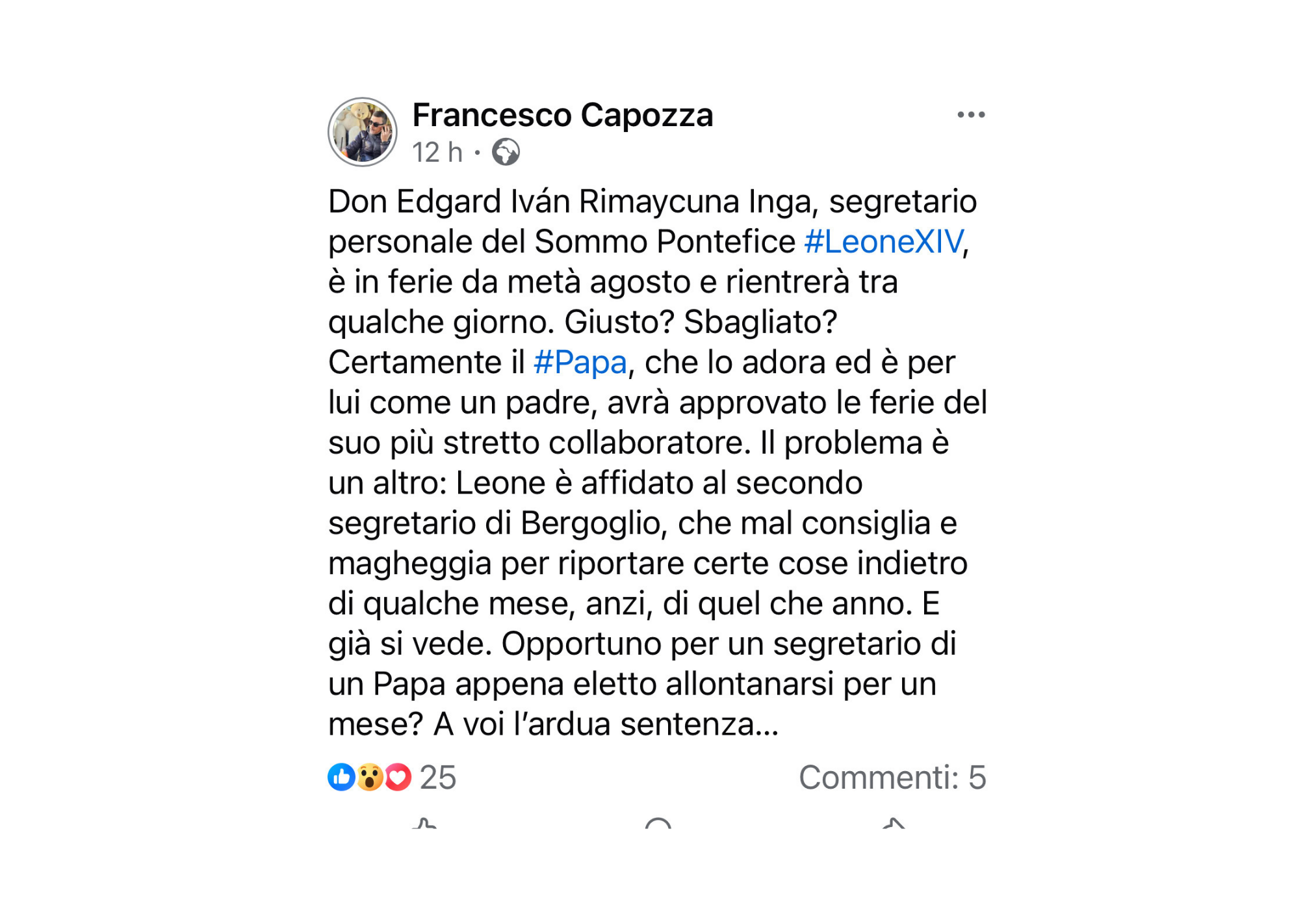
The attacks on Leo XIV’s secretary
Nor has Capozza spared Leo XIV’s secretary, making defamatory remarks about him and accusing him of having taken a holiday when in fact he had travelled to Peru on a mission on behalf of the Pope. Curiously, this happened precisely at a time when “someone” in the Vatican had taken it upon himself to dot the i’s and cross the t’s, making clear that the Augustinians would not be living with the Pontiff and that the claims were, essentially, nonsense.
Nonsense which, naturally, Capozza had also written with the same habitual certainty with which he writes everything. And among the Augustinians who supposedly would not be living with the Pope, who appeared?
Father Bruno Silvestrini: precisely the man whom Capozza, on other occasions, goes to great lengths to present as a «grande amico» (“close friend”). The Augustinian responsible for the papal sacristy who allowed Francesco Capozza and his partner into the Sistine Chapel outside the Vatican Museums’ normal opening hours. Even the Pope himself, then, was subjected to remarks of this sort from Capozza from the very first days of the pontificate. And as soon as he received the go-ahead from whoever habitually feeds him his “exclusives”, he lost no time in attacking Monsignor Edgard Iván Rimaycuna Inga: a priest loyal to the Pope and, above all, a priest of unquestionable worth, who certainly had not gone off on holiday, as Capozza attempted to suggest.
The clique: Giansoldati, Tornielli and the “dirty pact”
The fact that this individual is lashing out precisely now, after publication of the first instalment of the investigation which — as he knows perfectly well — directly concerns him, is further confirmation of his connection with Franca Giansoldati, whom he himself describes as an «amica» and «collega» (“friend” and “colleague”).
One might ask: colleague in what? Francesco Capozza is not a journalist.
The Order of Journalists made that perfectly clear, stating not only that he is not on the register, but also accusing him of falsifying the curriculum vitae submitted to the Marche Region at the time of his appointment to Corecom. All this confirms how Giansoldati, who shrewdly never writes anything herself, uses Capozza as the operational arm of a daily campaign against Silere non possum.
Numerous statements made by Capozza in his posts and livestreams are quite plainly the direct result of information passed to him by the Messaggero journalist: otherwise, Capozza could have no possible way of knowing them.
And this association — which, as we will demonstrate in our investigation Il Patto Sporco (The Dirty Pact), also includes Andrea Tornielli — knows perfectly well that if someone insults you from morning until night, sooner or later you become exhausted, it takes a psychological toll, your work suffers, and — this is the hope — some of the defamatory claims eventually stick, damaging your credibility in the eyes of people who know nothing about the Vatican.
In short, as George Bernard Shaw put it: «non lottare mai con un maiale nel fango: ti sporchi tutto, e al maiale piace» (“never wrestle with a pig in the mud: you get filthy, and the pig enjoys it”).
The point, however, is precisely that they enjoy seeing you get dirty too — and those who enjoy it most are the people watching from safely behind the scenes.
That is exactly why, last summer at the Rimini Meeting, Andrea Tornielli went out of his way to ask Silere non possum: «eh, ma come mai non rispondete agli insulti che scrive su di voi il mio amico ******** *****?» (“but why don’t you respond to the insults my friend ******** ***** writes about you?”).
In other words, Tornielli wanted us to respond to provocations and defamatory statements being spread by a “close friend” of his. Just consider that. This is supposed to be the Pope’s media director.
But we will deal with all of this in the instalment devoted to Andrea Tornielli, in which we will explain the method this man developed and through which he managed to reach the position he now holds. With evidence, as always.
The inaction of the police and prosecutors
Let us state it plainly: the public prosecutors’ offices — including those in Rome and Civitavecchia — which have for years been asked to put an end to what Capozza has been doing, have done absolutely nothing. Unfortunately, that is how Italy works.
And today we have to say so openly because what Capozza is doing has now gone beyond every reasonable limit of tolerance. As a newspaper, and since we cannot spend our time arguing with troubled individuals, we entrusted the matter to our lawyers in the hope that some result might be achieved within an “acceptable” period.
Yet the Rome Postal Police can apparently move with remarkable speed to challenge Silere non possum over having called Franca Giansoldati a «sciacalla» (“vulture”) for asking for a photograph of the dying Pope, while doing nothing about an individual who stalks, defames and makes false accusations, follows people and even unlawfully publishes personal data, placing them in such a state of anxiety and fear that they are forced to leave their family home. We therefore have no alternative but, as usual, to demonstrate what we say and explain why Francesco Capozza has over the years developed a genuine obsession with Silere non possum and its editor-in-chief.
In serious criminal justice systems — rather than ones governed by clientelism, amoral familism, quasi-mafia relationships and corruption — statements and behaviour of this kind would constitute more than sufficient grounds to bring the individual to trial and to impose urgent and stringent precautionary measures. In Italy, however, things do not work that way. It is a banana republic. Nothing new under the sun.
In the light of everything set out and documented here — and of the substantial body of material we have been forced to publish, which in any event represents only part of what exists concerning this self-styled journalist — one question now demands an answer:
how is it possible that Francesco Capozza remains accredited to the Holy See Press Office despite not being a journalist and, above all, in the light of everything he has written and everything he continues to do? Is it possible that this exclusive club of “information professionals”, which in recent months effectively crucified a poor priest and Vatican correspondent — accusing him of extremely serious crimes without a shred of evidence, riding the wave of a climate in which «tutti i preti sono abusatori» (“all priests are abusers”) — should then calmly retain among its ranks an individual who is committing offences on a continuous basis?
Paolo Ruffini, Andrea Tornielli and Matteo Bruni should now provide a substantive explanation.
Marco Felipe Perfetti
and Editorial Staff of Silere non possum