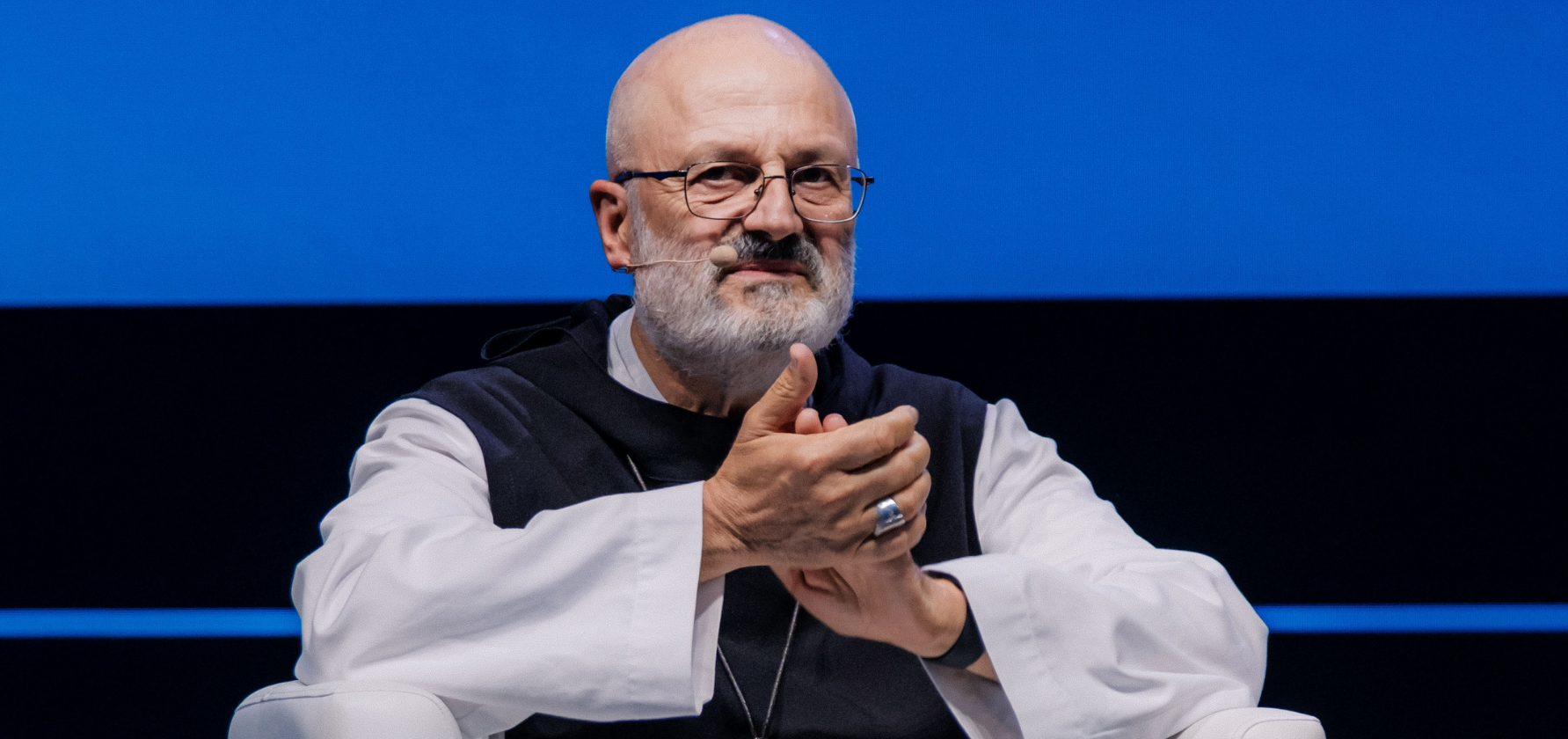
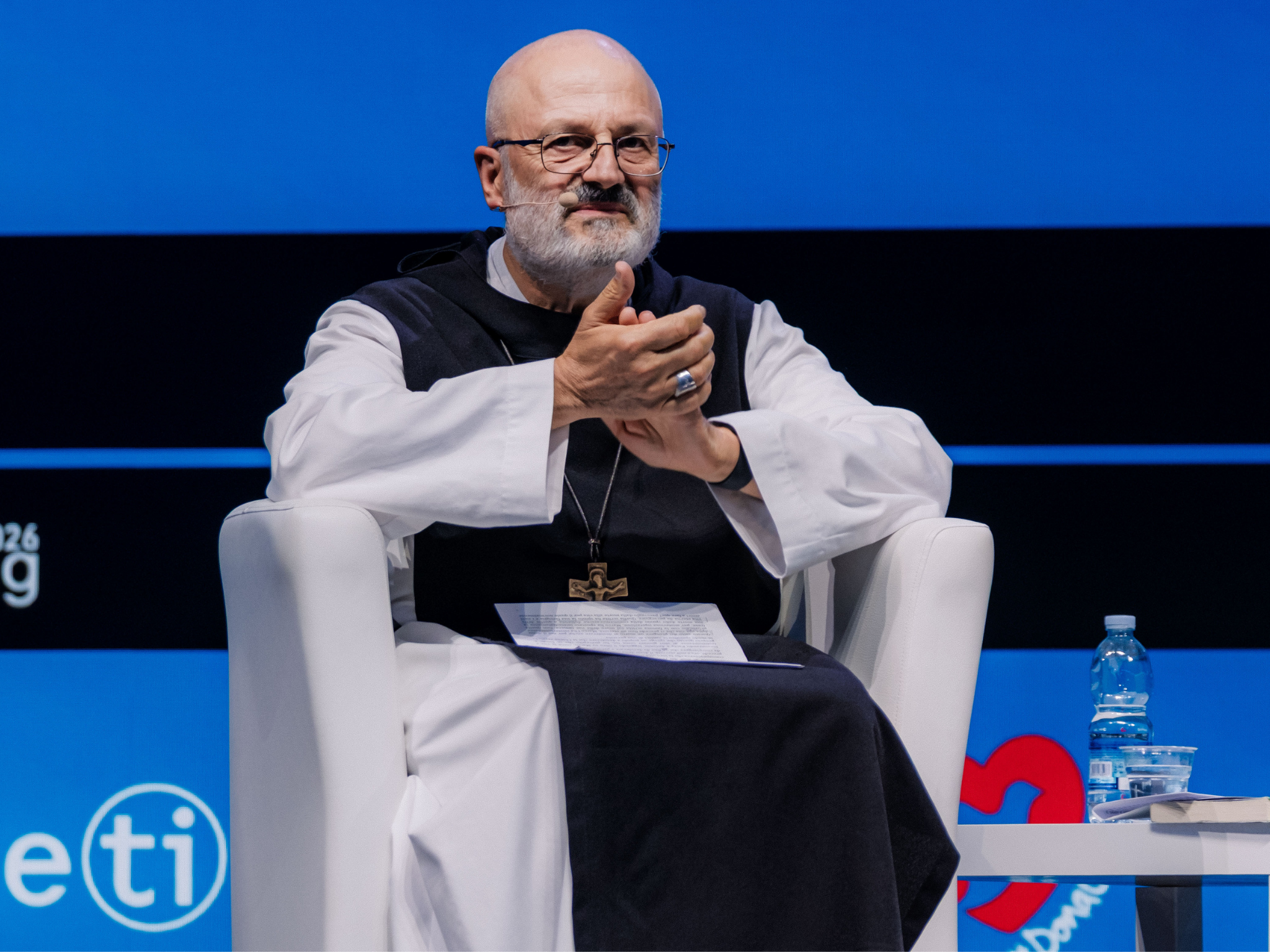
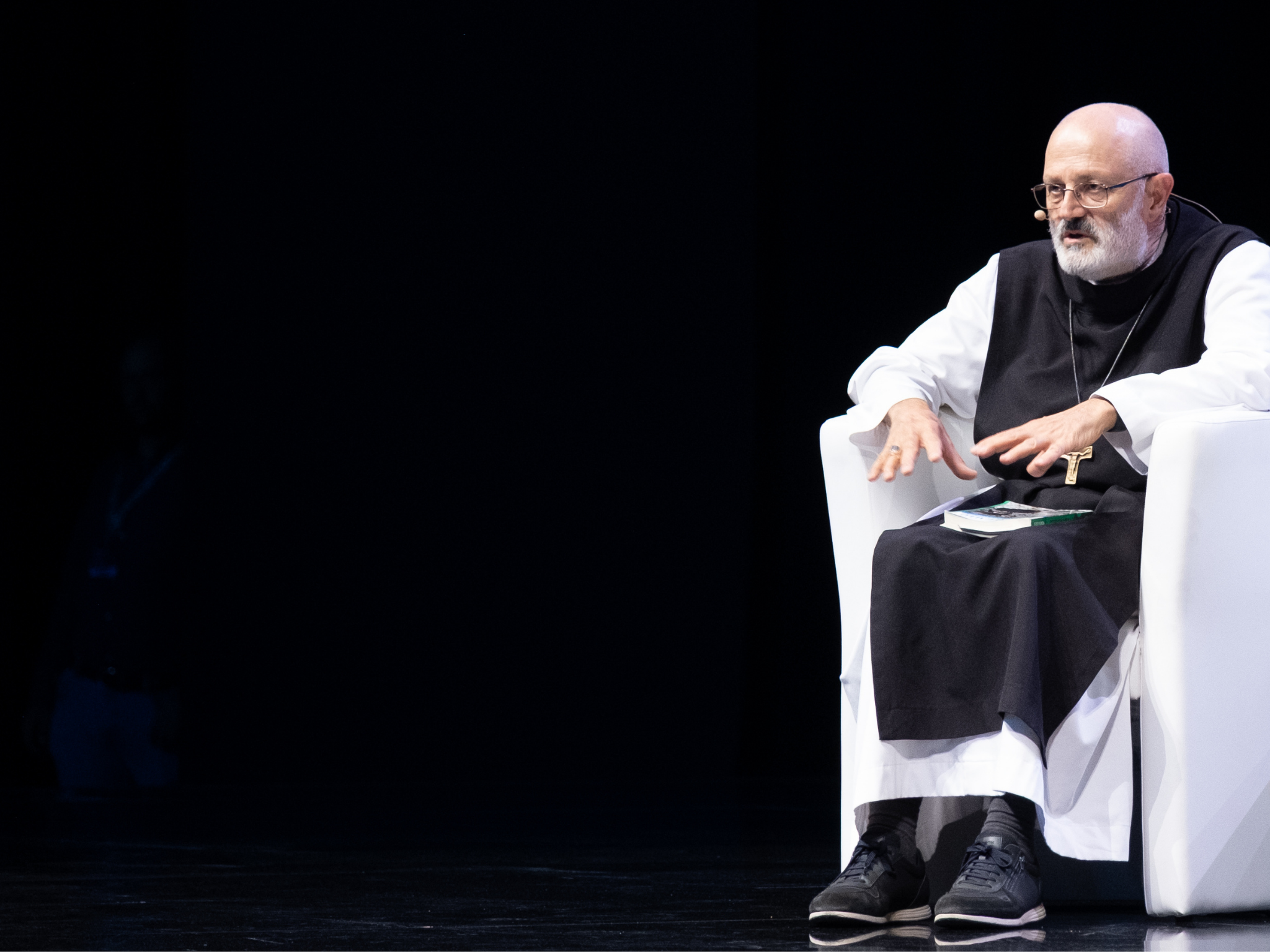
Rome - Over the past few days, at the Cistercian Monastic Formation Course, I have been listening to Abbot General Mauro-Giuseppe Lepori speak to us nuns about communion, fraternity, relationships and life with Christ. Yet as I listen to him, I find myself thinking about the decisions, interventions and methods he himself has adopted in several monasteries of our Order, as well as what happens here at the General House, where, moreover, he spends very little time, since he is almost constantly elsewhere. Addressing us, Lepori said that the monastery should be the place where we “help and educate each other to live everything always with Jesus”. Shortly afterwards, he described human relationships as “the true garden to cultivate” and presented fraternal love as the fruit of communion with Christ.
These are lofty words. And precisely for that reason, when I hear them from him, the gulf between the language of formation and the reality of the way he exercises authority becomes impossible to ignore. They are words I know well: they belong to the ordinary vocabulary of our monastic life, to our Rule and to our daily lives. But when I hear Lepori speak them, I am confronted with a contradiction that, over time, has become unbearable.
An abbot who diagnoses, but does not treat
Abbot Mauro is, in fact, very good at diagnosis. I do not say that sarcastically: I genuinely believe it. After all, how good are we in the Church at identifying other people’s problems, only to become suddenly short-sighted when it comes to recognising our own? Lepori’s problem comes after the diagnosis: the treatment. He is often able to recognise when a community is unwell, to identify its fractures and its difficulties. What is then missing, however, is a plan capable of healing it, putting it back together and giving it room to breathe again. Treatment becomes the management of a slow death.
It is rather like having a doctor who is very good at recognising an illness - an ability that should by no means be taken for granted - but who, once the diagnosis has been made, tells the patient: fine, now let us see how we can accompany you towards death. In some cases, the ability to intervene is lacking; in others, there seems to be no willingness even to look for another way. And when there is no proper understanding of how a community reached its crisis in the first place, there will inevitably also be an inability to provide it with the means to emerge from it.
Lepori, after all, said so himself with a frankness that continues to leave us dismayed. During the San Giacomo di Veglia affair, he gave an interview to Italian television in the cloister of this very General House, as part of what I regard as a report produced with remarkably little critical distance from the Abbot General’s own version of events. In that interview, he uttered a sentence that many of us have never forgotten: “I simply accompany these monasteries towards death.”
The question many of us asked ourselves then was a very simple one: is that really the role of the Abbot General?
The same question returns today as we listen to him speak of monastic life as a place of communion, of fraternal love as its fruit and of relationships as the “true garden to cultivate”. What does all this actually mean for Mauro-Giuseppe Lepori? Is this what he means by accompaniment? Because there is a gulf between the words addressed to us during a formation course and what we have seen happen in communities, and it can no longer be concealed beneath the language of spirituality. The problem is not what Lepori knows how to say. The problem is what he does after saying it.
Relationships preached and relationships practised
Building and cultivating relationships does not mean subjecting monks and nuns to interrogations, making accusations that are at times absurd and devoid of even the most basic logic because one is blinded by anger and personal resentment towards particular people or communities. And all this without even having the decency to look the person sitting opposite you in the eye.
Building relationships does not mean going from one monastery to another telling people that the nun who dared to contradict you is “mad”, “a psychiatric case” or mentally unstable; nor does it mean applying the same labels to those who gave her a voice. And when even that is not enough, a narrative is constructed around the religious sister and the journalists who reported her story, built on insinuation, malicious gossip, calumny and defamation, in an attempt to discredit the people rather than answer the facts they have brought to light.
Among the monks and nuns with whom I am spending these days, the judgement I hear about the way he exercises authority is remarkably consistent: Mauro-Giuseppe Lepori is regarded as unfit for the role he claims to carry out, that of forming consecrated people and accompanying them through matters as delicate as freedom, obedience and conscience. I do not say this because of some difference in monastic sensibility. The problem is far more serious.
When individual cases begin to form a pattern
In recent years, Silere non possum has published documents and testimonies concerning the actions of the Abbot General in several Cistercian communities. In the case of San Giacomo di Veglia, in Vittorio Veneto, Mother Aline Pereira Ghammachi has publicly denounced what she describes as abuses committed against her by Lepori. SNP’s investigation also reconstructed the role assumed by the Abbot General as commissioner at Zirc, Santa Susanna in Rome and Bornem, in Belgium. At Heiligenkreuz, one of the largest abbeys in the German-speaking world, the community was prevented, following the apostolic visitation, from immediately electing a successor to Maximilian Heim; Silere non possum has also reconstructed Lepori’s growing influence in that affair.
Anyone who continues to dismiss all this as resentment towards authority or, worse still, as a personal campaign made up of gossip, vendettas and nonsense is carefully avoiding the real issue. The issue is how authority is exercised and, above all, what happens when it enters the realm of conscience. And this is where what Lepori said to the Memores Domini becomes particularly serious.
Dissent turned into spiritual guilt
Beyond the confines of our monastic Order, Mauro-Giuseppe Lepori, who should above all safeguard his own monastic vocation of prayer, stability and cloistered life, also serves as spiritual assistant to the Memores Domini, the community of consecrated people linked to the Communion and Liberation movement.
During the spiritual exercises he preached to the Memores in July 2025, Lepori addressed those present in terms which, when read together today, are particularly disturbing. Lepori opens the first lecture by speaking about those who did not want to attend the retreat and about some who had asked to leave the Memores Domini. He describes this choice as a “real wound”. He goes so far as to say that a single person would be enough to inflict such a wound on the entire fraternity, because that fraternity is the Body of Christ. Shortly afterwards, his argument becomes even more explicit.
Lepori begins with belonging to the Body of Christ and, in the practical reality of life, identifies that belonging with a community, with “specific faces”, “specific authorities” and “a defined form”. He then says that failing to remain faithful to that belonging amounts to the “choice of nothingness”, to the choice “not to be”. Those who leave that form of belonging are placed within a sequence that leads to Judas; a few lines later, Lucifer appears. Departures experienced without the degree of anguish Lepori believes they ought to entail are even compared to assisted suicide.
These words are not my interpretation. Lepori said them, and there is an audio recording. Lepori does not mention Davide Prosperi and Alberto Brugnoli by name, nor does he literally say: “Anyone who opposes Prosperi and Brugnoli is the devil.” The mechanism he uses is subtler and, precisely for that reason, more troubling.
First, those who do not attend and those who want to leave are presented as the cause of a wound inflicted on the Body of Christ. Membership of a particular community is then bound to “specific authorities”. Leaving is subsequently associated with choosing nothingness, with Judas and with Lucifer. At the end of the spiritual exercises, Lepori returns once again to Judas leaving the company of the disciples: he recalls that “Satan entered into him”, says that Judas was no longer free because he was possessed by Satan, and uses that scene to reflect on what it means to depart from concrete communion. It is an extraordinarily powerful spiritual syllogism. And a dangerous one.
There is no need to say outright that “anyone who challenges the present leadership is demonic”. It is enough to construct a world in which belonging to a particular community and to its “specific authorities” is invested with Christological significance, while doubt, questioning, leaving and breaking away are gradually associated with Judas, Lucifer, Satan, nothingness and death. At that point, dissent ceases to be a matter for discernment. It becomes a spiritual fault.
Dysmas de Lassus and the anatomy of spiritual abuse
And it is precisely at this point that Dom Dysmas de Lassus’s book, Crushing the Soul: Spiritual Abuse in Religious Life, becomes unsparing.
De Lassus describes the process by which perfectly legitimate Christian language is distorted. Obedience becomes the subjugation of the mind; humility becomes the destruction of self-esteem; silence becomes a prohibition on speaking. Above all, unity can be turned into a “duty of fidelity” that leads to a single way of thinking and makes criticism and personal reflection intolerable.
Immediately afterwards, de Lassus describes an even more specific distortion: something breaks unity and therefore “can only come from the devil”. In the case he examines, the implicit message given to a religious who is having doubts about making profession is: God wants you to stay; the devil wants to stop you. The result is the suppression of personal discernment, because the decision has already been made by the authority on behalf of the person concerned.
In another chapter, tellingly entitled “A Single Way of Thinking”, de Lassus explains how any divergent thought can end up being automatically attributed to the Adversary. He then recounts the testimony of those who lived in communities where every doubt was regarded as coming from the devil, every objection was attributed to pride and every attempt at independent discernment was spiritually discredited. The Carthusian’s conclusion is unequivocal: at that point, the community also possesses a “rule of thought” that assaults the conscience.
It is difficult to imagine a more relevant framework through which to read the language used by Lepori with some members of our Order and with the Memores Domini.
De Lassus returns to the point: responding to a religious person’s difficulties with formulas such as “it is a temptation” or “it is the devil” reveals an absence of discernment and allows the person accompanying them to impose his own interpretation from the outset. The religious or consecrated person is infantilised: someone else decides for him which voice is God’s and which is the Adversary’s. This is the line that a superior has no right to cross.
Religious authority may require an action when it has the competence to do so. It cannot take possession of a subject’s intelligence, colonise his moral judgement and present its own interpretation of events as God’s. De Lassus puts it elsewhere in unequivocal terms: the vow of obedience concerns the will in action; a superior cannot order a religious what to think, whom to associate with or whom to listen to.
When a superior instead sacralises his own position, the dissenter finds himself caught in an almost watertight system.If he obeys, he is faithful. If he asks for explanations, he is proud. If he challenges, he divides. If he leaves, he wounds the Body. If he speaks out, he does the Adversary’s work.
De Lassus even records the formula addressed to victims who continue to speak after being told to remain silent: “You are doing the work of the Divider!” It is the use of religious guilt against those who speak out, one of the forms of pressure described in the book. And it is precisely what Lepori continues to go around saying about those who have the courage to denounce his actions.
This is the point that we consecrated women must have the courage to state without pious circumlocutions: the rhetoric of communion can become a means of coercing the conscience.
Christian communion does not confer infallibility upon a superior. The Body of Christ does not coincide with the power structure of the moment. A president, a leader, an Abbot General or an ecclesiastical assistant remain human beings. They can be wrong, they can abuse their position, they can be challenged and they must answer for their actions. No one acquires, by virtue of an appointment, the right to turn his own judgement into the will of God.
When those who criticise are accused of dividing
This also concerns the Memores Domini. Lepori’s words must be read in the context of a community in which the current governance has faced fierce criticism from within.
Giancarlo Martinelli, for example, wrote to the leadership denouncing what he called the “monologue” of those who seek to impose their own view and openly challenging the methods of the current governing board. Davide Prosperi, when Avvenire asked him about what had emerged from Silere non possum’s investigation into Communion and Liberation, said that he did not agree with the way those letters had been circulated.
What he carefully avoided explaining, however, was what happens to those letters when they reach him: they are thrown away and left unanswered. Nor did he explain how he reacts when criticism is put to him privately or within a small group: he becomes angry and accuses those raising it of fuelling division. Above all, he has never responded to the substance of the objections. Not even in the interview he gave to Gambassi in Avvenire. This is not an occasional reaction. It is a method: shift attention away from what is being alleged and on to the person making the allegation, object to the way criticism has been made public, invoke division, and leave the substance of the accusations untouched. It is the same pattern we find in Lepori’s conduct.
In such circumstances, speaking to people who are considering leaving the Memores Domini, describing their departure as a wound to the Body and then constructing a lengthy catechesis around Judas, Lucifer, Satan and the betrayal of communion is not a spiritually neutral exercise. Words have consequences, particularly when they are spoken by someone who holds authority.
We nuns know this better than most. We have surrendered an enormous part of our external freedom to community life. For precisely that reason, our consciences must be guarded with even greater rigour. Anyone who exploits the language of obedience, sacrifice, communion or the will of God has at his disposal instruments capable of reaching far more deeply than a simple administrative order.
A modus agendi that keeps repeating itself
This is why what is happening in our Order can no longer be filed away under the curial formulas of “accompaniment”, “discernment” and “complex situations”. Vittorio Veneto, Zirc, Santa Susanna, Bornem, Heiligenkreuz. But these are not isolated cases: other abbeys in Austria and Germany are also experiencing the same modus agendi, with dynamics recurring according to a pattern that has become recognisable and increasingly disturbing. The concentration of interventions and this understanding of authority now demand serious scrutiny of the Abbot General’s conduct, not another conference by the same man on the beauty of communion.
During these days, Lepori tells us that the monastery must be a place where we cultivate fraternal love. I listen to him and think of the people who, after challenging an ecclesiastical authority, were turned by that same authority into a problem “to be dealt with and reported to the Vatican”. I think of the nuns who have spoken. I think of the religious who have left. I think of the abbeys he has destroyed. I think of those who continue to remain silent because they know what it costs to be branded divisive, unfaithful, proud or an enemy of communion. Then I return to the pages of Dysmas de Lassus, a book I now carry with me almost every day and continue to reread, from time to time, at different moments in my day. I brought it here to Rome with me as well, because every time I open it again I find words and criteria that help to name dynamics which, in religious life, are too often confused, minimised or spiritualised.
We professed obedience, not the surrender of reason
When dissent is demonised, when leaving is laden with images of Judas and Lucifer, when fidelity to Christ is made to coincide with fidelity to particular men and concrete structures, the formation of conscience has already been contaminated by the exercise of power. Mauro-Giuseppe Lepori must be kept away from any role in which he can continue to exert this pressure on consciences without genuine oversight. The Order must have the courage to subject his conduct to independent scrutiny, listening to the communities and individuals involved, including those who have left or spoken out. We professed obedience according to the Rule. We did not profess the surrender of reason. Above all, we did not give Mauro-Giuseppe Lepori the right to decide, for each one of us, which side God is on and which side the devil is on.
A nun in love with Jesus
Silere non possum