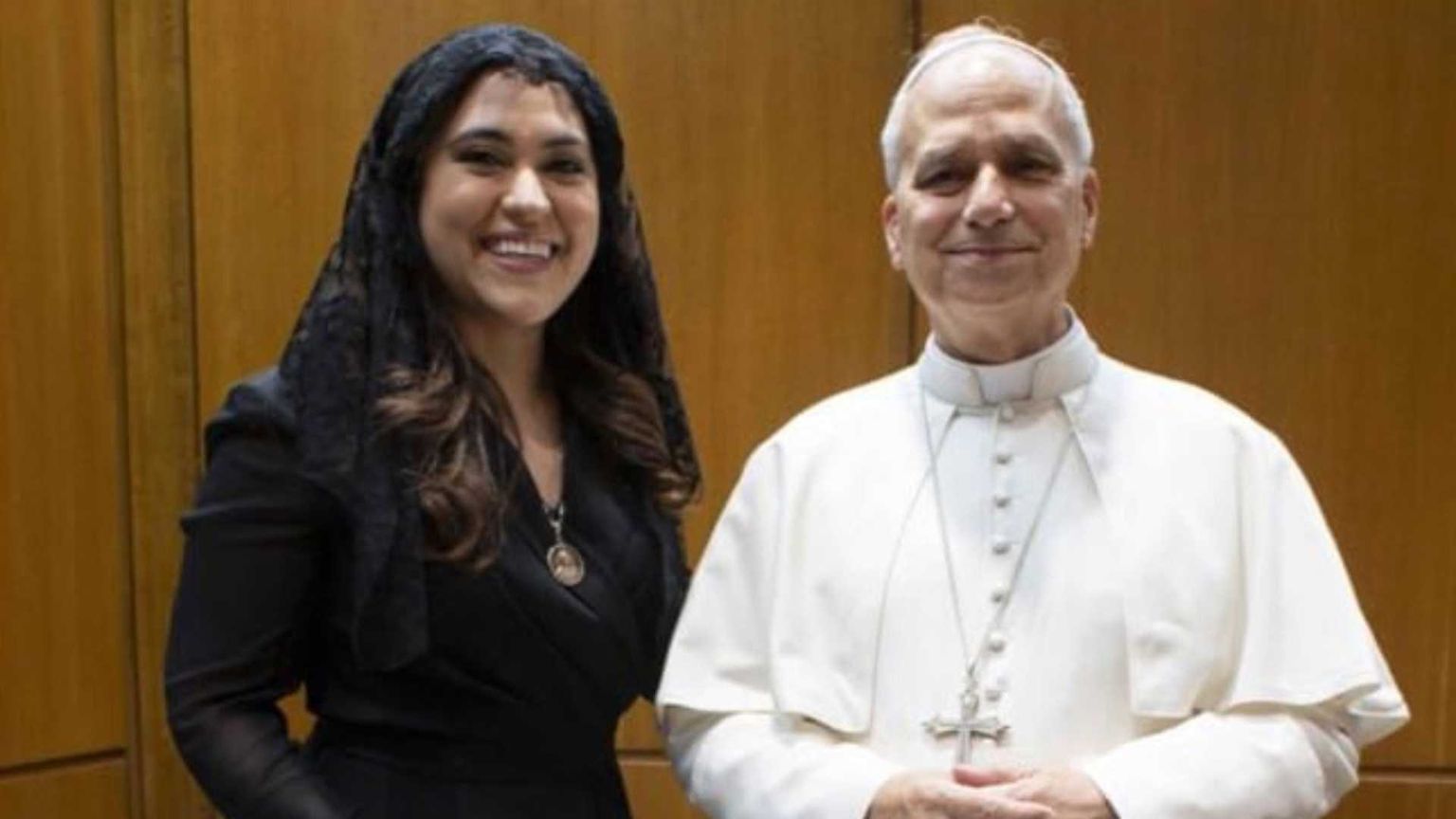
Vatican City - Historia magistra vitae, someone once wrote. And that is precisely what comes to mind when observing Pope Leo XIV’s latest appointment. A little over a year after his election, he has decided to begin, from the top, the work of addressing the most problematic dicastery in the entire Holy See: the Dicastery for Communication.
The choice of Maria Montserrat Alvarado, currently President and Chief Operating Officer of EWTN News, as the new Prefect of the Dicastery for Communication, with effect from 1 November 2026, has all the flavour of a restoration of justice and truth. This is a task to which Leo XIV has committed himself from the very first moment of his pontificate. Alvarado succeeds Paolo Ruffini, whom Pope Francis appointed to that post in 2018. Ruffini, formerly director of Rai3 and La7, arrived in the Vatican through the usual channels that had populated this micro-State for years: friendships, recommendations and reassurances. He was the first layman to hold the role, and the question of the laity, even with Montserrat Alvarado, still finds no real solution: lay people, as the Code provides, are not holders of the power of governance.
It is worth pausing, however, over this name and this provenance, since they say far more than the feverish mania for tweets and posts with which, in these few hours, an appointment that no one expected has been greeted has managed to grasp.
Who is Alvarado?
Born in Mexico City, educated at Florida International University and George Washington University, Alvarado held senior posts at the Becket Fund for Religious Liberty from 2009 to 2023, working in defence of religious freedom. Since 2023 she has headed EWTN News, the journalistic division of the Eternal Word Television Network, overseeing platforms that produce content in seven languages across television, radio, print and digital media. Maria Montserrat Alvarado joined EWTN in 2021, when she became founding anchor and presenter of the programme EWTN News In Depth. She has always shared the network’s style and editorial choices, to the point of taking up, in 2023, the position of President and Chief Operating Officer of EWTN News.
EWTN, then. The great American Catholic broadcaster founded by Mother Angelica. The very same network which, for a full twelve years, was viewed from Santa Marta and the Secretariat of State with a mixture of suspicion and contempt.
When criticism was “the work of the devil”
Let us return to September 2021. During his apostolic journey to Slovakia, Pope Francis met the country’s Jesuits. One of his confrères set out the situation of the local Church and its internal tensions: some even considered him heterodox, others idealised him. “How do you deal with people who look at you with suspicion?”, the religious asked. Francis’ reply became famous: “For example, there is a large Catholic television network that is constantly speaking ill of the Pope without any problem. I personally may deserve attacks and insults because I am a sinner, but the Church does not deserve this: it is the work of the devil. I have also said this to some of them. Yes, there are also clerics who make nasty comments about me. At times, I lose patience, especially when they pass judgement without entering into real dialogue. There I can do nothing. In any case, I go on without entering into their world of ideas and fantasies. I do not want to enter into it and for this reason I prefer to preach, preach... Some accused me of not speaking about holiness. They say I always speak about social issues and that I am a communist. Yet I wrote an entire Apostolic Exhortation on holiness, Gaudete et Exsultate.”
Francis did not have the courage to name it openly, and it is not lost on anyone that the United States is among the countries from which the largest contributions flow, but he made sufficiently clear whom he was referring to. Everyone, after all, understood immediately that the “large Catholic television network” was none other than EWTN. Conservative criticism was thus downgraded to a demonic creation, a fantasy, the chatter of resentful clerics. And yet something about this is very familiar. Not a single line of gossip has ever appeared on these pages, and Silere non possum is known throughout the world for its reliability and for being the only outlet to publish original and exclusive documents. Nevertheless, from time to time, some caricature in search of visibility tries to dismiss its work by speaking of gossip and chatter. Figures now mocked even by the few who still listen to them. The dynamic, however, is perfectly clear: do you say something that displeases me? Then I belittle you, defame you, delegitimise you.
The attempt to silence EWTN, however, did not end with that remark, later republished by Father Antonio Spadaro. The following year, in October 2022, it was the turn of the Secretary of State himself, Cardinal Pietro Parolin. Speaking precisely at a meeting organised by EWTN and its European affiliates, he delivered a speech as urbane in form as it was unequivocal in substance, centred entirely on the duty to live “in a spirit of communion with the Bishop of Rome”, at a time marked, he said, by “overly dramatic debates, even within the Church, which do not even spare the person and the magisterium of the Pontiff”. Beneath the veil of diplomatic courtesy, the message was a call to order: the spirit of communion had to be the “distinguishing mark” of their work, “felt” and “touched” in their broadcasts and articles. Translated: less criticism, more alignment.
The Church is varied, and that is her beauty
A few years later, the Church has a new Pope and with him a new style. What for years had been branded, by the Pontiff himself and by his collaborators, as an “attack on the Church” is today being valued, to the point that a member of that very network is called to communicate the Pope’s words to the world. After all, these were never anything other than legitimate criticisms of decisions of governance. Decisions often personal, at times even temperamental, which had nothing to do with dogmas or with the deposit of faith. They had nothing to do with “love for the Church”, which remained intact. Criticising the Pope is not a crime. It is an exercise of freedom of expression and, within the Church, before anything else, it is an exercise of that baptismal co-responsibility which the Council, the real one, recognised in every faithful person. The Church is beautiful precisely because she is varied: different liturgical and theological sensibilities coexist within her, and the claim to reduce everything to a unanimous chorus of consent is as sterile as it is hypocritical. That same season which made the Synod the manifesto of universal listening, where everyone could have their say, then reserved anathema for anyone who dared to dissent on the usual questions.
Today Leo XIV dismantles that mechanism with a single act of governance. And he does so in the most eloquent way: not with a document, not with a speech, but with an appointment.
Outside the Piazza Pia clique
And it is here that the lesson lies which the Pope imparts to all Catholics, priests, bishops and lay people, who above all in recent years have adapted themselves to this modus agendi and have begun to distinguish between those with whom one may speak and those with whom one must not speak. The good and the less good. Those to follow and those not to follow. Those labelled as opponents and those labelled as supporters, the “Catholics” and the presumed such, and so on. Leo XIV has gone to find the head of the Vatican media precisely in that network which, until yesterday, was treated as the enemy. He chooses her from among those who were branded as opponents of the Pope. And he draws her from an environment alien to the power logic that has long governed Piazza Pia, where the most tried and tested of Italian systems prevailed, and still largely prevails: if you are my friend, I mention you; if you are not, you do not exist. Andrea Tornielli acknowledged it with disarming candour this summer: “We cite whom we like and we speak about whom we like.”
Alvarado’s appointment speaks a different language, and it does so for two reasons that deserve to be underlined. The first. The Pontiff has shown that he is not afraid of those who do not think exactly as he does. He had already done so by granting an audience to a journalist such as Gareth Gore, the author of an investigation that was anything but accommodating towards an ecclesial reality, and he has confirmed it by listening, in recent months, to the most diverse voices. A government that is sure of itself has no need to surround itself with courtiers. It engages, it listens, and when necessary it calls into service someone who comes from a critical front.
The second. Leo XIV does not draw from the cliques of power, but from experience. He calls a professional who has led a multilingual media enterprise of global proportions, who understands the transition from traditional media to the culture of streaming, who knows what it means to manage an international newsroom in seven languages. Not a friend to be rewarded, but a competence to be employed. The difference, in a dicastery that for years has dragged behind it excessive costs and disappointing results, is abyssal. Alvarado comes from a broadcaster that reaches the most diverse parts of the world, quite another thing compared with the editorial staff of the Vatican News blog, where articles are translated according to the wishes and friendships of Andrea Tornielli.
A denial worth a magisterium
In the background remains the most searing irony. For eight years it was repeated that criticism of the Pope was “the work of the devil”, that those who dissented were Lefebvrists, schismatics, instruments of the Evil One. Today the successor of that Pope entrusts the communication of the Holy See precisely to someone who came from that world painted as hostile. This is not a surrender, nor is it a revenge. It is, rather, the recognition of an elementary truth that we have been repeating for years: when criticism is firm but courteous, and comes from those who live the Church daily from within, it is not raised against her, but in her favour. Distinguishing loyal criticism from calumny, and from sterile defamation pursued as an end in itself, requires intelligence and honesty. Confusing them, bending the second into a pretext for silencing the first, was the error of a season which today seems to be drawing to a close. When the Church is not afraid of herself, she knows how to draw from all her members. Even from those whom, for years, someone had preferred to exorcise.
G.N.
Silere non possum