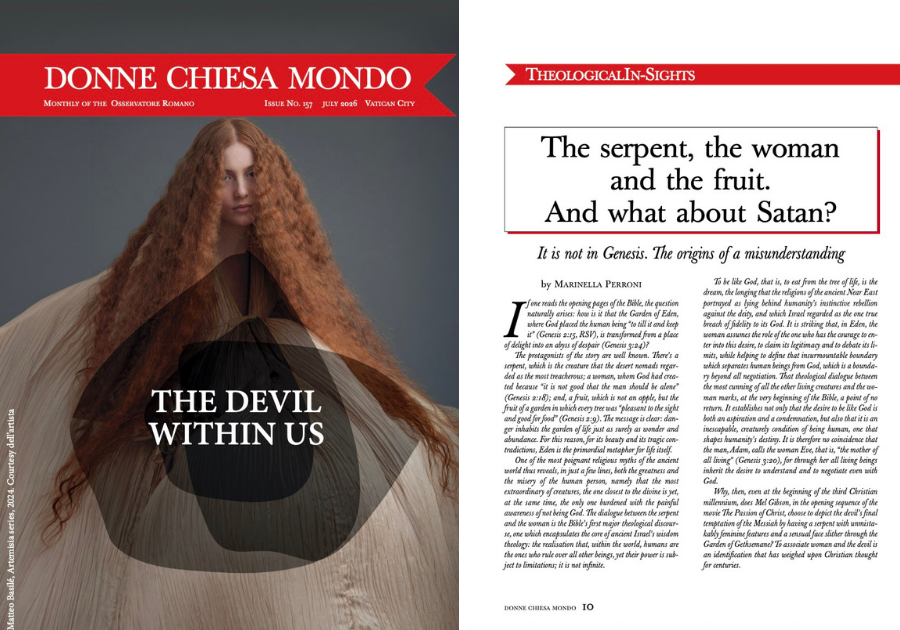
Vatican City - Every month, L’Osservatore Romano - now reduced to a newspaper that even the cleaners in the Vatican no longer use to wipe the great windows of its palaces - continues to spend thousands of euros funding the monthly magazine Donne Chiesa Mondo (Women Church World).
Issue 157, published on 1 July under the title ‘The Devil Within Us’, once again features the ravings of Marinella Perroni and the other ideologues who, at the expense of the Holy See, fill its pages with nonsense steeped in approaches wholly alien to the Catholic faith. There is nothing Catholic in those pages.
The question many inside the Vatican are beginning to ask is this: can Pope Leo XIV find ten minutes to read this material and decide, once and for all, that such content should be published elsewhere and financed with other people’s money? Catholics do not want to see offerings made to Peter’s Pence squandered on supporting this ideological apparatus.
As ever, the problem concerns not only what is written, but also the method by which it is written and imposed. The piece that best embodies the approach of the entire pamphlet is Marinella Perroni’s contribution to the Theological In-Sightssection: ‘The Serpent, the Woman and the Fruit. And What About Satan?’ The subtitle is already a declaration of intent: ‘It Is Not in Genesis. The Origins of a Misunderstanding’.
What Perroni never says
It should be stated at once: the Devil is cunning, as Sacred Scripture repeatedly reminds us. Perroni never explicitly states, in black and white, that the Devil does not exist. That would be too overt a thesis, and too compromising for a monthly publication issued under the masthead of the Holy See’s newspaper.
The ‘theologian’ and — astonishingly — ‘biblical scholar’, as well as founder of the Italian Women Theologians’ Association, therefore chooses a different path: more elegant, more cautious and, precisely for that reason, more insidious. She does not deny. She narrates. She tells readers that in the Genesis myth of the Fall ‘there is no devil’, and that the serpent is simply the animal desert nomads regarded as the most treacherous. She tells them that speculation about evil spirits entered Jewish theology only at a late stage, from the sixth century BC onwards, through contact with beliefs common to all ancient religions. She tells them that the Devil as a distinct entity appears only in a much later and heavily Hellenised text, the Book of Wisdom. She tells them that Paul and the First Letter to Timothy bound the hierarchy of the sexes to the creation account, so that ‘the serpent, the woman and the fruit’ became ‘the devil, women and sin’. Finally, she tells them that all of this served a patriarchal understanding of sexual difference.
Genesis, the history of religions, reception history and a critique of patriarchy: a hotchpotch. By the end, the reader has understood perfectly well where the argument is heading. The Devil is no longer a reality: he is a cultural phenomenon, a narrative device used by societies to express anxieties and construct enemies. There is no need to say it. It is enough to have shown it.
The Father Christmas method
It is the same rhetorical manoeuvre used when explaining the story of Father Christmas to an adult: one begins with Saint Nicholas of Myra, moves through Dutch folklore and ends with Coca-Cola and twentieth-century iconography. At no point does anyone utter the words ‘Father Christmas does not exist’. There is no need: the genealogy does all the work. Once a figure’s origins, transformations and uses have been explained, the suggestion has already been made that the figure can be reduced entirely to its history.
It is an intellectually sophisticated but logically unsound procedure, and it even has a name in the textbooks: the genetic fallacy. Reconstructing the historical origins of a belief tells us nothing, in itself, about whether its object is true or false. That Jewish angelology and demonology developed relatively late and in dialogue with other cultures is an uncontroversial point in exegesis; to conclude from this that the Devil is merely a cultural construct requires a leap that Perroni never makes explicitly — and precisely for that reason induces the reader to make.
What the article leaves out
The problem is not what Perroni writes, which is largely correct on a strictly exegetical level. Genesis 3 does not identify the serpent with Satan: that identification came later, developed within Second Temple Judaism and was made explicit in the New Testament — Revelation 12:9 speaks of ‘the ancient serpent, who is called the Devil and Satan’. No one disputes this.
The problem is what the article systematically omits. The Church’s faith in the existence of the Devil does not rest on a naïve reading of Genesis 3, as the piece suggests when it attributes it to ‘childhood catechism’ and ‘relentless preaching’. It rests on a precise dogmatic definition: the Fourth Lateran Council in 1215 declared that ‘the Devil and the other demons were created by God good in their nature, but they themselves became evil’ (DS 800). It rests on the Catechism of the Catholic Church, which in paragraphs 391–395 identifies this figure as ‘a fallen angel’ and speaks of a real ‘power’, not a social metaphor. It rests on the baptismal liturgy, which still asks every catechumen to renounce Satan — not an archetype and not a narrative device. And it rests on a recent Magisterium that has been anything but reticent: it was Saint Paul VI who warned in 1972 that ‘anyone who refuses to recognise his existence departs from the framework of biblical and ecclesial teaching’, while Pope Francis returned to the subject with a frequency that even irritated the kind of progressive theology of which Perroni and Linda Pocher are prominent exponents.
There is no trace of any of this in the article. A contribution presented as a Theological In-Sight on the Devil, published under the masthead of the Pope’s newspaper, devotes generous space to Mel Gibson and the female-faced serpent in The Passion of the Christ, yet cannot find room for a single line on the Fourth Lateran Council or the Catechism. This is no oversight: it is a calculated and deliberate move, what makes the entire operation possible. Citing the dogmatic teaching would have forced the author to take a position — either to affirm it or openly contest it. Omitting it allows her instead to remain within the realm of the unspoken, where the thesis can operate undisturbed.
An entire issue built on the same pattern
It would be unfair to single Perroni out, because her article provides the exegetical foundations for an architecture that runs throughout the entire issue. At the top of that structure is the editorial by Lucia Capuzzi and Rita Pinci, which performs the same sleight of hand at the beginning of the publication, but with more delicate material: a saint and Doctor of the Church. The piece begins with Teresa of Ávila, who saw the Devil as a real person — observing his ‘frightful’ mouth, hearing his voice and recording the details ‘like a chronicler of the invisible’ — and arrives, a few columns later, at a Devil who is the mirror, the algorithm, mom guilt and comparison with impossible ideals. The word remains the same from beginning to end; its referent, meanwhile, has changed in nature. It is like beginning an article by discussing a wolf and ending it by discussing inflation, while stubbornly continuing to call the latter ‘the wolf’.
The authors do construct a bridge, it must be said, and they do so through two precise moves. The first is Teresa’s ‘spiritual melancholy’, presented as an ‘extraordinary psychological anticipation’: the evil that persuades women that they are not good enough. The second is the etymology of diábolos, ‘the one who divides’, strategically positioned halfway through the argument: if the Devil is division, then everything that divides a woman from herself — judgement, performance and guilt — can legitimately be called the Devil. Just consider what these ageing women spend all day thinking about as they seek to impose their ideology even in our parishes.
This is the semantic licence underpinning the entire editorial. But the bridge is built with material taken from its rightful owner: Teresa believed both in interior temptation and in the Devil as a real, personal being. For her, the two were not alternatives — the latter was often the cause of the former, so much so that she recommended holy water to drive him away, not a self-esteem session. The editorial retains the psychological half of her experience and quietly discards the ontological half, using the saint’s authority to support a thesis she would never have recognised as her own. The same trick is repeated with Ignatius of Loyola: the ‘enemy of human nature’, quoted through Sister Vitagliani, is in the Spiritual Exercises a personal agent endowed with strategy and cunning, not a metaphor for social pressure. And the editorial’s concluding sentence sounds almost like a confession: the Devil, ‘even before being a presence, is a division’. That ‘even before’ is the safeguard clause — it fleetingly concedes that a presence exists, so that no one can accuse the authors of denying it, after the entire article has proceeded as though it did not.
The rest of the pamphlet follows the same score. Dacia Maraini explains that ‘evil resides within us’. The psychotherapist of the month translates demons into ‘the unresolved repressions of the past’. Page after page, the Devil is transferred from ontology to psychology and from theology to sociology, until all that remains of the Church’s constant teaching is a folkloric residue fit only for art history.
The problem is not that the issue contains psychological or sociological reflection. The problem is that this is presented in place of theology, with Teresa and Ignatius conscripted as unwitting guarantors.
The question that remains
In the same issue, Leo XIV’s Magnifica Humanitas is quoted several times, with the customary deference of those who invoke the Pope’s authority when it lends prestige to their arguments and circumvent it whenever the Magisterium — dogmatic teaching, rather than the selective invocation of papal authority — has something inconvenient to say.
Perroni’s cunning is, ultimately, the cunning of a particular way of doing theology within the Catholic Church. It is the same pattern shared by now-ageing figures such as Pocher, Faggioli, Melloni, Grillo and Perroni: people regarded by the young with a mixture of embarrassment and pity, unable to command an audience outside the Church and therefore intent on dragging into it agendas that have nothing whatsoever to do with the Church.
These campaigns are pursued not because they genuinely believe in them, but because they are fashionable. One need only look at the subject of homosexuality: Grillo even devotes books to it — on what grounds, no one knows — only to resort to homophobic insults whenever anyone dares expose his dirty little secrets. It would be difficult to find a more perfect emblem of the consistency of this circle.
The result is merely ridiculous. Nor is the problem even that these people continue doing what they do: the problem is that L’Osservatore Romano, led by another figure cut from the same cloth, Andrea Monda, continues to spend thousands of euros belonging to the Holy See to print, distribute and promote this nonsense.
The technique is demonic: never deny, always historicise; never state, always imply. The reader is left to draw the conclusion that the author has prudently avoided stating herself.
One simple question remains, and it deserves an equally simple answer from the embarrassing and expensive editorial team of Donne Chiesa Mondo (Women Church World): does the Devil described in the Catechism exist or not? If the answer is yes, issue 157 should have been written differently. If the answer is no, they should have the courage to say so — and to explain to the Pope why his newspaper takes that view.
Fr.P.E.
Silere non possum