Vatican City - When Cardinal Arthur Roche said that Leo XIV would not amend Traditionis custodes and would not return to the framework introduced by Benedict XVI with Summorum Pontificum, his remarks inevitably raised a question: was the Prefect of the Dicastery for Divine Worship expressing his own view, or was he actually conveying the Pope’s position?
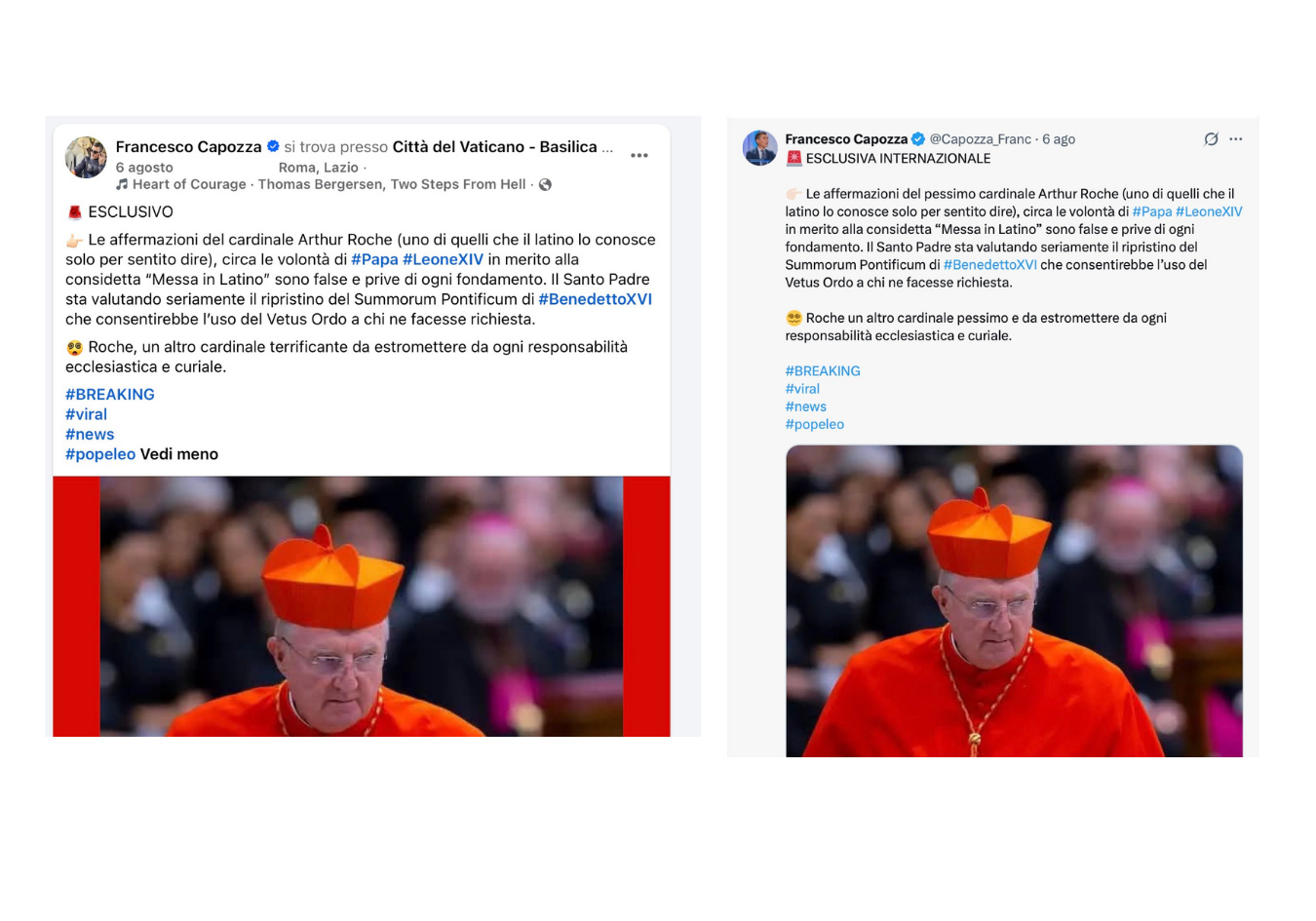
The usual frauds flaunting titles and the familiar psycho-blogs immediately sprang into action, launching yet another tirade against the British cardinal and accusing him of taking positions at odds with those of Pope Leo XIV. Nothing new there: it is the standard routine of people who manufacture controversies out of false and manipulated accounts designed solely to feed their own obsessions.
Fortunately, the reality is far less interesting than their fantasies. These are marginal figures who pick up snippets, half-sentences and supposed inside information here and there from the usual loose tongues hovering around Borgo Pio, without having any real knowledge of the dynamics they claim to report. They mistake gossip for journalism and idle chatter for a scoop.
Their reliability is, in any case, amply illustrated by the criminal proceedings in which they are involved, which speak far more eloquently than their incessant tirades on social media, where they sometimes even manage to cross the limits set by the platforms themselves and end up blocked or sanctioned. The amount of noise they generate bears little relation to the actual weight of their claims. By now, the result is that many people greet their latest outbursts with pity rather than interest.
In the interview he gave to The Tablet, published at the end of July and previously reported by Silere non possum, Roche had left little room for interpretation: “Pope Leo is not going to change Traditionis Custodes, and he’s not going back to Summorum Pontificum.”
A document predating that interview, published today at Pope Leo’s own request, now allows those remarks to be read in a more precise context. On 29 June 2026, a month before Roche made those comments, Leo XIV had addressed a letter on liturgical formation directly to the English cardinal, intended for the gathering held at the Benedictine Mount Angel Abbey in Oregon. The text deals primarily with the formation of God’s people and the ars celebrandi, but it contains a passage that takes on particular significance in the light of what Roche would say only a few weeks later.
The Pope writes that, “in order to promote the dignified celebration of the sacred mysteries, we must emphasize the need for fidelity to the approved texts and instructions”. He then draws attention to the respect that all those called to prepare the celebration of the divine mysteries, “and priests in particular”, must show “toward the rites promulgated by Pope Saint Paul VI and Pope Saint John Paul II”.
It is precisely this reference that makes the letter significant in the debate over the liturgy preceding the conciliar reform. Leo XIV does not mention Traditionis custodes, does not refer directly to the 1962 Roman Missal and introduces no new rules governing its celebration. Yet the ecclesiological and liturgical framework of the text corresponds to that underpinning the discipline introduced by Francis and which Roche, a month later, would say was intended to remain in force. In the motu proprio of 16 July 2021, Francis established that “the liturgical books promulgated by Saint Paul VI and Saint John Paul II, in conformity with the decrees of Vatican Council II, are the unique expression of the lex orandi of the Roman Rite”. Leo XIV’s decision expressly to name those same two Popes when calling for fidelity to the approved rites can therefore hardly be dismissed as incidental.
The connection is further strengthened by the theme of ecclesial communion. In his letter to Roche, the Pope makes clear that respect for liturgical norms must arise from an inner disposition of openness and trust in God, “manifesting humility before his greatness and sincere fidelity to ecclesial communion”. Leo XIV had already developed the same point publicly in his 27 May catechesis on Sacrosanctum Concilium: on that occasion, he recalled that no one may add, remove or alter on their own initiative what has been established in liturgical matters, explicitly linking respect for the texts and norms of the liturgy to the communion of the Church.
Here too, the parallel with Traditionis custodes is clear. Francis had presented the restrictions on the use of the 1962 Missal precisely in the context of seeking ecclesial unity. In the letter to bishops accompanying the motu proprio, he also explained that he intended to restore the unity of the Roman Rite around the books promulgated by Paul VI and John Paul II, indicating as the longer-term goal that the faithful attached to the earlier form should return to celebrating according to the books of the conciliar reform.
Roche’s remarks, then, amount to nothing more than the position Leo XIV had personally entrusted to him. Even before the Prefect publicly stated that the Pope would not change Traditionis custodes, Leo XIV had already written to him reaffirming the principle of fidelity to the rites promulgated by Paul VI and John Paul II and linking it directly to ecclesial communion.
The chronology is significant. On 27 May, during the General Audience, Leo XIV had addressed the liturgical reform, reiterating the need to safeguard the texts and norms of the liturgy. On 29 June, he returned to and developed that principle in the letter addressed personally to Roche, specifically referring to the rites promulgated by Paul VI and John Paul II. Finally, at the end of July, the Prefect of the Dicastery for Divine Worship told The Tablet that Leo XIV would neither amend Traditionis custodes nor restore the regulatory framework of Summorum Pontificum.
The letter therefore helps explain the confidence with which Roche spoke. At the same time, it provides a fairly accurate measure of the credibility of certain psycho-blogs and the usual frauds parading bogus titles who pontificate on social media every day, insult anyone who dares contradict them and circulate increasingly fanciful accounts, relying on the gullibility of part of their audience — people ready to click “like” without even noticing that, a few hours later, those same posts are quietly deleted for fear of the consequences.
It is a well-rehearsed routine: make the accusation, fuel suspicion, harvest approval and, once the ground becomes less safe, quietly erase what was written. The assumption, evidently, is that in Italy certain behaviour can continue indefinitely without consequences. But sooner or later, there is a price to pay.
Meanwhile, at Palazzo Pio there are still those who keep these people accredited on the strength of the publications they work for, even when their CVs, qualifications and conduct should at the very least warrant closer scrutiny. It is an issue that is bound to come to the surface: not only for those who use an accreditation, but also for those who grant it, renew it and choose to maintain it regardless. Within the Dicastery, however, the climate has changed, and before long someone will be called to account for this as well.
Fr.S.V.
Silere non possum