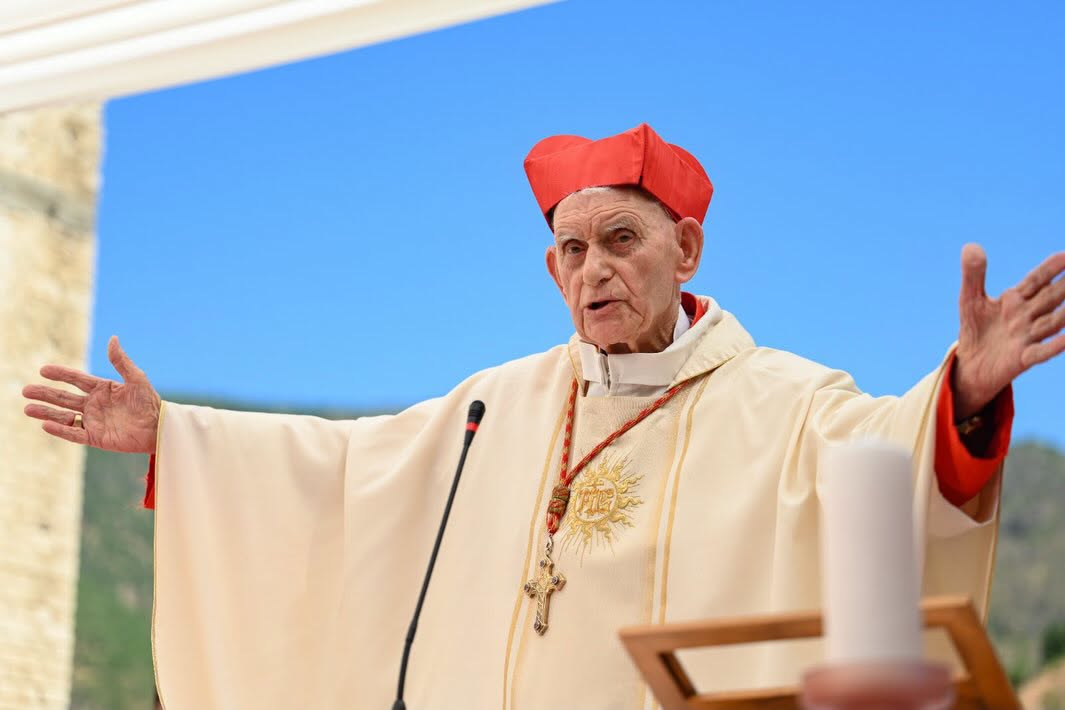
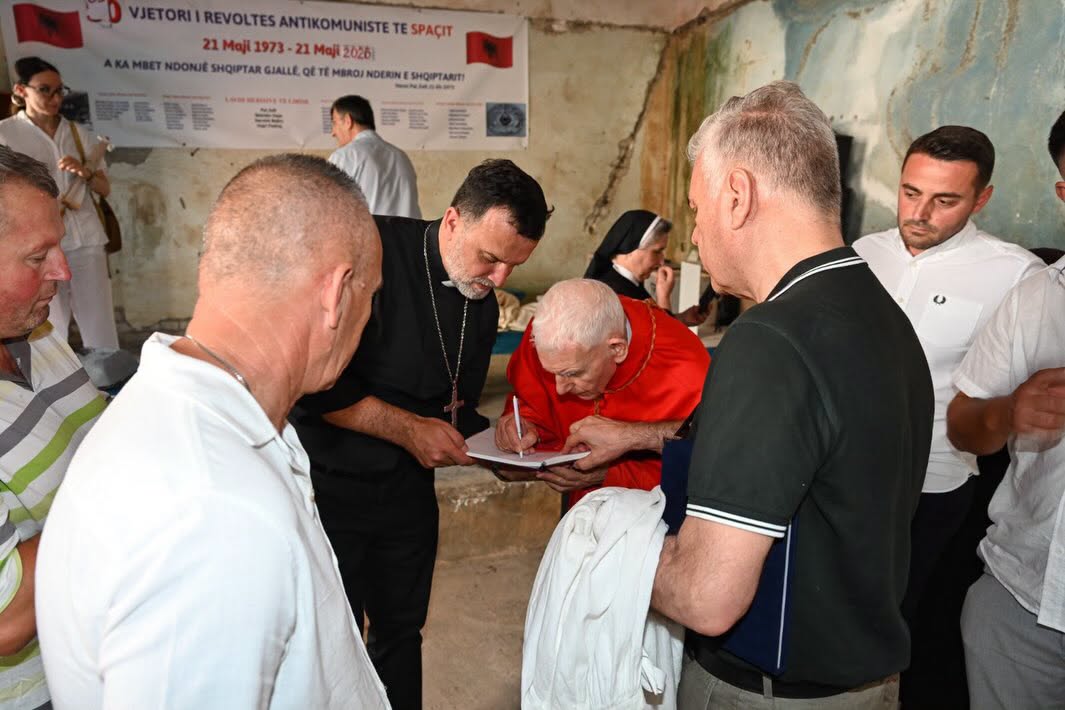
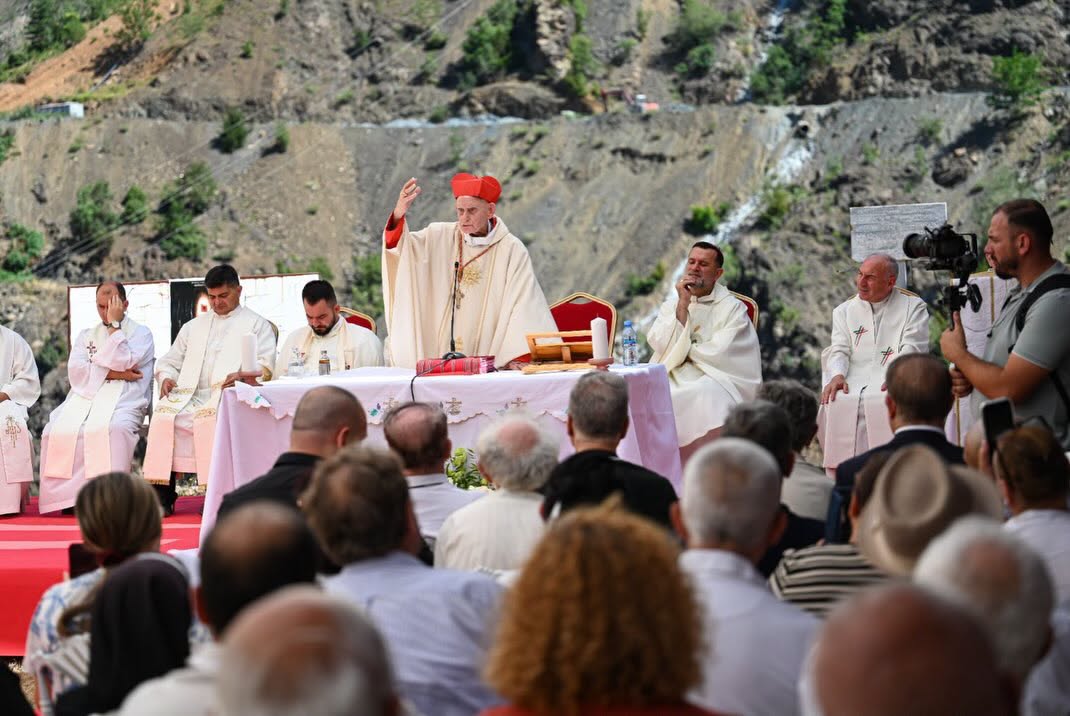
Cardinal Ernest Simoni, 97, has returned to celebrate the Eucharist at the site where he was subjected to forced labour for many years. On Friday 31 July, at the former Spaç prison camp in northern Albania, he presided at Mass for those who suffered and died in its mine tunnels under the communist dictatorship of Enver Hoxha. A message from Pope Leo XIV, dated 30 July, was read at the end of the celebration.
‘With deep emotion, I join Your Eminence in spirit, together with all those gathered at the former Spaç prison camp, to which you return after so many years to celebrate the Eucharist, Christ’s Sacrifice, which transformed the Cross from a sign of death into a promise of life,’ the Pope wrote. In his message, he described Spaç as the setting for ‘one of the most painful chapters’ in the history of the Albanian people.
Spaç, the message continued, ‘was a place where many bore the heavy cross of injustice’. The blood of those who suffered and died there ‘watered that land, making it a silent witness to faithfulness, courage and hope’.
Leo XIV reflected on the prayers that ‘rose to Heaven from that place’ and the ‘supplications whispered in the hearts’ of the prisoners. He then drew on the words of St Paul to the Romans to affirm that ‘no chain is strong enough to imprison a conscience enlightened by the Gospel, no night is so long that it can prevent the dawn the Lord prepares for His children, and no prison is deep enough to separate man from the love of God’.
The Pope concluded by asking that the memory of those who died should remain ‘a constant reminder of the inviolable dignity of the human person, the value of freedom and the commitment to peace’. He entrusted those present to the intercession of Our Lady and imparted his apostolic blessing upon the cardinal and all those who took part in the celebration.
Those remembered in particular during the Mass included the prisoners buried in the camp’s mass graves, without names or crosses. They had been Simoni’s fellow inmates in the same tunnels where copper and pyrite were mined, and the men with whom he secretly celebrated Mass at the risk of his life. As the cardinal himself has recalled on several occasions, he made do with hidden crumbs for the bread and grape juice pressed in secret for the wine.
Twenty-eight years in solitary confinement and forced labour
Born in Troshan, near Shkodër, on 18 October 1928, Simoni entered the Franciscan Illiricum college at a young age and was ordained a priest in 1956, having secretly completed his theological studies during his military service.
Branded an ‘enemy of the people’ by the communist regime, he was arrested on Christmas Eve 1963 while celebrating the Vigil Mass in Barbullush. He was initially sentenced to death on the charge of having prayed for US President John Fitzgerald Kennedy, but the sentence was later commuted to forced labour.
He spent eighteen years in solitary confinement and a total of twenty-eight years in prison, much of it in the mines of Spaç and later in the sewers of Shkodër. Released in 1990 as the regime collapsed, he openly resumed his priestly ministry in Albanian villages.
In 2014, his testimony before Pope Francis during the pontiff’s visit to Tirana moved those present. Two years later, on 19 November 2016, Francis created him Cardinal-Deacon of Santa Maria della Scala, dispensing him from episcopal consecration because of his advanced age.
A mine turned into a re-education camp
Officially known as ‘Re-education Unit 303’, the Spaç complex was established between 1967 and 1968 through the conversion of a copper and pyrite mine that had already been used as a labour camp since the early 1950s.
Hundreds of opponents of the regime, intellectuals and members of the clergy were imprisoned there and forced to work gruelling shifts in the tunnels while enduring appalling sanitary conditions and severe food shortages.
In May 1973, the camp was the scene of a three-day uprising, one of the very few episodes of collective rebellion in Hoxha’s Albania. The prisoners raised an Albanian flag from which the communist star had been removed, before special forces crushed the protest. The repression that followed led to four of the organisers being executed by firing squad.
The facility remained in operation until 1991 and has been recognised as a cultural monument since 2007, although decades of neglect mean that only some traces of its history survive.
Simoni’s return to Spaç, more than half a century after his imprisonment, forms part of a wider pastoral visit to Albania and carries a significance that goes beyond the event itself. The voice of one of the last direct witnesses to communist persecution has been heard once again, this time in freedom, in the very place where it was silenced for so many years.