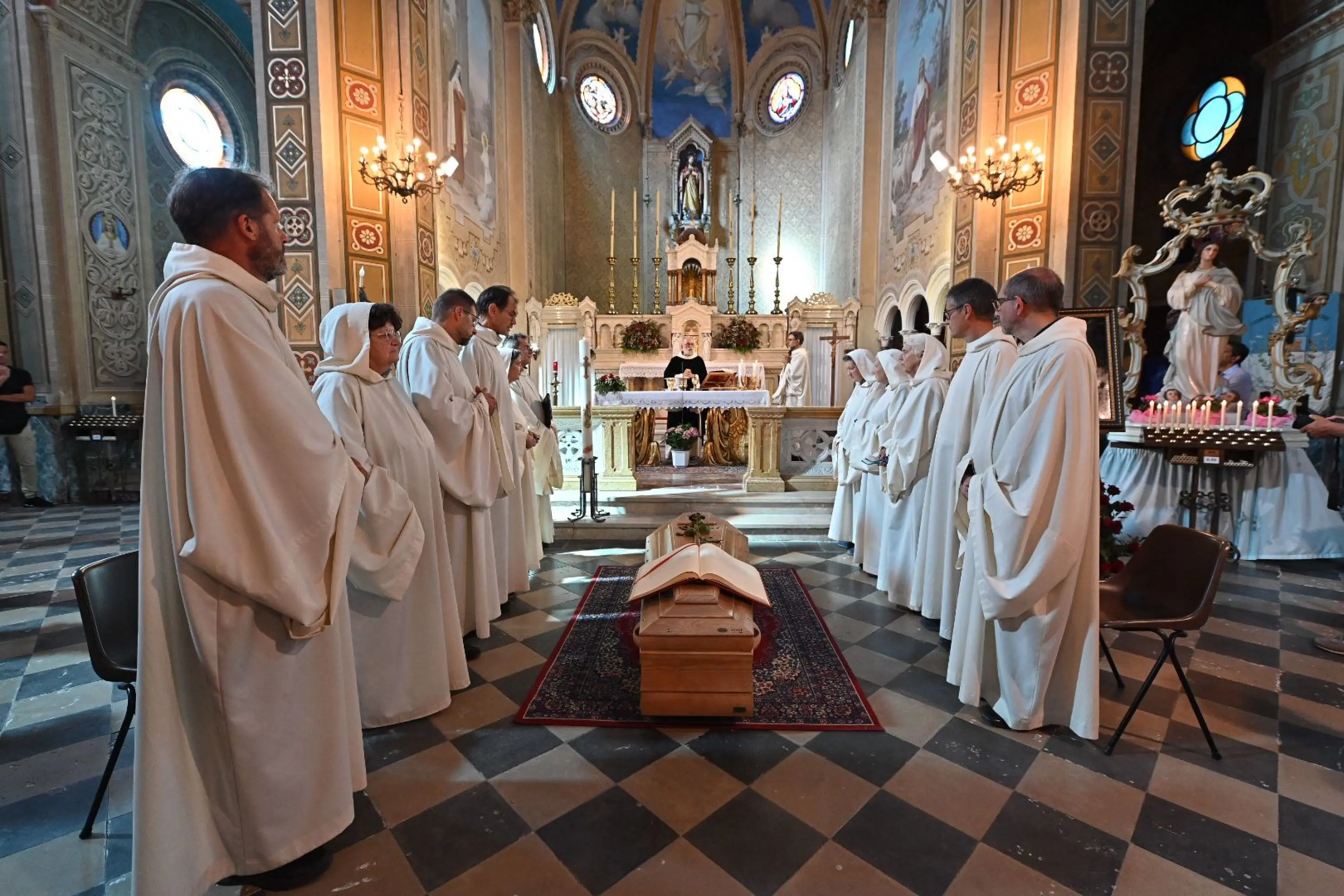
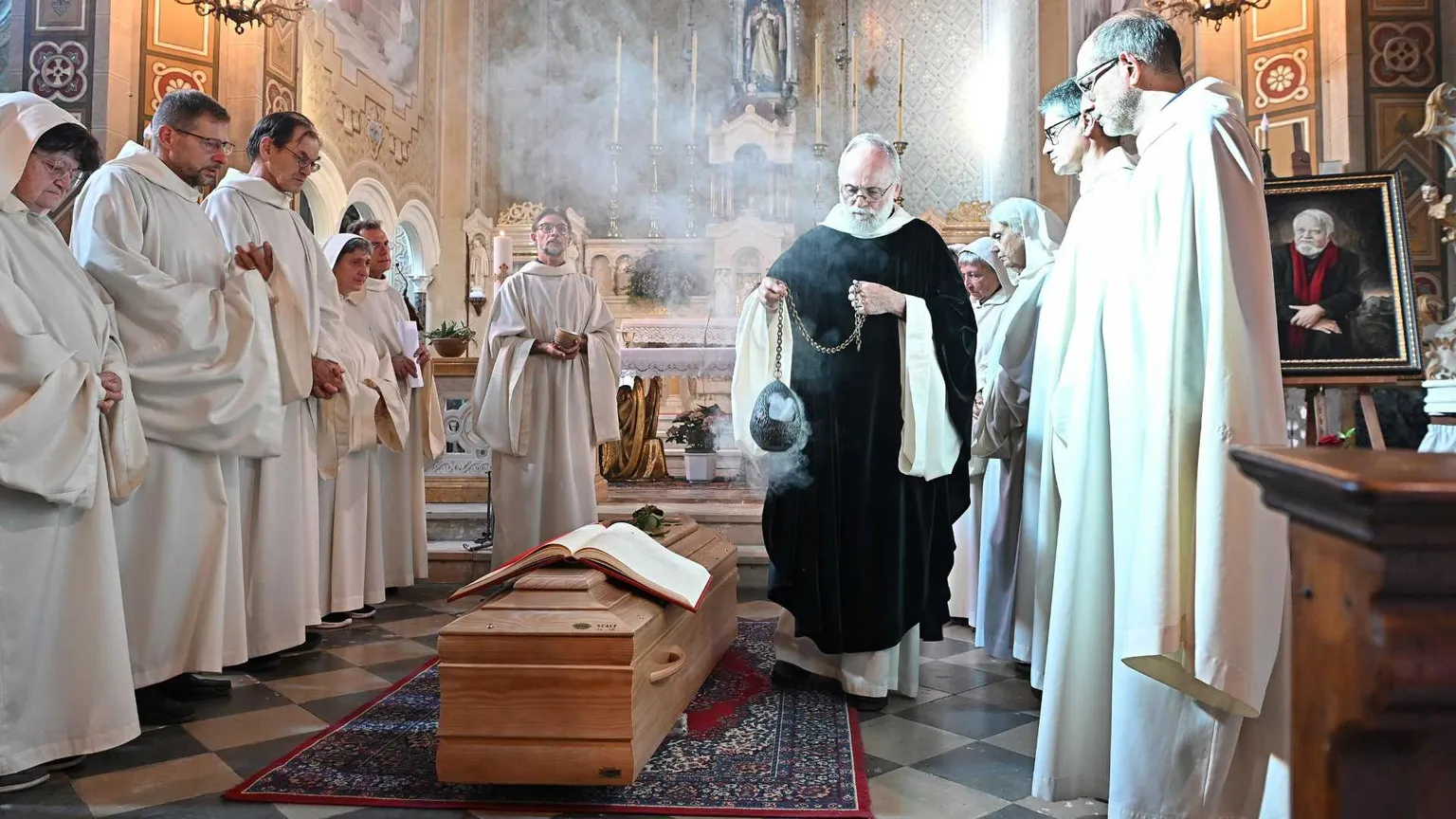
Castel Boglione - Enzo Bianchi had planned everything: who would preside, which Gregorian chants would be sung, which readings would be used, and the exact place where he was to be buried - in the earth, facing east, in the cemetery at Castel Boglione, the small town in the Asti area where he was born on 3 March 1943 and which has fewer than six hundred inhabitants. He had also left one request for those who came after him: anyone passing by should leave a rose or a few aromatic herbs. On Thursday 3 September, at 4.30 pm, in the parish church of the Sacred Heart of Jesus and Our Lady of the Assumption, those wishes were carried out to the letter, including the last: no applause.
The founder of the Bose Community had died on Tuesday 1 September at the Molinette hospital in Turin, aged 83, after being admitted on 9 August. His body had lain in repose from the morning of 2 September in the church of the Casa della Madia monastic fraternity in Albiano d'Ivrea, where a vigil was held that evening. It was then taken to Monferrato, to the village among the vineyards to which he had remained attached throughout his life and where, some time ago, he had bought a plot in the cemetery.
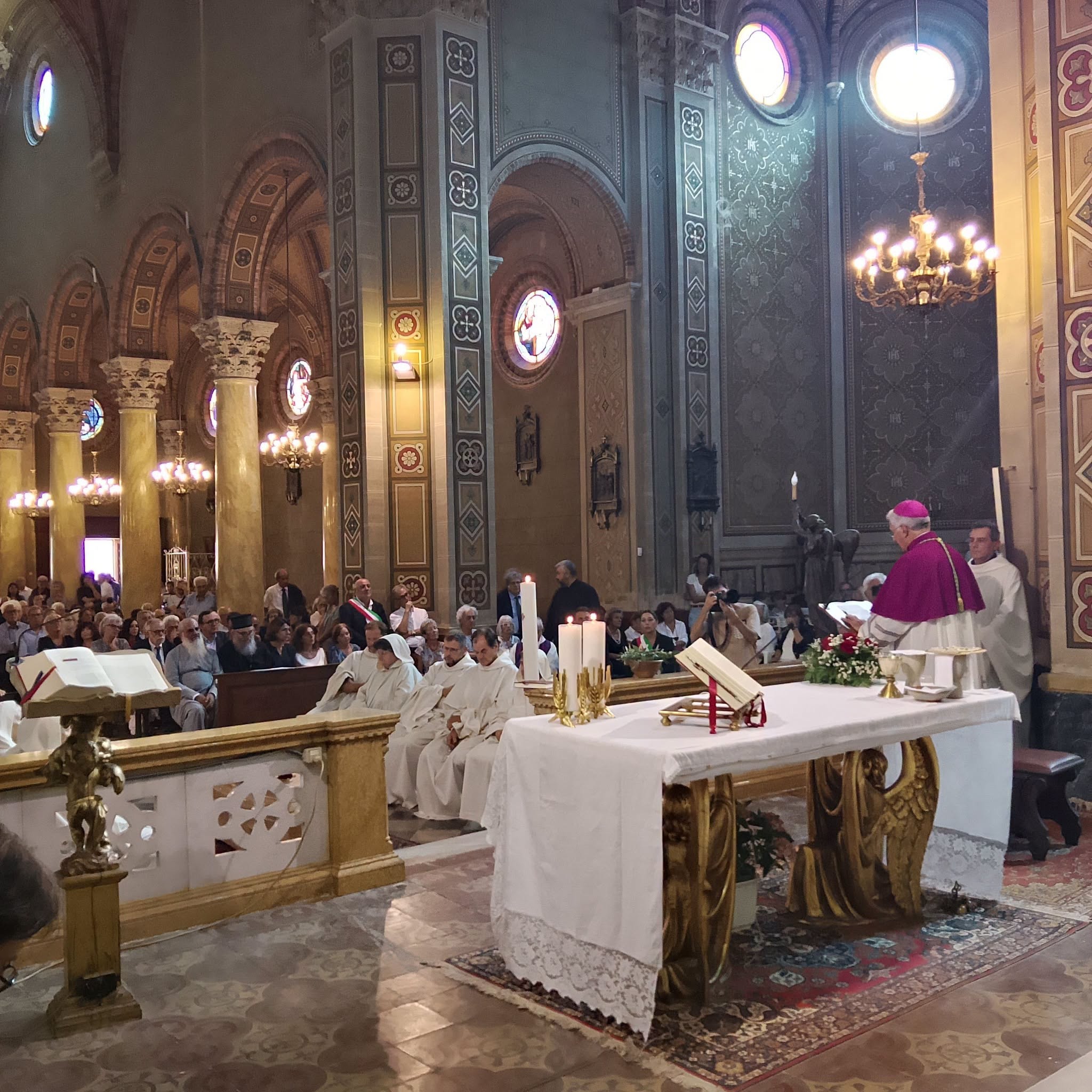
Around him were those who had stayed close to him through all these years, sharing his joys and accompanying him through his most painful moments: Goffredo, Giovanni, Maurizio, Claudio, Antonella and Laura, the brothers and sisters with whom he had founded Casa della Madia. With them were Emiliano, Valerio, Dario and Adalberto, the brothers of Cellole, the fraternity Bianchi had founded in Tuscany and which later shared the path of the Madia, as well as the sisters of the community of Cumiana. Several bishops were in the church, among them Archbishops Renato Boccardo and Marco Arnolfo, together with a number of priests. But the nave was filled above all with ordinary people, some of whom had travelled a long way in the early September heat. Among them was Valentino Castellani, the former mayor of Turin, who recalled the rural childhood he and Bianchi had shared and a friendship renewed in adulthood.
At Bianchi's own request, Brother Valerio Lazzarini presided. His homily began with the Desert Fathers and their insistence on beginning again, and from there he interpreted the final chapter of the founder's life: a man who, at eighty, had been able to start afresh and draw the seed of something new from a painful experience. “Enzo has emigrated,”Lazzarini said. “How many times in his life did he pray with his brothers and sisters the psalm, ‘Your face, Lord, do I seek’. He sought this encounter. It was the deepest reason for his life. This exodus is a painful loss. What fills us is a radiant sadness. At the age of eighty he said: ‘Today I begin again’ the life of fraternity. His was a beautiful, intense life; he was fascinated by beauty in all its forms; his interests were wide-ranging and he had an extraordinary ability to form relationships. Enzo, beloved brother, it has been a wonderful adventure. Thank you.” He then urged those present not to remain fixed on the stretch of road already travelled.
Renato Boccardo, Archbishop of Spoleto-Norcia, president of the Umbrian Bishops' Conference and a long-standing friend of Bianchi, read a telegram from Cardinal Matteo Maria Zuppi, president of the Italian Bishops' Conference, who was unable to attend because of previous commitments. “Enzo wrote an important page in contemporary Italian Catholicism,” Zuppi said. “His preaching and his many writings helped many people rediscover the primacy of the Word of God, the value of silence, prayer, fraternal life and hospitality,” and “he was also able to speak to those who lived on the threshold or felt distant from the Church.” The president of the Italian bishops addressed “all the sisters and brothers, in the certainty that Enzo now finds in the Lord the fulfilment of his earthly journey: everything is brought back together in the unity of God, even the deepest wounds.” He ended with a hope that sounded almost like a task entrusted to those who remained: “may his final desire for reconciliation and peace become for everyone a responsibility, a prayer and a commitment.”
In recent days the Umbrian archdiocese had already published a tribute from Boccardo, recalling “the long friendship that personally bound him to Br Enzo Bianchi”, his “many visits to the diocese for rich and fruitful formation meetings for priests and lay people” and his “long, wise and passionate service to the Church and to the cause of Christian unity.”Messages also came from other dioceses, representatives of the Orthodox world and the Dalai Lama, who, after learning of Bianchi's death, said that he had prayed for him.
The moment that left the church in silence came at the end. Goffredo Boselli, prior of the Casa della Madia monastic fraternity, read the farewell with his voice breaking, speaking “on behalf of my brothers and sisters of Casa della Madia, the brothers of Cellole and the sisters of Cumiana, who have always been so dear to us.” He addressed Enzo directly, “because you always said that the true celebrant of a funeral, the one who presides over it, is the person who has died and no one else.” He said that in his final days Bianchi had repeatedly recited in Latin a verse from Psalm 142, “Et non intres in judicium cum servo tuo” - enter not into judgement with your servant. When someone reaches the threshold, Boselli said, he knows that he cannot stand before God displaying his works and can only ask to be judged with mercy.
Boselli then said what has been missing from the official statements issued in recent days, often steeped in the kind of clerical hypocrisy that some have learnt very well over the years. He spoke of Bose as the one work of Enzo's life, “your spiritual body, your hard-won fatherhood,” and of the moment when that love “also became a sentence”: “You experienced the deepest trial of your life, the pain of someone unjustly forced to leave what he had created at the cost of all his strength, enduring the profound injustice of not knowing the reasons, the causes or the specific acts, despite repeatedly asking for them.”
He spoke of “the betrayal of your chosen disciple and others with him”, “the opportunism of those who acted to secure positions and personal advantages”, “the wickedness of the person whom you did not hesitate to call a ‘tormentor’”, and the abandonment by friends, “including priests and bishops”. Then came the sentence that struck those present and challenged their consciences: “You came to know the cruel face the Church can assume when, instead of being a mother, she becomes a stepmother: before doing it to you, she did it to many others among her finest sons.”
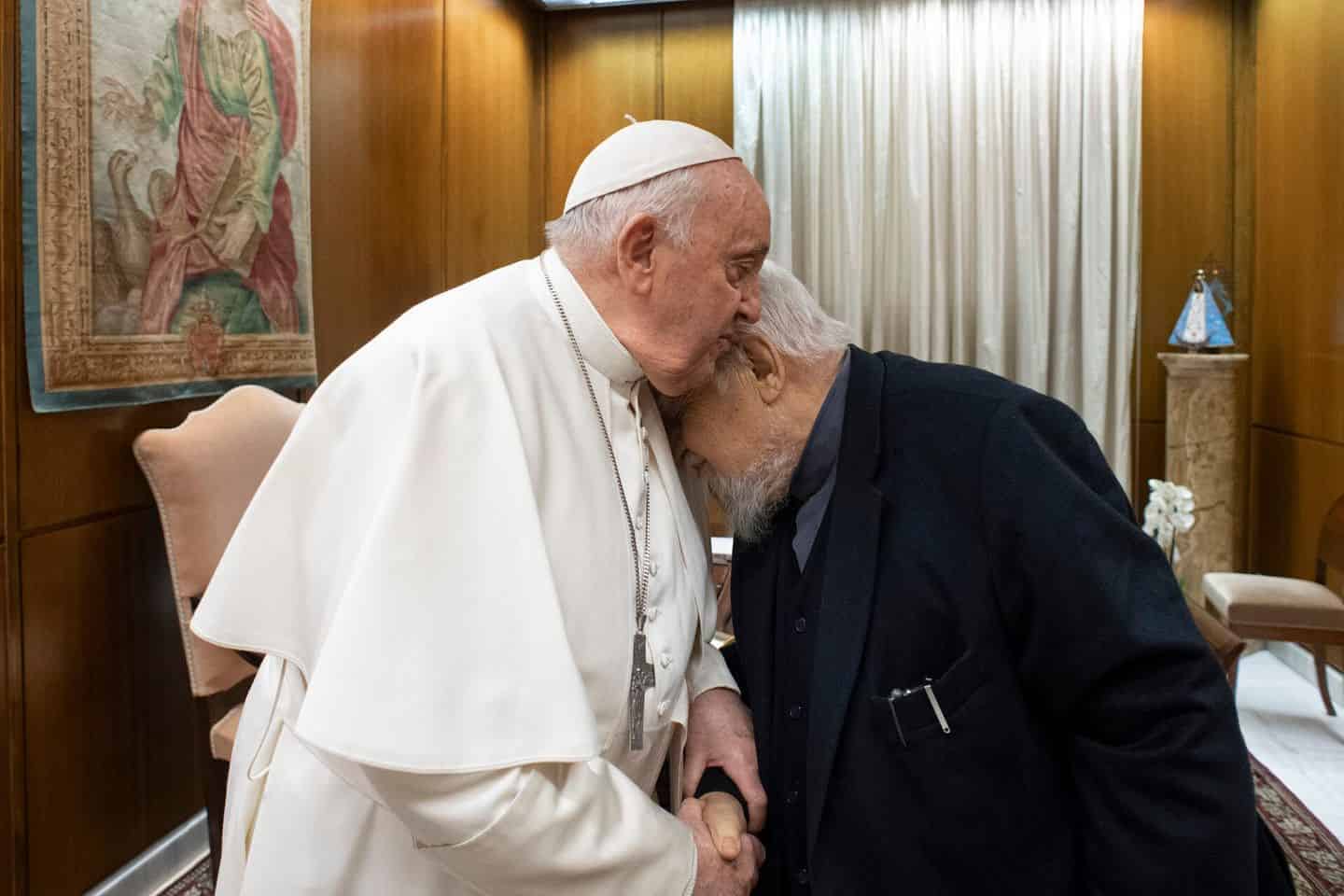
Boselli then made public an episode he had witnessed himself. On 16 December 2023, during a meeting with Bianchi, Pope Francis told him: “Enzo, I ask your forgiveness. What they did to you was disgraceful.” “I was there,” the prior said, recalling that during the same audience Francis blessed and encouraged the common life of Casa della Madia. “From that day, you seemed to be born again.”
It is worth recalling that the decree of 13 May 2020, issued by the Secretariat of State and approved in specific form by Francis himself, was an act of exceptional gravity. It gave no reasons for the decisions that had been taken, nor did it set out the facts that were supposed to justify them. In the vacuum left by the document, all manner of accounts began to circulate, often repeated by people who knew very little about what had actually happened. It was precisely those claims that led this newspaper to publish the decree in full, so that it could be judged on the basis of what it actually said rather than the “versions” constructed around the case. What emerged from the document was already serious enough: extremely severe decisions taken without explanation, restricting fundamental rights in a way that is difficult to reconcile with even the most basic safeguards afforded to the individual.
Behind Bianchi's removal, in fact, lay a much more specific plan: to push the founder out so that others could take control of the community. Listening to what Goffredo Boselli said in his farewell today is enough to understand how much the affair also had to do with internal power struggles and the ambitions of the “chosen disciple”. The Holy See found its way into that fracture and used it as an opportunity to intervene much more deeply in Bose. Bianchi had always resisted the idea of turning the community into a sui iuris monastery, precisely because he did not want that experience to be brought within a canonical structure that would place it in direct and almost exclusive dependence on Rome. Bose had been founded with a different vocation: as a genuinely ecumenical community, with a form of its own that could not easily be fitted into the traditional structures of Catholic monastic life.
This is where the story of Bose begins to resemble what happened in later years to other monasteries organised along much more conventional lines. Here too Rome intervened heavily in the community's structure, and Gianfranco Ghirlanda was given a decisive role. The result was to bring Bose within legal and ecclesiological categories that did not fully correspond either to its history or to its original identity. Above all, there remains a human reality, even before the canonical questions are considered. The Holy See chose to accompany and enable a process that caused enormous suffering, making use, too, of the ambitions and rivalries that had developed within the community. It is one of those episodes that show how easily the Church, when the logic of power is allowed to prevail over the care of people, can behave like a stepmother precisely where she ought to be a mother.
Casa della Madia came later, when Bianchi was almost eighty: “your final madness”, as Boselli called it, quoting the speech given at its inauguration: “I believe that one can begin again, that one must begin again even at the twilight of life, for as long as one is alive.” One passage in the farewell directly concerned the monks of Bose, some of whom were in the church, led by Sabino Chialà. On 1 September the community published a statement on its website entitled “For our brother Enzo”, in which it acknowledged that “the final years have been very painful for our Community. We have suffered and we have caused you suffering”. It also made public an exchange of messages between Bianchi and the prior, Sabino Chialà, around the feast of the Transfiguration on 6 August.
Bianchi wrote of an eye infection that had left him blind, of the dialysis he was about to undergo and of his awareness that he was “at the end of my days”. He asked that “paths towards visible reconciliation with you” be found “before I leave”. Chialà replied that he accepted the request and said that he had asked “several times” to see him again. The statement concludes that “time prevented us from reaching a visible reconciliation”. The picture this creates - of a monk who, sensing that the end was approaching, sought peace with the community - does not correspond to what actually happened over the years. Bianchi had repeatedly asked the whole community to put an end to that bitter conflict, including before Chialà became prior at the beginning of 2022: when he was confined to the hermitage, when he asked for explanations of what was being done against him and his brothers, and when Luciano Manicardi and Guido Dotti subjected him to the treatment that Silere non possum reported in the earliest days of its work.
The messages sent in August were only the latest of those attempts, and Boselli described them for what they were: “you took the first step”. Bianchi was at peace, and had been for some time. He had forgiven. The prior of the Madia gave the monks and nuns of Bose who were present a precise task: “It is now for us, your spiritual sons and daughters, to bring this desire of yours to fulfilment. It is the Gospel that asks this of us, and nothing but the Gospel.”
Zuppi's telegram remained the only institutional statement to mention the wounds and reconciliation. Nothing came from Rome. Neither the Secretariat of State, which signed that decree, nor anyone else in the Vatican considered the death of Bose's founder an occasion to take a step back and ask forgiveness - of him and of his brothers - for what had been done. That is hardly surprising. But it should be put on record, particularly because some of those who hurried to show their closeness in recent days, after learning that Bianchi was in hospital, had not been there over these past years. Bianchi had written that “as a Christian I know that my death must be an act: I want to live it as I have lived the life of which death is a part.” He had written about Patriarch Athenagoras, who, old and sensing that death was near, asked to be left alone with the chalice and the Eucharistic bread beside him. Bianchi had expressed a wish of his own: to breathe his last holding the hands of those he loved.
Boselli confirmed that this was how it happened. On 9 August, as he was admitted to hospital, Bianchi told him, “I feel that this time my hour has come: I am at peace.” He received the Eucharist as Viaticum, and the brothers and sisters of the Madia did not leave him alone for a moment. His final homily had been delivered on the night of the Transfiguration. A few days before his admission to hospital, he had completed his autobiography, which Einaudi will publish under the title La vita si fa in tanti. In 2024, also with Einaudi, he had published Fraternità, a book in which the chapter entitled “Fraternity and Betrayal” can hardly be read without thinking of Bose. He wrote that betrayal, a “radical repudiation of the relationship of covenant”, “can go so far as handing one's brother over to someone who can harm him”, and that those who suffer it are left facing an enigma, wondering how it is possible to pass “from powerful love to deadly hatred”.
He reflected on the story of Joseph, sold by his brothers, and on his farewell to them, when, after forgiving them, he sends them home with the instruction not to quarrel on the way. Bianchi's request for reconciliation on 6 August is also easier to understand when those pages are read again. In La vita e i giorni, Bianchi recalled a custom from his home town: on Sundays, after visiting the cemetery before dusk, people would take a walk repeating like a litany, “Jesus Christ is eternal life!” It was the only walk they took without any practical purpose.
Today he made that journey himself, carried on the shoulders of others and followed by a silent procession to the small cemetery among the hills and rows of vines, during the grape harvest. Boselli noted in his farewell that for years Enzo had said he would die in September, when the vines of Monferrato bear their fruit. In the same book, the founder of Bose wrote of searching along the banks for aromatic herbs, “especially thyme, which gives off its fragrance and flowers even if no one sees or smells it”, and of planting, at the beginning of his old age, an avenue of lime trees so that those who came after him would have a shaded road.
Now the earth is his, facing east. Anyone passing this way knows how to bring a smile to his face.
Marco Felipe Perfetti
Silere non possum