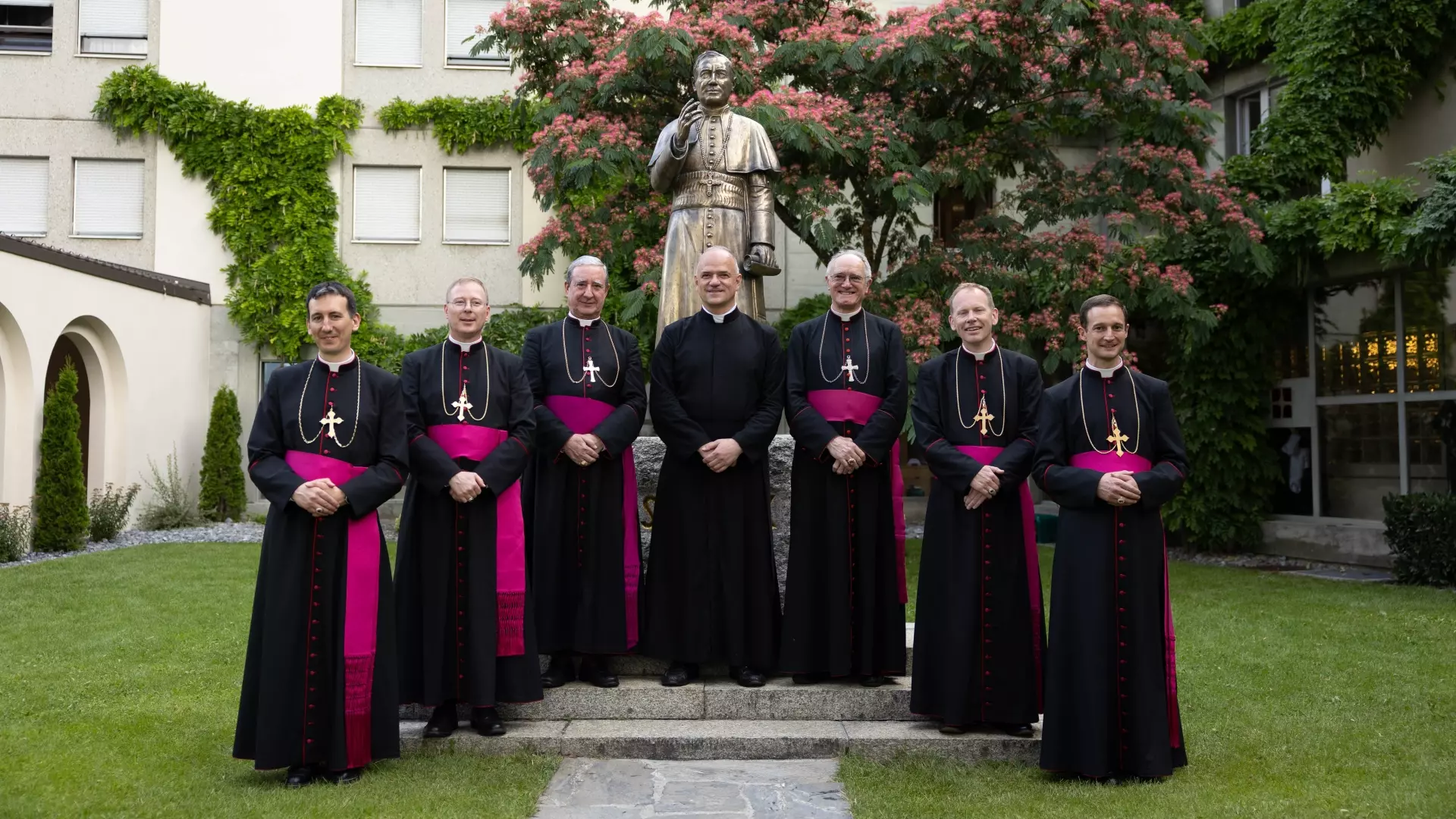
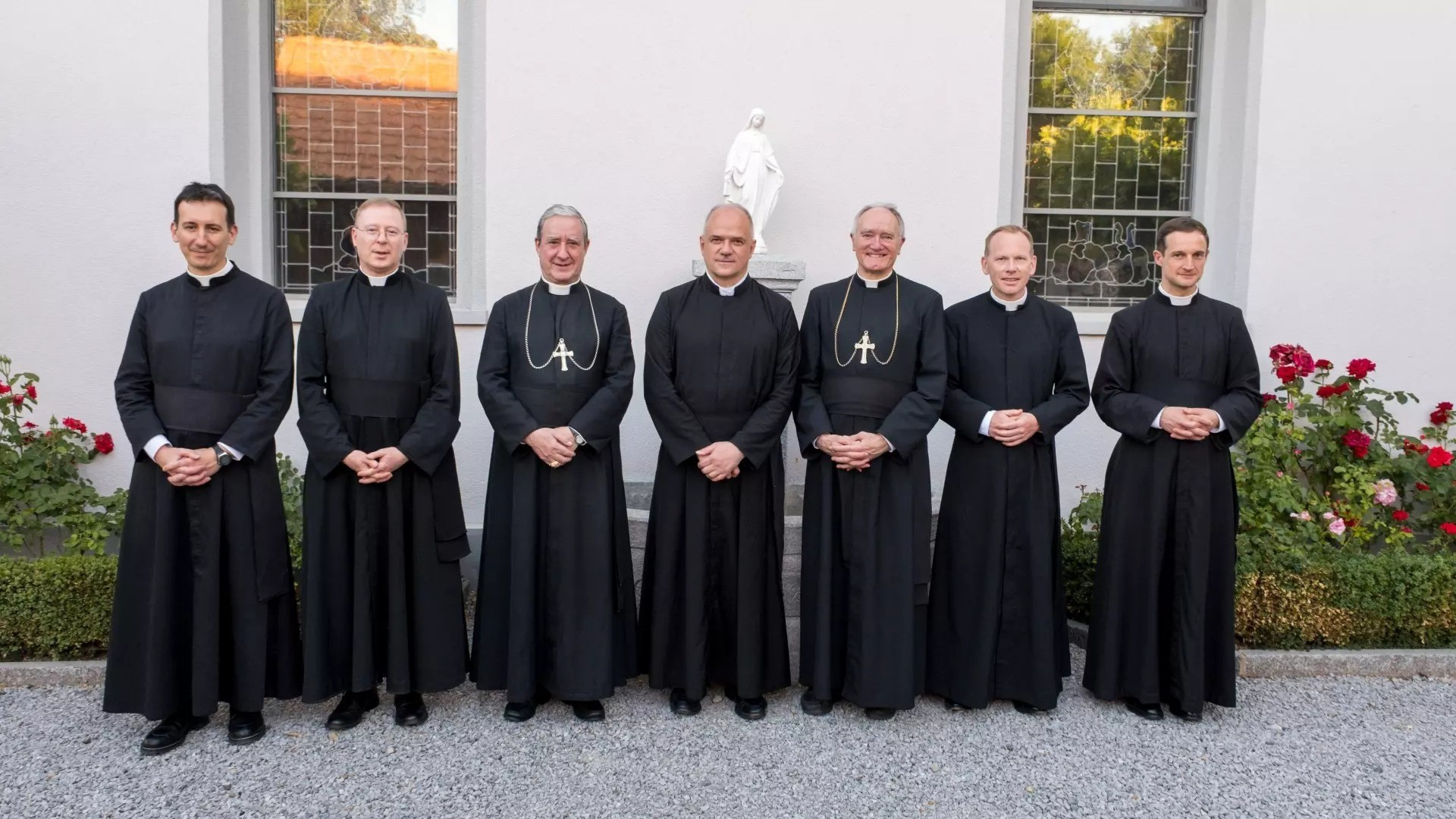
Looking at the images from the episcopal consecrations held in Écône on 1 July, one figure in particular stands out: Bishop Marc Hanappier. At thirty-six, he was the youngest of the four bishops consecrated that day, yet his measured pace, hands held in the customary liturgical manner and composed expression seem to belong to someone who has lived through another century. The contrast between his age and his demeanour reflects a phenomenon found in certain circles within the Catholic Church: young people choosing to inhabit an age other than their own, to the point of barely living in the present at all.
Hanappier’s case forms part of a broader trend. For years, traditionally minded Catholic circles have been growing particularly among younger generations, in ways that extend well beyond the liturgy. It can be seen in the way people dress, what they read, the friendships they form and even their understanding of authority. Many of these young people sympathise with monarchy and speak nostalgically of a social order - the alliance between throne and altar - that they themselves have never known and that, in many cases, even their grandparents never experienced.
Where figures are available, they suggest that the growth is real. In the United States, Harvard’s Cooperative Election Study recorded an increase in the proportion of Catholics among those born after 1997, from 15 per cent in 2022 to 21 per cent in 2023, with the rise particularly marked among men. In the United Kingdom, according to a Bible Society survey, Catholics now outnumber Anglicans among Generation Z. Attendance at Mass in the older rite is also increasingly concentrated among eighteen- to twenty-nine-year-olds, running counter to the broader decline in religious practice.
Very different phenomena, however, sit beneath the same label, and treating them as though they were one and the same makes the analysis less useful. One strand is largely aesthetic and driven by social media, with rosaries, incense and ornate vestments becoming visual material for platforms such as TikTok and Instagram. It is often accompanied by a degree of playful irony that softens any strong claim to identity. The trend informally known as “coquette Catholic” is one example, with cigarettes and rosaries appearing side by side on the same profile. There is also a more explicitly political strand: monarchist and counter-revolutionary, it interprets modern history as a long process of decline beginning with the French Revolution.
Psychology has coined a term for nostalgia for a period one has never actually lived through: anemoia. The word was invented by the writer John Koenig and later taken up by the philosopher Felipe De Brigard, who distinguishes it from conventional nostalgia not by its intensity but by its origin. Traditional nostalgia is rooted in personal memories; anemoia is constructed through the imagination and fed by films, photographs and second-hand accounts. Some researchers have linked the phenomenon to the rhetoric of populist movements, which can attract younger voters precisely by promising a return to an age they have never experienced themselves. The same interpretation applies equally well to youthful Catholic traditionalism, where the object of nostalgia is almost always an image reconstructed after the fact rather than an autobiographical memory.
There are also voices within the traditionalist world itself warning against this tendency. Cardinal Robert Sarah, marking the tenth anniversary of Summorum Pontificum, urged Catholics attached to the older form of the Mass to abandon the label “traditionalists”, precisely to avoid becoming little more than relics preserved on a shelf.
The question, then, is what really lies behind this search for the past: this mixture of gestures, sensibilities and interests assembled from different historical periods, together with the choice to spend time in circles and with people far removed from one’s own generation. Perhaps at its root lies a basic need to belong: the desire to find something stable at a time when certainty seems increasingly difficult to come by.
In our own ecclesial communities, too, we sometimes come across very young religious, seminarians and priests who behave as though they were ninety years old, as if fidelity to the Lord and to Tradition necessarily meant reproducing the forms, attitudes and customs of a world that, in reality, no longer exists.
The case of Bishop Hanappier - a thirty-six-year-old whose manner and movements seem to belong to another generation - is nevertheless difficult to dismiss as mere personal eccentricity. Rather, it shows the extent to which a particular kind of formation, human even before it is ecclesial, can create a genuine identity problem within an individual, one that sooner or later begins to surface in various forms throughout that person’s life.
Fr M.C.
Silere non possum