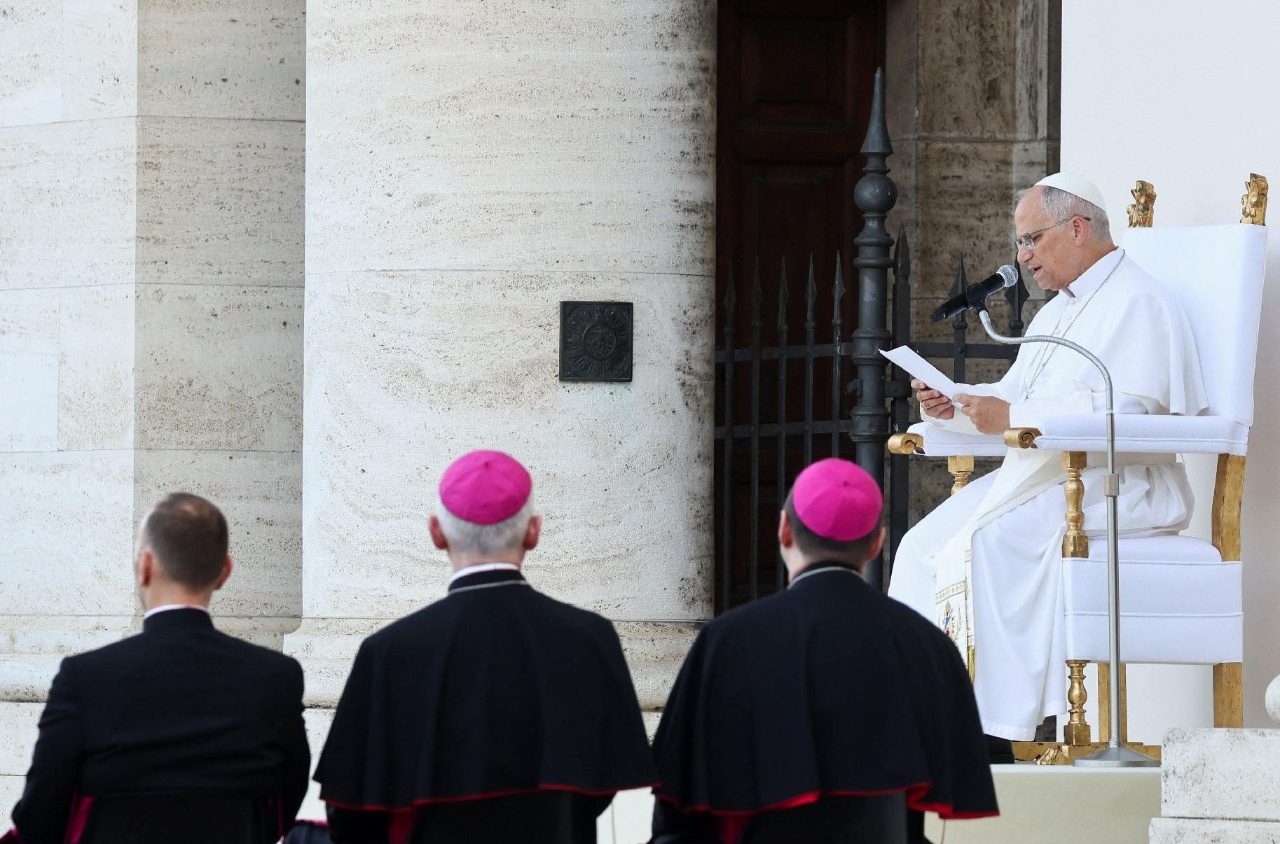
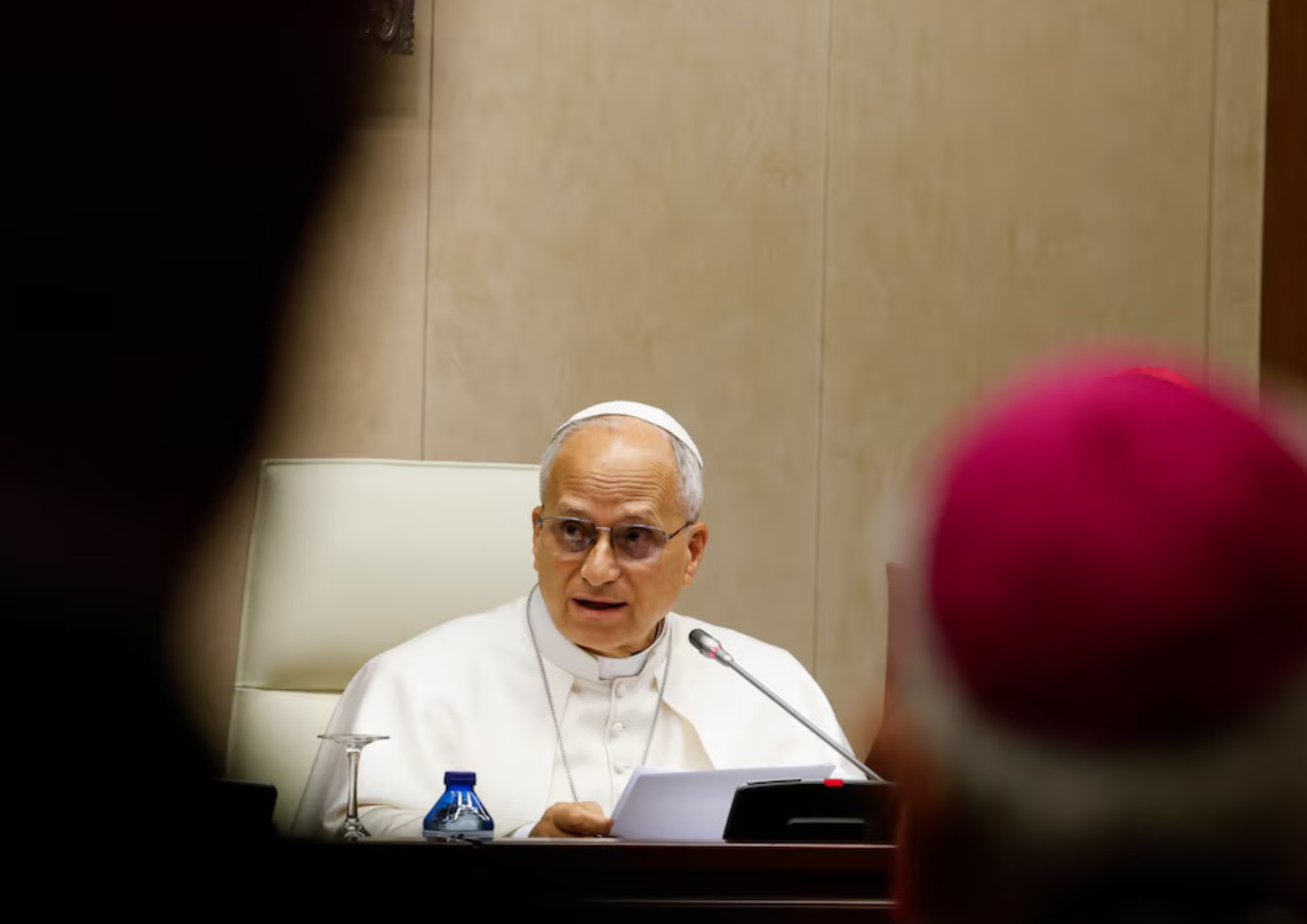
“I will give you shepherds after my own heart.” With this promise from Jeremiah, in 1992 John Paul II opened Pastores dabo vobis. This morning, thirty-four years later, before the Spanish episcopate, Leo XIV gave continuity to that appeal of the Polish saint. A kind of response: “Lord, give us your heart.” And it is precisely in that space - between the promise and the plea - that the fundamental features of this pontificate can be recognised with surprising clarity.
Following the example of a master, I would like to reread this address not as a conventional exhortation, but as a map: from it, the fundamental features of this pontificate can be recognised with surprising clarity.
The pilgrim and the restless heart
The first feature is the most personal, and it can be understood only if one keeps in mind where Robert Francis Prevost comes from. The journey described to the Spanish bishops is a sui generis journey, in which “we do not move physically, but we wish to let our hearts soar.” It is the grammar of Augustine: man as viator, the restless heart until it rests in God. It is no coincidence that Leo XIV’s episcopal motto - In Illo uno unum - is an Augustinian phrase on unity in Christ, and it is no coincidence that the first temptation the Pope describes to pilgrims is that of remaining fixated on “what we leave behind - places, things, ways of life,” and that of useless luggage which becomes a burden.
The exhortation of Saint John Paul II of 1992, in number 45, cites precisely that passage from the Confessions - the heart that finds no rest except in the Lord - in order to ground the religious dimension of priestly formation. Thirty-four years later, an Augustinian Pope takes up that same intuition and turns it into the axis of an address to the pastors of the Church in Spain. The freedom and courage to “leave behind structures that do not help us” coexist with fidelity to what is a treasure: it is the dialectic of the pilgrim who knows what to pack in his rucksack, and this - as we shall see further on - is the key to the whole of Leo’s magisterium on reform.
Communion against polarisation
The second feature has marked the pontificate since its first appearance from the loggia: concern for unity. Leo XIV speaks explicitly of “this time of increasingly drastic polarizations and oppositions” and asks of the Church a “witness to unity in diversity”. The image he chooses is that of the living mosaic: many tiles which, “without blending together, converge to reveal the beauty of the one Lord”.
In short: everyone called to collaborate, without claims to prominence. Which is exactly what too often does not happen - as has also been seen recently in the Dicastery for Communication, where, in order to appear to be someone, there are those who choose to strike at others.
It is, again, an ecclesiology of communion with an Augustinian stamp, in which the bishop is called to be a “visible sign of communion”: with Christ, with the Successor of Peter, with the presbyterate, with consecrated life, with movements.
Those who have learnt to know Prevost will have noticed that the word communion is not, in Leo XIV, a curial reflex, but a programme of governance. In an episcopate marked - in Spain as well - by internal fractures, to say that the bishop’s task is to “safeguard unity, foster dialogue, heal divisions” means indicating a method. And it means, implicitly, distancing oneself both from identity-driven nostalgias and from flights forward: both, in the Pope’s language, are pieces of luggage that prevent one from walking.
The heart of the Good Shepherd: the chiasm with Jeremiah
Leo XIV closes his address by entrusting himself to a prayer of Saint John of Ávila: “If you command me, Lord, to do what you did, give me your heart.” And he comments: “Lord, give us your heart.”
If we now reread the opening of Pastores dabo vobis, we realise that the entire exhortation is born from the promise of Jeremiah (3:15) which gives the document its title: “I will give you shepherds after my own heart.” The two phrases form a dialogue at the distance of a generation. John Paul II reminded us of the Lord’s exhortation; today Leo XIV makes it his own, places it on the lips of lay people no less than priests and those preparing to become presbyters, and turns it into an invocation.
It is the same theology of pastoral charity that Pastores dabo vobis places at the centre of everything in Chapter III: the priest as a living image of Christ, Head and Shepherd, whose existence is unified not by a technique, but by the gift of self. When Leo XIV states that “the human heart is not filled by accumulating experiences… it is filled when it discovers a calling”, he is simply reformulating, for the young people and formators of today, what John Paul II had written on the primacy of grace in vocation.
Vocations and formation: the continuity that is not hidden
Leo XIV explained that the preservation of structures cannot take precedence over the good of the vocation, and he reaffirmed two interwoven rights: seminarians have a right to the best possible formation, and the Church has a right to well-formed priests. The criteria he indicates for seminaries - authentic community life, formators devoted to study and spiritual accompaniment, adequate Centres of Theology - are, line by line, the programme of Chapters IV and V of Pastores dabo vobis, where formation is articulated in the four dimensions - human, spiritual, intellectual and pastoral - and the seminary is described as an extension of the apostolic community, that “to be with him” from Mark.
This is no minor reminder. Over the past twelve years we have all feared that someone might lay hands on seminaries and the formation of presbyters: let us not forget that this was precisely the first point on that list from which synodality was later chosen. And some forget that, if that choice went badly for us, others - far more delicate - were instead avoided.
As a model, today, Leo XIV proposes Saint John of Ávila, patron of the Spanish clergy, whose fifth centenary of priestly ordination falls this year, and whom Saint Paul VI described as “a simple priest”. The simple priest - in love with Christ, rooted in prayer, close to the people, who finds in the bishop “not only a recognized authority, but a father” - is exactly the priest whom Pastores dabo vobis sought to form. Certainly, too often the capacity of the formators themselves to form mature and resolved presbyters has been lacking; but the framework of Pastores dabo vobis has lost none of its relevance. No other documents are needed: what is needed is to apply and use those we already have, and which too many - including among formators - have never even read. Leo XIV does not like overturning and reinventing: he gathers the inheritance of his predecessors and recalls the Church to those points which prove ever more current.
The thirst for meaning and new languages
There is then a feature concerning the way this Pope looks at the world beyond our sacristies. Leo XIV does not describe secularisation as an enemy, but as a question that has gone unheard: many men and women of our time “do not directly reject God”, but carry “a deep thirst for meaning, truth, belonging and hope”, even when they do not know how to name it. The task of the Church, then, is to learn the language of the other: “to humble oneself so as not only to understand, but to share.”
This is an appeal that reaches first of all bishops, priests and workers who each day also inhabit the web. The Pope is saying something precise: there are no people on that side of the fence and people on this side, there are no good people and bad people. Our task is to bear witness and welcome everyone, including those who seem indifferent or even hostile.
And it is, by reflection, also an appeal to those who communicate. Great strategies are not needed - the Pope is telling us - but a missionary method: the same one that Pastores dabo vobis, moreover, attributes to the priest when it defines him as a “man of mission and dialogue”. Also on social media, also online.
The historical model the Pope evokes is eloquent. On the one hand Friar Hernando de Talavera, the Archbishop of Granada whom the Muslims themselves called the “holy alfaquí” - literally “holy doctor of the law” - because he had learnt their language and culture in order to proclaim the Gospel; on the other, Saint Toribio de Mogrovejo, Archbishop of Lima, whose third centenary of canonisation is being marked this year, and who did the same with the peoples of America. Two bishops capable of speaking the language of new cultures without thereby betraying the Gospel. Translated for us today - with our deserted spiritual plains and our silent cities - this means that proclamation is not measured by the ability to make the celebration “more or less attractive”, but by the witness of a community that restores to man “the conviction of being loved”. It is what the Pope is also repeating to us in his Wednesday catecheses dedicated to the liturgy. It is, once again, the pastoral charity of Christ the Good Shepherd returning as the only true language.
A reversal only in appearance
This address to the Spanish bishops gives us the portrait of a Pope who thinks in images of movement but governs through categories of communion; who inherits a Church “going forth” and a vocational ministry freed from the arithmetic of numbers; who rereads his predecessors - John Paul II, Benedict XVI and Francis himself - treating their words and intuitions not as an inheritance to be kept behind glass, but as a worksite still open. And who, as a good Augustinian, brings everything back to the one question that is dear to the Lord himself: unity in Christ, the heart of the Good Shepherd given to other hearts.
The promise of Jeremiah, John Paul II wrote, “is still living and at work in the Church”. In Madrid, before his bishops, Leo XIV proposed its fulfilment in the form of a question: no longer “I will give you shepherds after my own heart”, but “Lord, give us your heart”. It is a reversal only in appearance. Because only those who know they have already received that heart can ask for it again. And because a pilgrim, in the end, carries no other treasure in his rucksack.
Marco Felipe Perfetti
Silere non possum