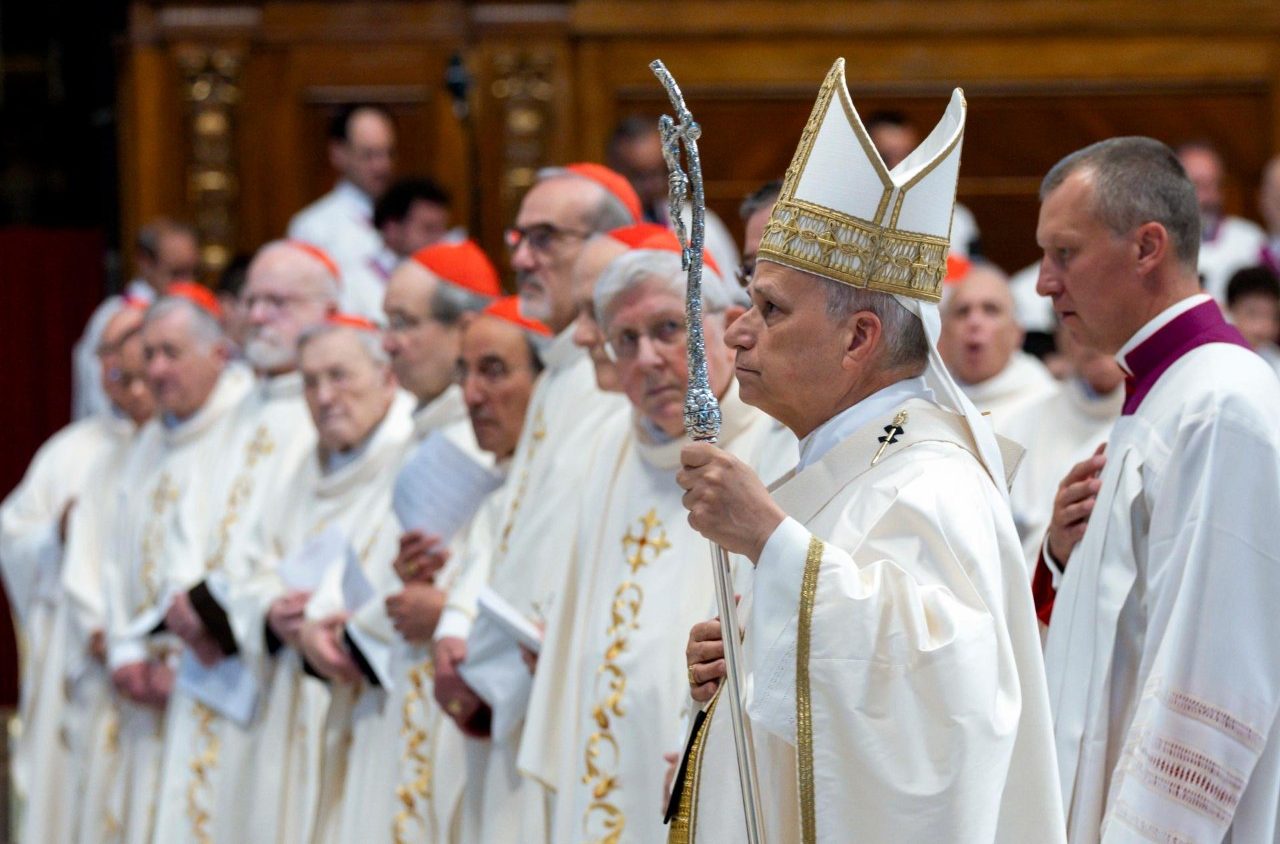
Vatican City - At 7.30 this morning, at the tomb of the Apostle Peter in St Peter’s Basilica, Leo XIV presided over the Mass opening the second extraordinary Consistory of his pontificate, scheduled for 26 and 27 June. It is the second gathering of its kind after the one held on 7 and 8 January, but it is not an isolated event. As the Pope made clear in off-the-cuff remarks at the close of the first meeting, the extraordinary Consistory has now become an established instrument of governance, to be held annually and always close to the Solemnity of the Holy Apostles. The choice of date, therefore, is far from incidental.
In his homily, Prevost reflected on the Johannine image of the true vine. From it, he drew the guiding logic of the entire gathering: “Remain in me, and I in you”, together with the warning that “apart from me you can do nothing” and the promise of “much fruit”. It is one of the defining features of this pontificate, which insists on the primacy of grace over every institutional initiative and derives from that priority, with practical consequences, a precise way of exercising governance.
Three criteria for discernment
Leo XIV offered the cardinals three points of guidance. The first is true freedom in faith: the relationship with Christ, he said, frees us “from sin and fear”, and this freedom both precedes and grounds proclamation. The second is peace in unity, and it is here that the homily connects directly with the agenda for the working sessions. The third is harmony through obedience, understood as listening to the Word and as the purification of intentions within the synodal journey.
On the second point, the Pope used his strongest formulation: “war is never worthy of humanity, and it is never blessed by God”. His reference to “high-tech weapons” and to resolving conflicts “as human beings and not as beasts” came only hours before the second session of the Consistory, due to take place in the afternoon on the theme “The Culture of Power and the Civilisation of Love”. Introduced by Cardinal Víctor Manuel Fernández on the basis of Chapter V of Magnifica Humanitas, the session focuses precisely on how the need to move beyond just war theory can be restated today. In other words, the Holy Father had already set the direction for the discussion the cardinals will hold behind closed doors.
The Pope explicitly referred to the encyclical “that I promulgated [though in fact he signed it, ed.] on 15 May”, placing its vision within Paul VI’s “civilisation of love” and describing the human family as a “magnifica humanitas that finds its head and redeemer in Christ”. Peace, he made clear, is not a sentimental aspiration but “a duty of justice”, rooted in an ethical rather than a merely biological principle.
The ecclesiological core: primacy as service
The most significant passage, however, does not concern geopolitics. It is the section in which Leo XIV defines the relationship between the Petrine ministry and the College of Cardinals. “In helping me in the exercise of the Petrine ministry,” he said, “you will find in me one who asks, not commands.” And again, the authority of primacy “belongs to the one who listens and only then leads, to the one who learns and only then teaches”.
The formulation merits close attention because it proposes an explicitly relational understanding of primatial authority: listening is not an ornament of governance, but its condition. It marks a sharp reversal from the approach of the past twelve years. Prevost thus takes up a theme developed by Benedict XVI, who in 2005, when he took possession of the Chair of the Bishop of Rome at St John Lateran, recalled that the authority entrusted to Peter and his successors is neither sovereign power nor the ability to impose personal ideas. The Petrine ministry, Ratzinger explained, is first and foremost a mandate of service, safeguarding the Church’s obedience to Christ and to his Word. The Pope, therefore, does not stand above the faith handed down to him, but is bound by it. He cannot bend the Church to passing fashions, expediency or shifting interpretations of the moment. Rather, he must safeguard and proclaim the Word of God in its entirety.
This is also the key to reading the passage in which Leo XIV brings together synodality and collegiality, defining both as “forms of Christian fraternity”: the former belonging to all the baptised, the latter specifically to bishops. Those familiar with the tensions that have emerged in recent months over the implementation of the Synod will understand the significance of this approach. Collegiality is not presented as a corrective to, or a limit on, synodality, but as its fulfilment within the unity of the Church and the common service of the faith.
The framework for the discussions
The homily opens four sessions spread across two days and entrusted to speakers from different backgrounds. After the greeting from the Dean, Cardinal Giovanni Battista Re, the biblical meditation will be delivered by Cardinal Grzegorz Ryś, while the third session on Saturday, “Building for the Good: the Work of Our Time”, will be introduced by Cardinal Stephen Brislin. Nearly two hundred cardinals will work in twenty groups, under an obligation of confidentiality and without the presence of the press. The fourth and final session, on Saturday afternoon, will return to the synodal process leading towards the 2027-2028 Assemblies, with an open discussion.
The Consistory will then conclude on 29 June, when the Pope will preside over the Mass of Saints Peter and Paul in St Peter’s Basilica, bless the pallia and impose them on the new metropolitan archbishops. Yet the line that will remain above all others is the one on primacy. A Pope who, before cardinals gathered from around the world, describes himself as “one who asks, not commands” is making clear the principle by which he intends to govern the Church. The coming days, in the confidential exchanges of the Consistory, will provide further evidence of it. This comes despite attempts in recent weeks by some cardinals habitually described as “traditionalists” to undermine the Pope through blogs devoted to psychological speculation, aimed more at discrediting him personally than at engaging in ecclesial debate.
fr.F.G.
Silere non possum