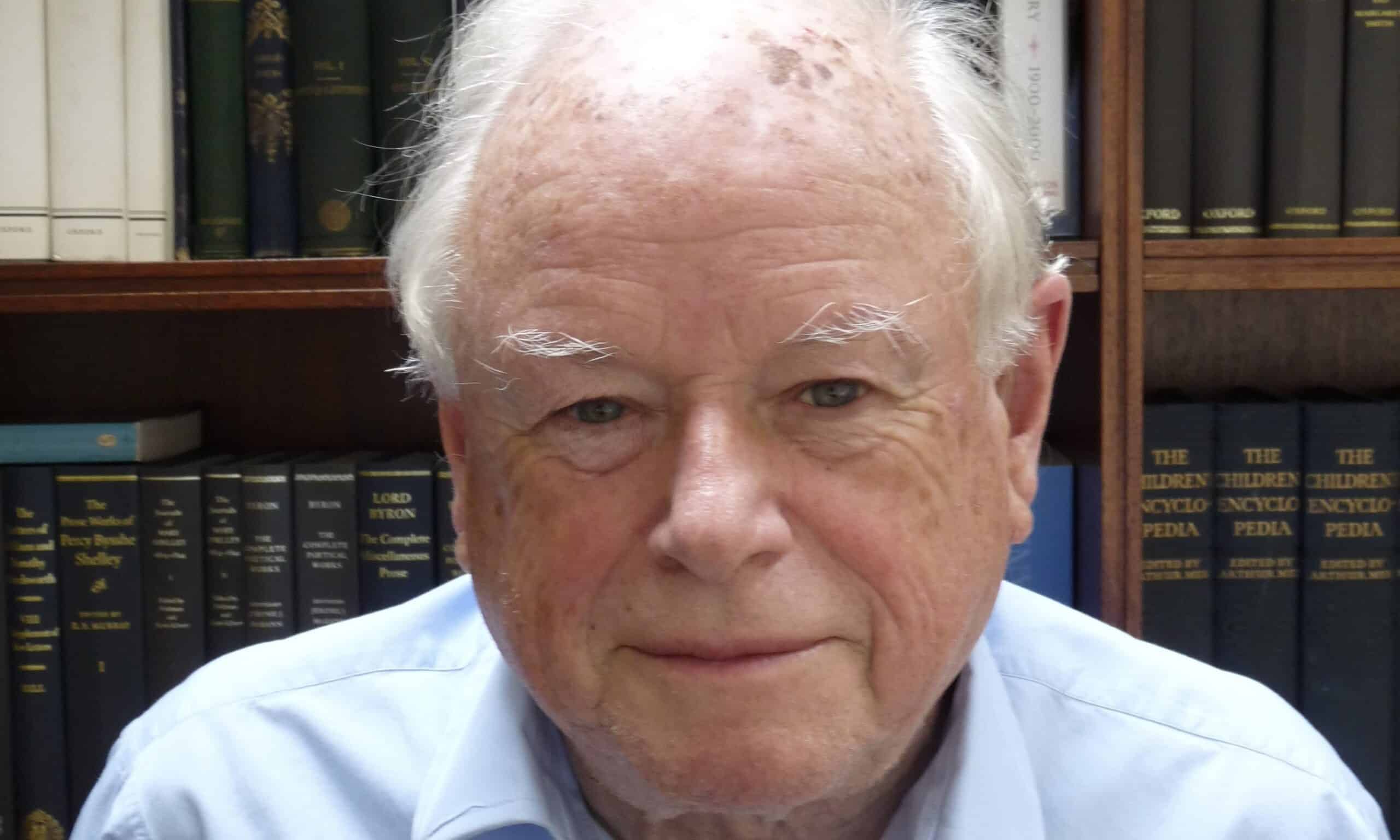
Sir Anthony Kenny, one of the leading figures in British philosophy in the second half of the twentieth century, died on 3 August at the age of 95. His death was announced by Balliol College, Oxford, where he became a Fellow in 1964 and later served as Master from the 1970s until 1989.
Born in Liverpool on 16 March 1931, Kenny grew up in a Catholic family and felt called to the priesthood from an early age. He trained at the Venerable English College in Rome, where he obtained a Licentiate in Sacred Theology, and was ordained in 1955. He spent several years serving as a curate in Liverpool while continuing the philosophical studies at Oxford that would shape the rest of his life.
It was philosophical reflection itself, pursued alongside his pastoral duties, that gradually began to unsettle his doctrinal certainties. In 1963, he asked to be released from the clerical state, a request that was granted. When he married Nancy Gayley in 1965, he incurred excommunication.
From that point onwards, his career became inseparably linked with Oxford. He joined Balliol as a Fellow and Tutor in Philosophy, became Senior Tutor in the 1970s and eventually Master, the college’s most senior office, a position he held for more than a decade. He also served as Pro-Vice-Chancellor of the University and, between 1989 and 1999, as Warden of Rhodes House, the institution that administers the renowned Rhodes Scholarships.
Kenny’s scholarly work ranged across widely different fields: philosophy of mind, in which he developed a rigorous critique of Cartesian dualism; the history of ancient and medieval thought; and the philosophy of religion. Together with Peter Geach, he helped develop what became known as analytic Thomism, an attempt to reinterpret Thomas Aquinas using the methods of contemporary philosophical analysis. He was also one of the literary executors of Ludwig Wittgenstein’s estate and played a role in editing and promoting the publication of the philosopher’s posthumous writings.
His departure from the priesthood was accompanied by a continuing engagement, never reduced to polemic, with the religious questions that had shaped him. Kenny came to describe himself as an agnostic, but continued to read and comment on theology, to reflect on the limits of human knowledge when faced with the question of God, and to engage publicly with representatives of traditions different from his own. In The Unknown God, he returned to these questions, acknowledging both the force of sceptical arguments and the enduring presence of religious questions in human consciousness.
This approach earned him an unusual degree of respect even in Catholic circles. The philosopher Edward Feser, while disagreeing with many of Kenny’s conclusions, repeatedly pointed out that Kenny never resorted to polemical shortcuts against his opponents, distinguishing him in this respect from the dismissive tone of some forms of contemporary militant atheism.
A former President of both the British Academy and the Royal Institute of Philosophy, Kenny leaves behind an extensive body of work. In 1985, he recounted his spiritual and intellectual journey in A Path from Rome, an autobiography tracing his journey from Catholic parish life to an academic career at Oxford. He returned to the subject in 2016 with Un affettuoso addio alla Chiesa, published in Italy by Carocci, in which he reaffirmed his distance from ecclesiastical structures without ever downplaying the seriousness with which he had once embraced his vocation.