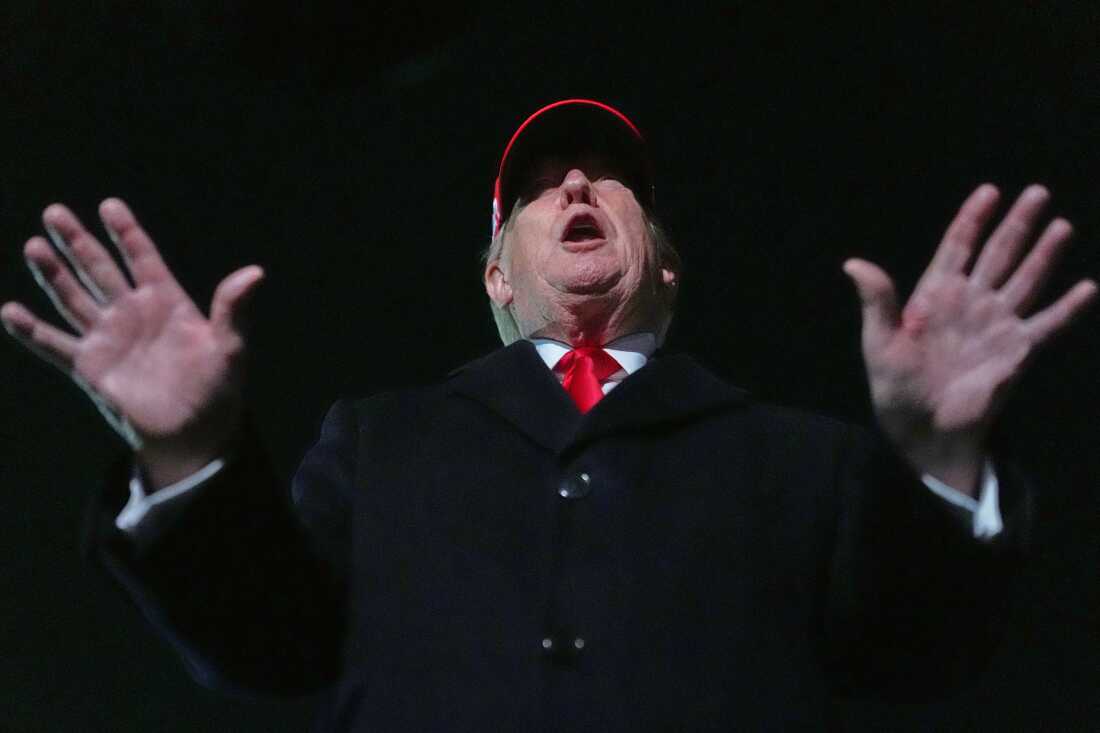
Power that cannot bear to be judged always ends up judging itself. Donald Trump may not realise it, but in the crude and vulgar attack he has directed at Pope Leo XIV in recent hours he has, unwittingly, produced his most faithful self-portrait: that of a man who mistakes strength for authority, consensus for legitimacy, and the silence of others for surrender. His words - published on his social media channel like the proclamations of a street tribune - would not merit a response were they not the troubling symptom of something broader and more dangerous: the tendency of a certain kind of populist politics to treat every moral institution as an obstacle to be torn down, every critical voice as an enemy to be stripped of legitimacy, and every spiritual authority as an instrument to be bent to electoral ends.
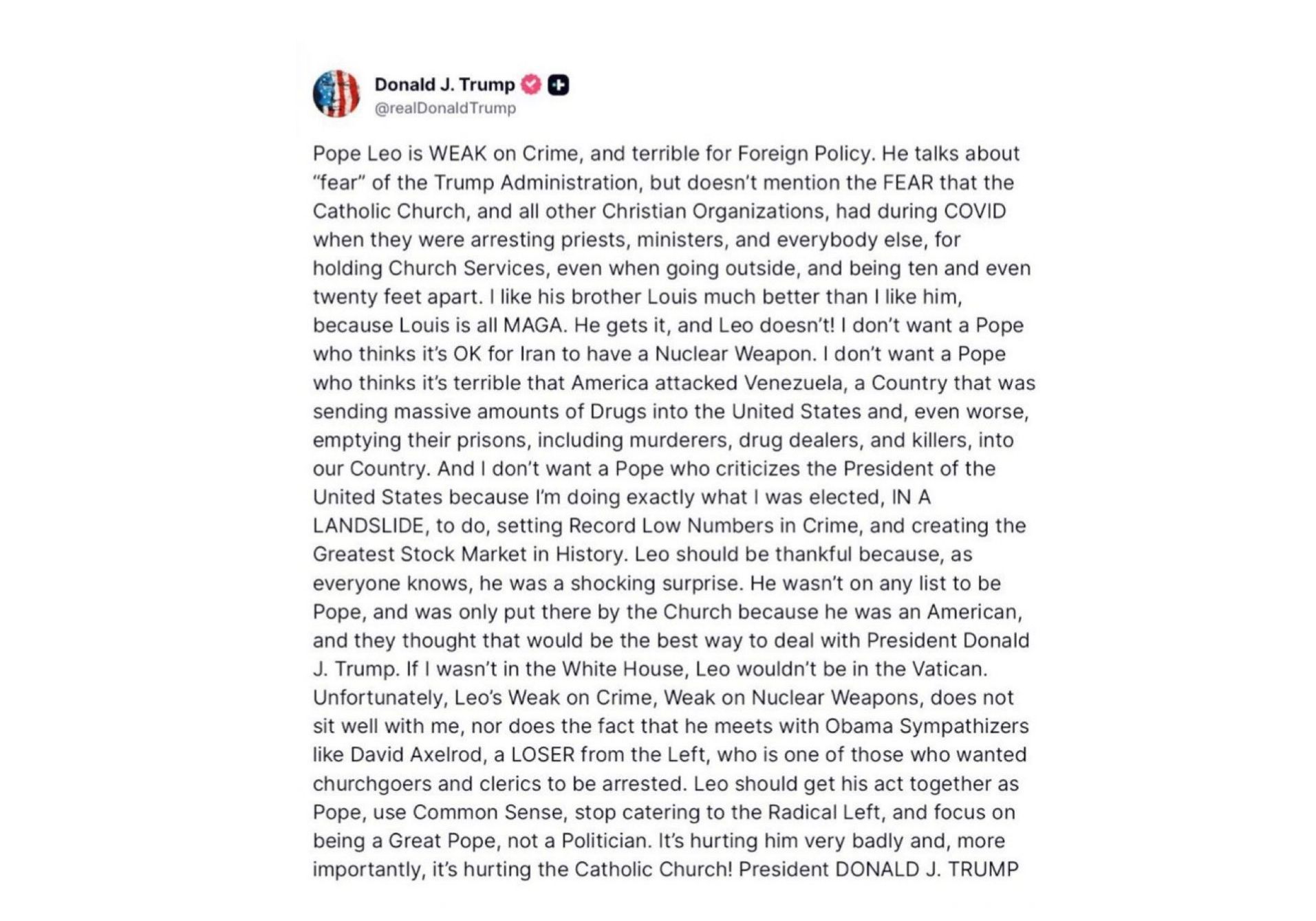
And yet Trump is not alone. Behind him - and around him, far beyond America’s borders - moves an audience of supporters who have embraced his very methods: reckless assertion, weaponised slander, the lie repeated until it begins to look like truth. We see it every day on social media, an arena in which verbal violence costs nothing and truth is always negotiable. People attack, defame and distort - and when someone points out the falsehood, the post disappears into silence, without retraction, without apology, as though it had never existed. That is the grammar of digital populism: arrogance in attack, cowardice in retreat. What makes all this not merely deplorable but dangerous is that Trump is not some anonymous local provocateur. He is the President of the United States of America. And when the most powerful man in the world adopts the register of the bully, he does not do so in a vacuum: he legitimises it, normalises it and turns it into a model. His followers - wherever they may be, in America or elsewhere - do not imitate him despite his position. They imitate him because of it. Trump accuses Leo XIV of being “weak on crime”, of failing to understand America’s “greatness”, of playing into the hands of the radical left. He warns him to “get back in line”. He even goes so far as to claim credit for his election, declaring that without him “Leo would not be in the Vatican”. These are statements that are not only false, but radically alien to even the most elementary understanding of what the Catholic Church is, of its nature, its mission and its mystery.
A journalist asked the US President why he had attacked the Pope, and he replied as follows.
As Romano Guardini wrote in Power and Responsibility: A Course of Action for the New Age (1951), in a reflection that remains searingly relevant: “Power is not in itself evil, but it becomes destructive when it regards itself as absolute and refuses to be judged by any authority higher than itself.” That is exactly what happens when a head of state arrogates to himself the right to judge the Vicar of Christ and instruct him on how he ought to behave. The president of the United States Conference of Catholic Bishops responded in measured yet unequivocal terms: «I am saddened that the President chose to write such offensive words about the Holy Father. Pope Leo is not his rival; nor is the Pope a politician. He is the Vicar of Christ, who speaks from the truth of the Gospel and for the care of souls». One is entitled to ask when J.D. Vance will make a statement in defence of the Pontiff, given his professed love for “Catholic values”, among which, surely, the Pope also has a place.
What Trump has done is not simply political criticism, nor a disagreement over matters of doctrine or foreign policy. It is an attempt publicly to humiliate the head of one of the oldest and most deeply rooted spiritual institutions in human civilisation, using the language of bullies - contemptuous, falsifying, arrogant - to assert that no moral voice has the right to exist outside his control. It is not the first time that political power has tried to silence the Church. Henry VIII did it, the Jacobins did it, Bismarck did it through the Kulturkampf, and so did the totalitarian regimes of the twentieth century. But those episodes took place within complex historical conflicts, in eras when the structures of international law either did not exist or were still embryonic. Today, in 2025, a democratically elected president insults the Pope on a social network because the latter dared to remind him that there are values - peace, human dignity, care for the poor - that cannot be measured in stock-market points or crime statistics.
Things must be called by their proper names: this is an act of institutional bullying that the free press, diplomacy and politics, of every colour, have a duty to condemn without ambiguity. Silence, or attempts to play it down, would amount to complicity. There is also a revealing detail that exposes the deeper level of the affair. Trump denounces Leo for his meetings with “Obama sympathisers like David Axelrod”, accuses him of not even having been on the shortlist to become Pope, and claims that he was chosen solely to manage relations with the White House. This way of reasoning - according to which everything in the world must revolve around Donald Trump - is not merely clinical narcissism. It is the mental structure of the despot, of a man incapable of conceiving an authority that is not subordinate to him, an institution that exists for reasons of its own rather than in service to him. Hannah Arendt, in The Origins of Totalitarianism, observed that one of the hallmarks of totalitarian thinking is the denial of any reality not functional to the system of domination: “The totalitarian does not argue: he erases. He does not refute: he destroys.” Trump does not go so far — at least for now — as physical destruction. But symbolic destruction, public delegitimisation, the reduction of the opponent to a puppet manipulated by enemies: these are his instruments, and he uses them with the same carelessness with which he lashes out at an inconvenient journalist or a federal judge.
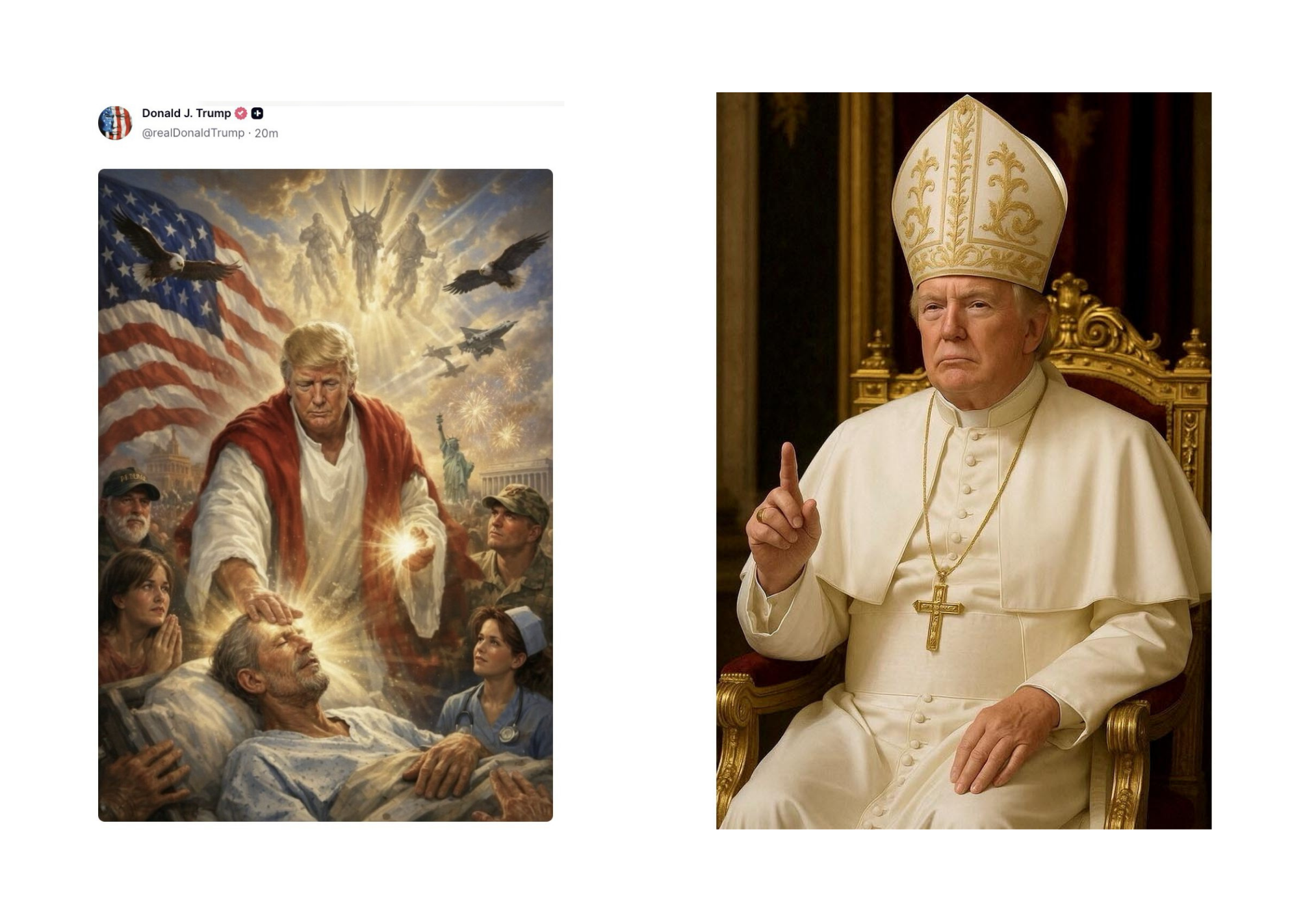
A few hours later, an image appeared that surpassed even the already disturbing one in which Trump had been portrayed in pontifical dress. This time, the analogy chosen was with Jesus Christ. It was not an off-the-cuff provocation: it is consistent with a narrative cultivated and sustained by those around him. Paula White, spiritual adviser to the White House, has for years preached that Trump is an anointed figure of the Lord, a Christological figure sent to earth to fulfil a divine mission.
Leo XIV, meanwhile, does not turn around. While the controversy rages, the Pope has set off on his third apostolic journey - the longest since the beginning of his pontificate - and his priorities declare, more clearly than any denial could, how little he is touched by the invective coming from Washington. Journalists will certainly try to drag him into the dispute during the in-flight press conference on the return from Equatorial Guinea; that is their method, and it would be naive to expect otherwise. But Leo will not descend to that ground. Not because he has nothing to say, but because he has chosen a register Trump neither knows nor can read: that of restraint, sovereign distance, composure that weighs more than any reply. It is the bearing of someone who knows that moral force does not need to raise its voice in order to be heard. Indeed, the more power shouts, the more unbearable that silent voice becomes. Not replying is not weakness; it is the highest form of authority. And perhaps it is precisely this, more than any doctrine, that Trump cannot bear. As Bernanos wrote in Diary of a Country Priest (1936): “Grace is everywhere.” And grace, by its nature, does not defend itself from the clamour of power; it passes through it.
But this silence cannot be that of the press, diplomacy or civil society. Silence in the face of injustice is not prudence: it is complicity. Trump’s attack on Leo XIV concerns more than the Catholic Church alone. It concerns anyone who believes that something exists above the logic of profit, force and electoral consent. It concerns anyone who believes that the poor, migrants, those condemned to death and peoples at war are entitled to a voice that represents them. It concerns anyone who holds that politics must be judged by ethical criteria, and not only by criteria of power. In this sense, to attack the Pope is to attack a principle. And the defence of that principle is a duty that transcends religious confessions, political allegiances and national identities.
L.V.
Silere non possum