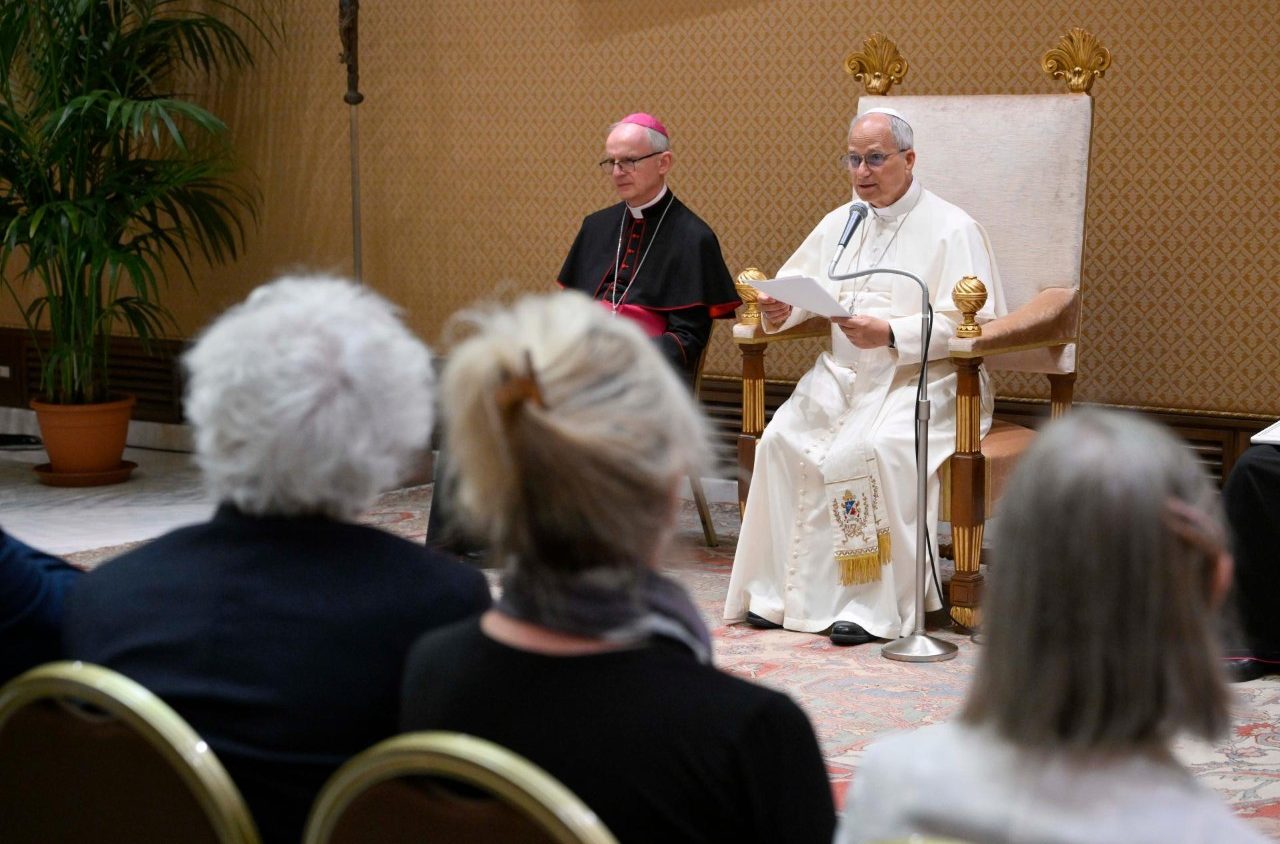
Vatican City - This morning, in the small hall of the Paul VI Hall, Pope Leo XIV received a group of writers in audience to mark the centenary of the Vatican Publishing House. Founded in 1926, the Holy See’s publishing house chose to celebrate its first hundred years by bringing a select group of novelists and poets from different parts of the world to Rome.
For years, Paolo Ruffini - thankfully now with his bags packed - and Lucio Adrián Ruiz, who has sunk into an uncontrollable depression since the Pope appointed the new Prefect, have relied on the same method: snapping up leading writers, already established authors with their own public following, appropriating them and presenting them as products of the Vatican communications machine. That is how they approached figures of genuine merit such as Colum McCann, Fr Adrien Candiard and the highly accomplished Norwegian writer Jon Fosse, winner of the 2023 Nobel Prize in Literature. With some of them, it even extends to “pilgrimages” through the bars and restaurants of Borgo Pio, the area around the Vatican, where Andrea Monda, Andrea Tornielli and the usual entourage take these authors to “make them feel at home” and coax another publication out of them between one mouthful and the next.
“The Vatican Publishing House lives off its reputation. Its name carries great weight: it is the Pope’s publishing house. Without that, it would already be dead.” Speaking to Silere non possum, a cardinal thus summarises the assessment that has long circulated in Vatican circles regarding the management of the publishing house.
The reference is also to encyclicals, whose publication is reserved exclusively to the LEV for a period. “They prevent others from publishing them because they know others would do the job better and that readers, if given the choice, would buy elsewhere. Besides, nowadays everyone downloads an encyclical from the internet,” the cardinal observes. For the prelate, the problem runs deeper: “In truth, they are already dead. They are being kept alive on life support.” He recalls what happened with the Pope’s official photograph after the election. “Official, though one does not quite know which one: first one, then another. Total disorder,” he says. The photograph of the Holy Father, the cardinal recalls, did not reach the John Paul II bookshop for months. In the meantime, “people downloaded it online and had it printed by photographers in Rome”. A decision which, he stresses, caused “an enormous loss for the Holy See”, precisely at the point when demand for a printed portrait of the new Pontiff was at its highest. “They are incapable; they work in the dark; they flounder,” the cardinal insists, adding that “Tornielli wastes time settling petty scores instead of doing his own job”.
As for the more prestigious authors, the cardinal acknowledges that the brand retains a certain pull. “They publish with the LEV because it is the Pope’s publishing house and that name still holds undeniable appeal,” he explains. But, he concludes, “they do not choose it for its quality, nor for its ability to disseminate, sell or genuinely support a message”. Leo XIV therefore found himself addressing an unusual gathering this morning. He chose to give them a speech built around three simple yet demanding propositions: writing is an act of truth; writing is a gesture of humanity; writing has to do with God.
Truth as a good to be shared
The first part of the address described writing as “an act of truth, of disclosure”: what we write, Leo XIV observed, reveals who we are, what we believe in and hope for, and what future we dream of. Yet truth, in this reading, is not a position to be defended. Citing his own encyclical on artificial intelligence and human dignity, Magnifica humanitas, the Pope recalled that “truth is not a territory to be defended, but a good to be shared”. From this came his wish for writers: that they might inspire an attraction to truth precisely because they have first allowed themselves to be won over by it.
A training ground in humanity
In the second part, the Pontiff drew upon a broad range of references. Terence’s words - “I am human, and nothing human is alien to me” - resonated alongside Pope Francis’s Letter on the Role of Literature in Formation, from which Leo XIV took up the Lewis-inspired image of reading as “seeing through the eyes of others”. Those who write enter into the lives of their characters; those who read, in a sense, “live many lives beyond their own”. In this widening of perspective, the Pope identified the root of solidarity, sharing, compassion and mercy, as well as an antidote to the temptation to make one’s own point of view absolute.
God in the midst of human stories
The third and more theological part connected the very form of writing with the structure of Revelation. Here the Pontiff referred to Cardinal Timothy Radcliffe O.P. and his Accendere l’immaginazione, recalling that, for Christians, nothing human is foreign to Christ, “the most human of all”. The God of the Bible, Leo XIV continued, does not reveal himself in the abstract, but in liberation from slavery, in the unexpected birth of a child and in faithful love: “he speaks through events and encounters, faces and stories”. “God works in our lives through what we do and what we are, and through the many people we meet,” Leo XIV recalled.
The echo of Saint Paul VI
In closing, the Pope gave the writers the words which Saint Paul VI addressed to artists: “We need you, your imagination, your gift for storytelling, your liveliness of thought.” We need them, he added, to create spaces of freedom and authenticity in which grace may allow a promise of consolation and peace to resonate. The same cardinal, speaking to Silere non possum, then draws attention to a group of authors whom the LEV continues to ignore: “There are many priests who write serious and profound works, genuine emerging writers, but they find no space in the major Italian bookshops because certain subjects evidently do not interest the market. Why do these supposed masterminds at the Dicastery for Communication not discover them, launch them and invest in them?”
The cardinal observes that even “the few religious figures seen here this morning are writers who made their name on their own and with the help of other publishing houses. They merely sank their teeth into the morsel once others had done all the cooking”. In the last row, almost as though they were schoolchildren put in detention, sat Natasa Govekar and, beside her, her goddaughter, Sister Nina Benedikta Krapić M.V.Z. It was not clear in what capacity Govekar was present: perhaps as head of the theological-pastoral department? Yet one question continues to be asked by many within these walls: what she has actually produced over the years, apart from the constant promotion of Marko Ivan Rupnik. A little further on, as ever, were Andrea Monda and Andrea Tornielli: ever-present, like parsley on every plate.
A.G.
Silere non possum