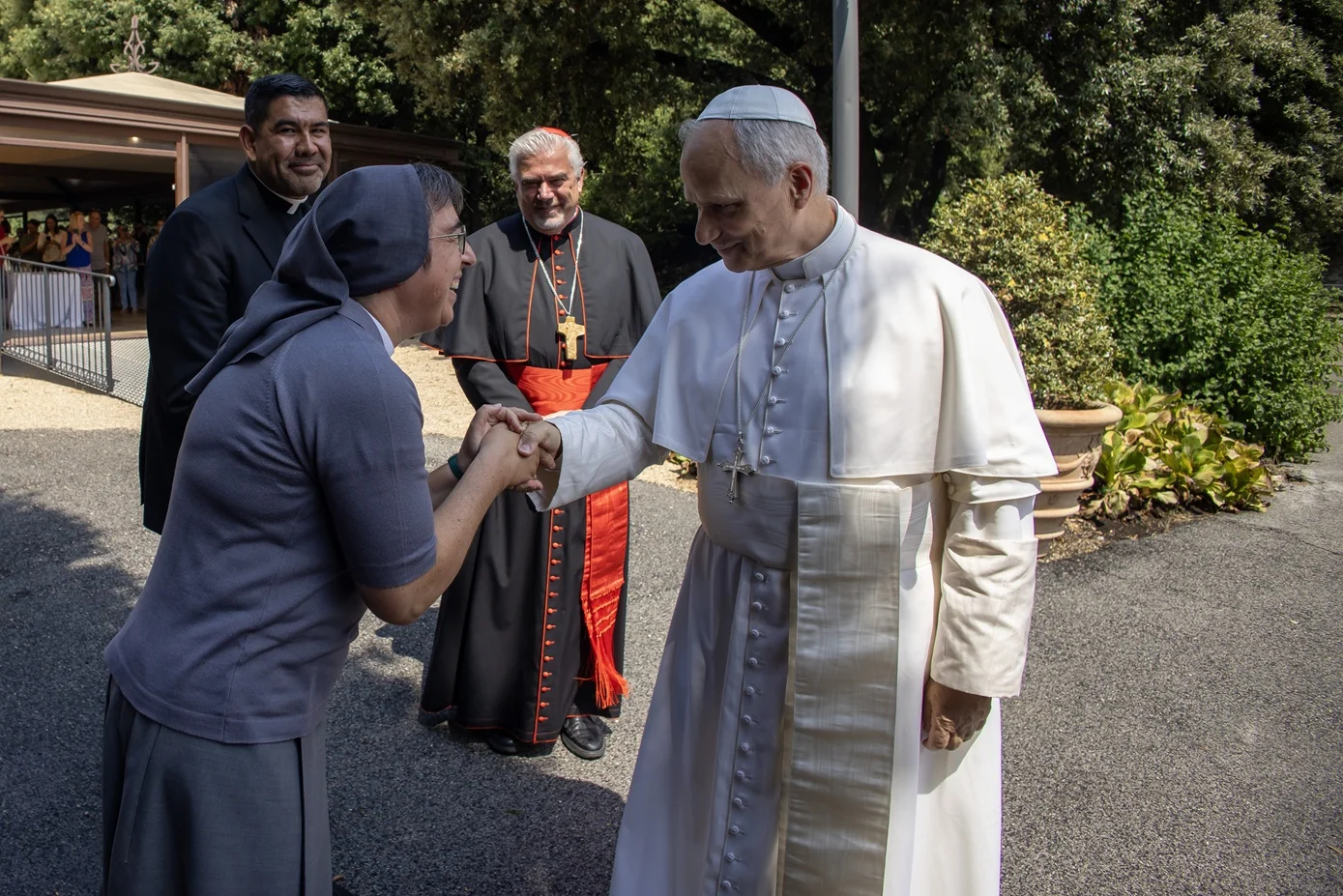
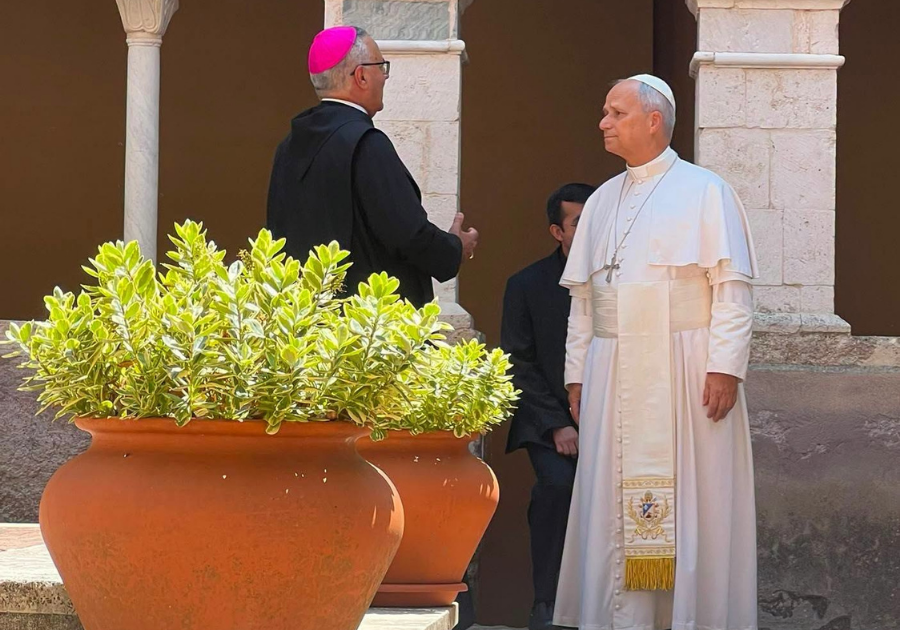
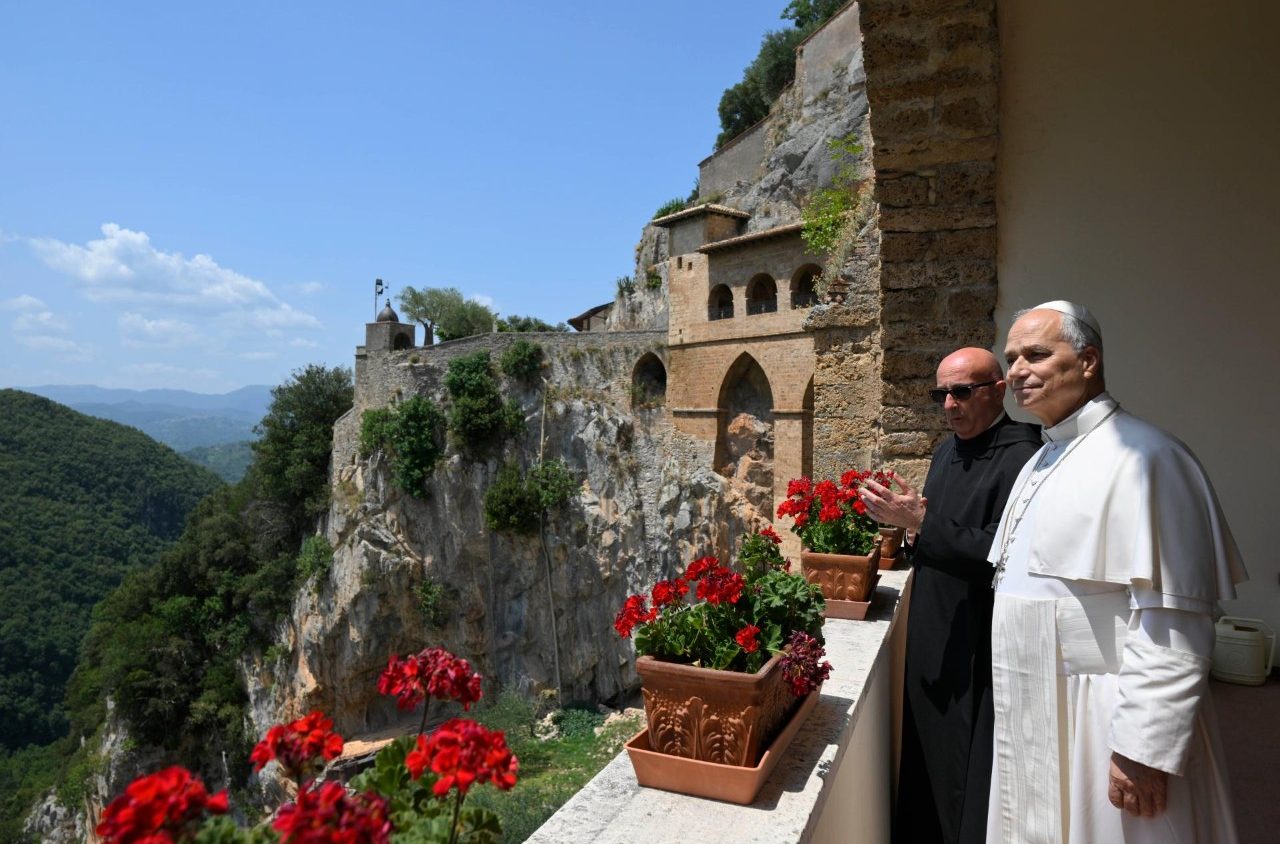
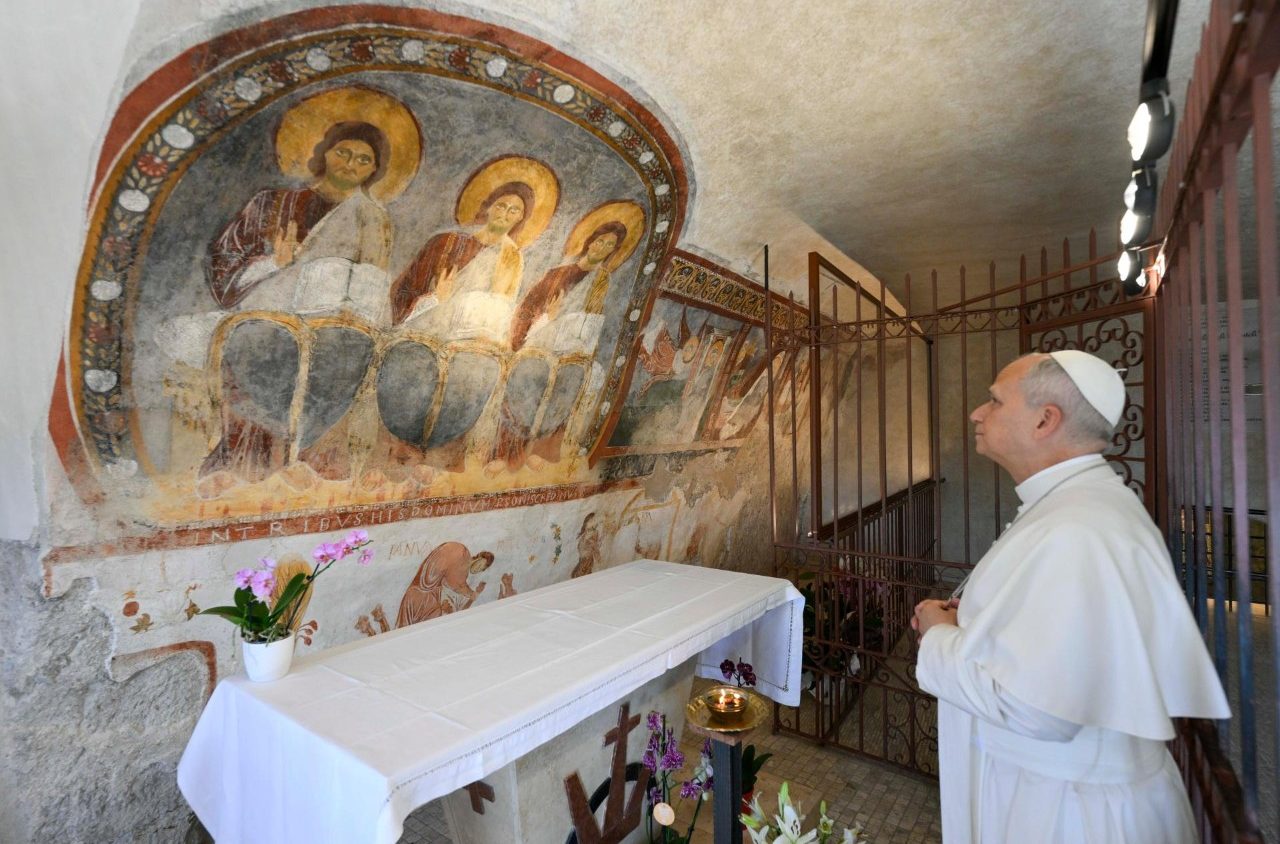
Over the course of forty-eight hours, Leo XIV retraced the geography of Saint Benedict’s life in reverse. On Monday 20 July, the Pope left Castel Gandolfo, where he is spending his summer break, and travelled to Monte Cassino, pausing in prayer before the tomb containing the remains of the Patriarch of Western monasticism and his sister, Saint Scholastica. This morning, Wednesday 22 July, he reached the Shrine of the Most Holy Trinity at Vallepietra, in the Simbruini Mountains, where he prayed before the ancient fresco venerated inside the cave, more than 1,300 metres above sea level, before greeting some of the faithful and members of religious communities who were present. From there, he descended towards the Abbey of Subiaco, the cradle of Benedict’s experiment in communal monastic life. These were private visits, without ceremonies or official speeches. Even the monks themselves were informed only a few hours in advance and asked to observe absolute discretion, so that the Pope could savour the peace and silence of which they have long been faithful guardians.
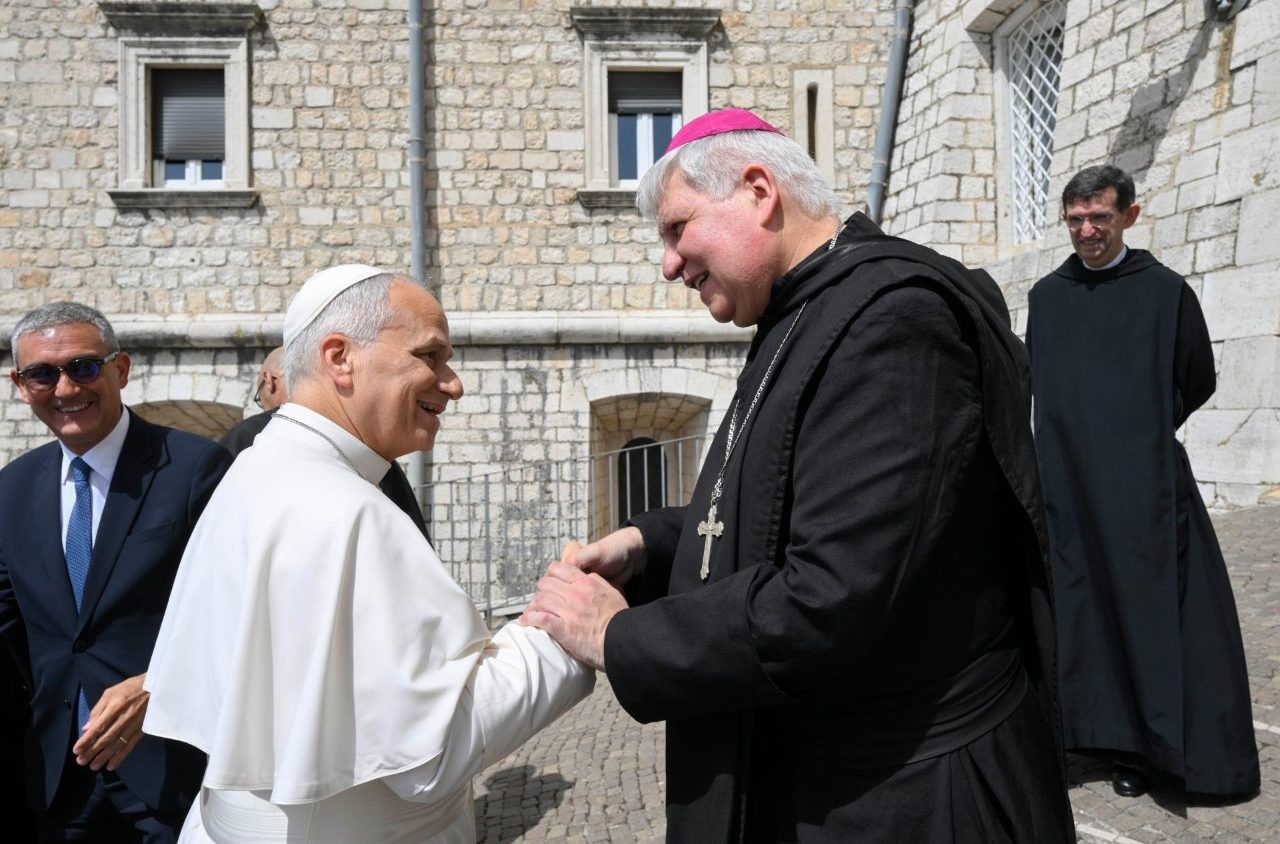
At Monte Cassino, the Pope was welcomed by Abbot Luca Fallica and by what remains of that monastic community. He prayed the Hour of Sext with the monks, visited the archives and library, and ate with the community before returning to the Alban Hills. At Benedict’s tomb, he entrusted to the Patron of Europe his plea “for peace in those regions of the world marked by bloodshed and conflict”. He also relit the votive lamp brought there by Paul VI in October 1964, when Montini, consecrating the basilica rebuilt after the bombing of 1944, proclaimed Benedict the principal patron of Europe and hailed him as Pacis nuntius. Leo XIV’s gesture thus echoes a succession of papal pilgrimages: after Paul VI came John Paul II and Benedict XVI, who chose to bind his pontificate to that name. Meanwhile, the abbey, devastated by two disastrous abbacies that have reduced both the number of monks and the quality of community life to the bare minimum, is looking towards 2029, when it will mark 1,500 years since its foundation. Provided, by then, that it still has something to celebrate and that its doors remain open.
There is also a canonical dimension that gives the two destinations added significance. Monte Cassino and Subiaco belong to the now very small number of territorial abbeys: ecclesiastical jurisdictions entrusted to the government of an abbot, bearing witness to an order in which the monastery formed the juridical, spiritual and pastoral centre of an entire territory. The reforms of recent decades have progressively reduced their boundaries to the monastic nucleus, restoring these places to their essential character: communities called to live according to the Rule and to radiate its strength throughout the Church.
During the pontificate of Francis, who in Italy relied on the apostolic nuncio Emil Paul Tscherrig, a figure particularly hostile to these institutions, the territorial abbeys, deeply rooted in the history and distinctive character of their regions, went through an especially critical period. Fortunately, they were ultimately affected only in part: Monte Cassino lost its entire territory and today retains only what directly pertains to the abbey itself; the Holy See had already done the same for Subiaco in 2002. Towards the end of his pontificate, Francis also ordered a visitation of the Abbey of Subiaco, entrusted to Cardinal Giuseppe Petrocchi. It ultimately concluded in the best possible way, since all financial matters were found to be in order. The fact that the Bishop of Rome chose to cross the threshold of both abbeys within the space of two days therefore carries a precise significance.
Leo XIV wants to visit and pray, but also to encounter these places at close quarters and see them for himself: genuine lungs of the Church. The Pope is firmly convinced that monastic life is fundamental to the life of the Church and that the Church has a duty to preserve it, support it and foster its growth. It is an acknowledgement of the enduring fruitfulness of this form of ecclesial life, today often treated as a marginal survival, but in reality decisive for the history of faith, culture and European civilisation.
The direction of the journey is striking. Benedict travelled from Subiaco towards Cassino: from the cave of the Sacro Speco, where he lived for three years in solitude, to the thirteen monasteries of the Aniene Valley, and finally to the mountain on which, around the year 529, he built the monastery destined to shape the West and give it its Rule. Leo XIV travelled in the opposite direction: from the tomb to the source, from fulfilment back to the beginning. Those familiar with the monastic tradition will recognise in this journey backwards a characteristically spiritual movement: a return to the beginning, the reditus ad fontes invoked by every authentic reform of religious life. To travel upstream towards the source means asking what made possible everything that followed.
Between the two abbeys, almost as the theological hinge of the itinerary, lies the stop at Vallepietra. The rock-hewn shrine, set into the Colle della Tagliata above the sheer drop into Subiaco’s Sacred Valley, preserves the fresco of the three divine Persons before which the Pope paused in prayer. The presence of the Trinity at the heart of a Benedictine pilgrimage possesses its own hidden coherence. Baldwin of Forde, the twelfth-century English Cistercian, rooted the common life of monks in the common life of the Trinity: “God does not live in the singular,” he wrote, and from that eternal communion flows the law of the monastery, which is mutual love. To pray before the Trinity between Monte Cassino and Subiaco is therefore to go back beyond the Rule itself, to the mystery on which it is founded: men live together under an abbot because God himself is communion.
In a letter written in 1069 to the hermits Albizo and Peter, Peter Damian compared monks to beacons placed along the shore. Those who remain steadfast on the coast and shine a light through the nocturna caligo of this life, guiding the shipwrecked towards the harbour, he argued, are of greater use than those who throw themselves into the waves and risk being overwhelmed by them. The image precisely conveys the role played by the great monastic sanctuaries for fifteen centuries: fixed lights, recognisable from afar, which offer direction without pursuing anyone. A Pope who, during his days of rest, climbs towards those beacons appears to be telling us where he himself seeks guidance, and where he invites the Church to seek it: in stability, in choral prayer, in daily work and in the wise sense of measure that the Rule calls discretio.
Finally, there is the personal dimension. Leo XIV is a son of Saint Augustine, formed in a spirituality that places interiority and fraternal communion at its centre. His decision to turn to the school of Benedict, moreover in private and without ceremony, bears witness to an interior freedom capable of drawing upon the entire heritage of consecrated life. Augustine and Benedict, after all, converge at the same point: common life as the path to the Father. Those who remember the first months of this pontificate will recall how insistently the Pope has presented peace both as a duty and as a plea. At the tomb of the Pacis nuntius, that plea found its natural altar.
News reports have described these as surprise visits, and so they were for the communities that received him, having been informed only a few hours beforehand. Yet, considered together, these summer outings form a pattern that is anything but improvised. In August 2025, setting out from the same palace at Castel Gandolfo, Leo XIV had already travelled to the Shrine of Mentorella to pray for peace. The Pope’s rest thus takes the form of pilgrimage: days away from audiences, spent instead in the places where the faith of the West learnt to pray, to work and to preserve books and the land. From the cave at Subiaco to the mountain of Cassino, Benedictine history teaches that every lasting edifice is born from a long silence.