Tallinn – The journey began in Viimsi, where Siim Kallas lived and where he served as mayor between 2017 and 2019. On Saturday 29 August, Estonia bade farewell to its former prime minister with state honours, one week after his death during the night of 21–22 August. He was 77. News of his death had been announced by his daughter Kaja Kallas, Estonia’s former prime minister and the current EU High Representative for Foreign Affairs.
The government had declared 29 August a national day of mourning. From 8am until 9pm, the Estonian flag was flown at half-mast on state and local government buildings, including the Pikk Hermann tower above Toompea, where one of the most recognisable symbols of Estonian independence is raised every morning. Flags were also lowered at the War of Independence Victory Column and at other public locations across the country.
The route taken by the hearse retraced much of Kallas’s public career. The first commemoration took place at 9.40am outside Viimsi municipal hall. From there, the hearse entered Tallinn, stopping at 10.10am outside the Ministry of Foreign Affairs, at 10.15am outside Eesti Pank, Estonia’s central bank, at 10.20am at the Ministry of Finance, at 10.26am outside the Riigikogu and, four minutes later, at Stenbock House, the seat of the Estonian government.
These were the institutions in which Kallas spent much of his political life: governor of Eesti Pank from 1991 to 1995, foreign minister between 1995 and 1996, finance minister from 1999 to 2002, prime minister from 2002 to 2003, and a member of the Riigikogu on several occasions. The Estonian government also regards him as one of the leading figures in shaping the economic system of the restored Republic and in the process that led the country into the European Union and NATO.
At 10.40am, the coffin arrived outside the Estonia Concert Hall in central Tallinn. Waiting there were the honour guard of the Defence Forces’ Guard Battalion and the military band. Inside the building, representatives of Viimsi municipality, the Reform Party, the Ministries of Foreign Affairs and Finance, the central bank and Parliament took turns forming a guard of honour. From 11am, the hall was also opened to members of the public wishing to pay their respects to Kallas and sign the book of condolences.
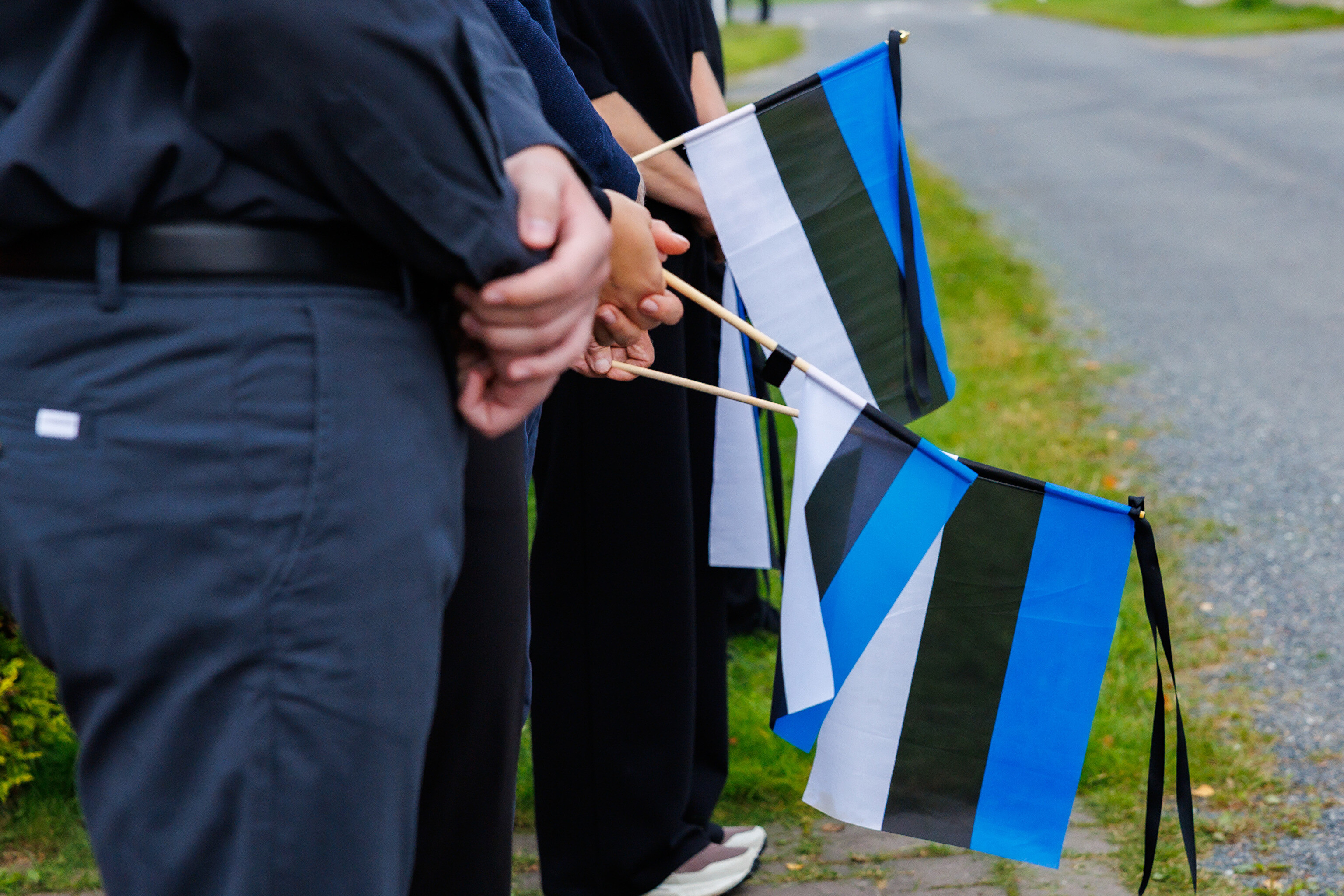
The ceremony at the Estonia Concert Hall
The official commemoration began at 1pm with the national anthem and a performance by the Estonian National Symphony Orchestra, conducted by Olari Elts. Speakers included President Alar Karis, Prime Minister Kristen Michal, Eesti Pank governor Ülo Kaasik, former European commissioner and current Governor of the Bank of Finland Olli Rehn, and Arne Mikk, an honorary member of the Estonia Society. A remembrance from the Kallas family was read by the actress Helena Lotman.
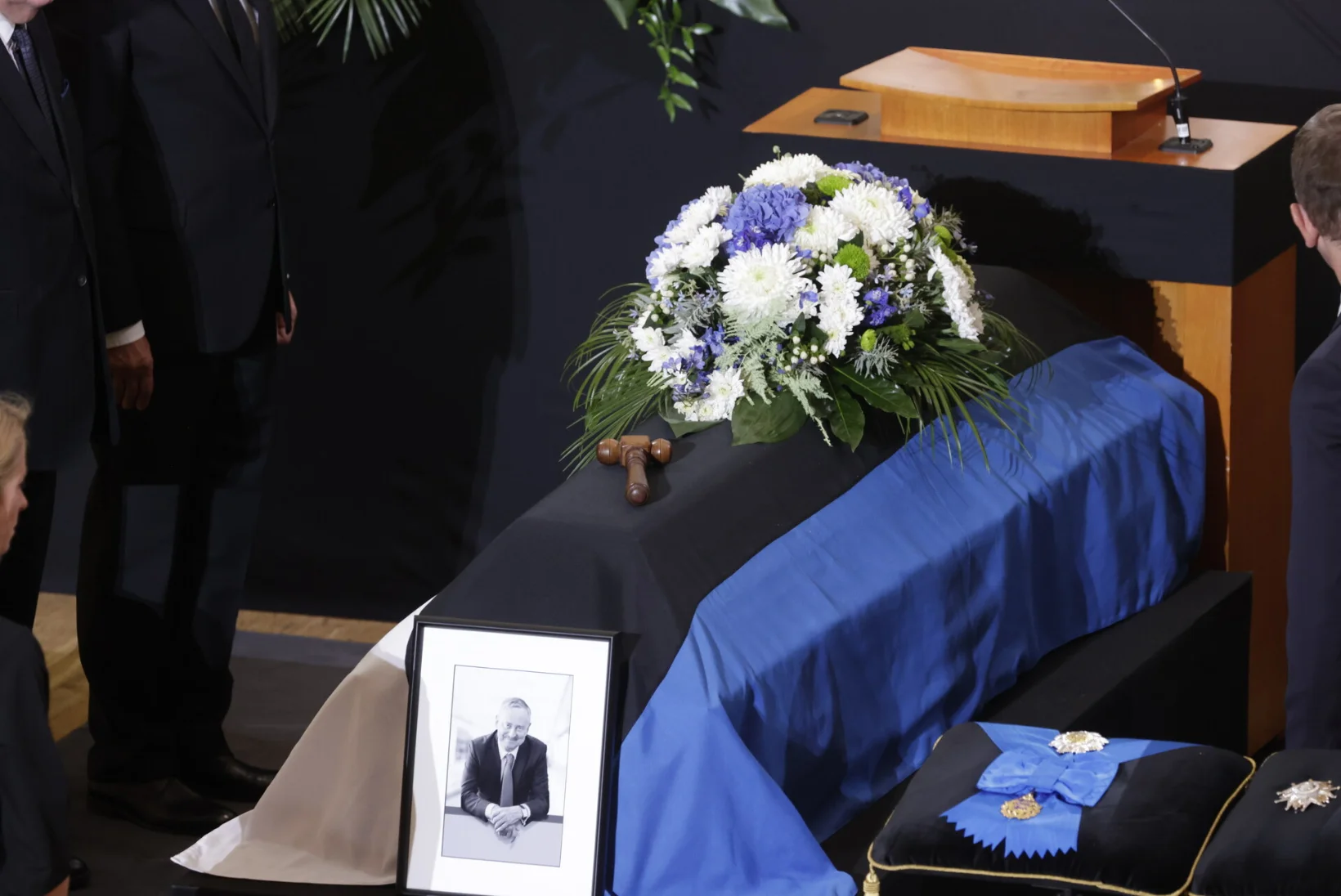
Karis focused in particular on Kallas’s ability to turn ideas that might have seemed highly ambitious in the 1980s into concrete political decisions. According to the president, it was also through his work that Estonia was able to become a modern state, anchored in Europe and founded on the protection of individual freedoms. After the head of state’s speech, current and former prime ministers placed on the coffin the gavel used during government meetings.
Kristen Michal, the current prime minister and chairman of the Reform Party, said that a statesman can also be judged by whether his decisions stand the test of time. For Michal, Kallas combined political skill, courage and perseverance. The two had worked together for many years within the party founded by Kallas himself in 1994.
Olli Rehn recalled the years they spent together in the European Commission led by José Manuel Barroso. He described Kallas as “a remarkable Estonian, a great European” and traced the thread connecting his work during the final years of the Soviet Union with Estonia’s European course after independence. Rehn also recalled Kallas’s close ties with Finland, his command of the Finnish language and the cooperation between Eesti Pank and Suomen Pankki.
From IME to the Estonian kroon
To understand the significance attached in Estonia to Kallas’s death, it is necessary to go back to 1987, when the country was still part of the Soviet Union. On 26 September that year, Kallas, together with Tiit Made, Edgar Savisaar and Mikk Titma, published in the newspaper Edasi the proposal known by the acronym IME, Isemajandav Eesti: a project calling for substantial economic autonomy for Soviet Estonia and which already contained the idea of a separate monetary system.
After the restoration of independence on 20 August 1991, Kallas took over as governor of Eesti Pank. He was one of the central figures in preparing the monetary reform of June 1992, when the Soviet rouble was replaced by the Estonian kroon. The new kroon was pegged to the German mark at a rate of eight kroons to one mark, and a currency board system was adopted. The reform allowed Estonia to break rapidly away from the rouble area, which at the time was suffering from extremely high inflation.
The next stage of Kallas’s political career began with the founding of the Reform Party in November 1994. Kallas served as its chairman for ten years. He later joined the government, first as foreign minister, then as finance minister and finally as prime minister. During his time as head of government, between 2002 and 2003, Estonia completed its negotiations for accession to the European Union. The country joined both the EU and NATO in 2004.
That same year, Kallas moved to Brussels as Estonia’s first European commissioner. He remained at the Commission for ten years and served as vice-president in both administrations led by Barroso. From 2010 to 2014, he held the transport portfolio. After returning to Estonia, he unsuccessfully ran for the presidency of the Republic in 2016; he then led Viimsi and returned to the Riigikogu in 2019.
In September 2024, he left Parliament and retired from politics. The Reform Party’s secretary-general told ERR at the time that the decision was linked to a deterioration in his health, although Kallas, interviewed the following day, presented it above all as the natural moment to make way for a new generation.
Saturday’s ceremony concluded outside the Estonia Concert Hall with honours from the military company, the Defence Forces band and a gun salute. It marked the end of the public part of the funeral of a politician whose career spanned almost the entire history of restored Estonia: from the final Soviet years to the kroon, from the emergence of the political system of the 1990s to the country’s entry into European institutions.