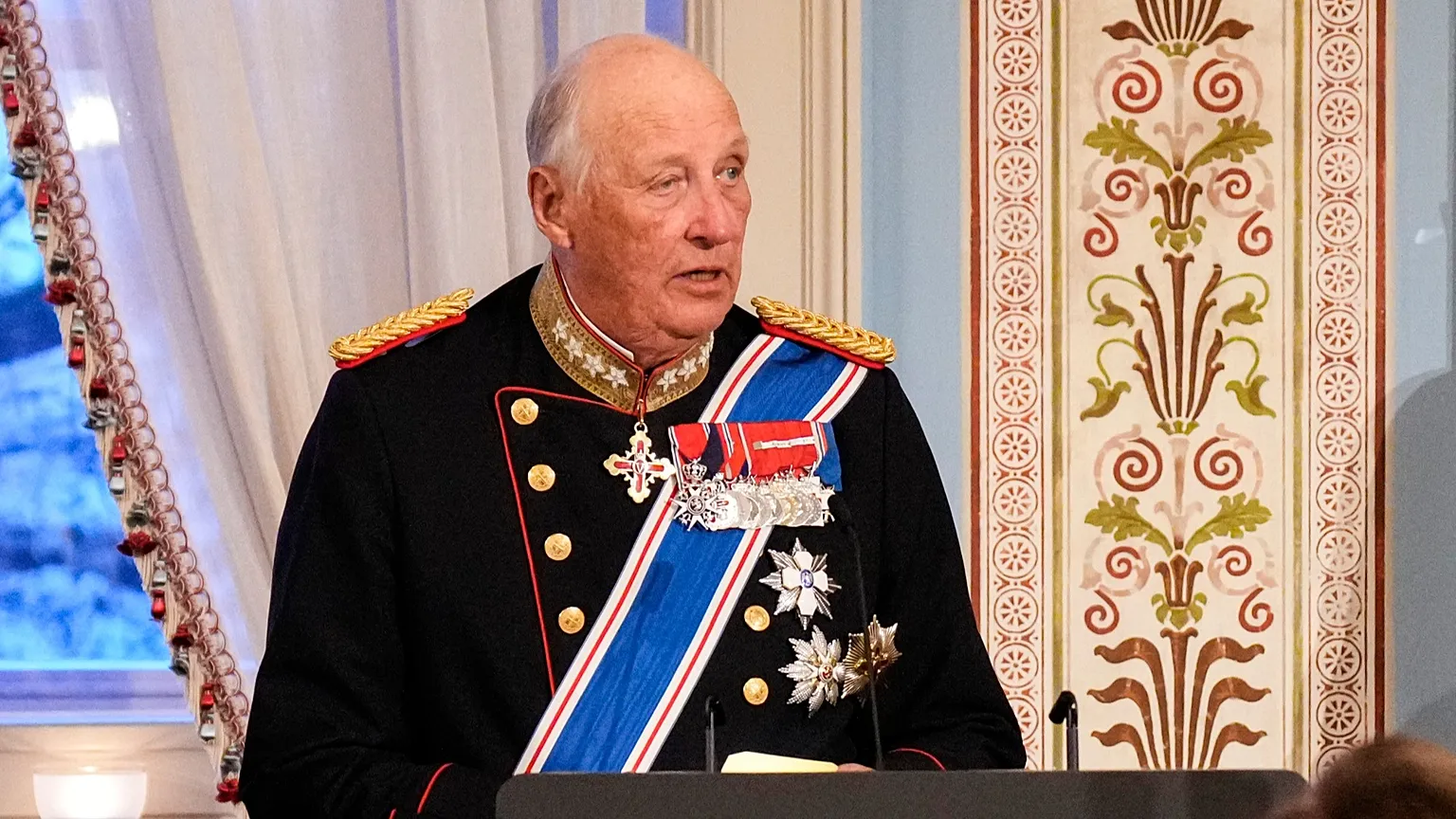
Oslo - At noon, church bells will ring across Norway. For one hour, from midday until 1pm, just as they did in January 1991 after the death of Olav V. The Church of Norway has instructed churches to ring their bells following the death of King Harald V, while its Presiding Bishop, Olav Fykse Tveit, spoke of a day of mourning tempered by gratitude for what the King had meant to the country. The bells, he recalled, evoke “the presence of God on earth and the hope of life after death”.
There is something distinctly Norwegian about this farewell too. Harald died as head of state of one of Europe’s most secularised countries, having reigned for thirty-five years over a society profoundly different from the one in which he had grown up. Yet Christianity remained, in his life, something more than a constitutional requirement bound up with the Crown.
Harald spoke about it with characteristic reserve. When Harald Stanghelle asked him directly about his faith for Kongen forteller, published in 2020 after a long series of conversations with the King, Harald was careful not to fashion himself as an especially devout man. He said he did not want to portray himself as “more religious than ordinary people”. He did, however, add that the Christian upbringing he had received as a child had remained with him, together with a search for a deeper meaning to existence. Stanghelle, who discussed faith, religious freedom and pluralism openly with Harald, described a thread running through his entire reign. That thread can be traced back long before his public pronouncements.
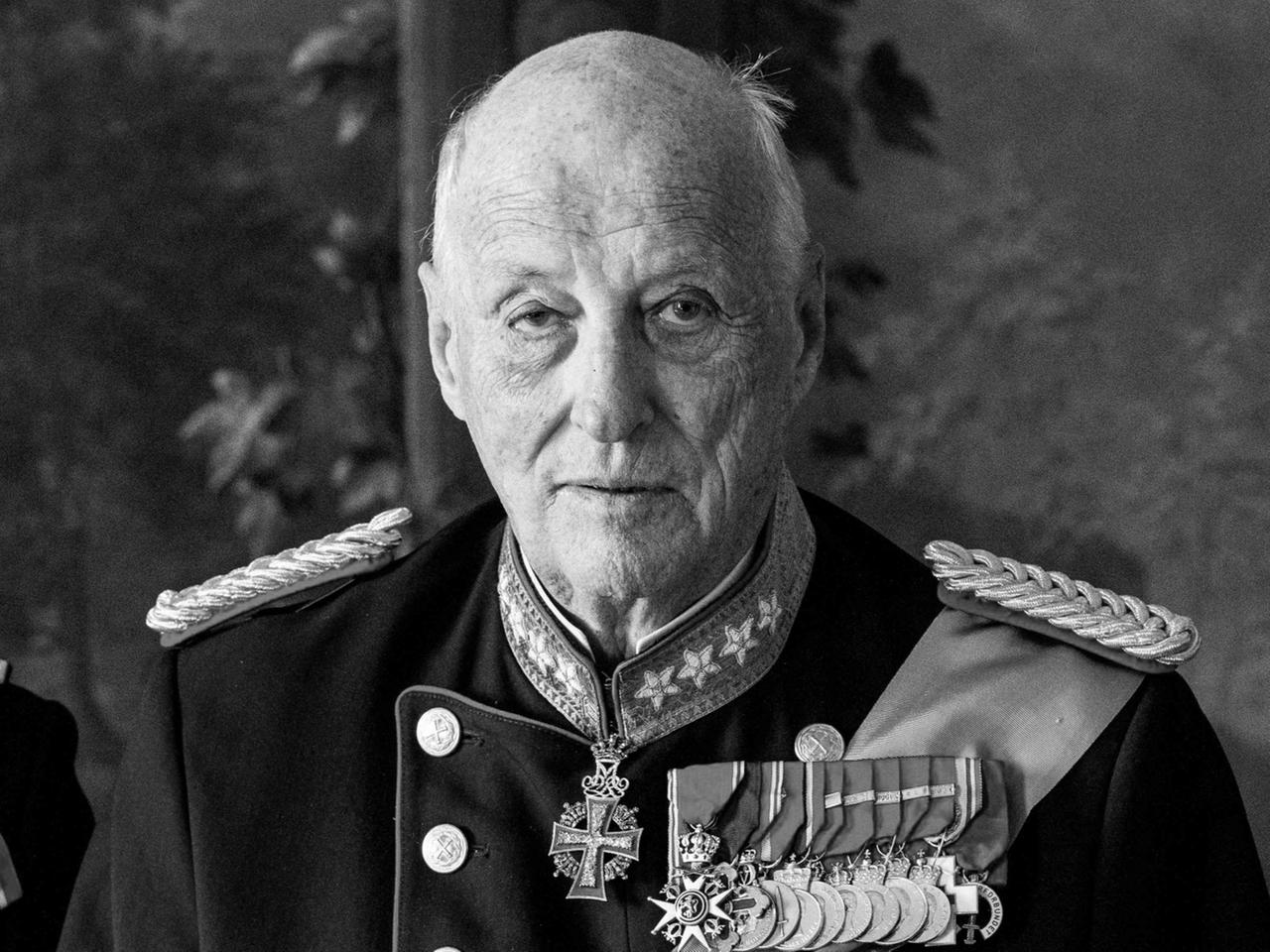
Olav V died on 17 January 1991. Harald became King at that very moment. Years later, he would recall being “slightly terrified”: his father had been immensely popular, and Harald doubted whether he could live up to his legacy.
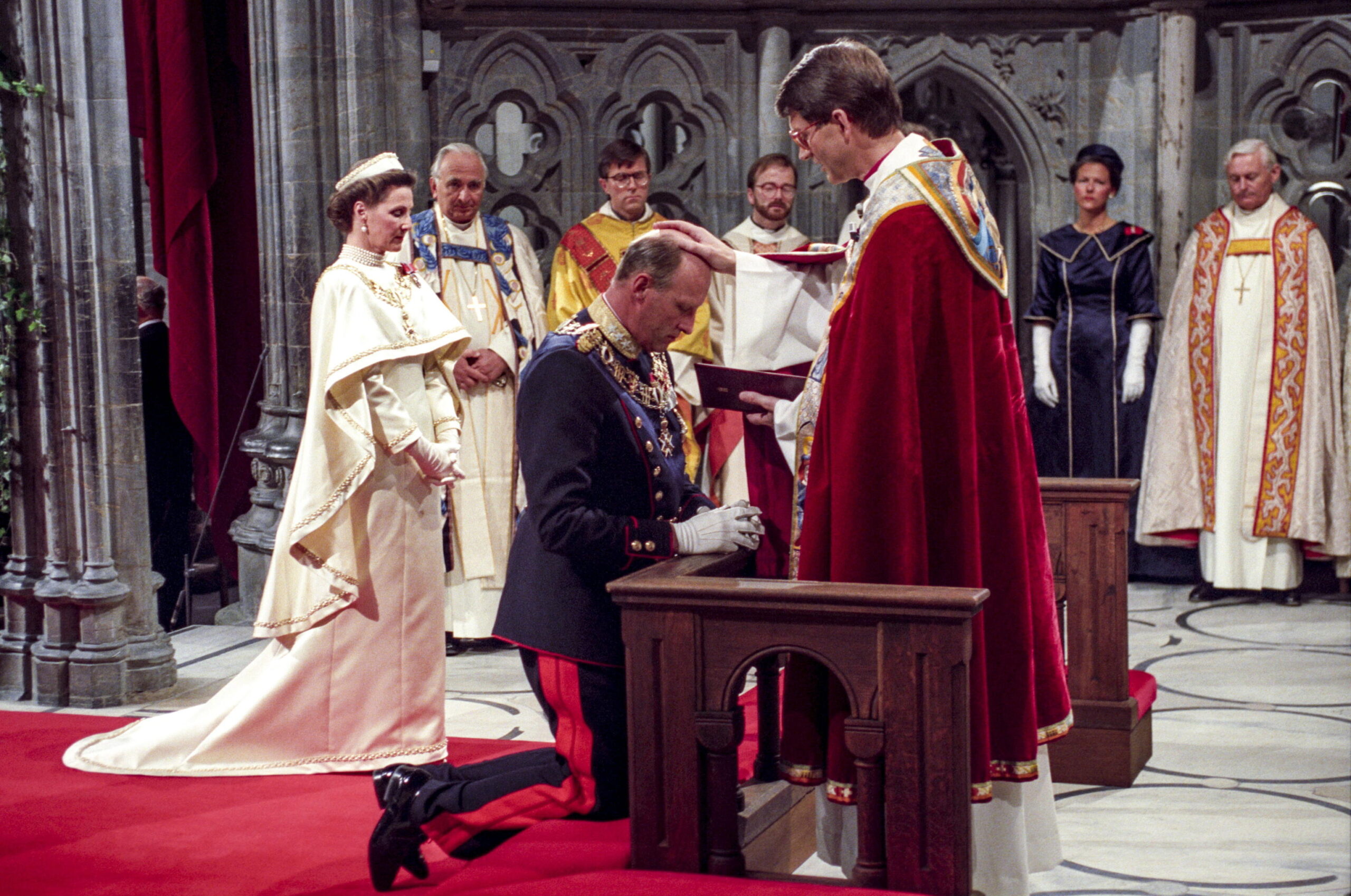
Five months later, on 23 June, Harald and Sonja entered Nidaros Cathedral in Trondheim. Coronations of Norwegian monarchs had been removed from the Constitution in 1908. Olav had nevertheless chosen, in 1958, to have a religious signing ceremony, a blessing for the exercise of the royal office. Harald decided to continue that tradition. It was a decision taken by Harald and Sonja themselves. Before the cathedral altar, the King knelt as Bishop Finn Wagle laid a hand on his head and prayed that God would bless, guide and sustain him in his service to the people and to the Church. The Royal House still recalls Harald’s words today: receiving God’s blessing upon their task, and kneeling in the same place where his father and grandfather had knelt, gave him “great strength”.
Almost thirty years later, Harald recalled with Stanghelle the packed cathedral, the singing of the congregation and what he had felt physically that day. He said it had given him goosebumps. Above all, he explained that the service had been “deeply personal” to him. The distinction matters. A king may attend a liturgy because ceremonial protocol requires it. Harald wanted that liturgy to take place. The more delicate episode came twenty years later.
In 2012, Norway changed the constitutional relationship between Church and State. The Constitution ceased to define the Evangelical Lutheran faith as the state’s public religion; the Church of Norway remained defined as the folkekirke, the people’s Church, while religious freedom and equality in public support for different religious and philosophical communities were strengthened. The process of separation continued, and in 2017 the Church became an independent legal entity. One sentence, however, remained in the Constitution: “The King shall at all times profess the Evangelical-Lutheran religion.” Harald later said that retaining that provision mattered personally to him. The King himself took the initiative in asking for the monarch’s religious requirement to be preserved during the constitutional revision. He did so through Trond Giske, then the minister responsible for church affairs. Later, Harald himself would question whether it had been appropriate for him to intervene in that way. Norway was redefining the relationship between Church and State, and the King did not oppose that change. On this point, however, he intervened personally: he wanted the Crown’s confessional link to remain enshrined in the Constitution. He spoke about it in terms that may now seem surprising for a Scandinavian monarch. He told Stanghelle that it seemed wrong to assume that, as other religions became more prominent, Christians should make their own identity less visible. In Harald’s view, those who profess another faith readily understand that a Christian should profess his own. Being secure in one’s own roots, he argued, allows for a more assured encounter with those who believe differently. This also helps explain one of the most famous speeches of his reign without detaching it from the rest of his personal history.
On 1 September 2016, during a celebration in the grounds of the Royal Palace, Harald tried to describe what Norway had become. He spoke of immigrants from Afghanistan, Pakistan, Poland, Somalia and Syria; of families, divorced people, the elderly and homosexuals. And he spoke of religion: “Norwegians believe in God, in Allah, in Everything and in Nothing.” He concluded by saying that Norway was made up of all those people.
That sentence has often been treated as a manifesto for the modernisation of the monarchy under Harald. And it was. But it takes on a more revealing meaning when read alongside what he said about his own faith. The King who fully acknowledged the place of Muslims, atheists and people of different convictions within the national community was the same King who had asked for the constitutional requirement that he profess the Evangelical Lutheran faith to remain in place.
Harald evidently saw no contradiction between the two. Religious coexistence, in his conception of Norway, did not require people to conceal what they believed. Prayer, too, generally remained absent from his public speeches. That was why Stanghelle was struck when, on 15 March 2020, in the first days of the pandemic, Harald said on television that his thoughts and prayers were with the Norwegian people: with the sick, their families, healthcare workers and those who feared losing their jobs. The King later explained that he had chosen those words deliberately because, at the time, he feared a very high death toll.
Harald’s faith therefore comes into view at the moments when the burden of public office weighed most heavily: the beginning of his reign, the constitutional transformation of the Church, the pandemic and death. Without preaching, and without any particular inclination to speak publicly about his inner life.
Perhaps that also explains why the Church of Norway’s response to his death immediately took on such a personal character. On Thursday, as the King’s condition deteriorated sharply, the bishops of the Church of Norway were in Rome on a study visit and had just met Pope Leo XIV. They gathered spontaneously in prayer and decided to cut short their visit and return home. Parishes and cathedrals opened their doors so that the faithful could pray and light a candle. Today, the bells will speak.
Harald was born in 1937. As a child, he experienced the exile brought about by the Nazi occupation; he lost his mother at seventeen and spent decades watching his father as he prepared for a duty which, when it finally fell to him, frightened him. That duty remained with him until his death. In 1991, before the altar at Nidaros, he had asked for God’s blessing to be invoked upon that service. Thirty-five years later, in the Norway he helped to change, the bells of those same churches accompany him on his last passage.