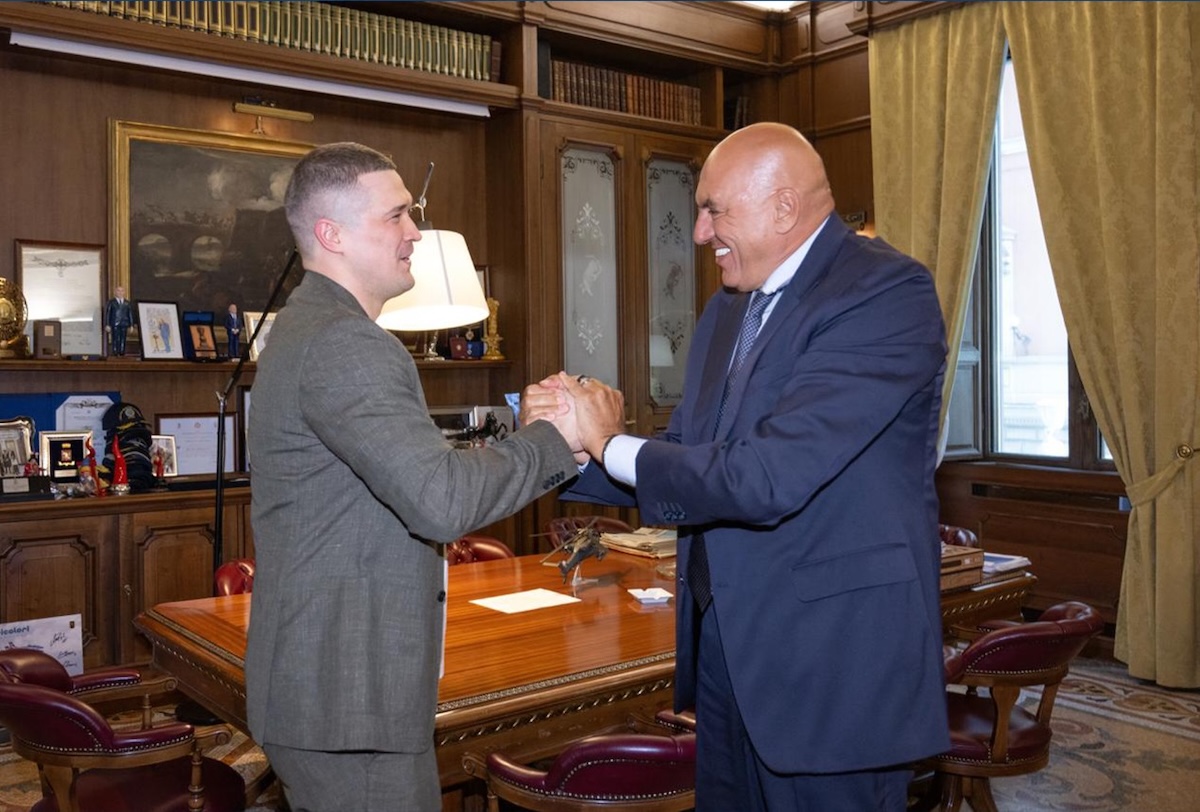
Rome - Italian Defence Minister Guido Crosetto confirmed on Friday afternoon what had been circulating for days in defence circles: Mykhailo Fedorov, the former Ukrainian defence minister removed by Volodymyr Zelensky in mid-July, is to become his adviser on innovation. The announcement followed a meeting between the two in Rome, where discussions focused primarily on drones, unmanned systems and air defence. Crosetto said it was “essential to seek opportunities for dialogue and the exchange of experience” at a time when the way wars are fought is changing rapidly. Fedorov, meanwhile, wrote on X that he had embarked on “an international working mission”, with Rome as his first stop, suggesting that similar appointments could follow in other European countries.
Fedorov is 35. Before entering politics, he worked in digital marketing. In 2019, Zelensky appointed him to lead the Ministry of Digital Transformation, where he built his reputation on modernising Ukraine’s public administration. After Russia’s invasion, that technical expertise became increasingly intertwined with the war effort. Fedorov promoted Brave1, a platform that allows military units to purchase drones and weapons systems directly, bypassing traditional procurement channels, and which some have dubbed the “Amazon of weapons”. He also developed direct links with Silicon Valley, meeting Palantir chief executive Alex Karp several times and taking part in talks with SpaceX over Russian access to Starlink. When he became defence minister at the beginning of 2026, he brought the same approach to the job and almost immediately clashed with armed forces commander Oleksandr Syrskyi over the direction of Ukraine’s military strategy.
The dispute cost him his job. Zelensky removed him in mid-July, after just six months in office. The decision triggered demonstrations across Ukraine, with thousands taking to the streets to demand his reinstatement. The president responded by replacing Syrskyi with General Mykhailo Drapatyi and offering Fedorov another government post, which the former minister turned down. On 18 August, Fedorov once again publicly called for new elections, something prohibited under martial law and, in practice, impossible while the war continues. According to several media reports, the move cost him some of the public support he had gained in the preceding weeks, while clearly positioning him as a potential rival to the president. Fedorov is also reported to have received offers to work with other governments, but chose Italy. That places Rome within a broader competition among European countries that have long regarded Ukraine’s wartime experience as expertise worth acquiring: when it comes to drone warfare, Kyiv has become a point of reference that no European defence establishment can afford to ignore.
On this front, however, Italy is playing catch-up. In April, while still heading the ministry, Fedorov publicly thanked Estonia for its support: around €110 million in 2026, equivalent to the 0.25% of GDP Tallinn allocates to Kyiv each year, as well as Estonia’s role, alongside Luxembourg, in coordinating the so-called IT Coalition. The consortium has so far raised around €1.4 billion for military communications systems, digital infrastructure and battlefield-management tools - precisely the area in which Fedorov will now work with the Italian Defence Ministry. On 7 July, just days before his removal, Kyiv and Estonia also signed an agreement in Ankara, on the sidelines of the Nato summit, to deepen cooperation on drones and air-defence systems, including provisions for joint production. Estonian Foreign Minister Margus Tsahkna described the agreement as giving Estonia direct access to Ukraine’s most advanced military technologies.
The two approaches are revealing. Tallinn has spent months building an intergovernmental channel based on specific financial commitments and clearly defined industrial benefits. Crosetto has appointed one man, under an arrangement whose legal framework and remuneration have yet to be specified.
The Italian move comes during a week of intense diplomatic activity surrounding the conflict. A few days earlier, CIA Director John Ratcliffe had made an unannounced visit to Moscow, which the Kremlin described simply as a “meeting at security level”. On 31 August, Vladimir Putin is due to meet Xi Jinping at the Shanghai Cooperation Organisation summit in Bishkek, with the two potentially meeting again twelve days later at the Brics summit in India. The Chinese leader is then due to meet Donald Trump in the United States on 24 September. In the background are the corruption investigations engulfing Ukraine’s establishment, which have reached close associates of Zelensky himself and are steadily eroding his domestic credibility. Just four days before receiving Fedorov, the Italian government had renewed its support for the Kyiv administration at the latest meeting of the “Coalition of the Willing”. That makes the decision to bring in one of its internal critics more delicate than Crosetto has suggested.
The Kremlin, for its part, continues to insist that elections must be held in Ukraine, portraying Zelensky as a leader who has lost his legitimacy and with whom it refuses to negotiate. It is the same demand that Fedorov, now working with the Italian Defence Ministry, publicly made of his former government just eleven days ago.