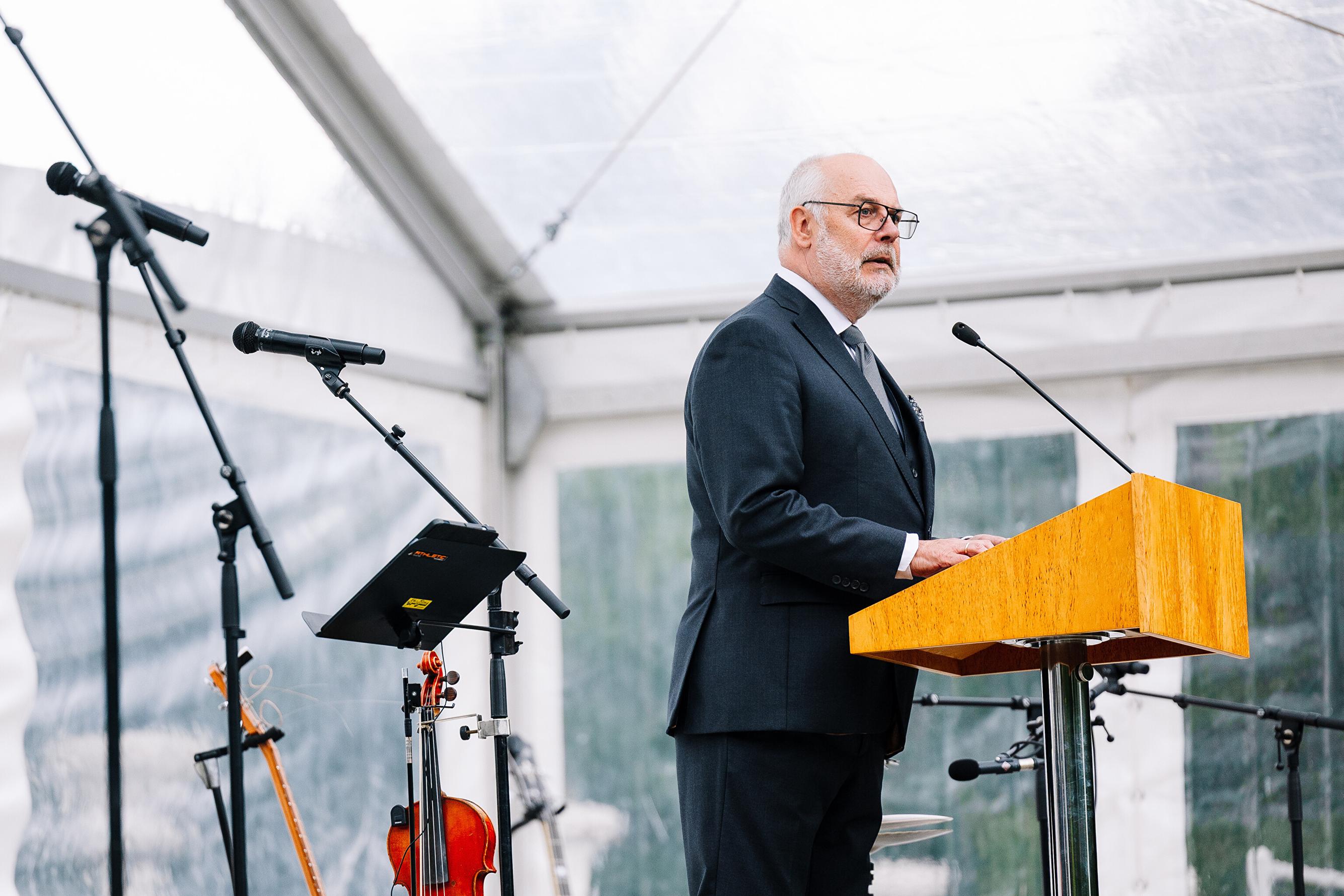
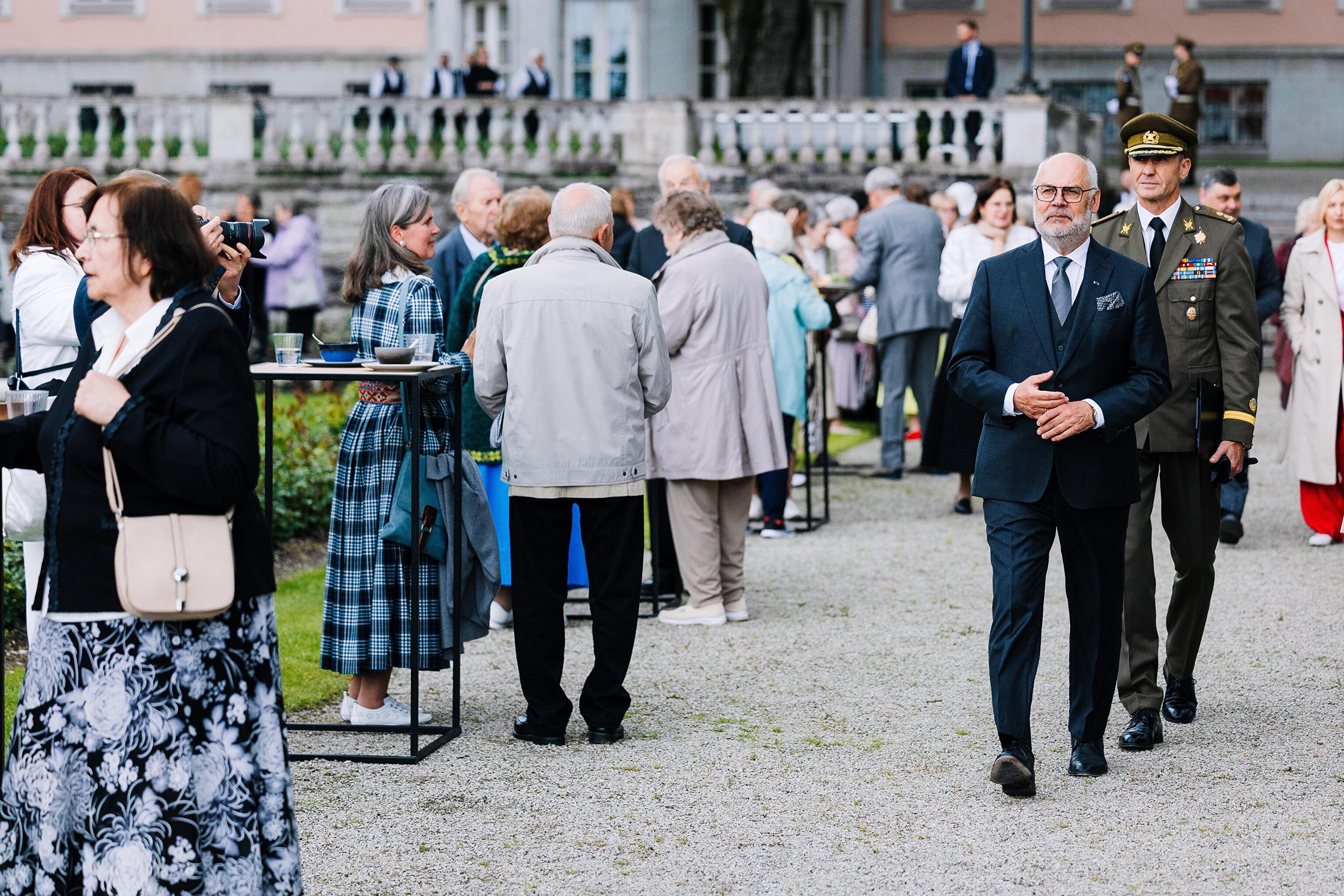
TALLINN – In the rose garden of Kadriorg Park, in front of the presidential palace, Estonia gathered on Sunday to remember the victims of the juuniküüditamine, the June deportation, on the 85th anniversary of one of the most painful nights in its history. At the proposal of Eesti Memento Liit, the President of the Republic, Alar Karis, had invited representatives of those deported by the Soviet occupation authorities to Kadriorg on 14 June. The opening addresses were delivered by the head of state himself and by the Minister of Justice and Digital Affairs, Liisa-Ly Pakosta.
It was a ceremony of survivors and descendants: a few hundred people, many of them elderly, representing all the families that had been affected. That, after all, was the meaning of the president’s opening words.
“So today all of Estonia is here”
Karis began by thanking those present for coming to Kadriorg, and said that through them their fellow deportees from every corner of the country were also present in spirit, together with all those whose graves remain in foreign lands and those who, having survived that brutal journey, now rest in their homeland. “So, in truth, today all of Estonia is here,” he said.
The president then made a personal gesture, unusual in an official address. He said he had just been looking through his mother’s notebook, in which she had recorded the story of their family during the hardest years: who was deported in 1941 and who in 1949, some on both occasions; who disappeared, who remained in Siberian soil, and who managed to return home. “So much pain,” Karis said. “Pain as in all your family stories. Pain throughout the history of Estonia.”
Speaking before those gathered, the head of state evoked the broken lives of those families: people with whom joys and worries had been shared, with whom one had laughed until tears came, studied, sung and played. All of this, he said, was interrupted by “the indifferent cruelty of a foreign power, the occupiers’ fear of our people, and a vision blinded by a totalitarian utopia”.
In Estonia, he continued, everyone had someone whose fate caused anguish, someone to mourn or whose return was awaited, someone to whom letters were sent from wounded hearts, or parcels put together by taking food from one’s own table, when at last the chance arose. This was done in uncertainty over one’s own fate, Karis said, “but with love in the heart, and in this way holding fast to our Estonia”.
A warning drawn from memory
The final part of the speech became a warning. The Estonian people, the president said, were “stronger than that inhuman cruelty”, because they knew that injustice must not prevail and that evil could not be allowed the last word. They preserved their stories and their songs, their language and their culture — also, he stressed, thanks to the will to live of the victims of deportation and to their firm conviction that they were spiritually stronger and morally superior to the occupiers. This, according to Karis, made it possible to return to normal life and to rebuild a free and democratic Estonia.
For precisely this reason, he insisted, the past must be remembered: “because those same crimes committed by the occupiers against our people, and those mechanisms for producing fear, are also at work in the world today”. There are always ideologies that find a justification for violence, he warned; lies and confusion are always spread in order to carry out evil; and unfortunately there is never any shortage of people who end up believing them, or who simply look away. His closing words were an appeal: “Let us protect one another and protect a free Estonia.”
A day of mourning across the country
The ceremony at Kadriorg was only one part of a national day of remembrance. Across Estonia, commemorations were held with speeches, wreath-laying ceremonies and prayers for the deported and the fallen. On the evening before, the victims had already been remembered in Käru, in Järva County.
In Tallinn, Inimõiguste Instituut once again brought the installation Pisarate vagun into public space, as it has done every year since 2013. Since 2024 it has been accompanied by a graphic narrative by the artist Veiko Tammjärv, reconstructing in images how the 1941 deportation began — a tool designed for those who do not read long historical essays, but who can be reached by images and by human stories. At the Maarjamäe Memorial to the Victims of Communism, new plaques bearing the names of victims were unveiled along the wall of remembrance, and a representative of the Ministry of Defence laid a wreath at the foot of the monument to the officers.
In the preceding days, along the tracks at railway stations and in some of the country’s ports — the places from which thousands of people began their journey into the unknown — Naiskodukaitse had arranged for black-and-white mourning ribbons to be fixed in place, bearing the message: “I will not forget you.”
What happened on the night of 14 June 1941
On the night between 13 and 14 June 1941, between one and two in the morning, operational groups of four men — usually led by a security agent — knocked on the doors of hundreds of homes across Estonia. Families woken from sleep were read an order declaring them arrested or expelled from their homeland; there had been no court judgment. They were given anything from ten minutes to a couple of hours to pack, in theory up to 100 kilos, though the rule was often ignored. They were then loaded onto lorries and taken to railway stations, where trains made up of cattle wagons were waiting: adult men were placed in wagons marked with the letter “A”, for arrested, while women, children and the elderly were placed in those marked “B”.
In the course of that operation, the Soviet security apparatus deported an estimated 10,000 people to Siberia. Among the victims were 132 children under the age of one — some of whom were born during the journey, inside the wagons — 1,378 children aged up to seven, and 15 elderly people over the age of 80, the oldest of whom was 87. Around 6,000 people, including children, women and men, died of hunger and exhaustion or were killed.
Archival research by historians at the Estonian Institute of Historical Memory firmly dismantles the propaganda myth that the deportation was dictated by military necessity. The majority of the victims were not people who could be considered militarily “dangerous”: more than two-thirds were family members of the arrested heads of household, and around a quarter were minors. The aim of Stalin’s regime, the scholars conclude, was to destroy the national elite of a newly conquered territory and to instil terror in the population, showing that even women, children and elderly people with no involvement in any activity were not safe.