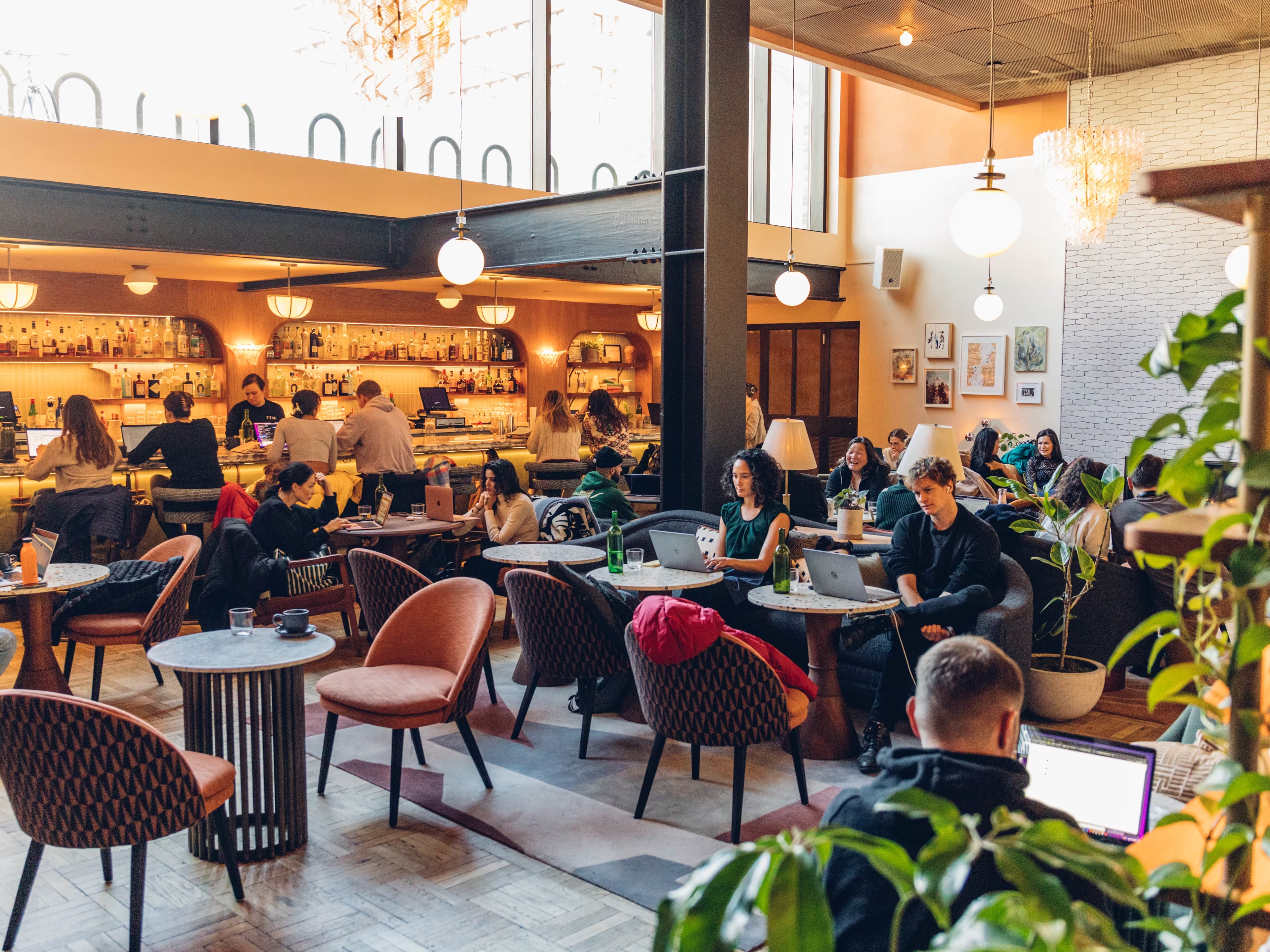
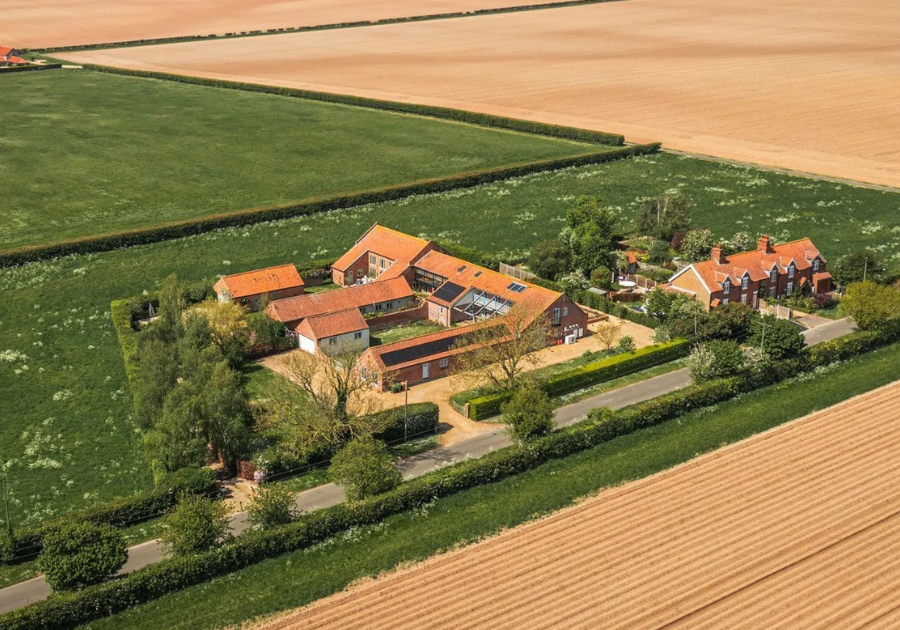
A small digital firm: six, seven people. They pack their bags, take laptops, cables and a Starlink dish, leave the city office and for a week move out to a converted barn deep in the countryside. There is a pool, a tennis court, footpaths to walk and an air quite unlike the city's. They carry on working online, as they always have, even on the warmest days spent in front of a screen. But here they share something else: they sleep under the same roof, they cook together, they make time for a walk, and in the evening they stop and talk. It is not a holiday, but nor is it only work. It is a new form of professional life together, scarcely imaginable to our parents and grandparents: the work remains, but the way it fills the days and builds relationships has changed.
For five years now Britain's boardrooms have been waging a culture war over precisely this. CEOs proclaim "the great return"; Amazon has hauled its people back five days a week, John Lewis has settled on three, and the likes of Lord Sugar and Stuart Rose line up to tell anyone who will listen that working from home is not proper work. The young, in this telling, are quiet-quitting snowflakes allergic to graft. It is a convenient picture, and a false one. What is described here is neither an exception nor a generational affectation, but the concrete expression of a deeper change for which the evidence is now solid. Before writing it all off as disengagement, one would do well to understand the reasons for it.
It isn't laziness. It's a different order of priorities
Start with the British data, because it is unusually good. Researchers at King's College London, drawing on more than a million Labour Force Survey observations, found that the share of workers willing to comply with a five-day office mandate has fallen to 42 per cent, down from 54 in 2022. Among women, nearly two-thirds say they would quit or look elsewhere rather than return full-time; among fathers of school-age children, the figure has climbed from 38 to 53 per cent in two years. This is not a fringe. According to the Office for National Statistics, more than a quarter of British workers are now hybrid and around one in eight fully remote, giving Britain the second-highest adoption of hybrid working in the world. The "great return" is, in the hard numbers, a great refusal.
The international picture says the same. Deloitte's annual survey of Generation Z and millennials, now in its fifteenth year and drawing on more than 22,500 responses across 44 countries, finds these cohorts placing stability, skills and wellbeing ahead of the rapid climb: only a quarter of Gen Z want fast promotion. Randstad calculates that the average under-thirty now stays in a first job barely 1.1 years, against 2.8 for Generation X — not restlessness for its own sake, but a search for the growth employers fail to offer. One in three expects to move on within the year. They leave because they find no reason to stay.
The heart of the change is a shift in meaning. For boomers and much of Generation X, work-life balance was a luxury to be bargained for, a line to be wrung out of the pay packet. For those in their twenties today it is a given: they refuse routine overtime, they defend their boundaries, they count mental health among the non-negotiable conditions. They work to live, not the other way round. Whoever reduces all this to laziness, or an inability to put in the hard yards, mostly proves they have not understood it. They speak with the conditioned reflex of the keyboard boomer: a generation that, for all its difficulties, could picture what its life would look like from twenty to forty. That certainty is gone. And not infrequently the very people handing out lessons on sacrifice are those who never truly knew precarity — who always had a safety net beneath them, or who still draw on someone else's money.
Fair pay, not exploitation
Here the British case is starker than almost anywhere, and it is the part the lecturers tend to skip. The Resolution Foundation's landmark Ending Stagnation report found that fifteen years of flatlined wages have cost the average worker around £10,700 a year in lost pay growth. Nine million younger workers have never known an economy with sustained wage rises. Real pay was not expected to claw back its 2008 level until 2027. Millennials are half as likely to own a home, and twice as likely to be renting privately, as their parents were at the same age.
The old formula — sacrifice now, be rewarded later — has simply stopped paying out. When a deposit on a first flat swallows a decade of saving, when the commute costs a week's groceries, and when full-time workers are queueing at food banks, "sacrifice now" forfeits its moral authority. Hence the flat refusal of exploitation dressed up as paying one's dues, and the entirely sacrosanct insistence on being paid for what one actually does.
Those days in the countryside have a technical name
The barn in the fields is no whim; it is a classified phenomenon. As early as 2022 a paper in the World Leisure Journal set out the first taxonomy of the "workation", distinguishing the solo version, the coworkation and the workation retreat. This belongs to the third — the collective, do-it-yourself cousin of what large firms call the corporate retreat. And the trend is a current, not a trickle: industry surveys for 2026 record a 308 per cent rise in countryside settings for company retreats between 2023 and 2024, with most organisers running remote or hybrid teams and more than half of fully remote firms calling such retreats essential.
Britain pushed the underlying idea further than most. It hosted the world's largest trial of a four-day week — 61 companies and some 2,900 workers, full pay for four days — and the results, assessed by Cambridge and Boston College, were emphatic: burnout fell by 71 per cent, stress by 39, while revenue broadly held. Fifty-six of the 61 firms kept the shorter week; a later trial saw every participant do the same. The staycation boom did the rest, turning shepherd's huts and barn conversions into makeshift offices. The farmhouse these young people chose is the private, friendly version of all of it.
A question not to be left unsaid
Here the sharpest contradiction opens up. The very generation that demands clear lines between life and work happily embraces a format that dissolves them: one works, eats, sleeps and unwinds in the same place, with the same people. Is it rest, or is it work annexing the last reserve of free time?
The evidence holds both answers at once. The retreat heals a real wound of remote work — the literature is clear that isolation erodes belonging and the support of colleagues, feeding stress and anxiety; being together in person nourishes a deep human need. Yet the reverse is just as well proven: most remote workers struggle to switch off, four in five check email outside hours, and the always-on mentality grinds people down. There is a grim irony in the politics here. Labour came to office promising a legal "right to switch off", so that, in its own words, homes would not become 24/7 offices. The pledge was then quietly dropped from the Employment Rights Act, with one government source pronouncing it "dead", before ministers half-revived it as a vague future code of practice. The generation that most wants the boundary was promised it in law and handed an IOU. A badly conceived workation, meanwhile, can turn that week in the country into an open-air office one never leaves.
Everything, then, depends on who decides, and why. It is one thing for a company to dispatch its staff to bond under the guise of a holiday; quite another for a band of friends and co-owners to choose, freely, to work with their feet in the grass. The owner of the time changes — and with it the meaning of the whole undertaking.
An older rediscovery
There is, lastly, an echo that should not be missed, and it lands with particular force in Britain. This is the homeland of the so-called Protestant work ethic, the country Max Weber half had in mind when he traced the modern gospel of labour: idle hands, the dignity of toil, a person's worth proved by industry, presenteeism as a virtue. To watch Britain now question the cult of the desk is to watch a culture interrogate its own inheritance.
The Catholic tradition begins somewhere else, and it sounds remarkably like the slogan of these young workers. "We work to live, not live to work," we often say among ourselves — and it is almost the paraphrase of a principle the Church's social teaching has set out for generations: the primacy of the person over work. John Paul II's Laborem exercens put it without ambiguity — work is for man, not man for work — and made it the measure of any economic system. Before it, Rerum Novarum had bound the worker's dignity to a just wage, not to exploitation passed off as virtue. And there is rest: the claim to time reclaimed from work, which today sounds like a generational novelty, is written into the oldest of laws — the seventh day. Laudato si' restated it as a brake on the technocratic acceleration that devours every human rhythm.
Seen from here, the barn with the satellite dish is not merely a fashion. It is a rediscovery — perhaps unwitting, perhaps still only aesthetic — of the conviviality and the rest that the Christian tradition has always defended. It remains to be seen whether these young people are truly recovering the meaning of work, or merely furnishing the cage more tastefully. But the right question, this time, is theirs. And that is no small thing.
E.F.
Silere non possum