
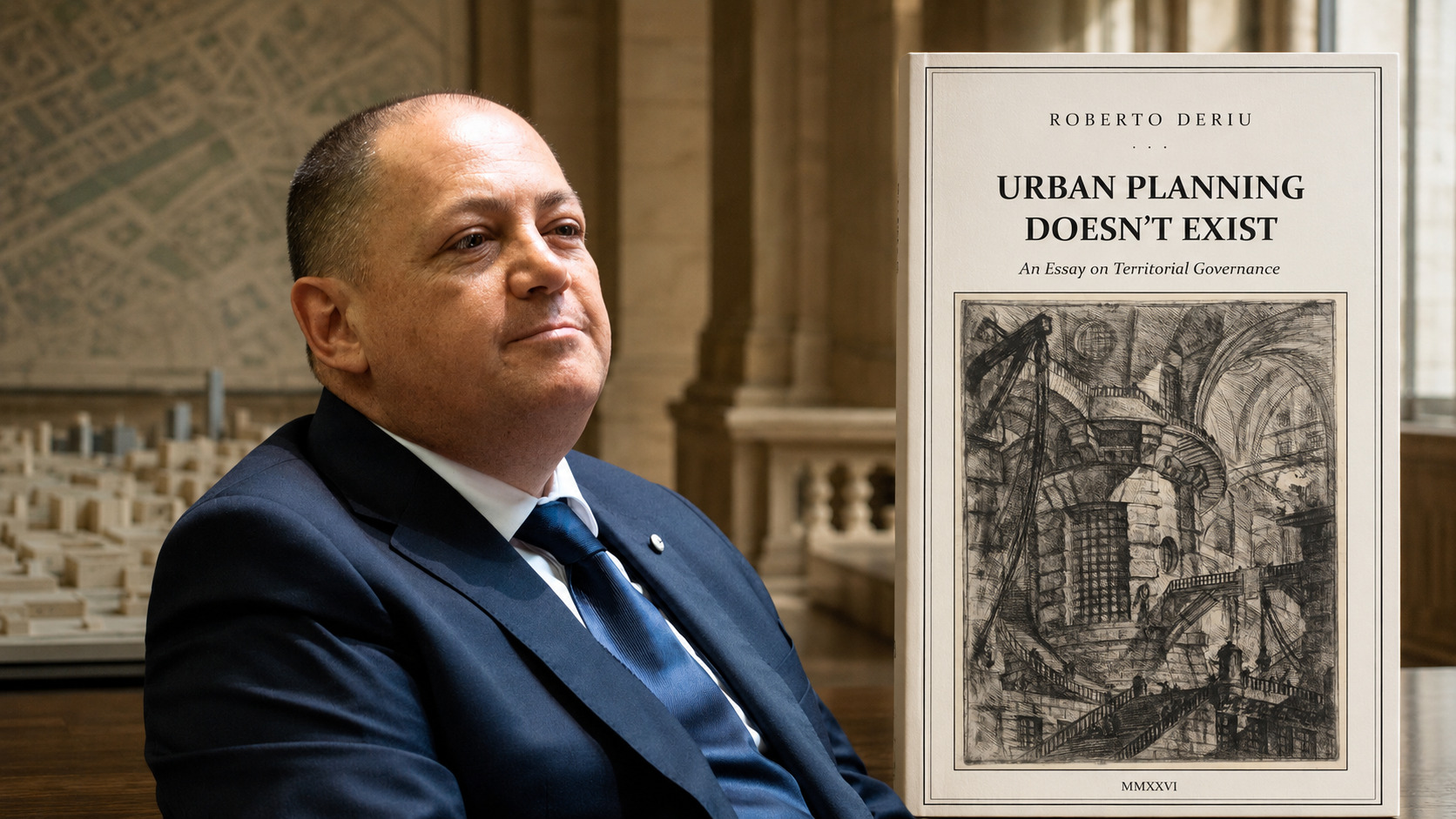
What remains of urban planning when the plan invariably comes after the decisions have already been taken elsewhere? This is the question at the centre of Urban Planning Does Not Exist, Roberto Deriu’s new essay. The book takes to its most radical conclusion an idea the author has been repeating for more than a decade, at conferences and in council chambers, always prompting the same reaction: a half-smile, the mild disbelief usually reserved for a well-judged provocation. From the opening pages, however, Deriu makes clear that the phrase expresses a diagnosis formed through thirty years in public administration. The entire book sets out to prove it.
Readers who have already encountered Il principe della Repubblica, published this year by Castelvecchi, edited by Carlo Sanna and with a preface by Arturo Parisi, will recognise both the author and a method he has already tested elsewhere. Deriu says so explicitly in the preface. From that volume, which examined democracy as a method, he takes the virtue of patience and the Greek distinction between Chronos and Kairos, since territories have rhythms of their own that rarely coincide with those of the people who govern them.
The same thread runs through all his work, from La democrazia rapita in 1998 and Scacco matto in 2011 to Vincere in politica con la trattativa in 2024, when the method finally acquired the name it deserved. Urban Planning Does Not Existis its most practical application, addressing a subject the author knows from within. He served in Nuoro’s municipal government from 2000 to 2005, was President of the Province of Nuoro from 2005 to 2014 and is now a member of the Regional Council of Sardinia, where he leads the Democratic Party group.
A thesis in three stages
The central argument is contained in the title itself. Deriu develops it through three distinct propositions, each of which dismantles a misconception common among planners and public administrators.
Urban planning does not exist as an autonomous science. There is no neutral body of expertise capable of designing a city from above, because every planning decision depends on economics, demography and politics. The discipline always comes later, giving form to decisions made elsewhere.
Nor does it exist as an effective power. Master plans may prohibit, restrict and zone, but they remain a dead letter without the social agreement needed to support them. A prohibition that lacks consent merely generates applications for exemptions and legal disputes.
What remains, therefore, is bargaining. “What exists is planning politics - that is, negotiation - not urban planning,” Deriu writes, summing up three hundred pages of argument in a single sentence.
The strength of this thesis does not come from academic study alone. Deriu describes how he learnt to distinguish, almost at a glance, between an administrative measure that would produce a tangible result and one destined only to generate further paperwork. The difference never lay in the technical quality of the document, but in what had happened around it: who had been heard, who had been persuaded and who had agreed to make a concession.
“The sidewalk knows things the plan drawing does not know,” he writes of his years in Nuoro’s municipal government: where people actually cross the road, which square is genuinely used and which remains nothing more than a patch of colour on a plan.
A journey through history, ending in Sardinia
The essay builds an extensive historical survey around this thesis. It begins with the grid cities of ancient Greece, when a static society allowed the design of a city to coincide with the city itself. It then moves through the corrective utopias and comprehensive plans of the twentieth century, Jane Jacobs’s revolt of the sidewalk against grand schemes imposed from above, and finally the contemporary fragmentation of urban planning as a discipline.
The closing section turns to Italian and Sardinian legislation. One chapter is devoted to what Deriu calls “endemic laws”: a system that advances through successive exemptions, from the national “Save the Home” legislation adopted by the Region to rulings by Sardinia’s Regional Administrative Court. The law thus confirms what the book’s historical analysis has already shown.
Principled negotiation, from Harvard to the governance of territory
The book’s final proposal returns to a method Deriu had already applied to politics in Vincere in politica con la trattativa: the principled negotiation developed by Roger Fisher and William Ury in the celebrated Getting to Yes, published in 1981 as part of the Harvard Negotiation Project and translated in Italy as L’arte del negoziato.
The method involves discussing interests rather than positions, separating people from the problem, developing several options before choosing between them and assessing possible agreements against objective criteria. Deriu says he tested these principles “where those scholars had not imagined it”: in council chambers and at the negotiating tables where decisions about territory are actually made.
This method leads to the proposal with which the book concludes: the closed table, where a mayor and a developer reach an agreement away from public scrutiny, should be replaced by an open conference, where the private party brings its resources and the public brings its rights - schools, rent-controlled housing and public spaces.
The exchange remains the same, Deriu observes, but the nature of the act changes: it becomes a contract rather than a favour. “A contract can be read, discussed, improved; a favour can only be suspected,” he writes, in one of the book’s most effective formulations.
London’s unintended confirmation
It is difficult to read these pages without thinking of a case that has become a standard reference in the United Kingdom whenever negotiated planning is discussed: the regeneration of the Heygate Estate in Elephant and Castle, London.
Southwark Council negotiated with the developer Lend Lease to reduce the proportion of social housing from 35 to 25 per cent. The decision was based on a financial viability assessment which, under the council’s internal policy, was withheld even from the planning committee responsible for approving the development. The document was classified as “private and confidential, not to be seen by planning committee”.
It took three years of legal action, including freedom of information requests, an appeal to the Information Commissioner’s Office and a hearing before the relevant tribunal, before the assessment was made public. It then emerged that the consultancy appointed by the developer itself had set the profit threshold above which a higher proportion of social housing would, by definition, be considered “unviable”.
Whatever view is taken of the final outcome, the Southwark case illustrates Deriu’s diagnosis with remarkable precision. The negotiation was taking place in any event, but it was being conducted somewhere hidden even from the elected representatives required to approve the scheme.
This is precisely the question at the centre of the book: where should the negotiation that inevitably takes place be conducted? In a forum that produces rules and public records, or in one that leaves behind only suspicion?
The United Kingdom has already provided a partial answer. After the Heygate case, several London boroughs, including Islington, Lambeth and Southwark itself, began requiring viability assessments to be published in full. Since December 2025, national guidance has made publication the default position. To use Deriu’s phrase, the open conference is already being put into practice.
A politics that negotiates
The essay ends with an image worth quoting in full, because it captures Deriu’s entire intellectual argument: “At the end there remains what was there at the beginning, finally recognised: politics that negotiates. Not a surrender, but the way a community decides about itself when no one can prevail alone.”
The conclusion is less resigned than the title might suggest. If urban planning as an autonomous discipline is an illusion that must be abandoned, politics as the art of reconciling competing interests remains, for Deriu, the only legitimate means of governing territory - provided that it is conducted openly.