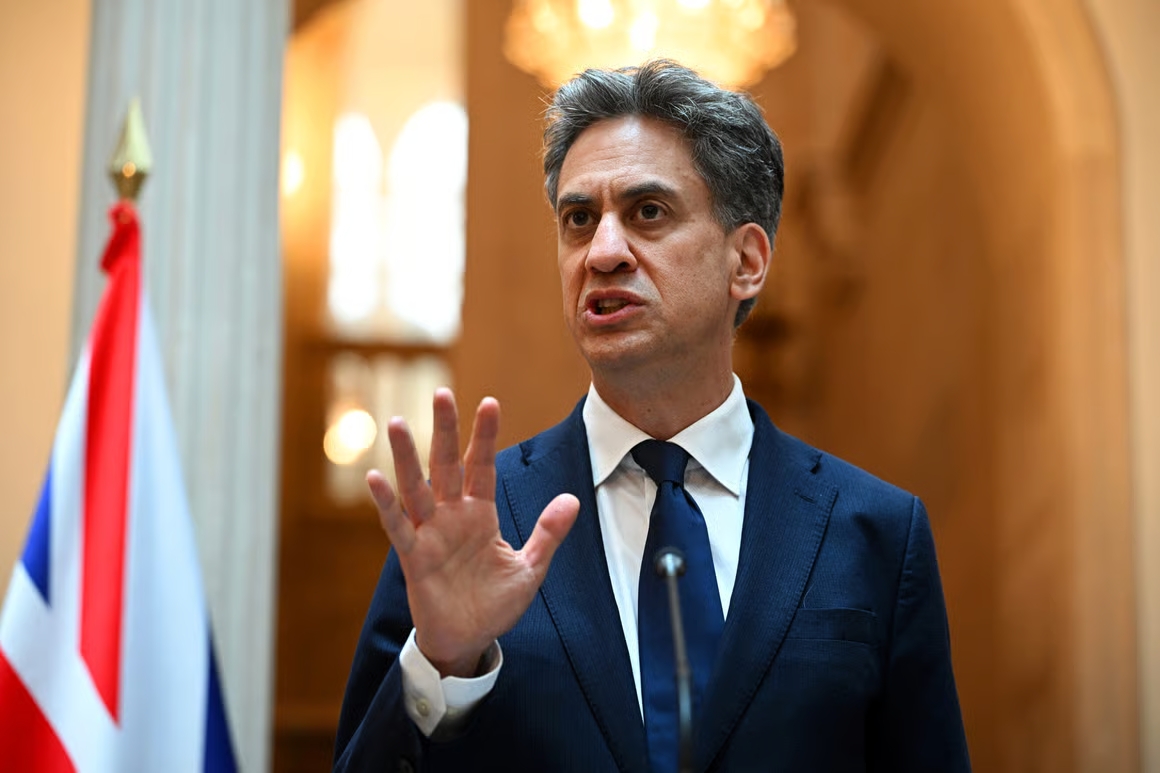
London - Yesterday, Tuesday 8 September, Foreign Secretary Ed Miliband announced in the House of Commons a new sanctions regime targeting Israeli settlements in the occupied Palestinian territories. That afternoon, his Israeli counterpart Gideon Sa’ar called a press conference in Jerusalem and ordered the closure of the British consulate in East Jerusalem. The two announcements came only hours apart.
The British measures include a ban on imports of goods produced in West Bank settlements, sanctions on companies and individuals providing services that support settlement expansion, including construction and financing, and further restrictions on arms exports to Israel. Anyone who continues to facilitate or finance such trade will be pursued “with the full force of the law”. The measures are expected to come into effect within six to nine months. In economic terms, they are limited compared with the overall volume of trade with Israel, which Miliband said the government had no intention of targeting: there will be no boycott of the State of Israel within its internationally recognised borders.
The most significant change is a legal one. Until yesterday, the British government regarded the settlements as illegal; it now considers the occupation as a whole unlawful, bringing its position into line with the advisory opinion issued by the International Court of Justice in July 2024. Miliband said the government accepted the United Nations definition of ethnic cleansing and that ethnic cleansing was taking place in parts of the West Bank, “perpetrated by terrorist settlers”. He accused Netanyahu’s government of turning a blind eye and said that some of its ministers had, through both their words and actions, supported the forced displacement of Palestinians. On Gaza, he spoke of growing evidence of war crimes, while leaving it to the international courts to determine whether genocide had taken place. In his speech, he also recalled that his parents were Polish Jews who had fled Nazism.
Miliband said the move had been accelerated by Israel’s publication of tenders for around 1,200 homes in the E1 area, between Jerusalem and Ma’ale Adumim: a project that would sever the territorial continuity of the West Bank and make a viable Palestinian state far more difficult to achieve. Over the summer, settler raids on Palestinian villages became more frequent and more violent, including sieges lasting several days and attacks on crews working for foreign news organisations. The move has been coordinated with other governments. Eleven other countries, including France and Canada, have pledged to introduce similar measures at national level and signed a joint statement describing the initiative as “a further turning point” in support of the two-state solution.
Sa’ar, in coordination with Netanyahu, announced four countermeasures. The first is the closure of the consulate in Sheikh Jarrah, East Jerusalem, which handles London’s relations with Palestinians in the West Bank, Gaza and Jerusalem; the British embassy in Israel will remain in Tel Aviv. Israel annexed East Jerusalem after the 1967 war and regards it as part of its “undivided” capital, a claim to sovereignty that the United Kingdom and most other countries do not recognise. Itamar Ben Gvir had called for the mission to be closed “today”. The second measure is the expulsion of British representatives from the US-led civil-military coordination centre in Kiryat Gat, which oversees the various stages of the plan for Gaza. The third is the termination of the activities of the British Support Team in Ramallah, the small military contingent that has for years trained the security forces of the Palestinian Authority.
The fourth measure is an entry ban on twelve British citizens accused of “antisemitic and anti-Israel activity”. Eleven are parliamentarians: Jeremy Corbyn and Zarah Sultana of Your Party; Labour MPs Diane Abbott, Naz Shah, John McDonnell and Richard Burgon; and Greens Hannah Spencer, Carla Denyer, Siân Berry, Ellie Chowns and Adrian Ramsay. The twelfth is lawyer Fahad Ansari, director of the organisation Riverway to the Sea, who is involved in an application to the Home Office seeking to have Hamas removed from the list of proscribed organisations.
Sa’ar described Miliband’s accusations as “outrageous lies” and London’s decision as “morally distorted”, accusing Britain of interfering in Israel’s autumn election campaign and of making the move with the forthcoming Labour conference in mind. He argued that thousands of Palestinians employed in the settlements would pay the price for the sanctions and warned that Israel reserved the right to take action, “at our discretion”, against the other signatory countries as well. He ended by urging foreign governments to abandon what he called “the dead end of sanctions and boycotts”. Israel’s opposition rejected the British decision but portrayed it as the result of a diplomatic failure by Netanyahu; the Palestinian Authority described it as “an important practical step”. Washington has backed Israel. US ambassador to Israel Mike Huckabee said the United Kingdom could face “repercussions or retaliation” from the United States if it goes ahead with the sanctions.
Andy Burnham became prime minister after Keir Starmer, whose initial position on the war in Gaza had cost Labour a substantial amount of support on the left. Burnham announced a “reset” in relations with Israel shortly after taking office, and Miliband’s announcement is the first concrete expression of that change. Since July 2024, the Labour government has recognised the State of Palestine, resumed funding for UNRWA, restricted military exports, imposed sanctions on ministers Ben Gvir and Smotrich and suspended negotiations on a free trade agreement with Israel; Sa’ar himself listed each of those measures. The Conservative opposition has attacked the government from a different direction. Shadow Foreign Secretary Tom Tugendhat told the Telegraph that Israel is one of Britain’s most important intelligence partners and that, when he was Security Minister, several terrorist attacks had been prevented thanks to that cooperation. In the Commons, he accused Miliband of seeking to brand Israel a “rogue state”. By the time the sanctions come into force, the Israeli elections will already have taken place. No date has been given for the closure of the consulate.