
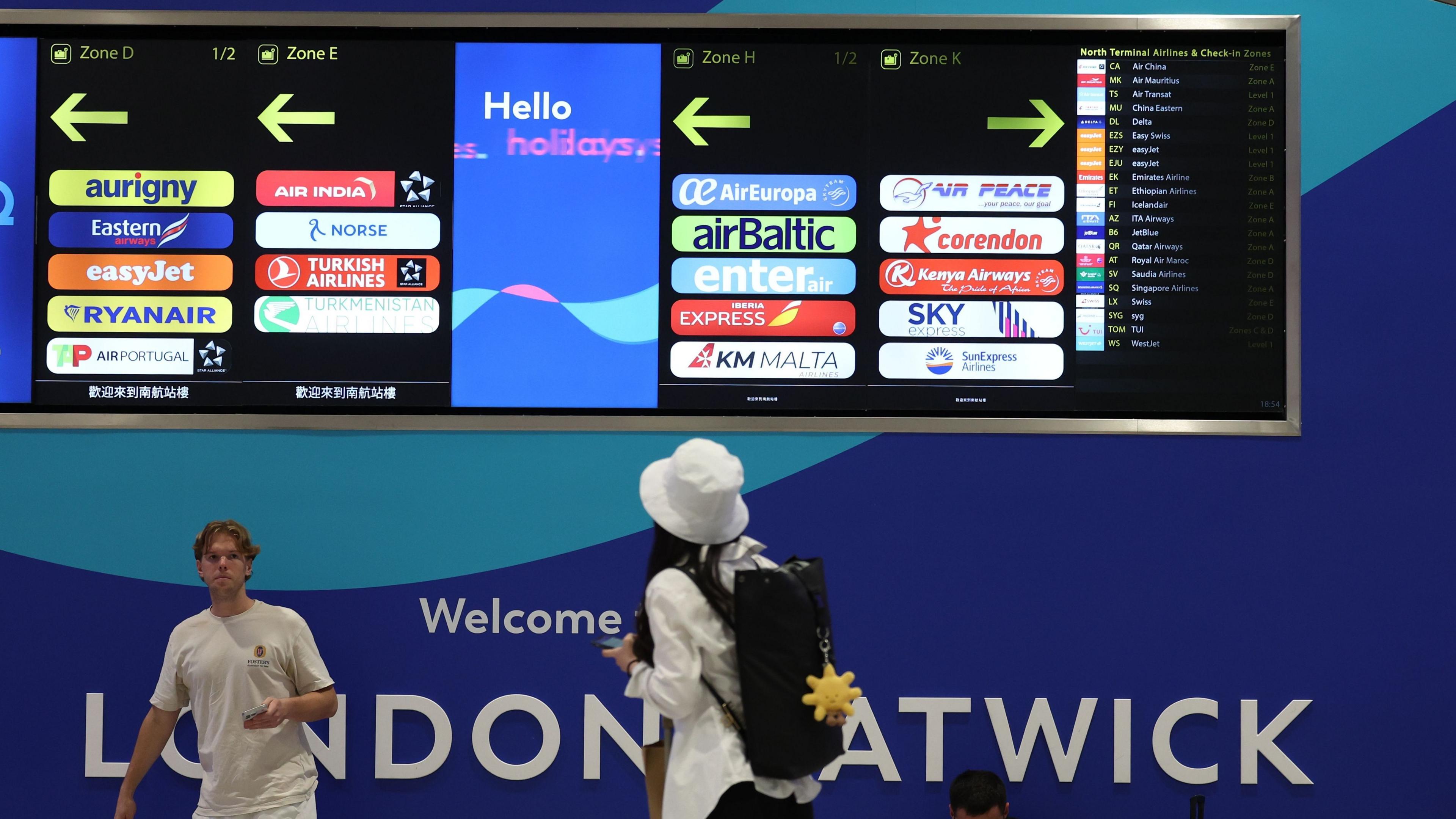
London – Earlier today, 8 September, around lunchtime, departures at some of the UK’s biggest airports began to be disrupted. At Heathrow, aircraft were held on the ground for around 40 minutes; traffic briefly resumed before being halted again. At 1.46pm, NATS, the company that manages air traffic control in the UK, issued its first update, saying it was investigating ‘a technical issue’ affecting departures and that its engineers were working on the problem.
More airports were affected as the afternoon went on. Heathrow, Gatwick, Stansted and London City were among the worst hit, along with Manchester, Birmingham, Edinburgh and Belfast. Disruption was also reported at Luton, Aberdeen, Glasgow and Southend, as well as at airports in Jersey and the Isle of Man. In Dublin, some services to and from the UK were delayed.
NATS traced the fault to its ‘flight processing system’, which processes the information needed to manage flights. The company has not yet explained which component failed or what caused the technical problem. To keep operations running safely, the flow of aircraft was sharply reduced. UK airspace was not completely closed and some flights continued to depart, but at a much lower rate than usual.
Heathrow initially said the problem was affecting departures, while arrivals were continuing as normal. Later in the afternoon, however, Eurocontrol also imposed restrictions on traffic bound for London: arrivals at Heathrow and Gatwick were temporarily suspended, while some incoming flights were diverted to Brussels, Amsterdam, Paris and Düsseldorf. The restrictions announced by Eurocontrol for London, southern England and Wales are due to remain in place until 9pm this evening.
At around 3.46pm, NATS said it had identified the problem within the flight processing system and that engineers were working ‘urgently’ to restore normal operations. A further update came at 4.59pm, when the company said a fix had been implemented and the system was beginning to recover. NATS warned, however, that it would take time for operations to return to normal.
Getting the system back up and running does not mean flight schedules immediately return to normal. After several hours of delayed or cancelled departures, aircraft and crews are out of position and airlines have to rebuild their rotations. Some carriers have warned that the disruption could continue into Wednesday.
The figures
Shortly after 4.40pm, Flightradar24 was showing almost 300 cancellations. British Airways had cancelled 96 flights, easyJet 92, KLM 20 and Lufthansa 12. The figure was still provisional.
Delays were far more widespread. According to Flightradar24 data, 352 flights to or from Heathrow were delayed, out of an average of around 1,300 movements a day; at Gatwick the figure was 281 out of 850, at Manchester 249 out of 650 and at Birmingham 101 out of 300.
EasyJet has said the disruption in the UK is causing delays across its European network and that some flights are unable to operate. British Airways has confirmed that its services have been affected and that it is in contact with passengers. Ryanair, meanwhile, says more than 65,000 of its passengers have been affected, with delays of up to eight hours and more than 50 flights cancelled.
Transport Secretary Heidi Alexander has said she was briefed on the disruption and that engineers had identified the source of the problem and were working to resolve it. She apologised to passengers and advised them to check the status of their flight directly with their airline. NATS has so far described what happened as a ‘technical issue’ and has not said what caused it.

What is NATS?
NATS is the UK’s main provider of air traffic control services. It has a public-private ownership structure: 49 per cent is owned by the Crown, 42 per cent by the Airline Group, 4 per cent by Heathrow Airport and 5 per cent by the employee share trust. It manages traffic in UK airspace and in the eastern part of the North Atlantic, and also provides air traffic control services at airports. Its two main control centres are at Swanwick in Hampshire and Prestwick in Ayrshire.
Its chief executive is Martin Rolfe. He took temporary charge of the company in May 2015 and was appointed CEO in October that year. Since then, he has had to deal with two major nationwide disruptions, in August 2023 and July 2025, as well as criticism from airlines over other problems reported this year.
The 2023 collapse
The most serious previous incident occurred on 28 August 2023, the summer bank holiday Monday. A problem with the flight plan processing system forced NATS to reduce the capacity of UK airspace for around six hours. The automated system was no longer able to process flight plans normally and some of the work had to be done manually.
According to NATS, around 1,500 flights were cancelled that day, with further cancellations in the days that followed as airlines tried to restore their schedules. An independent review commissioned by the Civil Aviation Authority estimated that more than 700,000 passengers were affected: around 300,000 by cancellations, 95,000 by delays of more than three hours and at least another 300,000 by shorter delays.
The collapse was caused by an exceptional combination of data contained in a flight plan. NATS’s initial investigation found that the system had encountered two separate waypoints, thousands of miles apart, which were identified by the same code. Both the main system and the backup system entered a safety mode that prevented flight plans from being processed automatically. NATS modified the software in the days that followed.
The CAA subsequently referred the incident to an independent panel. Its final report, published in November 2024, made 34 recommendations covering NATS, airlines, airports, the regulator and the government. Those directed at NATS included reviewing its contingency arrangements and the management of engineering resources, as well as communicating more quickly with airports and airlines when there was a risk of major disruption.
The incident was also examined by the House of Commons Transport Select Committee. Ryanair chief executive Michael O’Leary accused NATS of having some of its engineers ‘at home watching morning television’ while the system was in crisis. Rolfe rejected the allegation: ‘We are a very serious organisation. We would never operate in that way.’ He said there had been the required number of engineers at Swanwick and that other specialists were able to provide support remotely.
The July 2025 failure
On 30 July 2025 there was another disruption at Swanwick. On that occasion, NATS described the issue as ‘radar-related’. The technical fault was quickly resolved by switching to the backup system — according to reports at the time, the system was unavailable for around 20 minutes — but restrictions and the resulting backlog affected traffic for several hours. More than 150 flights were cancelled.
The following day, Alexander summoned Rolfe and described the incident as ‘an isolated event’, adding that there was no evidence of hostile activity or a cyber-attack. Ryanair again called for the NATS chief executive to resign; its chief operating officer, Neal McMahon, said no lessons had been learned since 2023. EasyJet also criticised the fact that another air traffic control failure had caused widespread disruption during the busy summer period.
In 2026, Ryanair had already blamed NATS for two further incidents. On 22 June, the airline said a failure of Bristol’s ATC systems had caused four cancellations and delays of more than three hours for over 2,000 of its passengers. On 7 July, it reported another ‘UK ATC system failure’, which it said delayed 155 flights and almost 30,000 passengers. On both occasions, Ryanair called on Rolfe to step down. These figures were released by the airline itself and should be distinguished from the major nationwide incidents of 2023, 2025 and today.
Today’s incident has once again focused attention on the processing of flight data, but it is not yet possible to establish whether the fault affected the same component that failed in August 2023. At the time, NATS referred to its flight plan processing system; today it has used the broader term flight processing system. The technical cause of the disruption will need to be established before it is possible to determine whether there is a direct link between the two incidents.
What passengers are entitled to
In the UK, the rights of passengers affected by cancellations and long delays are governed by UK261, the Assimilated Regulation 261/2004. The cause of the disruption matters primarily in determining whether passengers are entitled to fixed financial compensation. The Civil Aviation Authority regards air traffic control decisions as events that can amount to ‘extraordinary circumstances’, but says each case must be assessed on its own facts and according to the measures taken by the airline.
Airlines’ obligations to provide care and rerouting remain in place even when the carrier is not responsible for the disruption. If a flight is cancelled, passengers can choose between a refund for the unused part of their ticket or an alternative flight, either at the earliest opportunity or at a later date. If another airline can get a passenger to the same destination significantly sooner, the CAA says they may be entitled to be rerouted on that service; passengers are advised to agree this with their own airline before buying another ticket themselves.
While passengers are waiting, the airline must also provide reasonable meals and refreshments, means of communication and, where necessary, hotel accommodation and transfers. If the carrier cannot arrange this assistance directly, passengers can pay reasonable costs themselves and claim them back afterwards. It is therefore advisable to keep boarding passes, messages received from the airline and receipts for any expenses.
The disruption has already reignited the dispute between NATS and some of the major airlines. Ryanair has once again called for Rolfe to resign, while Wizz Air has said NATS is in need of urgent reform. For NATS, the immediate priority is to clear the backlog that has built up at airports now that the flight processing system is working again.