It is striking to see Écône on the front pages of international newspapers, in lead stories and discussed in editorial meetings where the Vatican normally appears only when a Pope dies, a new Pope is elected, or a scandal breaks. It is more striking still because, until only a few days ago, the Society of St Pius X remained, for much of the public, a distant label: “the Latin Mass people”, a stubborn minority, a liturgical nostalgia confined to the margins of Catholic life.
Today, everyone is talking about it. In Italy, Corriere della Sera put the challenge to the Pope on its front page; Il Fatto Quotidiano wrote of space being opened up for the MAGA world; La Stampa produced a dossier; la Repubblica explicitly linked the Lefebvrist affair to the radical right. Even the international press has treated the consecrations as a rupture that goes beyond the bounds of religious reporting. It is unusual for a matter of canon law to attract this degree of attention. That is precisely why it is necessary to ask what the press is really seeing.
Rome, naturally, has played its part. The consecration of four bishops without a pontifical mandate has clear canonical consequences and gives newspapers a simple, immediate and readily understood word: schism. But it would be naïve to think that the interest arises solely from the Holy See’s document. Rome issues documents, notes and decrees with great frequency. Many remain confined to the religious pages. Certainly, in this case the Dicastery has pronounced on priests illicitly consecrated as bishops, but I am certain that most of the world’s population could not care less.
The real story, then, lies elsewhere. To understand it, one has to look at the matter through the eyes of a news editor on a general-interest newspaper. The focus is plainly the political world, which sees in the Society an ally, a symbol and a possible rallying point. Écône was not attended only by faithful and priests. Mario Borghezio, Roberto Fiore and a delegation from Forza Nuova were also there. They were real, visible presences, welcomed into a ceremony intended to resemble a gathering of resistance. Borghezio spoke openly of a “metapolitical” question, of Tradition resisting the collapse of modernity. That is political language before it is religious language. And the Society of St Pius X has always done everything it could to ensure that this fusion of the sacred and the political remained attached to it.
This is the decisive point. Liturgy explains the form. Politics explains the significance.
For many faithful, the older Mass has an authentically spiritual dimension. It would be unfair to reduce those who attend it to activists of the radical right or voters looking for symbols of identity. There are young people, families, priests, religious and bishops who find in it silence, continuity, discipline and beauty: a liturgical form which they believe more readily fosters recollection and preserves a religious grammar they regard as solid.
These are faithful who live ordinary lives in the Church’s parishes and associations, in full communion with and obedience to Rome. They may prefer the older rite out of personal sensitivity, without setting it against the liturgy reformed by Paul VI and without turning a spiritual preference into an ecclesial or political claim. They know that the validity of the Eucharist does not depend on language, vestments or the orientation of the altar: the sacrament remains the same.
In other circles, however, which prefer to describe themselves as “traditionalist” rather than simply Catholic, even while formally remaining within the Church, an entire system of belonging has developed around the older liturgy over the years, extending far beyond the missal.
The Mass becomes the visible sign of a wider worldview: hostility towards pluralism, interreligious dialogue, religious freedom and the Second Vatican Council; nostalgia for a social order in which Catholicism does not engage with modern society, but claims to judge it from above and bring it back under a single discipline.
This is where the themes the far right knows well and exploits with skill come into play: the campaign against people’s rights, the obsession with “gender”, the family recast as an instrument of exclusion, and the portrayal of immigration as both a religious and a civil threat. These are words which, removed from their pastoral and theological context, are turned into slogans of identity. They no longer serve to enlighten consciences. They serve to draw a boundary and identify an enemy.
Catholic teaching on life, marriage and the dignity of the human person is not the same thing as a far-right political programme. That distinction is essential. The problem begins when those words are used to build a permanent political platform, when the Gospel becomes a language of mobilisation against someone: today against gay people, tomorrow against women, the day after against migrants, and against anyone who does not share a certain idea of nation, family and social order.
The Society of St Pius X does not have the numbers to amount to a mass phenomenon within the Catholic Church. Its figures are often repeated as proof of irresistible growth: hundreds of priests, schools, priories, communities spread across many countries, and thousands of people gathered at Écône. These figures show an organised, international structure. They do not, however, demonstrate a strength comparable to the ordinary life of the Catholic Church.
Even images of major celebrations can mislead. When all those who wish to attend the older Mass, coming from different regions and countries, converge on the same place for an exceptional event, the church or marquee will inevitably be full. That is not sociological proof of a majority. It would be like gathering all the faithful of a diocese in a single parish and then claiming that parish represented the whole of religious practice in that area.
The comparison does not withstand scrutiny. Ordinary Catholic celebrations are spread across thousands of parishes, communities, chapels, hospitals and religious houses. A crowd concentrated in one place creates an immense visual impact, but tells us nothing, in itself, about the true scale of the phenomenon. The Society understands the value of such images very well: the crowd, the vestments, the young people, the length of the rite, the rain endured together, the sense of being a besieged but faithful people. It is an exceptionally powerful act of identity-building.
That is also why they sought, so insistently, a photograph beside Leo XIV: it would have served to legitimise, in the eyes of their faithful, a communion which does not exist in reality. Prevost, however, chose not to allow himself to be used. He has always left the door open to unity; he has not done so for pretence. Since 2009, years have passed, Popes have come and gone, and opportunities for dialogue have multiplied, yet the Society has taken no real step towards Rome. There was therefore no reason once again to offer alibis, images or gestures that could be turned into propaganda while yet another challenge to the Pope’s authority was being prepared.
And that is precisely what interests radical politics. Millions of people are not needed to influence public debate. What is needed are symbols, transnational networks, simple language and the ability to turn frustration into belonging. A small, cohesive and disciplined community can wield cultural influence far beyond its numbers when it offers a political movement a ready-made religious imaginary: authority, order, purity, hierarchy, external enemies, the decline of civilisation and the promise of restoration.
The tragedy begins when the Gospel is used as electoral material or as a moral guarantee for interests that have little to do with the Gospel. It is not only about the “cash-filled envelopes” handed out to these communities. Economic interests can also take more ordinary forms: the network of schools, associations, publishing ventures, conferences, fundraising, digital channels, events, cultural products and identity campaigns. Every community has the right to support and organise itself. The problem arises when the perception of a permanent emergency becomes the fuel of the organisation, when fear of the world strengthens support, increases donations and consolidates internal power.
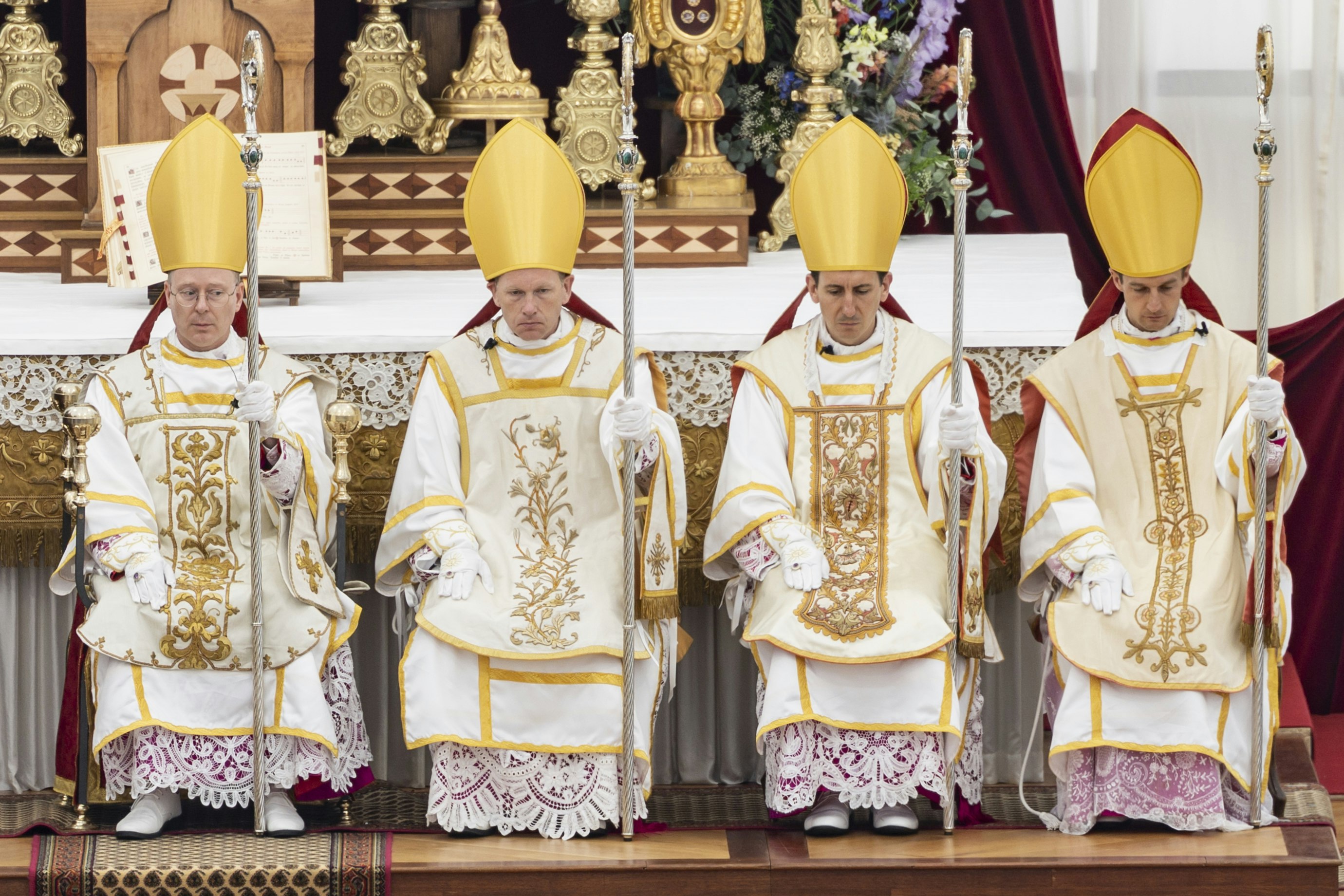
At Écône, alongside expensive vestments inspired by 1988 but newly made, and rites presented as unchanging, there were also modern tools of mobilisation, including online donations. It is evidence of a reality able to use ancient language and highly modern techniques to build belonging, visibility and resources. This is why the general press is talking about it. Not because it has suddenly discovered Latin or canon law. It is talking about it because it recognises a story about power, identity, the far right and the way religion can be turned into a political platform.
The question, then, is not confined to the Society of St Pius X. It concerns all those realities which, while formally remaining in communion with Rome, use Tradition as the banner of a permanent cultural war. They sow discord and calumny, as the Marco Agostini case showed. It concerns a Church sought not for Christ, but for the usefulness it may have in fighting battles.
The Lefebvrist affair has become national and international news for this reason. It is not simply about four bishops consecrated without a pontifical mandate, after even mimicking the traditional parchment scroll - that is, the Pope’s appointment - with another scroll containing a statement prepared to justify the absence of that mandate. It concerns an attempt to turn Catholicism into a fortress of identity, in which Tradition is no longer a living memory to be received and safeguarded, but a banner raised against the Church and the world. Newspaper reporting clearly shows the move from the ecclesial question to the political one: Corriere recorded the presence of Borghezio and Fiore at Écône, together with their “metapolitical” language; la Repubblica reconstructed the historical link between the Lefebvrist milieu and the far right; Il Fatto interpreted the operation also in relation to the space occupied by the American Catholic right and the MAGA universe.
As for the numbers, those same reports speak of several hundred priests, hundreds of places of worship and a structured international presence, while placing the crowd at the Écône ceremony at between roughly 15,000 and 20,000 people: figures which show a concentrated mobilisation, not a comparative measure of ordinary Catholic practice.
fr.P.B.
Silere non possum