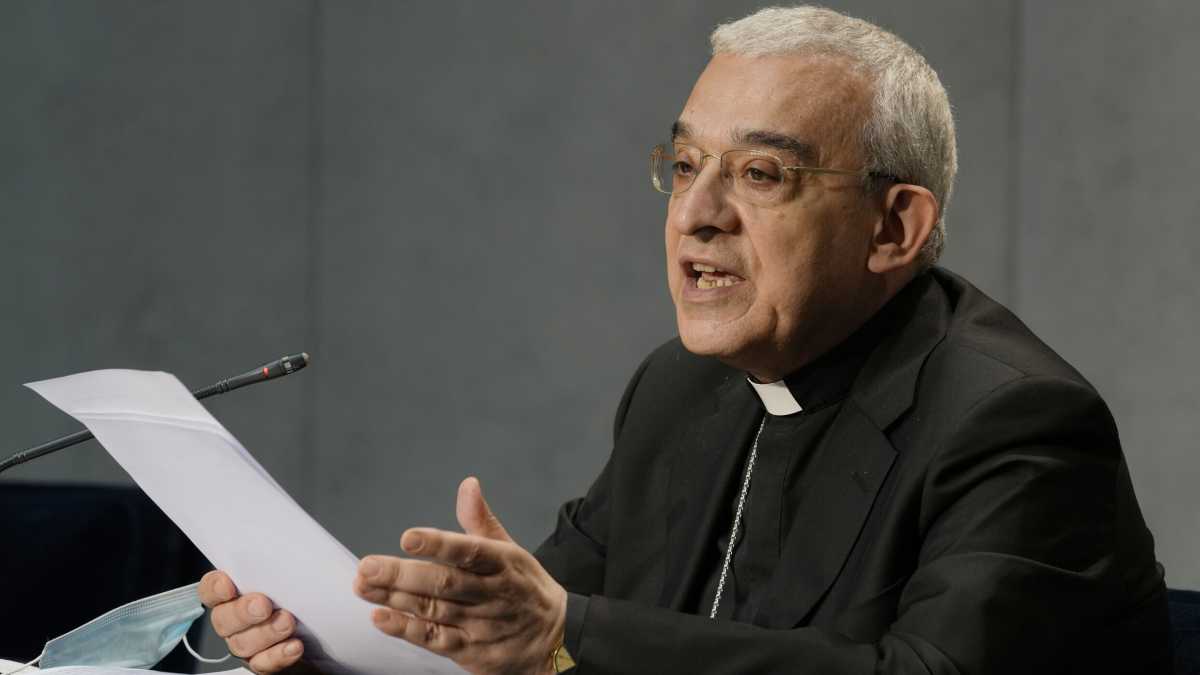
At the end of May, Archbishop Filippo Iannone, Prefect of the Dicastery for Bishops, presided over a solemn Mass in Zagreb in honour of Our Lady of the Stone Gate, patroness of the Croatian capital, before leading the traditional procession through the city centre. The following day, he delivered a keynote lecture at the Croatian Catholic University to mark the twentieth anniversary of its foundation. During his stay in Zagreb, the Naples-born Carmelite also gave an extensive interview to the Catholic weekly Glas Koncila, his first since Leo XIV appointed him to succeed him at the head of the Dicastery responsible for overseeing the selection of candidates for the episcopate across much of the world.
A Dicastery serving the Pope and the particular Churches
Iannone begins by setting out the remit of his office: the establishment, life and work of dioceses; the identification of candidates for the episcopate to be presented to the Pope; and the ministry of bishops in their own Churches. All of this, he stresses, is carried out in the spirit of the interdicasterial cooperation envisaged by Praedicate Evangelium, which requires the Dicastery to work with other bodies of the Roman Curia, from the Dicastery for the Clergy to the Dicastery for Institutes of Consecrated Life.
The Prefect explains that the Dicastery’s authority rests with the Plenary Assembly of its members, all of whom are appointed by the Pope, while he is responsible for its day-to-day work, assisted by the Secretary. He also points to one of the changes introduced by Francis and now incorporated into the relevant legislation: members of the Dicasteries may be priests, religious or lay people, men and women alike.
Asked how such a large volume of cases can be handled when both members and dossiers are scattered around the world, Iannone gives an almost terse reply: the Dicastery relies on the Apostolic Nuncios, “who know the situation of the local Churches well”.
To those who might regard posts such as his own, and his previous role as Prefect of the Dicastery for Legislative Texts, as lofty and remote from the life of ordinary Catholics, Iannone turns the perspective around. Any member of the faithful may write to the Pope or to a Dicastery, he explains, and he himself receives many letters from ordinary Catholics reporting problems in the life of their dioceses. The Dicastery examines whether those concerns are well founded or the result of misunderstandings and, where they are justified, intervenes “to restore peace within the community”.
The same was true, he recalls, at the Dicastery for Legislative Texts, where individuals and groups appeal when they believe that certain legislative measures introduced by diocesan bishops are unlawful.
Succeeding the Prefect who became Pope
One striking fact runs through the entire interview: Iannone has succeeded the man who is now the Supreme Pontiff. The appointment, he says, was “unexpected and moving”, and brought with it the sense of inadequacy that, in his view, everyone feels when entrusted with responsibilities of this kind.
Yet the fact that the then Cardinal Robert Francis Prevost led the Dicastery for several years is, in Iannone’s view, an advantage. The direction has already been set, and continuing along that path makes the task easier, not least because the Prefect and the Pope meet regularly to discuss the Dicastery’s work.
What kind of bishop is the Church looking for today? Iannone explains that Leo XIV, both in his private daily meetings with individual bishops and in meetings with groups of bishops, identifies the pastoral priorities facing the Church, from evangelisation to care for creation. He also restates the fundamental qualities that should shape episcopal life: attention to the interior life, prayer, openness to others, a willingness to collaborate and concern for those on the margins. The essential model, however, remains “always and in every age Christ the Good Shepherd”.
Turning to the danger of self-referential and inward-looking attitudes within the Church, the Prefect recalls Pope Leo’s recent meeting with associations and movements. Every group, he says, must see itself as part of a body rather than as the whole. Diversity is a source of richness when it is joined to a concern for unity; when it closes in on itself, “it becomes harmful and damages the Church”.
It is the bishop, “the father of the whole community”, who must foster relationships and, where necessary, correct those who move away from this vision. Iannone identifies that ability as one of the principal qualities required of a candidate for the episcopate.
The universal Church and the local Churches: Augustine as a guide
Asked about the tension between the universal and local character of the Church, brought into sharper focus by calls for greater authority to be transferred to the particular Churches, the Prefect returns to the Second Vatican Council. The universal Church, he explains, is present in the particular Churches and comes from the particular Churches, without simply being the sum of them.
A particular Church is truly Church to the extent that it remains in communion with the others. When it separates itself from that communion, it ceases to be the Church of Jesus Christ, which subsists in the Catholic Church governed by the College of Bishops with the Pope at its head.
In considering the relationship with local traditions, Iannone turns to the principle attributed to Saint Augustine: “In necessariis unitas, in dubiis libertas, in omnibus caritas.” Unity in the essentials of faith, discipline and the sacraments; freedom in the way those essentials are applied; charity in all things.
It is no coincidence, he observes, that episcopal conferences today enjoy a much wider field of action than they did in the past. His response is equally clear when asked about the supposed tension between democratic sensibilities and the hierarchical and sacramental nature of the episcopal munus. Applying political categories to the Church, he says, “is misleading”, because the Church has a different nature.
That does not mean excluding participation. The Council reaffirmed that every baptised person bears responsibility for the life and apostolate of the Church, and those who govern by virtue of the Sacrament of Holy Orders must allow the faithful to exercise that responsibility through the appropriate structures, from pastoral councils to finance councils. “In this area, we are all still on a journey,” the Prefect acknowledges.
Priests who decline the episcopate
One of the most significant passages in the interview concerns priests who decline episcopal appointment. Iannone explains that the demands placed on bishops have grown, diocesan life has become more complex, vocations are in short supply, and some priests simply do not feel ready. “It is a fact that some priests do not accept,” he acknowledges.
He therefore calls for an end to the assumption that the episcopate is merely an honour. A bishop is also a human being, with moments of discouragement and difficulties in his relationships. Criticism is legitimate when a bishop makes mistakes, but it cannot be the only response: bishops must be supported and, above all, prayed for.
On synodality, the Prefect warns against reducing it to the assertion of rights, which are in any case already recognised by the Code. Synodality means “feeling part of a whole and taking responsibility for it”. The burden of a diocese does not fall on the bishop alone, but on all the faithful.
The more deeply someone lives the faith and takes part in the life of the community, the greater the authority their contribution carries, because they speak from within rather than superficially from the outside.
The interview concludes with a reflection on the Church in Croatia, which Iannone is visiting for the first time: a Church which, after the years of suffering it endured in the past, is making fruitful progress in strengthening its communities and encouraging greater co-responsibility among the faithful. In Zagreb, at least, he also sees many vocations, a sign of vitality for the Church and its communities.
s.F.V.
Silere non possum
Darko Grden interviewed the Prefect of the Dicastery for Bishops
Could you briefly introduce the Dicastery for Bishops, its area of responsibility and your role as Prefect?
The Dicastery for Bishops deals with everything concerning the establishment, life and work of dioceses, the identification of candidates for the episcopate to be presented to the Pope for appointment, and the ministry of bishops in their dioceses.
As Pope Francis’s Apostolic Constitution Praedicate Evangelium on the Roman Curia makes clear, one of the most important features of the work of the bodies that make up the Roman Curia is interdicasterial cooperation: collaboration between the Dicasteries. In carrying out its work, the Dicastery for Bishops therefore collaborates with other Dicasteries, including the Dicastery for the Clergy, the Dicastery for Institutes of Consecrated Life and others.
Every Dicastery has an essential structure. There is a Plenary Assembly made up of all the members of the Dicastery, who are appointed by the Pope. The authority of the Dicastery rests with this Plenary Assembly.
The Assembly is chaired by a Prefect, who is responsible for the Dicastery’s ordinary work and is assisted by a Secretary. The general direction of the Dicastery and its most important decisions are determined by the Plenary Assembly, which meets periodically and includes members from various parts of the world.
One of the changes introduced by Pope Francis and now incorporated into the legislation is that the members of the Dicasteries, including the Dicastery for Bishops, need not all be bishops. They may also be priests, religious or lay people. And when we speak of lay people, no distinction is made between men and women.
To what extent is the Plenary Assembly able to deal with such a large number of cases, particularly those concerning appointments, when both its members and the cases themselves are scattered around the world?
The Dicastery for Bishops, like the other Dicasteries, relies on the cooperation of the Apostolic Nuncios, who know the situation of the local Churches well.
Before taking up your present post, you were Prefect of the Dicastery for Legislative Texts. From the point of view of the “average” Catholic, both roles might appear, how shall I put it, very elevated and therefore somewhat remote.
The Roman Curia, and therefore its Dicasteries, exists to assist the Pope in the exercise of his Petrine ministry. As the Successor of Peter and Vicar of Christ, the Pope is responsible for the governance of the universal Church. He could not exercise his ministry alone and therefore needs collaborators. Those collaborators form the Roman Curia.
Over time, the Roman Curia has become increasingly international and, in certain respects, increasingly specialised. Each body has its own specific area of competence, which it places at the service of the Pope so that he may make decisions.
Every member of the faithful may also write to the Pope or to a Dicastery. I receive many letters from ordinary Catholics around the world who report problems in the life of a diocese. They approach the Dicastery and we assess whether the concerns they raise are well founded or whether they stem from misunderstandings and so forth. Where they are well founded, we try to take action and address the problem in order to restore peace within the community.
From the outside, therefore, it may appear that the Dicasteries in Rome are far removed from the life of local communities. Once you work within them, however, you realise that they serve both the Pope and the various particular Churches.
The same was true at the Dicastery for Legislative Texts. Many members of the faithful, either individually or in groups, appeal to the Dicastery when they believe that certain legislative measures adopted by diocesan bishops are unlawful because they are incompatible with the universal law of the Church. In such cases, the Dicastery examines the matter and, where necessary, intervenes.
What does it mean to you to have been appointed by the Pope who was Prefect of the same Dicastery immediately before you?
It was an unexpected and moving appointment. I think we all feel unequal to the responsibilities we are asked to undertake. We therefore entrust ourselves to the Lord’s help and move forward.
None of us, moreover, is alone. We have many collaborators and many highly competent people. I succeeded the Holy Father in this work, which he carried out for several years before me. This means that he himself gave the Dicastery a particular direction, and I see this as an advantage. By continuing along the path identified by the then Cardinal Prevost when he was Prefect, I can move forward more easily.
There are also regular discussions between the Prefect of the Dicastery and the Pope.
Is there a model or ideal of the episcopal vocation that you keep in mind when choosing among candidates for a local Church? Are there any particular characteristics in this respect under the present pontificate?
The Pope meets bishops individually every day. Those meetings are private. He also meets groups of bishops.
When he meets them, the Pope identifies the priorities currently facing the Church: evangelisation, care for creation and so forth. In this way, he indicates the priorities that bishops should follow in their pastoral ministry.
At other times, in his meetings with bishops, the Supreme Pontiff also reiterates the fundamental qualities that should shape the life of a bishop: attention to the interior life, prayer, openness to others, a willingness to collaborate and concern for those on the margins.
In this way, the Holy Father presents a model that each bishop can embody in his own life and in the circumstances in which he lives. The essential figure and model for every bishop, however, is always and in every age Christ the Good Shepherd.
It is hardly new to observe that men and women today, encouraged by new means of communication, tend to withdraw into themselves or into closed groups in which everyone thinks as they do. The life of the Church is not immune to this tendency. A bishop, however, cannot close himself off from the diversity of people and ecclesial realities.
Pope Leo recently met representatives of associations and movements, reiterating the teaching of the Church: every group and every movement within the Church must regard itself not as the whole, but as part of a body, first the diocesan community and then the universal Church.
It must not, therefore, become self-referential, but must engage with others. Different people and groups may be active within a diocesan community, and this diversity is a source of richness when it is joined to a concern for unity. When diversity closes in on itself, it becomes harmful and damages the Church.
The person who must foster these relationships and, where necessary, correct those who depart from this vision is the bishop. The bishop is the father of the whole community. The ability to fulfil that role is certainly one of the qualities most sought after in a candidate for the episcopal ministry.
In recent times, a tension appears to have emerged which in some way affects the bishop’s ministry: the Church’s simultaneously universal and local character. How can local sensibilities be respected without placing the long-term unity of the Church at risk, particularly in view of the repeated calls in recent years for greater authority to be transferred to the level of the local Churches?
This is a question that has always attracted the attention of theology and theologians. The teaching to which we refer on this subject is that of the Second Vatican Council.
The Second Vatican Council used an expression that remains a point of reference: the universal Church is present in the particular Churches and comes from the particular Churches. This means that the universal Church is not simply the sum of the particular Churches, because it is present in each particular Church.
In simple terms, a particular Church may call itself Church to the extent that it is in communion with the other Churches and, together with them, forms the Church of Jesus Christ.
When it separates itself from that communion, it ceases to be the Church of Jesus Christ, because the Church of Jesus Christ, as the Council stated, subsists in the Catholic Church, which is governed and led by the College of Bishops with the Pope at its head.
Today, as you have mentioned, there is a strong concern to respect local traditions. Here we can refer to an expression attributed to Saint Augustine which remains a valid principle. This is not merely a modern problem.
If we examine the history of the first centuries of the Church, we find that this concern was always present and was sometimes expressed so forcefully that it even led to schisms.
According to Saint Augustine: “In necessariis unitas, in dubiis libertas, in omnibus caritas.” In essential matters, there must be unity; in matters open to discussion, freedom should be allowed; but in all things there must be charity.
There must be unity in the essential core of the Catholic faith, in the discipline of the Church and in everything concerning the essence of the sacraments. There may be diversity in matters concerning how these essential principles are put into practice.
Indeed, episcopal conferences today, whether national or regional, have a much broader field of action than they did in the past. In all things, there must be mutual understanding and support.
The other tension might be described as one between modern democratic sensibilities and the hierarchical and sacramental nature of the bishop’s munus. On the one hand, the ability to listen and collaborate appears to be an unquestionable requirement for a bishop. On the other, there are cultural contexts in which a bishop’s ability to govern his portion of the flock of God already appears to have been seriously weakened.
Applying to the Church categories that belong to the world of politics is misleading. The Church has a different nature.
At the same time, however, the Church also learns many things through its engagement with the world in which it lives and acts. People today have a greater desire to play an active part in the life of the community. This also corresponds to the teaching of the Church.
The Second Vatican Council reaffirmed that every baptised person is responsible for the life and apostolate of the Church. Being responsible means that a member of the faithful must assume responsibilities. But it also means that those who lead communities by virtue of the Sacrament of Holy Orders must allow the faithful to exercise those responsibilities.
How do the faithful exercise this responsibility? Through the bodies established for that purpose. There are pastoral councils, finance councils and others.
Under the Code of Canon Law, every member of the faithful has the right, and in some cases even the duty, to make their aspirations known to the bishops, to offer guidance and to suggest choices concerning the life of the community. In this area, we are all on a journey and we all need to grow.
Following Pope Leo’s confirmation or appointment of their membership, three women now serve on your Dicastery. This is still something relatively new, although it was introduced by Pope Francis in 2022. There is therefore already some experience to draw upon. How would you assess that experience? And why is it important for women to be involved in the work of this particular Dicastery?
I have been leading this Dicastery for only a few months, but I have personally had the opportunity to see the contribution that these women, two religious sisters and one laywoman, make to its work.
Their contribution is highly valued and important, because women may approach and assess situations differently. They bring different sensitivities, and this is of great help in the kind of work we have to carry out, namely identifying candidates for the episcopate.
I would, however, stress that consulting women is not an entirely new development. When Apostolic Nuncios conduct their enquiries to identify candidates for the office of bishop, they do not and must not consult bishops alone. They also involve other members of the People of God, while always respecting pontifical secrecy, whose purpose is to protect the good name of those concerned.
A few years ago, when the abuse crisis was being felt particularly acutely, someone from what was then the Congregation for Bishops said that an increasing number of priests selected to become bishops did not feel able to accept the appointment. Does this still happen?
Yes. I had heard about it before; today I can say that I encounter it myself.
I would not say that it is solely a consequence of the abuse crisis. I would say, rather, that the demands placed on bishops have generally increased, and some priests genuinely do not feel prepared to take on those responsibilities.
Life has become much more complex: the life of dioceses, the lives and ministry of the priests for whom a bishop is responsible, the shortage of vocations and so forth.
Perhaps exercising this ministry was not easy in the past either, but we live today and must assess the present situation. We do not have precise data that would allow us to make comparisons. But it is a fact that some priests do not accept.
Does this mean that the assumption that becoming a bishop is merely a great “honour” is becoming increasingly difficult to sustain?
Too little thought is sometimes given to the fact that a bishop is also a human being and has his limitations, like each of us. A bishop too may experience moments of discouragement or difficulties in his relationships.
When the liturgy invites us to pray for bishops and priests, therefore, we should do so with greater conviction, because they need support.
When someone makes a mistake or holds views that are open to question, it is legitimate to criticise him. We must not, however, stop at criticism alone. We must be willing to help and, above all, to pray for bishops.
And is that synodality?
Synodality is not about making claims and must not be understood simply as asserting or fighting for rights.
There are groups within the People of God that wish to affirm their right to express themselves. That right is already established and provided for in the Code.
Synodality also means feeling part of a whole and taking responsibility for it. The bishop must not bear the burden of the diocese alone. All the faithful must feel that this burden also rests upon them.
Certainly, the more deeply someone lives the faith and participates in the life of the community, the greater the authority their voice carries, because they are not speaking superficially from the outside, but from within.
Do you have any impressions of the Church in Croatia?
I know Croatia through several bishops and priests whom I have met during my ministry. This is my first visit to Croatia.
I believe there is a Church here which, after the years of suffering it endured in the past, is making fruitful progress in strengthening its communities and encouraging greater co-responsibility among the faithful.
I believe this will bring great benefits. At least here in Zagreb, I can see that there are many vocations, and this contributes to the vitality of the Church and its communities.