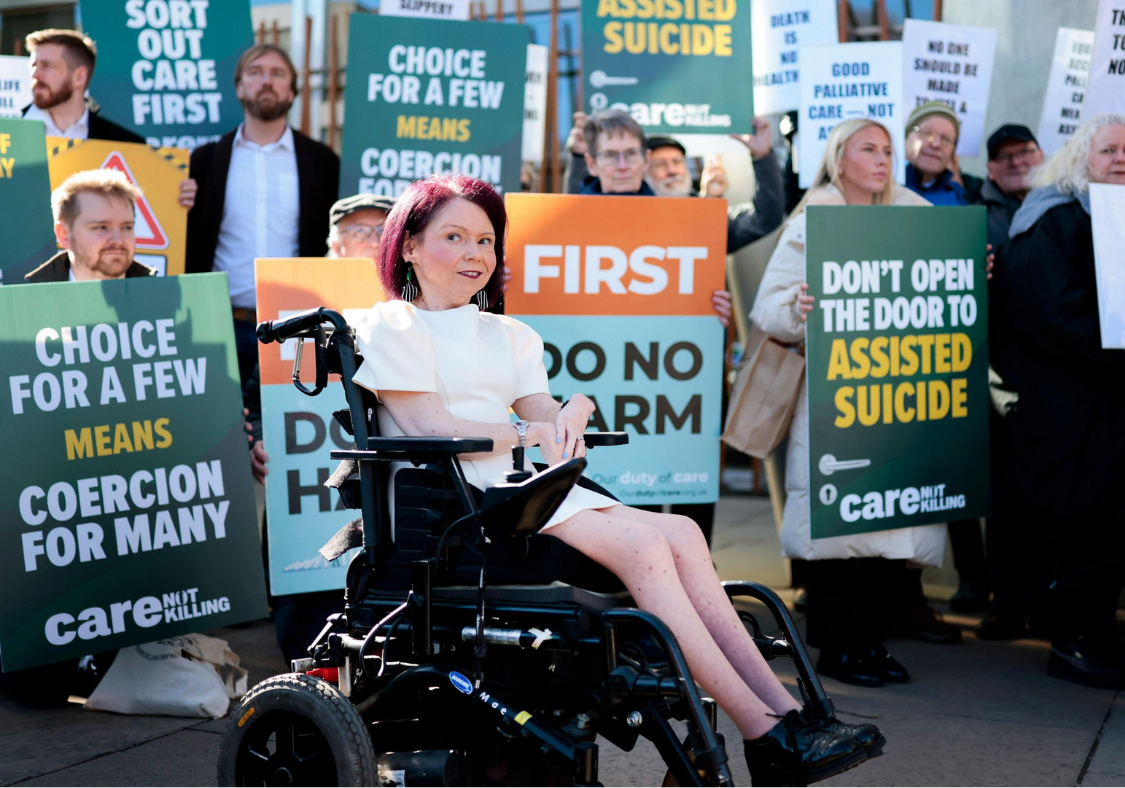
Edinburgh - The Scottish Parliament has rejected the Assisted Dying for Terminally Ill Adults (Scotland) Bill by 69 votes to 57, with one abstention. The proposed legislation would have allowed terminally ill adults with less than six months to live to seek medical assistance to end their lives.
The vote was held as a free vote: every MSP was able to express their position according to conscience, without being bound by party discipline. David Bol, deputy political editor of The Scotsman, described the final vote as “potentially the biggest decision in the history of the Scottish Parliament” - a judgement echoed by numerous political commentators. Catholic bishops also noted that the vote fell on 17 March, the feast of Saint Patrick, patron saint of Ireland.
An intense ecclesial campaign
In the months leading up to the vote, the Bishops’ Conference of Scotland had carried out a broad public campaign. Bishop John Keenan of Paisley, president of the Conference, made his position clear in forceful terms. Describing the bill as “a dreadful mess,” he warned of its structural dangers: “Liam McArthur’s bill is not safe - and it will harm many more than it wants to help. I urge the Scottish Parliament to reject this legislation.”
Shortly before the final vote, Keenan again appealed to the moral responsibility of Parliament: “This bill is a serious threat to vulnerable Scots, including the elderly, disabled, those who suffer from poor mental health, and victims of domestic abuse. In a world that often prizes independence, those who are vulnerable can easily feel like a burden. True compassion is not found in killing but in walking with those who suffer, ensuring they receive the medical, emotional, and spiritual care that affirms their inherent worth. Every person - regardless of age, illness, disability, or circumstance - is a gift from God. There is no such thing as a life without value.”
The bishops had also raised concrete concerns about the text itself. According to Keenan, the bill was technically incomplete, since it required key protections for doctors and healthcare workers to be removed from the Scottish legislation and dealt with separately by the UK Parliament at Westminster - a legislative paradox that further weakened consensus around the proposal.
“Prayer moved hearts”
Immediately after the result was announced, the response of the Scottish bishops took on a tone that went beyond political satisfaction. “Prayer is what moved hearts on this important issue,” the bishops said. Bishop Keenan then issued a fuller statement: “Members of the Scottish Parliament can be confident that they have taken the correct and responsible course of action. Their vote serves to protect some of Scotland’s most vulnerable individuals from the risk of being pressured into a premature death.” He then called for the vote to be treated as a starting point, not a conclusion: “As a society, our responsibility is not to address suffering by eliminating the sufferer, but to surround each person with care, respect, and dignity until their natural end. Our next priority must be to strengthen palliative care by ensuring that it is properly funded and accessible to all who require it.”
He added: “I am especially grateful to those who upheld the principle of human dignity and advocated on behalf of the vulnerable. Your principled commitment has not gone unnoticed.”
The concerns that weighed on the vote
Many parliamentarians were driven towards a no vote by concerns that went beyond ecclesial pressure. According to figures cited by Right to Life, the women’s policy think tank The Other Half found that seven in ten Scots were concerned that victims of domestic abuse could feel pressured into ending their lives if assisted dying were legalised. Further polling showed that only one in five Scots would support legislation allowing patients with anorexia to end their lives through assisted suicide - a possibility that, critics argued, was technically permitted by the wording chosen in the bill.
What happens now
For the legal framework in Scotland to change, an entirely new bill would have to be introduced, debated and passed at Holyrood. For now, the issue has been shelved.
The Scottish outcome has also had repercussions in London. The defeat at Holyrood contributed to a wider climate of scepticism that ultimately led to the collapse of the bill for England and Wales in the House of Lords on 24 April 2026, after more than 1,200 amendments were tabled by opposing peers. Two fronts, two victories for the Catholic Church in Britain - though the Church knows that legislative pressure has not been exhausted, and that the issue is likely to return to the parliamentary agenda before long.
fr.V.C.
Silere non possum