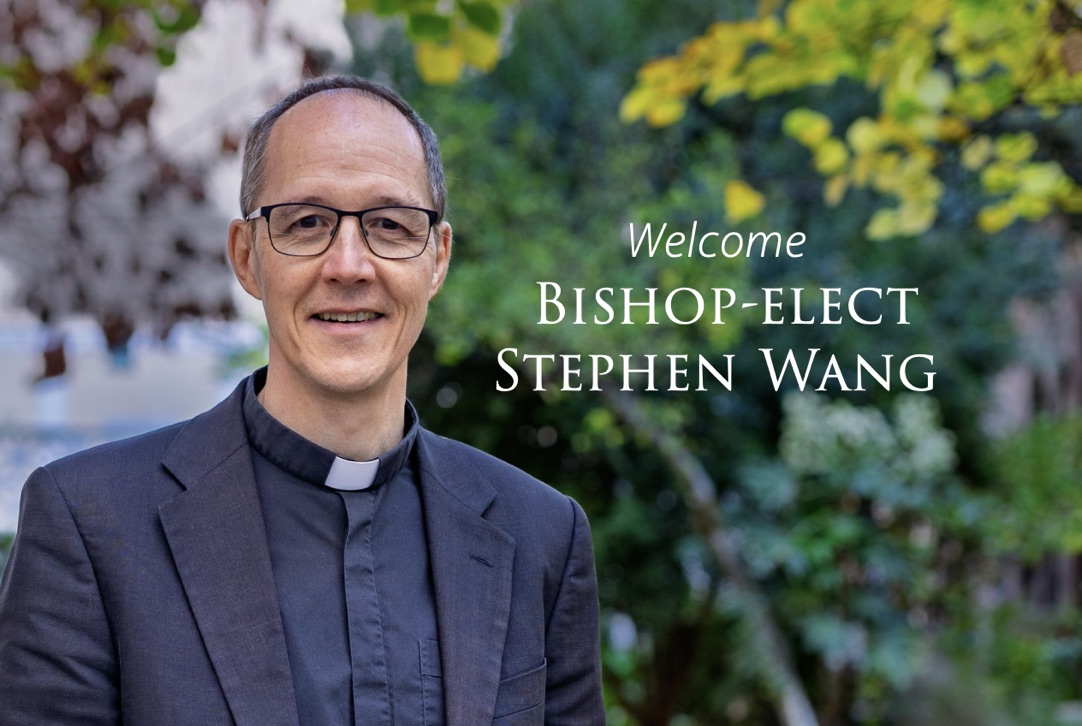
Vatican City - Pope Leo XIV today appointed Fr Stephen Wang, a priest of the Archdiocese of Westminster and until now Rector of the Venerable English College in Rome, as Bishop of Arundel & Brighton. The diocese has been vacant since 14 February 2026, when Archbishop Richard Moth, appointed to the primatial See of Westminster on 19 December 2025, took possession of the Archdiocese.
“Gratitude and trepidation, and a profound sense of peace”
The Bishop-elect entrusted his first thoughts to a statement which reveals something of the man before the pastor: “This appointment has come as a huge surprise. I feel a mixture of gratitude and trepidation; an excitement and curiosity about all that lies ahead; and above all, a sense of peace. I’m grateful to Pope Leo for calling me and putting his trust in me, and to Archbishop Moth for all his care for the Diocese over these years.
“I’m sad to be leaving the Venerable English College, and the Diocese of Westminster. But I am overjoyed at the thought of coming to Arundel & Brighton, getting to know the people, and working together to build God’s Kingdom. Coming from a landlocked diocese where the hills are no bigger than London buses, I look forward to some wild swimming and walks on the South Downs.
“I will need lots of prayers and support. I hope that even with all my weaknesses I can be a loving shepherd, a spiritual father, and a brother as well. I know that if we put the love of Jesus and Mary at the centre of everything we do, and always seek to love and serve one another, then we cannot go wrong. Jesus will guide us through his Holy Spirit, lead us to the Father, and help us to lead others along the same path.”
A rector called to a new mission
Stephen Wang was born in London on 8 November 1966. His father is Chinese and comes from Guangdong, a detail which the priest has spoken of over the years with reserve and gratitude, recalling the spiritual bond he feels with Catholics persecuted in mainland China.
Raised in Hertfordshire, he took a Bachelor’s degree in Theology and Religious Studies at the University of Cambridge before completing his formation in Rome. He gained a Licentiate in Philosophy at the Venerable English College, where he was a student from 1992 to 1997, and a Licentiate in Fundamental Theology at the Pontifical Gregorian University.
Ordained a priest for the Archdiocese of Westminster on 3 January 1998, he has followed a path that combines parish ministry, academic work and administration. He served as a parish curate in Dollis Hill from 1998 to 2001, before moving to the Fisher House University Chaplaincy in Cambridge from 2001 to 2003. During those same years, he completed a doctorate at the University of Cambridge with a thesis on human happiness.
From 2005 to 2013, he served as a formator and lecturer at Allen Hall Seminary, becoming Dean of Theology in 2009. His curriculum also includes a less common qualification for a future bishop: a Master of Business Administration from the University of Reading, obtained between 2007 and 2009. It is a credential rarely found in the episcopate, but one likely to prove useful for a bishop responsible for diocesan finances, schools and property.
From 2013 to 2021, Wang was University Chaplain for the Archdiocese of Westminster, directing the Newman House Student Centre and serving as Catholic chaplain at the London School of Economics. Appointed Director of Vocations in 2019, he returned to Rome in 2021 as Rector of the Venerable English College, the seminary founded in 1579 by William Allen which gave the Church in England and Wales forty-four martyrs.
Wang is perhaps best known to the wider public as the founder of Sycamore, an evangelisation programme based on short videos and open conversations. It has been translated into numerous languages and adopted by parishes around the world. He is also the author of Aquinas and Sartre, The New Evangelisation and Sycamore: The Catholic Faith Explained. His profile combines intellectual depth with a strong instinct for communication, qualities which have clearly not gone unnoticed by Pope Leo XIV.
A young diocese with a weighty inheritance
The Diocese of Arundel & Brighton is among the youngest in England and Wales. Pope Paul VI erected it on 28 May 1965 with the bull Romanorum Pontificum, separating it from the Archdiocese of Southwark, of which it remains a suffragan see. Its territory includes West Sussex and East Sussex, part of Surrey and the unitary authority of Brighton & Hove, covering almost 5,000 square kilometres. It has around 182,000 baptised Catholics within a population of more than three million, spread across around ninety parishes and served by more than seventy Catholic schools. The cathedral, dedicated to Our Lady and St Philip Howard, stands in Arundel, in the shadow of the castle of the Dukes of Norfolk, the leading Catholic family in the country.
It is a small diocese, but one with considerable weight in the recent history of the Catholic Church in England. Cormac Murphy-O’Connor began there, governing the diocese from 1977 to 2000 before moving to Westminster and receiving the red hat. Richard Moth, now Archbishop of Westminster, also left Arundel & Brighton only a few months ago. Two of the diocese’s five bishops have gone on to the primatial See of Westminster. It is a statistic that some observers will inevitably note beside Wang’s name. His profile, like that of the twentieth-century rectors of the Venerable English College who preceded him - most notably Arthur Hinsley and William Godfrey, both later Cardinal Archbishops of Westminster - invites longer-term speculation.
The voices from Westminster and Southwark
The first reaction came from Westminster. Archbishop Richard Moth, President of the Bishops’ Conference of England and Wales and Bishop of Arundel & Brighton from 2015 to 2026, said: “I warmly welcome the appointment of Bishop-elect Stephen Wang as the Bishop of Arundel & Brighton and thank Pope Leo XIV for providing for the needs of the diocese. Bishop-elect Stephen has served the Church in many roles, most recently as the Rector of the Venerable English College in Rome. He will bring a wealth of experience to this role, and I am delighted for both Bishop-elect Stephen and for the people and clergy of Arundel & Brighton.
“I ask all in the Diocese of Arundel & Brighton to pray for him as he prepares to serve as their bishop.”
His predecessor’s welcome was echoed by the metropolitan Archbishop. Archbishop John Wilson of Southwark, whose ecclesiastical province includes the Diocese of Arundel & Brighton, said: “I am delighted that the Holy Father has appointed Fr Stephen Wang as the sixth Bishop of Arundel & Brighton. I welcome him most warmly to the Province.
“Fr Stephen has a real heart for the Lord and a love for God’s people. His passion for formation and mission comes through clearly in his ministry. His work founding the ‘Sycamore’ initiative to share the Christian faith and its relevance today is testament to his commitment to evangelisation.
“Fr Stephen’s many gifts will serve him well as a pastor for the people and clergy of the diocese. I pray that the Lord blesses him abundantly in the years ahead.”
Finally, Canon Jonathan Martin, who has served as Diocesan Administrator since February, spoke on behalf of Arundel & Brighton itself. Stressing the gift of a new shepherd for the faithful, he said: “I am delighted that the Holy Father has appointed Fr Stephen Wang as our new bishop, and I am certain that this news will bring great joy to all the Faithful of the Diocese. Bishop-elect Stephen will be known to many of us; we assure him of an affectionate welcome and of our prayers as he prepares himself for his episcopal ordination, and this new ministry to which the Lord has called him.”
An appointment that says much
With this appointment, Leo XIV confirms a pattern which is becoming increasingly clear in England: the choice of pastors with experience in formation, a Roman background and a capacity for direct evangelisation. Wang, who in recent months had spoken positively of the return of many young English people to regular religious practice, takes charge of a diocese where that development will need to be accompanied, rather than simply celebrated.
The Mass of Episcopal Ordination and Installation will take place in the autumn at the Cathedral Church of Our Lady and St Philip Howard in Arundel. At the Venerable English College, which under Wang’s rectorship passed through the Jubilee Year with a community of around twenty seminarians, attention now turns to the question of his successor.
Fr.L.C.
Silere non possum