There is an atheism more insidious than declared atheism: Leo XIV called it “a state of practical atheism” in his first homily in the Sistine Chapel, in the presence of the cardinals. It is the atheism of those who reduce Jesus to one moral teacher among many, a respectable and harmless figure. And it is precisely this form of unbelief that prevails in countries which, historically, have never really known the Catholic faith. It happens even in Europe: the continent certainly has Christian roots, yet there are places where those roots never truly took hold.
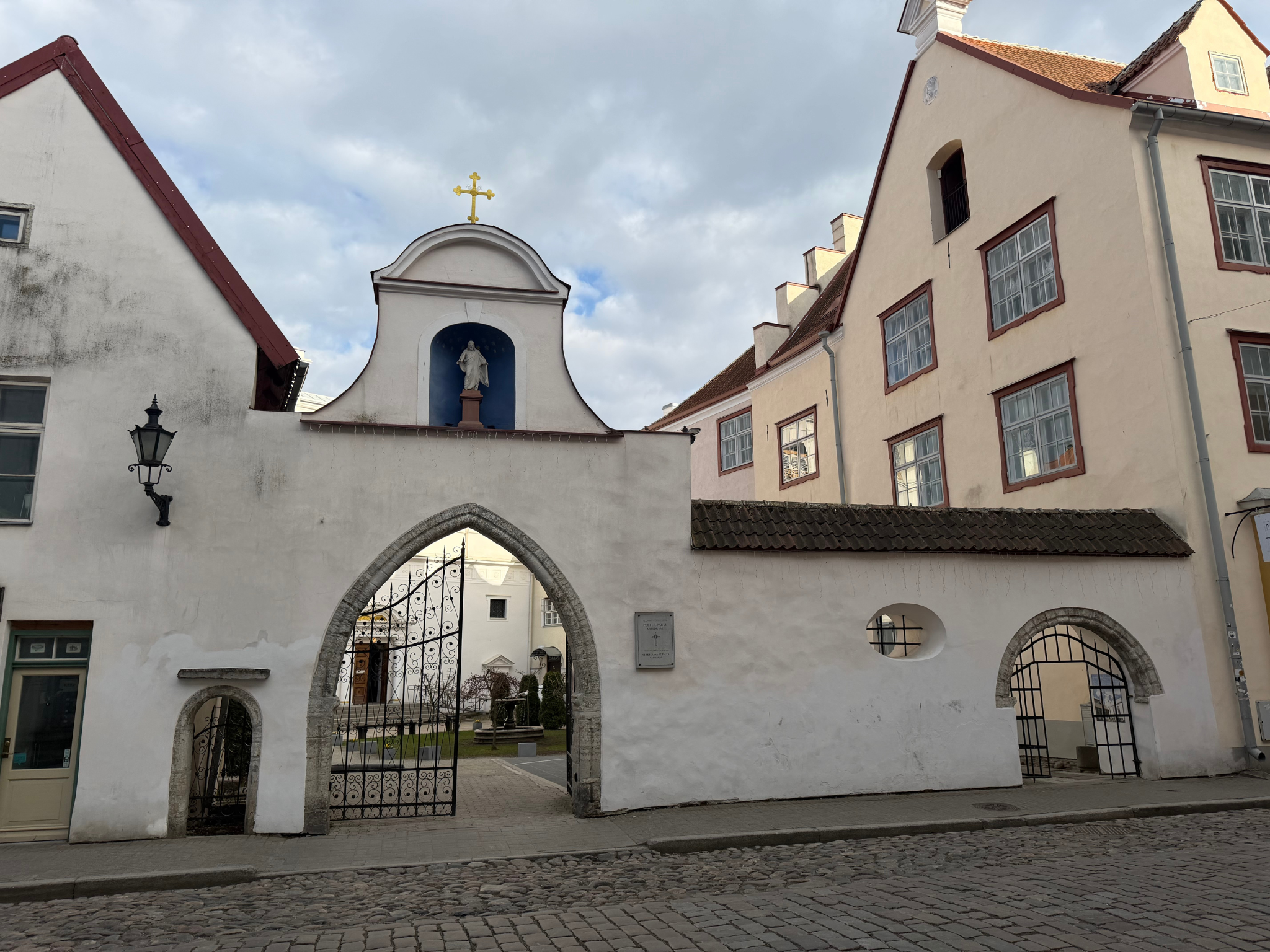
We saw this for ourselves in conversations with monks living in Estonia. They describe their experience as an unusual challenge of evangelisation: here, what for an Italian is part of a shared inheritance - culturally even before it is religious - simply does not exist.
Estonia is perhaps the starkest case of this diagnosis. Regularly ranked among the least religious countries in the world, it offers figures that speak for themselves: according to Statistics Estonia’s 2021 census, only 29 per cent of the population declares a religious affiliation, 58 per cent declares none, and 13 per cent prefers not to answer. Among ethnic Estonians, the figure falls sharply: barely 17 per cent identify with a faith, while 71 per cent say they are non-believers. Catholics are a tiny fraction, well below one per cent. In purely statistical terms, this is a place of first evangelisation in the heart of Europe.
Yet the most important fact is not the number. Estonian irreligion does not have the hard face of Soviet state atheism, though that too has left deep scars. It is a gentle, distracted irreligion, made up more of indifference than hostility. Many Estonians are so unfamiliar with religion that they do not even regard unbelief as part of their identity: God simply does not enter into the questions of everyday life. And yet this is where an opening appears, because this is not a fully formed nihilism. More than half of Estonians say they believe in a spirit or life force, and alongside the traditional Churches there survives a widespread spirituality of nature. The heart is not closed; it is simply looking elsewhere. Here too, then, as in so many parts of the world, the problem is not spirituality, but religion. There are people who believe in something higher without recognising themselves in a faith, a Church, a concrete community: believing without belonging.
The altar to the unknown god
Anyone who wants to proclaim the Gospel in such a context must return to chapter 17 of the Acts of the Apostles. Paul arrives in Athens, the intellectual capital of his age, and does not find persecutors. He finds the curious, the sceptical, the wise, people who enjoy discussing new ideas without committing themselves to anything. He does not attack them. He walks through the city, observes it, and begins from what is already there: the altar dedicated “to an unknown god”, which becomes the bridge for speaking of the living God.
This was precisely the key with which Saint John Paul II, in Redemptoris Missio, relaunched the idea of the modern “Areopagus”: the new cultural, social and media spaces in which contemporary man searches without knowing that he is searching. Secularised Estonia is one of these Areopagi. The missionary does not enter it as the conqueror of a hostile square, but as someone able to recognise, beneath the surface of indifference, an unspoken question. The life force in which Estonians say they believe, the almost religious respect for nature, the moral seriousness with which this people guards its freedom: these are altars to the unknown god. They are not to be torn down; they are to be inhabited and brought to fulfilment. And here the words of the great Polish Pope continue to resound: “Do not be afraid.” This is not an invitation to bravado, but the opposite of the timidity that now paralyses so many of our communities. In a country where Catholics are few and not very visible, the temptation is prudent silence. The Gospel, however, asks that the doors be opened wide - even when there seems to be no one waiting behind them.
Faith is not born of an idea
It would, however, be a mistake to imagine evangelisation as a campaign of arguments: syllogisms do not defeat indifference. Benedict XVI saw this clearly, and often repeated that being Christian is not the result of an ethical choice or a lofty idea, but the encounter with an event, a person. It is the sentence that opens Deus Caritas Est, and it is precisely the medicine needed by a society that has stopped believing not because it has found better answers, but because it has stopped asking the questions. Benedict XVI grasped this in two formulations that, here, are worth more than any pastoral strategy. The Church, he said, “grows not by proselytism, but by attraction”: and in Estonia, where any form of religious pressure can still feel like a colonial imposition, that is the only path that remains open. The rest is done by the “creative minorities” of which he spoke: small communities that generate culture, beauty and charity, and show by their lives what words can no longer say. Estonian Catholicism will never be a sociological majority. It can be a leaven.
Holiness as the only apologetic
This is exactly the point on which Leo XIV is insisting today. In his address to the plenary assembly of the Dicastery for Evangelization, citing Benedict XVI, the Pope pointed to holiness - the lives of men and women “touched by God” - as the most credible form of evangelisation in a world that mistrusts every claim to moral greatness. People can, in substance, argue endlessly over the doctrine of the Church; but before a life visibly transfigured by the Gospel, they stop. It is not the great preacher who converts the indifferent person: it is the neighbour whose life cannot be explained without God.
This is precisely the opposite of the diluted Christianity from which we began. Where proclamation is watered down so as not to offend the sensibilities of a dechristianised society, it ends up having nothing to offer that the world does not already possess. Where, instead, faith becomes visible holiness, it becomes the one argument that indifference does not know how to refute. And in lands where Christianity has also been rejected because it was perceived as the religion of foreign rulers, only a holy and gratuitous life can dissolve suspicion. The same applies to digital witness. When a young person comes across someone who communicates well, without aggression and without the need to attack, he is struck by it and ends up asking: why? That is where evangelisation truly begins. We are used to speaking a great deal, but it is gestures that raise questions. The task of the Christian, before offering answers, is to awaken that question - why do you live like this? - and to be ready with the only answer that matters: because I am a disciple of Jesus.
A Church that must allow itself to be re-evangelised
On 1 June, receiving the participants in the General Assembly of the Pontifical Mission Societies in the Clementine Hall, the Pope called for an “ongoing missionary conversion” and recalled that World Mission Sunday also serves to remind the faithful of the “older” and more established Churches how urgent it is that they too be drawn back into the missionary spirit of the whole Church. Mission, in other words, is not something rich Churches do for poor Churches far away. It is a movement that converts the one who undertakes it. Even Europe’s ancient Christianities - and still more the Catholic diasporas of the North - need to be evangelised anew.
For Estonia’s little Catholic flock, this is a liberating word. It is not a matter of “reconquering” a country, an undertaking that would discourage anyone who looked at the statistics. It is a matter first of allowing oneself to be converted, of rediscovering the fire of the encounter with Christ, and from there radiating it without calculating its effectiveness. The criterion is the one Leo XIV himself indicated, and which the Baptist handed down once and for all: “He must increase, but I must decrease.” Where the missionary disappears behind the Message, proclamation becomes effective.
What, then, is to be done
To evangelise, then, does not mean organising cultural crusades. It means something humbler and at the same time more radical: being a friendly and selfless presence in a society that seems to have no time for God; preserving the beauty of the liturgy and of places, so that those who sense a “life force” without knowing how to name it may intuit where that force has a Face; practising charity where the State does not reach, because gratuitous love remains the argument that no indifference has ever been able to refute; and, above all, living an everyday, ordinary holiness that makes faith not a debatable idea, but an inexplicable and attractive fact.
The altar to the unknown god is already there, in the heart of a gentle and serious people. It falls to Christians - few, creative, unafraid - finally to engrave a name upon it.
fr.V.B.
Silere non possum