Vatican City - On 18 July 2026, the German website domradio.de reported: ‘The Vatican has produced three video documentaries about Pope Leo XIV. The last of them, which follows his career in Rome, has now been blocked until further notice. There appear to have been legal difficulties.’
The German outlet reported that YouTube had suspended the Dicastery for Communication’s documentary over copyright issues following a claim lodged by RAI.
The story is particularly significant, although the Italian press chose not to report it, for reasons that Silere non possum has been exposing and documenting for years: the relationship between certain figures in the media and Palazzo Pio has become so collusive as to be embarrassing. Inside the Vatican walls, however, the affair attracted considerable attention and assumed importance for several reasons.
First, many began pointing out that these videos, promoted by Andrea Tornielli and Paolo Ruffini as though they were some great new revelation, had in fact proved a flop. Copyright complaints have now been added to the failure of the entire operation. Second, documentaries of this kind are not simply uploaded to YouTube like any ordinary video; they are distributed through entirely different platforms. Putting them on YouTube inevitably cheapens the work and diminishes its value. Admittedly, given the quality of the finished product, one might also ask which platform would be suitable for it. But that is another matter. One must always bear in mind that we are dealing with people who use the Pope’s media in much the same way as a boomer butcher from Tor Bella Monaca would.
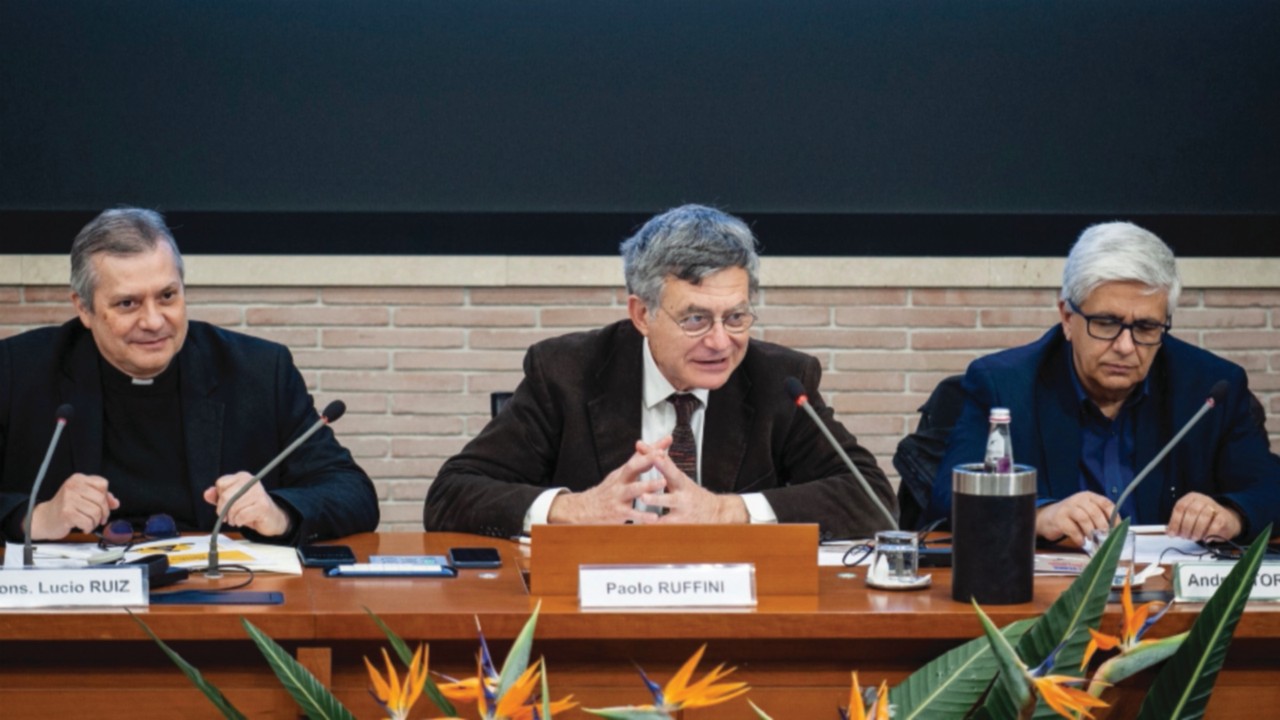
Finally, many reacted with particular irritation to the petty acts of spite that Andrea Tornielli has begun directing at his enemies, seriously jeopardising the Holy See and arranging for embarrassing figures with criminal convictions to publish defamatory tirades and posts that have invariably backfired on him. The sole result has been to add still further to the records of people who presume to occupy a place in Vatican journalism, while being regarded with pity not only in the dioceses from which they were expelled, but even by the four followers who still watch them pursue their latest obsession.
And so the documentary remained blocked by YouTube for three full days. The platform made it perfectly clear that RAI had claimed the material used in the film.
On Monday, 20 July 2026, Silere non possum published the article ‘Tornielli and selective copyright enforcement: RAI blocks the Vatican News documentary’. Its publication sent Andrea Tornielli and the outgoing leadership of the Dicastery for Communication into a frenzy. The German outlet may be read by only some people - despite the story subsequently being carried by Germany’s main news agency and picked up by several newspapers in the country - but Silere non possum is read everywhere and provides coverage in no fewer than four languages.
What infuriates Tornielli most, however, is that Silere non possum is read precisely in the places where he is most anxious that it should not be. And so, while Palazzo Pio carefully prepares everything that Maria Montserrat Alvarado is to be shown, in order to make a good impression and pretend that everything is running smoothly, it is hardly acceptable for an affair of this kind to emerge just before her arrival.
Anxious telephone calls therefore began to be made to Via Alessandro Severo, while Prefect Paolo Ruffini, who has no shortage of contacts across the media landscape, moved heaven and earth to ‘resolve the matter as quickly as possible’. For the leadership of Palazzo Pio, however, simply restoring the content was not enough. A statement was also required explaining that it had all been nothing more than a misunderstanding. Otherwise, who would explain what had happened to the Pope and to Maria Montserrat Alvarado?
RAI duly issued a statement. Let us therefore take another look at this jewel of a press release from RAI, the very organisation whose conduct in recent years has helped prompt independent bodies such as Reporters Without Borders to issue damning assessments of Italian journalism, describing it as increasingly less free and ever more heavily influenced by politics. These are the same organisations that have placed Italy among the countries suffering a steady decline in press freedom. Hardly a model of transparency, in other words.
The requested statement
RAI begins by referring to the ‘alleged block’. Alleged. As though everyone around the world who tried to access the video on YouTube over those three days had suffered exactly the same collective hallucination and been confronted with precisely the same error message. No, it was not ‘alleged’. It happened, it is documented, and several news agencies had already reported it on 18 July, complete with the date and time. Describing it as ‘alleged’ in the first line of a statement whose second line confirms both its existence and its cause is hardly the kind of institutional communication one would expect from a ‘national’ broadcaster. It is more like the thief caught red-handed who insists, ‘I haven’t stolen anything’, even as the stolen goods fall from his pockets.
Then comes the finest detail of all: ‘a few hours’. Hours. As we have demonstrated, the block was first reported on Friday by numerous German colleagues. The statement appeared on Monday evening, just hours after the Silere non possum article was published. Andrea Tornielli’s worst nightmare. In the meantime, in case the Italian broadcaster had failed to notice, there had been a Saturday, a Sunday and even the Angelus, for good measure. Describing a three-day blackout as ‘a few hours’ destroys the credibility of whoever drafted a statement that had been ‘strongly requested by the Vatican’.
The final flourish is the claim that the material ‘had been properly requested and formally released’ by RAI’s offices. The necessary authorisations therefore existed. Yet months later, and for no logically comprehensible reason, YouTube blocked the documentary because ‘RAI had claimed the rights’. And the broadcaster to which Italians pay a substantial amount of money every year through a licence fee charged to their electricity bills - including those who never watch RAI and do not even want to hear its name mentioned - needed three full days, not a few hours, to resolve the matter? Interesting.
And the Dicastery? Not a word. Three days of deathly silence while the documentary about the Pope’s life remained switched off like a blown light bulb, and no one - we repeat, no one - could be bothered to write two lines saying, ‘We apologise, we are working to resolve the problem.’ Behind the scenes, they did everything possible to ensure that RAI would be the one to explain the affair, three days later and in the evening, by which time the story had already circulated among newspapers and news agencies.
After all, Andrea Tornielli and his associates always communicate in the same way: like the fishwives of Chioggia, exchanging posts and screenshots among the alleyways and canals, telephoning, messaging and arranging everything behind the scenes. They then send out whichever unfortunate convicted offender happens to be available, the exiled ‘long-standing friend’ tasked with launching the latest broadside. One more conviction, after all, will merely be added to the many already accumulated. Why should Tornielli care? Nor does it matter that no one genuinely takes them seriously. The aim is not to appear credible - that would be impossible, given their sorry histories - but to make noise. Even a little noise will do, provided it is enough to maintain the pretence that they exist.
The final result is a public broadcaster attempting to defend itself by lying even about the length of its own ‘alleged’ error, and a two-thousand-year-old institution allowing an algorithm to silence it for an entire weekend, trusting - or perhaps knowing perfectly well - that no one would notice. For one very simple reason: in truth, not even Vatican employees watched that documentary, let alone anyone else.
Fr.L.E. and V.L.
Silere non possum