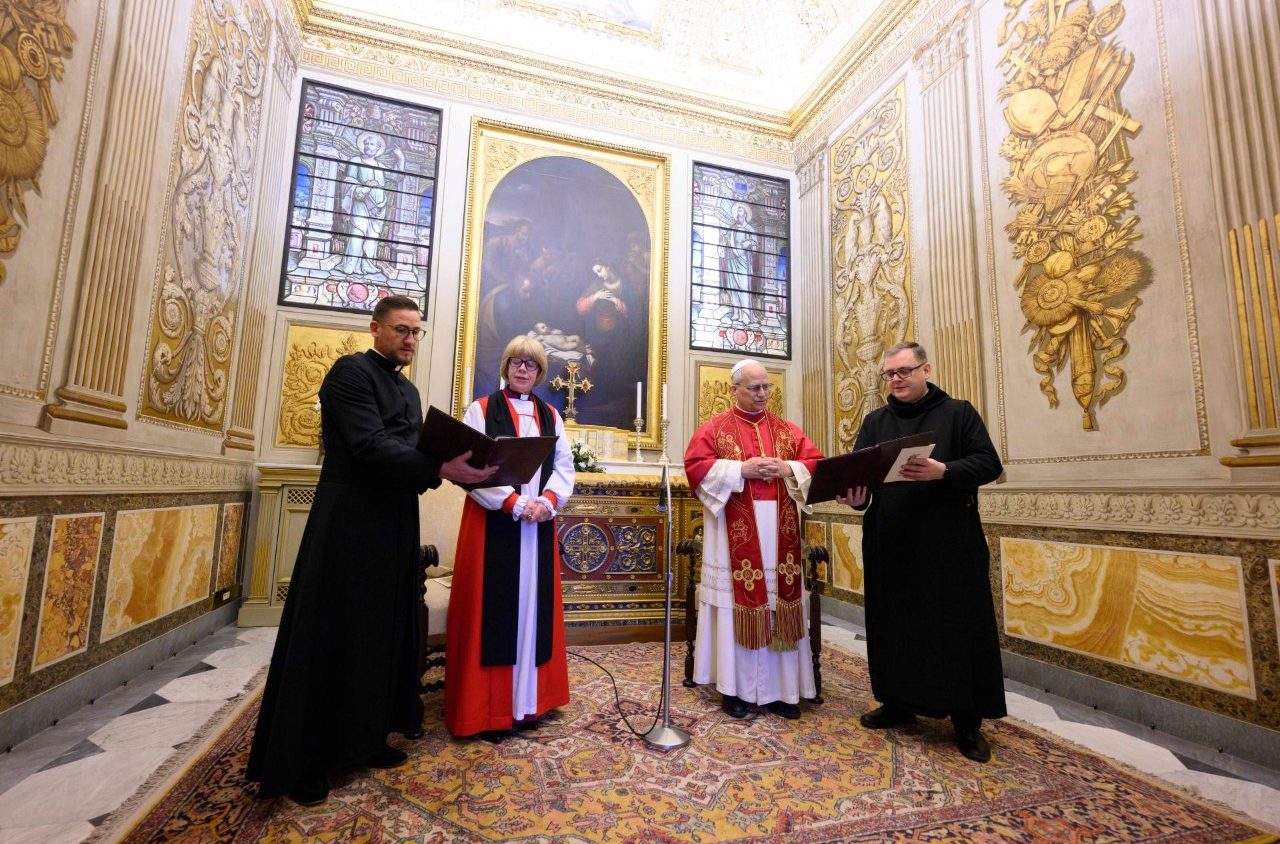
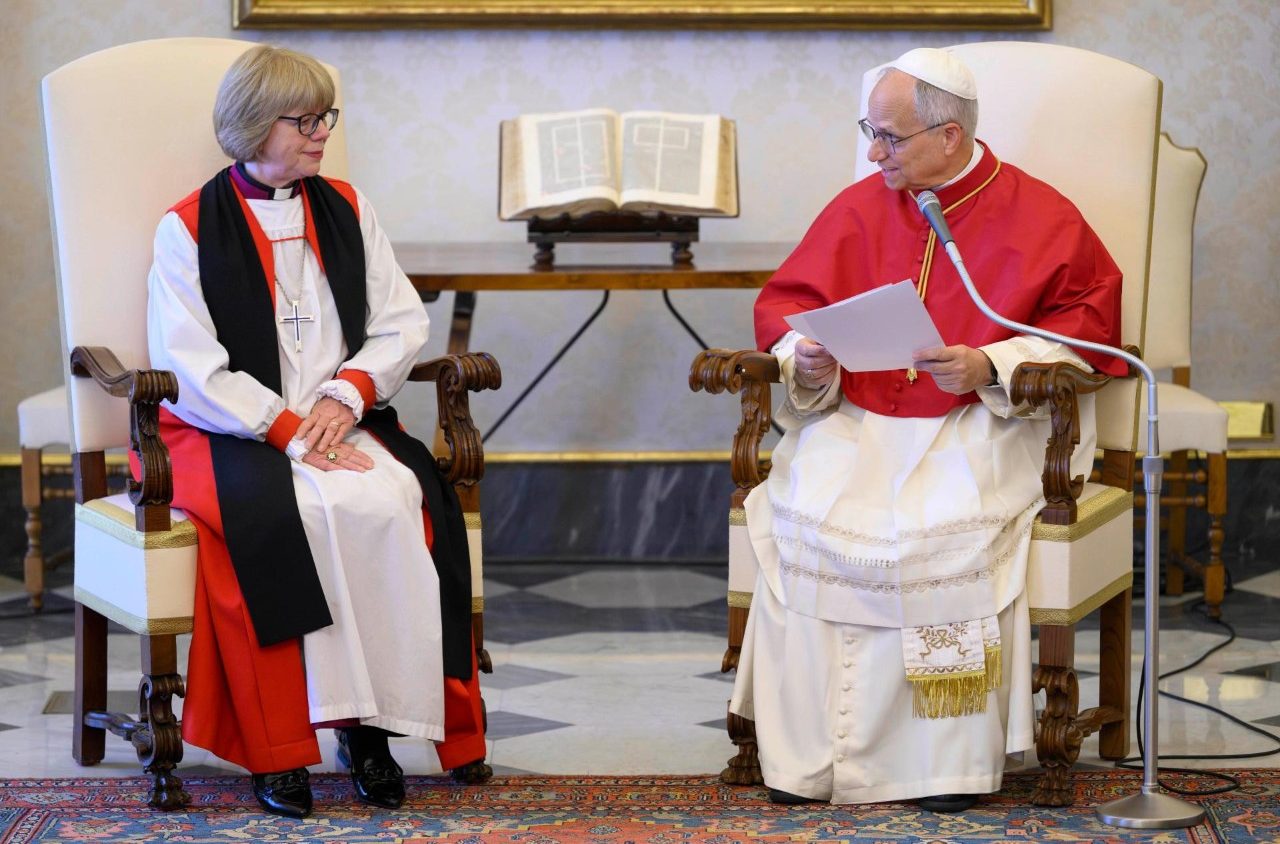
Vatican City - This morning Pope Leo XIV received in the Apostolic Palace Her Grace Sarah Mullally, Archbishop of Canterbury, accompanied by an ecumenical delegation. The meeting forms part of the long-standing tradition of dialogue between the Catholic Church and the Anglican Communion, a tradition which the Pontiff was keen to recall with particular warmth in his welcome address.
Recalling the historic meeting sixty years ago
Addressing the Archbishop, Leo XIV recalled the memorable encounter between Saint Paul VI and Archbishop Michael Ramsey sixty years ago. An anniversary which Mullally herself commemorated with Cardinal Kurt Koch in Canterbury Cathedral on the morning after her installation. "Since then," the Pope underlined, "Archbishops of Canterbury and Bishops of Rome have continued to meet and pray together." The Pontiff also expressed his gratitude for the ministry of the Anglican Centre in Rome, likewise established sixty years ago, offering a special greeting to the Centre's Director, Bishop Anthony Ball, who this very evening will be commissioned by Archbishop Mullally as her Representative to the Holy See.
"Peace be with you": the greeting of the risen Christ
At the heart of the Holy Father's address was a profound reflection on Eastertide and the first words spoken by the risen Jesus: "Peace be with you." Leo XIV revisited a theme dear to him, already expressed on other occasions: the peace of the risen Christ is an "unarmed" peace. "This is because he always responded to violence and aggression in an unarmed way, inviting us to do likewise," the Pope explained, taking up what he had already affirmed in his Message for the LIX World Day of Peace of 1 January 2026. Christians, he added, are called to bear together "prophetic and humble witness to this profound reality." It is an admonition which Leo XIV, albeit indirectly, also seems to extend to those Catholics so active online who, rather than taking to heart the call to communion and the words of love and conversion that the Pope addresses to all, fill social media with embarrassing and frankly scandalous comments, taking aim even at the ministry of Archbishop Mullally. Such people forget an elementary truth of the Gospel: the conversion of hearts never comes about through insult.
Divisions among Christians weaken the proclamation of the Gospel
The Pontiff addressed with frankness the question of unity among Christians, observing that "while our suffering world greatly needs the peace of Christ, the divisions among Christians weaken our capacity to be effective bearers of that peace." For this reason, he urged constancy "in our prayers and efforts to remove any stumbling blocks that hinder the proclamation of the Gospel." In this context, Leo XIV revealed a personal aspect of his ministry, recalling the motto he chose at the time of his episcopal consecration: In Illo uno unum, "In the One - that is Christ - we are one," an expression drawn from Saint Augustine. A choice that bears witness to how attention to unity, both within and beyond the Church, has always accompanied his pastoral ministry.
The ecumenical journey: progress and new challenges
The Pope acknowledged the complexity of the theological dialogue between Anglicans and Catholics, begun precisely sixty years ago with the Common Declaration of Paul VI and Ramsey, which spoke of seeking the "restoration of complete communion in faith and sacramental life." While conceding that "much progress has been made on some historically divisive issues," Leo XIV did not conceal the present-day difficulties: "New problems have arisen in recent decades, rendering the pathway to full communion more difficult to discern." An implicit reference to the questions running through the Anglican Communion itself today, but also to the historically unprecedented fact that, for the first time, Rome finds itself in dialogue with a woman as Archbishop of Canterbury. A reality which, for us Catholics, cannot be overlooked: as far back as the bull Apostolicae Curae of 1896, Leo XIII had already declared invalid all ordinations conferred according to the Anglican rite, holding them devoid of any sacramental effect. To this is now added the further question of women's ordinations, which the Catholic Church likewise considers invalid, as definitively reaffirmed by Saint John Paul II in Ordinatio Sacerdotalis in 1994.
Echoes of Pope Francis and the call not to give up
Particularly significant was the reference to his predecessor. Leo XIV cited the words spoken by Pope Francis to the Primates of the Anglican Communion on 2 May 2024: it would be "a scandal" if, on account of our divisions, Christians failed to fulfil their common vocation to make Christ known. To these words the new Pontiff added an admonition of his own: "It would also be a scandal if we did not continue to work towards overcoming our differences, no matter how intractable they may appear."
Towards the unity willed by Christ
In conclusion, Leo XIV invoked the Holy Spirit - that same Spirit whom the Lord breathed on the disciples on the evening of the resurrection - that he may guide the steps of both Christian traditions in seeking the unity willed by Christ "for all his disciples." Turning at last directly to Her Grace, the Pope prayed that the Holy Spirit would make her "fruitful in the service to which she has been called," extending his blessing to her family also.
This morning's meeting therefore represents a further important piece in an ecumenical journey which, even amid renewed difficulties, continues to be regarded by Rome and Canterbury alike as an indispensable vocation for the very credibility of the Christian proclamation in the contemporary world.
D.L.E.
Silere non possum