Mount Athos - The Byzantine liturgical calendar marks 15 August as one of the Twelve Great Feasts of the year, the Dodekaorton: the Dormition of the Theotokos, the Mother of God. The word “Dormition” comes from the Greek kimisis, meaning “falling asleep”, the same root from which the word “cemetery” ultimately derives: a place of rest while awaiting the resurrection. The feast is preceded by two weeks of fasting and brings the summer cycle of Marian feasts to a close.
Scripture gives no account of the final days of the Mother of God. The narrative associated with the feast comes entirely from the tradition of the Church, taking written form in liturgical and homiletic texts from the fifth century onwards and becoming firmly established in Byzantine worship by the seventh century.
The account handed down by tradition
According to the liturgical texts, after Pentecost Mary remained in Jerusalem with the Apostle John, to whose care Christ had entrusted her from the cross. When the hour of her departure came, the apostles, scattered throughout the lands where they were preaching the Gospel, were miraculously gathered at her bedside; only Thomas was absent, as he was then preaching in India. At the moment of her repose, the hymnography and iconography of the feast depict Christ himself descending from heaven to receive his mother’s soul into his arms, represented as an infant wrapped in white swaddling clothes.
Her body was carried in procession to a tomb near Gethsemane, in the Kidron Valley. Thomas, who arrived three days later, asked to see the body of the Theotokos one last time; when the tomb was opened, the apostles found it empty. According to tradition, the translation of her body into heaven was confirmed by the announcement of an angel and by a subsequent appearance of the Mother of God to the disciples, who were gathered at table according to the custom of setting aside a portion of bread for the Lord.
The fast before the feast
The celebration is preceded by a period of abstinence from 1 to 14 August, known as the Dormition Fast. Its rules are among the strictest of the liturgical year: meat, eggs, dairy products, fish, wine and oil are excluded. Fish is permitted on 6 August for the feast of the Transfiguration of the Lord, while wine and oil are allowed only on Saturdays and Sundays during the fast. The fast ends on the eve of the feast, on the evening of 14 August.
The theological meaning
Liturgical theology teaches that Mary, having reached the end of her earthly life, underwent the death common to every human being, a condition arising from the mortality inherited through fallen human nature; patristic texts distinguish her departure from the sacrifice freely accepted by the Son on the cross. Although held to have been free from personal sin, the Theotokos is presented in the hymnography of the feast as being, like every human person, in need of the salvation accomplished by Christ in the face of the trials, suffering and death of this world.
The hymns of the feast repeatedly return to one image: she who gave birth to Life could not be held by the tomb. The troparion of the feast sings of her as the Mother of Life, translated to life by the One who had dwelt in her virginal womb; the kontakion likewise proclaims that neither the tomb nor death could hold her.
The biblical readings appointed for the vigil and the Divine Liturgy include Mary’s canticle in the Gospel according to Luke and Saint Paul’s Letter to the Philippians on the humiliation and exaltation of Christ. The feast is understood in an eschatological sense: the destiny of the Theotokos anticipates that promised to every believer in the universal resurrection, as the first fruits of the glory reserved for those who hear the word of God and keep it.
The icon of the feast
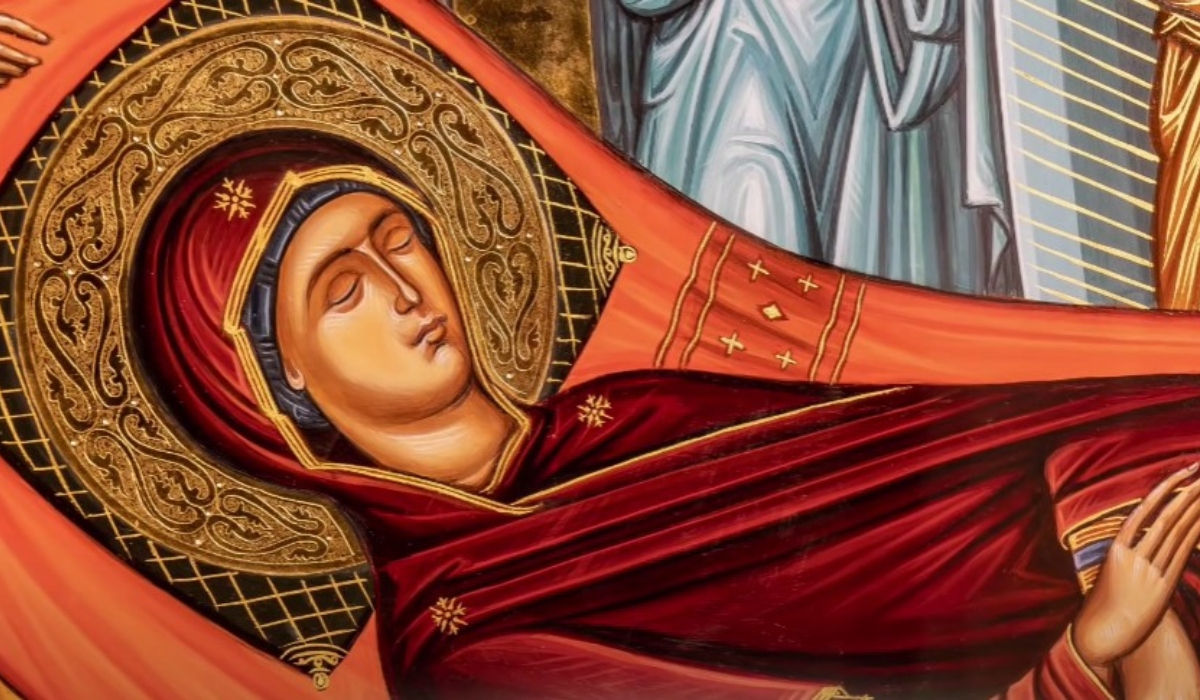
The icon of the Dormition depicts the Theotokos lying on her funeral bier, surrounded by the apostles and the bishops of the apostolic Church who have gathered at her bedside. Behind the bier stands Christ, surrounded by a mandorla of light, holding his mother’s soul in his arms in the form of an infant clothed in white. In the upper part of the composition, the Theotokos is sometimes shown already taken up into heaven and received by ranks of angels.
Liturgical customs
In many communities, it is customary to bless flowers and aromatic herbs on the day of the feast. A number of monasteries also preserve the rite of the bread of the Panagia: a portion of bread is raised at the end of meals in honour of the Mother of God, in remembrance of her appearance to the apostles after her departure, reassuring them of her continuing presence beside them.