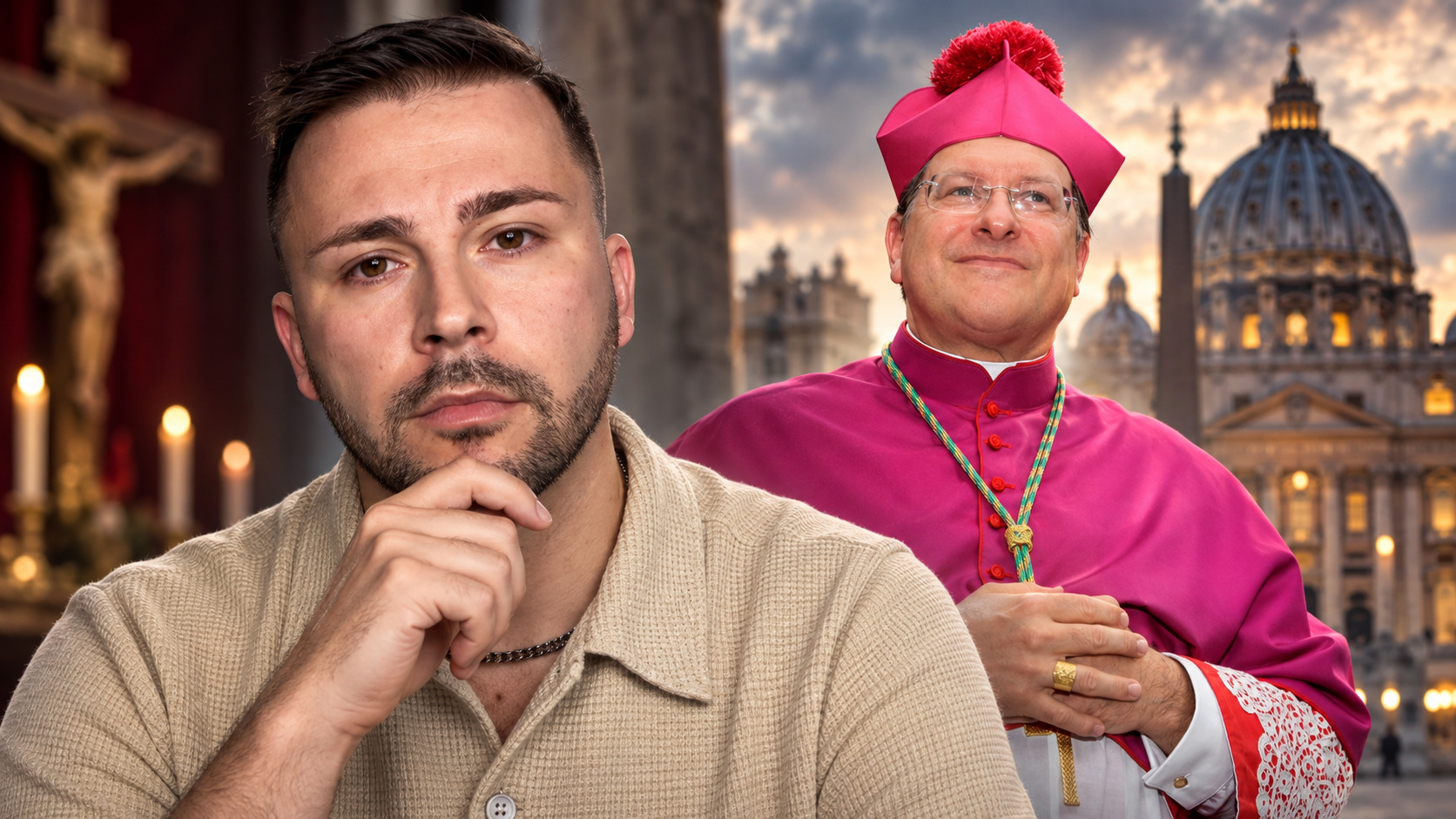
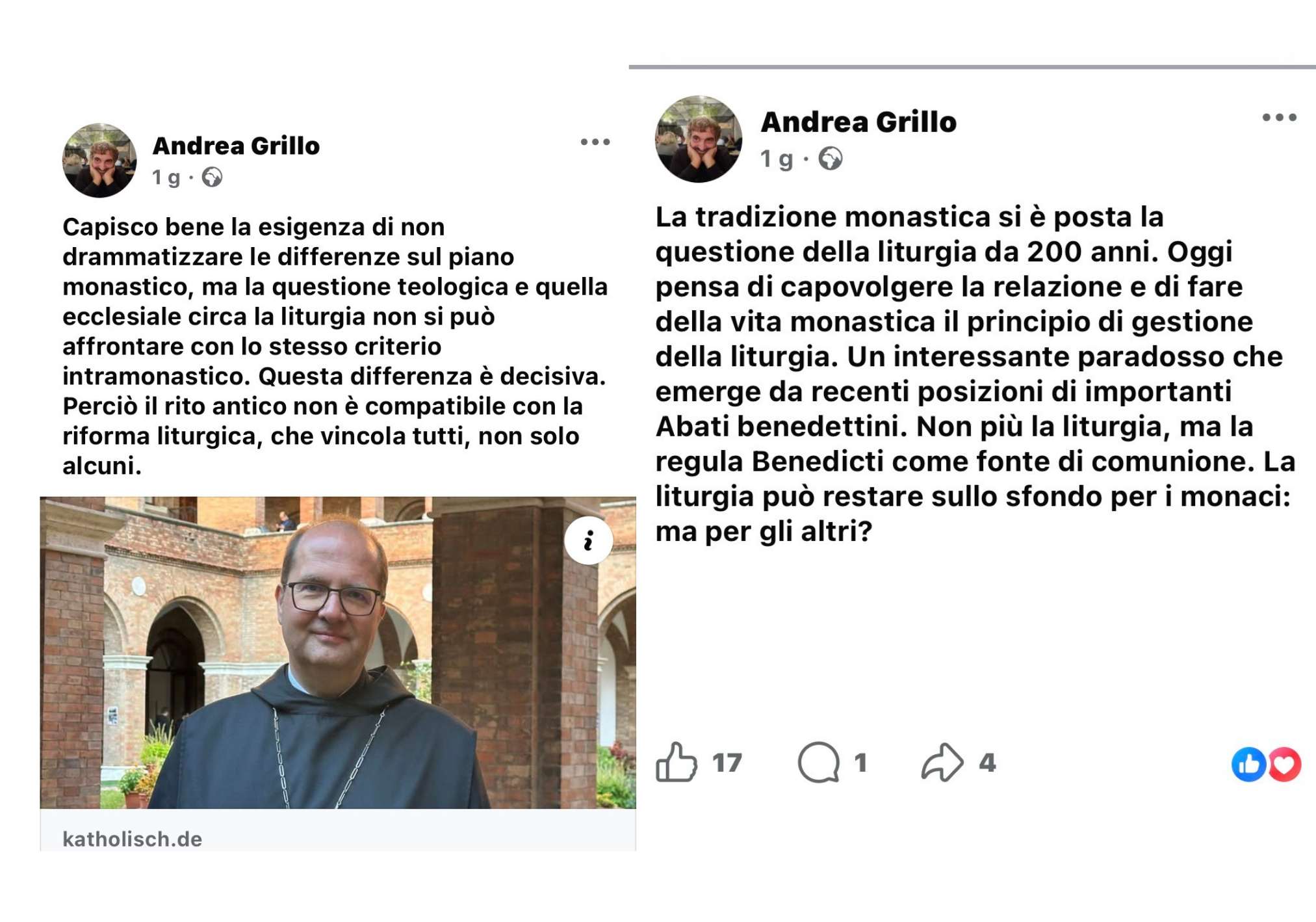
There is something pathetic, and at the same time instructive, in the way Andrea Grillo continues to hammer away at his Facebook keyboard like an unemployed boomer who has still not realised that the party is over. In the past few hours, Avvenire published an interview with the Abbot Primate of the Benedictine Confederation, Dom Jeremias Schröder OSB, who took up Leo XIV’s appeal - made last March in the letter to the bishops of France through Cardinal Parolin - for a “generous inclusion” of those who sincerely adhere to the Vetus Ordo. Words of peace, of monastic good sense, of ecclesial charity. Schröder simply explained how, in Benedictine monasteries, the two liturgical forms coexist harmoniously, without conflict, and how he himself - who celebrates only with the new Missal - is received with respect at Fontgombault and in turn shows that same respect towards communities that celebrate according to the ancient rite. A concrete, lived testimony, not an ideological one.
It is worth recalling, moreover, how we got here. Avvenire began to look at Fontgombault after the interview the abbot gave to Silere non possum. It was in fact this outlet that brought to light the authentic richness of that monastic community: the many positive aspects of its internal life, the valuable insights these monks can offer the Church, the way in which they live the liturgy in full ecclesial communion.
Then all hell broke loose. The self-styled keyboard liturgist immediately stepped in to explain to the world - and above all to an Abbot Primate who lives monastic liturgy every day of his life - that he had got it all wrong. That peaceful coexistence in monasteries would in fact be a surrender. That “respect” between brothers would be an overturning of the Liturgical Movement. That Guéranger, Beauduin, Casel and Vagaggini had been betrayed by Schröder and by the Abbot of Solesmes, Kemlin, guilty of having suggested that the good of monastic communion may stand above ritual uniformity.
A pontificate that is over, and a figure left behind
It is worth saying plainly how things stand. During the previous pontificate, Grillo had found a microphone. It was a time when a certain violent, polemical, divisive vocabulary found an audience, when those who raised their voices against “traditionalists” - an increasingly broad category, almost wide enough to include anyone who did not agree with him - could feel intellectually protected. That time is over. Leo XIV, with his calm and firm style, has imposed a change of tone that has rendered the Grillos of every rank obsolete. The Pope speaks of a “painful wound”, calls for a “new mutual perspective”, asks for “greater understanding of the sensitivities of others”. Grillo, instead, writes of “anarchy imposed from above”, of “ritual indifference”, waves around Zizola from 2007 like a polemical relic, and invokes a Ratzinger from 2001 bent to factional use.
He is the perfect emblem of a bygone era: violent, vindictive, arrogant. Little competence, plenty of malice. And he types out that malice there, on the boomers’ social network, where he thinks he is still the master, while in reality he is simply a man who has not noticed that the train has left without him.
Ideology dressed up as theology
Let us examine the piece on its merits. Grillo’s thesis is that Schröder and Kemlin have “overturned” the Liturgical Movement, because they allegedly reduce the liturgy to an “affective” dimension in which “everyone can cultivate their own passions”, preserving unity only through the label of respect. Hence the decisive accusation: the Regula Benedicti would not suffice as a principle of communion, and outside the enclosure all this would not work.
It is an ideological thesis, and for several reasons.
First reason: Grillo pretends not to know - he, who ought to be teaching this - that the coexistence of different ritual forms is the historical norm of the Catholic Church, not a pathological exception. Eastern rites and the Roman rite, Ambrosian and Mozarabic, Dominican and Carthusian: the Church has always lived from the plurality of her rites without communion being undermined. If ritual diversity truly produced “anarchy” and prevented “common action”, one would have to conclude that the Catholic Church has never been in communion with herself. It is an absurdity that speaks for itself.
Second reason: Grillo knowingly confuses unity with uniformity. It is a crude theological error. The Church is one in faith, in the sacraments and in hierarchical communion, not in the rigid identity of every single rubric. Schröder says something elementary and profoundly Catholic: that mutual respect between those who celebrate with different Missals is not a renunciation of communion, but a mature form of it. Grillo turns this evident point into a betrayal of Vatican II. Whether it is intellectual dishonesty or ideological short-sightedness, take your pick.
Third reason, the most serious: Grillo cites Guéranger, Beauduin and Casel as though they were his allies, when the entire Liturgical Movement arose precisely from the monastic experience of the liturgy as lex orandi lived in the concrete reality of communities. Exactly what Schröder and Kemlin are defending. The idea that monks should receive lessons on the Liturgical Movement from a lay lecturer at the Sant’Anselmo Athenaeum who attacks the Abbot Primate of Sant’Anselmo is a short circuit that would be enough on its own to close the matter.
Fourth reason: Grillo’s rhetorical move is classic and dishonest. He takes a monastic argument and accuses it of not applying outside the enclosure. But Schröder never said that his experience was the canonical model for the universal Church: he said that it is a model, that it works, that it shows coexistence is possible. It was the journalist who asked him whether the Benedictines could be a model, and he answered with the prudence of someone who knows his own charism: “in a certain sense, yes”. Grillo pretends that Schröder claimed what Schröder did not claim, and then beats him over the head for the claim he has attributed to him. It is the keyboard polemicist’s handbook.
Fifth reason: the Pope has already spoken. Leo XIV has asked for “generous inclusion”. Grillo responds with generous exclusion. The Pope speaks of “healing a wound”; Grillo reopens the wound with the scalpel of polemic. The Pope invokes the Holy Spirit for “concrete solutions”; Grillo offers abstract solutions, founded on a theoretical principle - ritual uniqueness as the condition of communion - which the history of the Church disproves and which the current magisterium does not share.
The scandal of Sant’Anselmo
And here we come to the most embarrassing point in this whole affair, the one that ought to be addressed with the seriousness it deserves. Andrea Grillo teaches at the Pontifical Athenaeum of Sant’Anselmo and receives a salary whose embarrassing figures Silere non possum has revealed. The Grand Chancellor of Sant’Anselmo is Dom Jeremias Schröder, the Abbot Primate. In other words, the person whom Grillo, in the past few hours, has publicly attacked, accusing him, in substance, of having betrayed the Liturgical Movement, of administering coexistence according to a theologically unsustainable principle, and of having made himself complicit in a position contradictory to Guéranger and to the Liturgical Reform.
Consider for a moment the enormity of this. A lecturer at a pontifical athenaeum publicly attacks, on social media, his own Grand Chancellor on a matter that lies precisely at the heart of his teaching. He does so in a contemptuous tone, with the usual claim to be the sole custodian of true liturgical doctrine, with the usual reduction of those who disagree with him to objects of polemic. And he does so at the very moment when the Pope himself has indicated a direction of travel opposed to his.
That such a figure can continue to teach in that institution, where the ultimate superior is precisely the Abbot Primate of the Benedictines, says something far from secondary about the state of certain ecclesiastical academic circles. This is not about asking for censorship: it is about asking for coherence. Either one teaches with the institutional fidelity that a pontifical athenaeum requires, or one becomes a full-time Facebook polemicist. With one’s own money, however, not with that of Catholic institutions. The two things cannot coexist without damaging the credibility of the institution.
Leo XIV has marginalised, simply through his style, an entire season of verbal violence disguised as liturgical and theological reform. Grillo has still not noticed. He continues to hammer away at the keyboard, convinced he is the guardian of the liturgy, while the real liturgy is celebrated every day in the Benedictine monasteries he presumes to correct - with the patience, respect and communion that Schröder described and that the Pope has asked for.
The train has left. On the footboard, someone is still typing.
fr.L.C.
Silere non possum