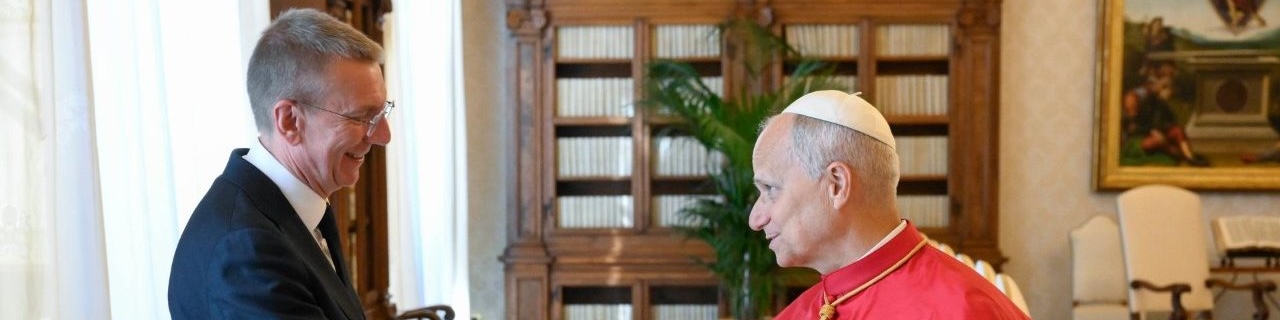
On Friday 4 September, Leo XIV received Edgars Rinkēvičs, President of Latvia since July 2023, at the Apostolic Palace. It was the first time the two had met since Robert Prevost was elected pope on 8 May 2025. On that day, Rinkēvičs had addressed the new pontiff on X, wishing him a fruitful pontificate and “strength in these difficult times”, while recalling the “cordial ties” that Riga and the Holy See have always maintained. After the audience, the president went on to the Secretariat of State, where Cardinal Pietro Parolin and Archbishop Paul Richard Gallagher were waiting to receive him.
The statement issued by the Vatican press office was of the brief, formulaic kind routinely released after meetings with heads of state: satisfaction at the good relations between the two countries, followed by “issues of common interest, both internationally and regionally, with particular reference to the ongoing conflict in Ukraine”, and a call for “greater commitment on the part of the international community to promoting peaceful solutions”. Seven lines in all.
The Latvian version is longer and includes details that do not appear in the Vatican statement. It was released through the LETA news agency by the president’s communications adviser, Mārtiņš Drēģeris. First, Rinkēvičs invited Leo XIV to visit Latvia. Second, in his meeting with Parolin, the president said he appreciated the Holy See’s role in efforts to secure the release of Ukrainian prisoners of war and the return of children deported to Russia. “Latvia firmly supports the return to Ukraine of all children who have been illegally transferred and deported, and for Russia to be held accountable for the crimes it has committed,” his office quoted him as saying. Third, they discussed the Middle East and the conflict with Iran: according to Drēģeris’s account, Riga wants a solution as quickly as possible that prevents Tehran from acquiring nuclear weapons, restores the flow of goods through the Strait of Hormuz, ends threats to shipping in the Red Sea and brings an end to civilian suffering.
On 24 November last year, Leo XIV had received Latvian Prime Minister Evika Siliņa in a private audience during her visit to Rome for the national pilgrimage promoted by the Archbishop of Riga, Zbigņevs Stankevičs. After the meeting, the Latvian government said the talks had focused on European security, support for Kyiv and the Holy See’s role in bringing Ukrainian minors home. Just over nine months later, the same issues have returned to the table, although the government in Riga has changed in the meantime: Siliņa resigned on 14 May after the Progressives withdrew from the coalition, and Andris Kulbergs has been prime minister since 28 May.
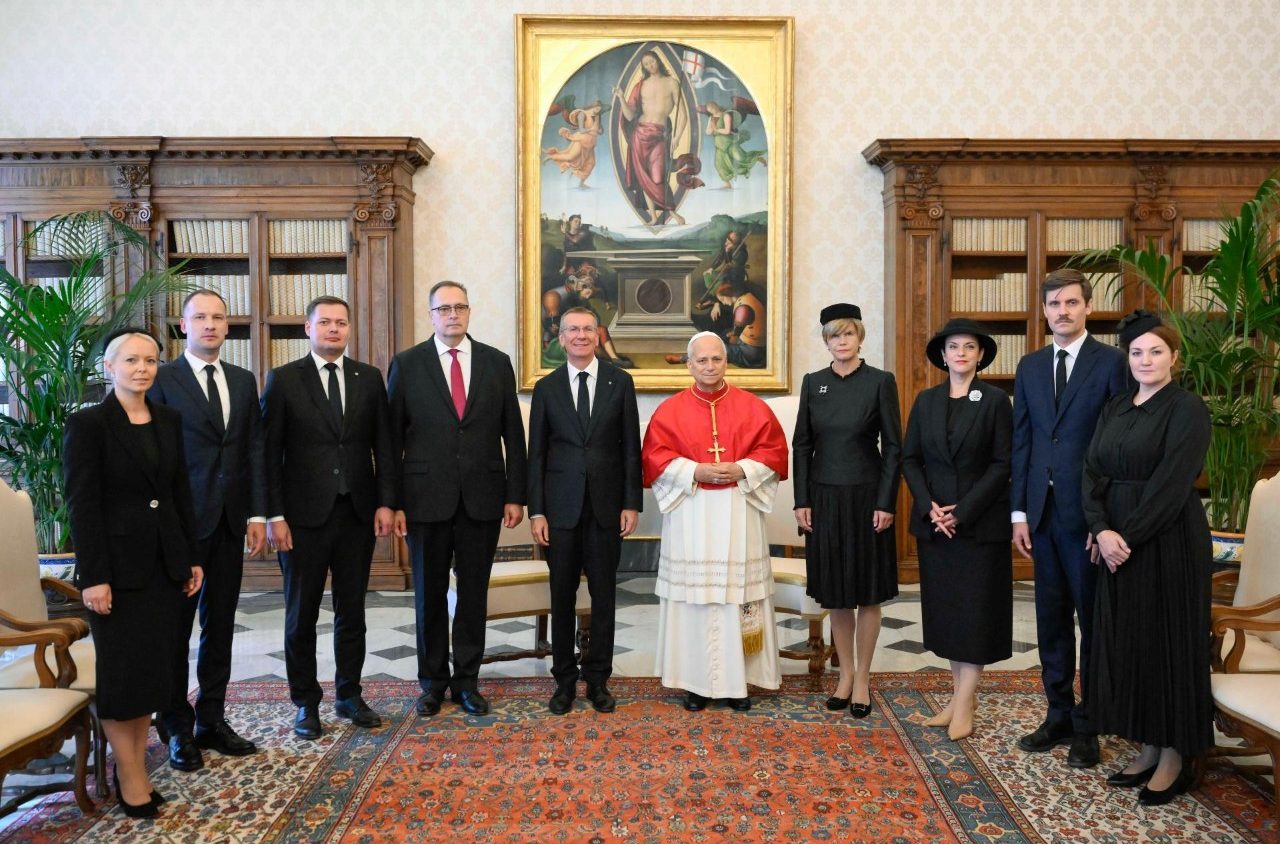
Rinkēvičs, 52, was born in Jūrmala and served as foreign minister for twelve years before the Saeima elected him president; in keeping with Latvian convention, he left his party, Unity, upon his election. He is the first openly gay head of state of a European Union country. He had already been in contact with the Holy See during his time as foreign minister: on 14 March 2022, three weeks after the invasion of Ukraine, he met Pope Francis and thanked him for the position taken during the Cold War, when the Vatican never recognised the annexation of the Baltic republics by the Soviet Union. Francis visited Latvia on 24 September 2018, travelling to Riga and Aglona as part of a journey through all three Baltic states to mark the centenary of their independence.
There is also a date that the Latvian side chose to recall at the end of its statement. The concordat between Latvia and the Holy See was signed at the Vatican on 30 May 1922 by Foreign Minister Zigfrīds Anna Meierovics and Cardinal Pietro Gasparri, ratified by the Constituent Assembly on 19 July, and entered into force with the exchange of ratifications in Rome on 3 September of the same year. The day Rinkēvičs arrived in Rome therefore marked exactly 104 years since that treaty, one of the first signed by independent Latvia with a foreign state. Catholics account for around a fifth of Latvia’s population and are concentrated mainly in Latgale, the eastern region bordering Russia, in a country where the other two main religious groups are Lutherans and Orthodox Christians.
The delegation also included Foreign Minister Baiba Braže, who had arrived in Italy on 2 September with a separate schedule of meetings: a meeting with Maurizio Gasparri, chairman of the Italian Senate’s Foreign Affairs and Defence Committee, devoted to security in the Baltic, Ukraine and the Middle East, and a lecture at the NATO Defence College in Rome on the future of the Alliance and Latvia’s contribution to collective defence since 2022. The Vatican statement’s reference to “greater commitment on the part of the international community” should also be read in the light of the fact that, since January, Latvia has been serving a two-year term on the UN Security Council as a non-permanent member.
The visit came one month before the Saeima elections, scheduled for 3 October. The president is not involved in the vote and on Saturday 5 September will be in Cesvaine, in the centre of the country, to observe the Namejs 2026 national defence exercise. As for the invitation to Riga, Leo XIV currently has a trip to France in his diary, with visits to Paris, Lourdes and Metz on 25 and 26 September; another papal visit to Latvia only eight years after Francis’s would be highly unusual.