Vatican City – Since January, Leo XIV has been working his way, Wednesday after Wednesday, through the entire body of documents of the Second Vatican Council. The Pope has chosen a sequence that reverses the order in which they were promulgated: he began with the Dogmatic Constitution Dei Verbum, approved in November 1965 and among the last documents of the Council, moved on to Lumen gentium of November 1964, and is only now addressing Sacrosanctum Concilium, which, on 4 December 1963, was in fact the very first text promulgated by the Council Fathers. The sequence follows primarily a thematic progression – from the revelation of the Word, to the nature of the Church, and finally to the worship that the Church herself offers to God – rather than the chronological order in which the documents were approved.
The series began on 7 January with an introductory catechesis on the significance of the Council as a whole. Between 14 January and 11 February, five reflections followed on Dei Verbum: God’s revelation to humanity, Christ as the revealer of the Father, the relationship between Scripture and Tradition, Sacred Scripture as the divine word expressed in human language, and the role of the Word in the life of the Church. From 18 February to 13 May, the Pope then devoted nine stages to Lumen gentium, retracing the mystery of the Church as the sacrament of the unity of the human race, her reality as both visible and spiritual, her identity as the People of God, the priestly and prophetic dimension of the faithful, her apostolic foundation and hierarchical structure, the vocation of the laity, the call to holiness, the journey of the pilgrim Church towards the heavenly homeland and, finally, the Virgin Mary as the model of the believing assembly.
The third section of the series, devoted to Sacrosanctum Concilium, began on 20 May. The first reflection placed the liturgy at the heart of the Church’s life; the second, on 27 May, revisited the liturgical reform sought by the Council and its relationship with tradition; the third, on 3 June, focused on the language of the rite, between sign and symbol. The sequence was interrupted for a week – on 17 June the audience was devoted to the apostolic journey to Spain, which had just concluded – before resuming on 24 June with a reflection on the Eucharistic mystery and, following the customary summer break in July, on 5 August with an address on the prayer of the Church.
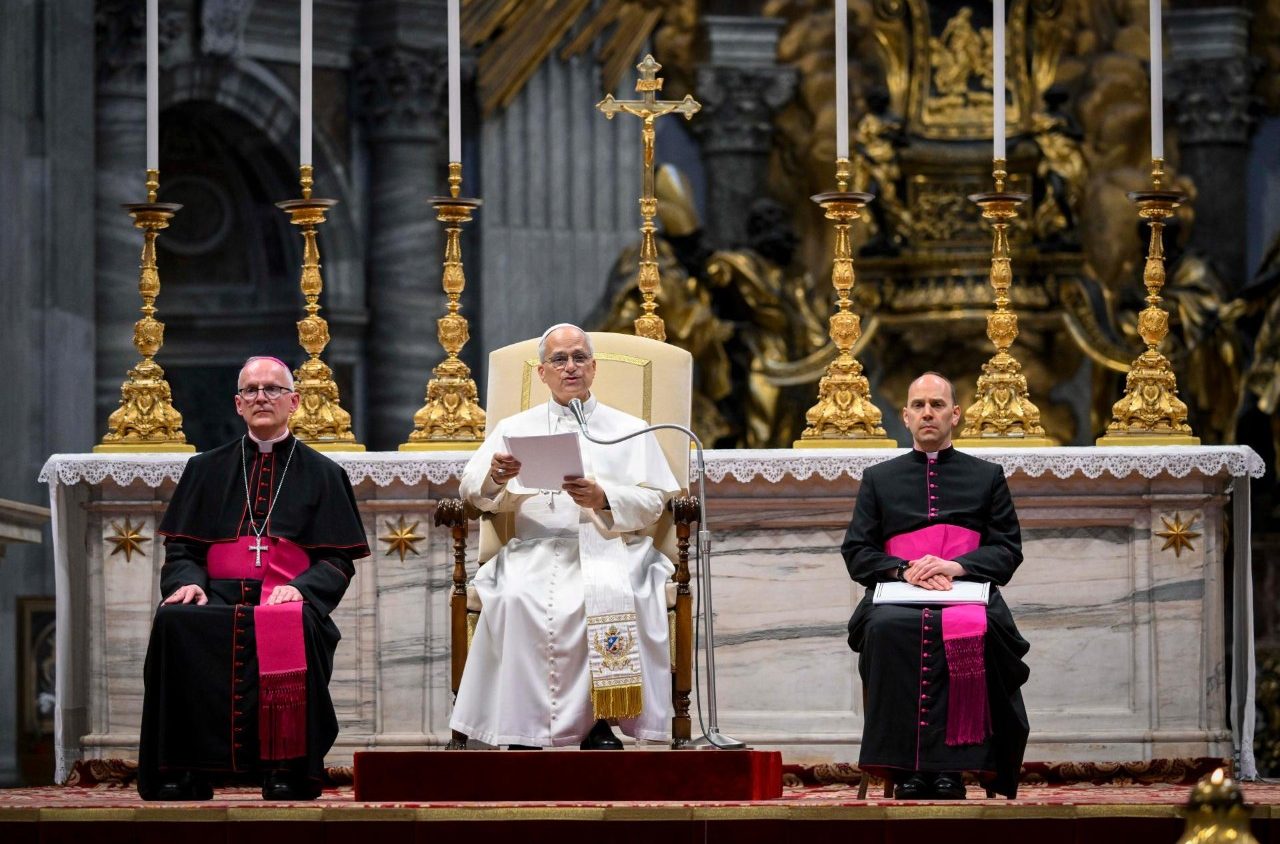
This morning, in St Peter’s Basilica because of the high temperatures, Leo XIV delivered the sixth instalment in this section, devoted to the liturgical year, the subject of the fifth chapter of the Constitution. The Pope recalled that the expression entered ecclesiastical language thanks to the Benedictine Prosper Guéranger, and referred to the teaching of Pius XII in the Encyclical Mediator Dei, according to which the cycle of Christian feasts is not a cold and lifeless representation of events of the past, but rather the living presence of Christ, who continues his work of mercy in the Church. On this basis, Leo XIV described the liturgical year as a constant renewal of the work of salvation, enabling the faithful to remain in contact with the Lord’s redemptive action.
At the heart of this renewal, the Pope placed Sunday, described by the Council Fathers as the “foundation and kernel” of the liturgical year and recognised, in many languages, as the Lord’s Day. Leo XIV recalled the teaching of John Paul II in the Apostolic Letter Dies Domini of 31 May 1998, according to which Sunday reveals the very meaning of time, directing days, months and centuries towards their ultimate goal: Christ’s Second Coming. Hence his emphasis on participation in the Eucharist as the heart of the sanctification of Sunday and on the indispensable value of an assembly physically gathered around the altar, characterised by bodily presence and the active participation of the faithful called together. The Pope appealed for the best possible conditions to be found so that even those who are unable to take time off work on Sundays may nevertheless take part in Holy Mass.
The catechesis then retraced the historical development of the liturgical cycle: from the weekly Easter to the annual Easter celebration, extending over the fifty days culminating in Pentecost and prepared for by the penitential season of Lent; from the subsequent development of the Christmas cycle, modelled on the Paschal cycle; to the incorporation of Marian devotion and the commemoration of martyrs and saints. In closing, Leo XIV described this structure as the “guiding principle” and the essential framework for all pastoral action of the Church.
At the conclusion of the audience, the Pope greeted English-speaking pilgrims and visitors, with a particular welcome for groups from Malta and Zimbabwe. He invoked upon them and their families the joy and peace of Jesus Christ, before concluding with his blessing.