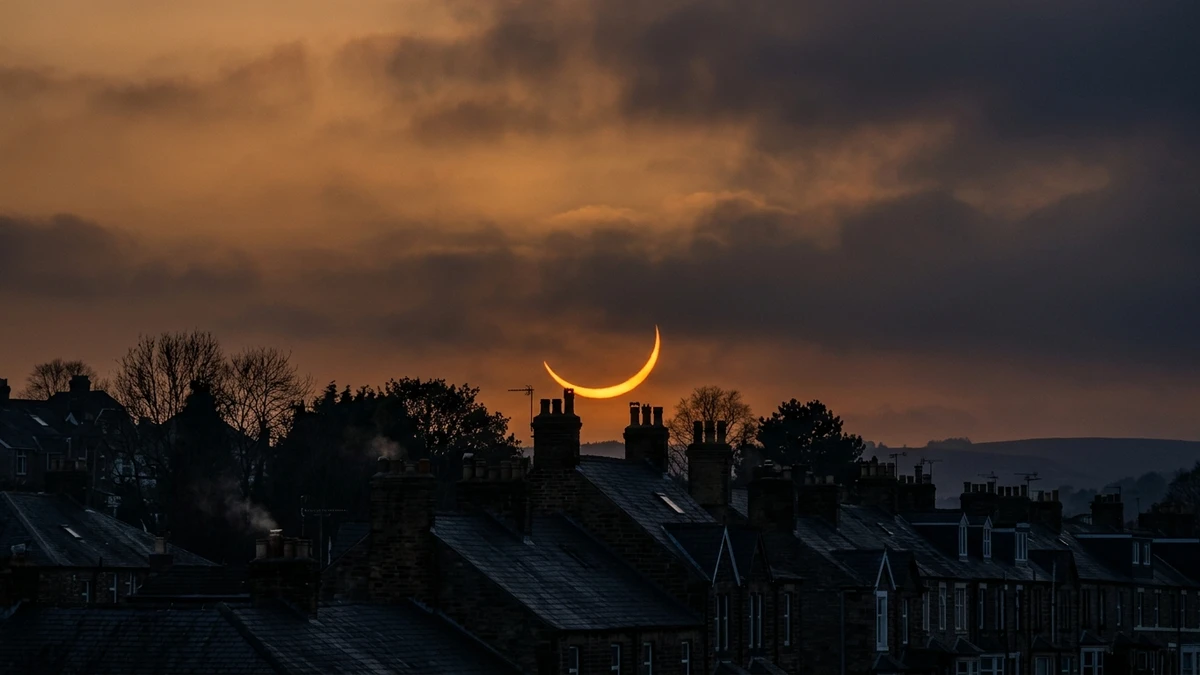
On Wednesday evening, 12 August, the Moon will move across the Sun above London for almost two hours, covering around 91 per cent of the solar disc at the peak of the eclipse. According to calculations by the Royal Observatory Greenwich, it will be the deepest eclipse visible from the capital since 2015. The Observatory will also stream the event live for anyone whose view is obscured by cloud.
The path of totality, where the Moon completely blocks out the Sun, will cross only Greenland, Iceland and northern Spain, which will witness its first total solar eclipse since 1905. London, however, will see a partial eclipse throughout. Even at maximum coverage, when the Sun is reduced to a narrow crescent, enough light will remain to make direct viewing unsafe.
When and where to watch
The eclipse will begin at around 6.16pm BST, when the Moon first starts to cover the edge of the Sun. Maximum coverage, at roughly 91 per cent, is expected at about 7.12–7.13pm, by which time the Sun will be low in the sky, only around ten degrees above the western horizon. The eclipse will end shortly after 8pm, almost half an hour before sunset in London, which is due at 8.28pm.
Because the Sun will be so low, choosing the right viewing spot will matter. Anyone hoping to follow the eclipse will need an unobstructed view towards the west or north-west, clear of buildings, trees or higher ground. The specialist website Absolute Eclipse recommends Primrose Hill and Greenwich Park as two of the best places in the capital, both offering elevated positions and open views of the western sky. The Thames riverside around Chiswick or Putney is another practical option for those who would prefer to watch from river level.
Safety advice
Unlike a total eclipse, which includes a brief period when the Sun is completely obscured and can be viewed without eye protection, London’s eclipse will never become safe to look at directly. Experts at the Royal Observatory Greenwich recommend using eclipse glasses certified to ISO 12312-2 from the beginning of the event until it is over; ordinary sunglasses do not provide sufficient protection.
Anyone planning to photograph the eclipse, or view it through binoculars or a telescope, should fit a certified solar filter to the front of the lens. It should never be placed behind the eyepiece, as doing so risks damage both to eyesight and to the equipment.
The last comparable eclipse
The last deep eclipse seen from London was on 20 March 2015, when 85 per cent of the Sun was covered. Across the UK as a whole, the nearest comparable event was in 1999, when the path of totality crossed parts of Cornwall and Devon.
In London, the 91 per cent coverage expected on 12 August will still be enough to produce a noticeable change in the light, making it dimmer and cooler in tone, although the sky will not become dark.