

When Facebook introduced the thumbs-up in 2009, it presented it as a small revolution in approval: a quick way of saying “I like this” without having to write a comment. Sixteen years later, that gesture has become something quite different, and probably far less interesting. The like, across all social networks and not only on Facebook, has ceased to be a reliable unit of measurement for approval, because those who give it often do so for reasons that have little to do with approval at all. It is worth looking more closely, because two apparently distant phenomena - the viral success of hateful content and the widespread habit, in “certain circles”, of handing out likes indiscriminately - in fact tell the same story: that of a gesture emptied of meaning. A story which, in the Catholic community, also speaks of something else: hypocrisy, and a substantial inability to inhabit digital spaces. Perhaps this is no coincidence. For some time now, we have even forgotten how to live in real spaces: we have shut ourselves inside a sect of like-minded people, associating only with those who think as we do. It is hardly surprising, then, that the same closure is replicated - more automatically, more blindly - when we move to the screen.
Hatred pays, in engagement terms
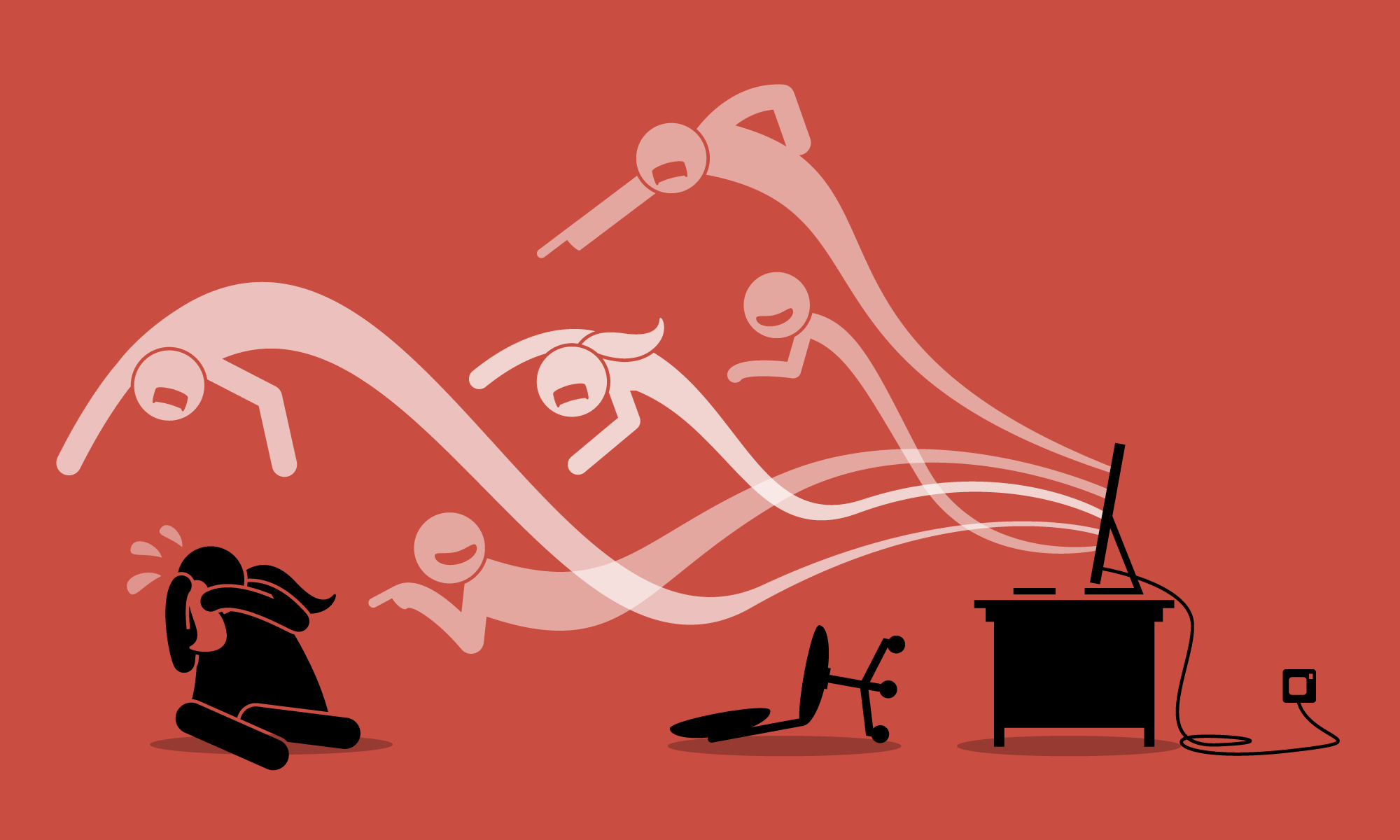
That aggressive content performs better than other content is no longer a suspicion, but an established fact. Several studies have shown that posts expressing indignation, anger or contempt towards an opponent - political, religious, professional or cultural - generate significantly more reactions than calm or constructive content. The mechanism is well known: the algorithms of the main platforms reward whatever produces engagement, and indignation produces engagement better than any other emotion. A measured post asks the reader to think; an indignant post asks only for a reaction, and reacting requires less effort.
Take, for example, the many posts circulating about war, or about cases such as Garlasco - although the same applies to countless other subjects. How many people really stop to check whether what is being shared is authentic? It is an operation that even many journalists do not know how to carry out; some of them, speaking about ongoing conflicts, have passed off AI-generated images as footage of real bombings. It is a tragedy within the tragedy. Yet it also happens, far too often, that ordinary users publish nonsense which then bounces around virally as though it were established truth - only for it to emerge a few days later that the screenshot was false, the quotation invented, the news story entirely non-existent.
On social media, this creates a structural asymmetry. A balanced, documented piece of content that invites reflection may gather twenty or thirty likes. A post that violently attacks an identified enemy - the politician, the bishop, the foreigner, the journalist - may gather thousands. It would be naïve to conclude that the second position is more widely shared than the first: what we are measuring is not consent, but willingness to click. And that willingness is activated far more easily when the content touches a raw nerve. A like given to hatred, in short, is not a vote: it is a nervous discharge.
Not all likes carry the same weight
There is another aspect which is rarely made explicit, yet which profoundly changes the way we should read those counters. The numbers are always the same - one hundred is one hundred, one thousand is one thousand - but the people behind them are not. A post that receives a thousand likes from authoritative public figures, respected professionals, intellectuals, esteemed personalities and serious journalists is not the same as a post that receives a thousand likes from a network of anonymous accounts, angry profiles, serial trolls and figures who have built their visibility on systematic aggression. Yet on the counter, those two “thousands” look identical. It is an optical illusion with concrete consequences. Economic ones too.
It happens very often, especially in our own circles, that embarrassing figures exchange likes with one another, building bubbles of mutual recognition in which the hateful reward the hateful, the conspiracy theorist applauds the conspiracy theorist, and one person obsessed with the Pope cheers on another person obsessed with the Pope. A small economy of appearances is created: the numbers rise, the algorithm notices, the content circulates - and that circulation becomes, in the eyes of distracted observers, a form of legitimisation. “If he has all those likes, he must be famous,” thinks someone who has no time to look at who put those likes there. But the truth is that behind certain numbers there is no authoritative consent at all: there is only a claque feeding itself.
The same is naturally true in a positive sense too: a measured comment signed by a person of recognised competence carries, in terms of real public debate, far more weight than a hundred comments from faceless profiles. Learning to “weigh” likes - asking not only how many there are, but who is giving them - is one of the most necessary exercises if we are not to be deceived by the numerical appearances of this ecosystem.
The like as a greeting
There is then a second form of emptying, less conspicuous but perhaps just as significant, and particularly visible in certain environments - the Catholic one among them, though not only there. This is the like handed out indiscriminately, with no correlation to the content actually being “rewarded”. It can be seen clearly when observing the behaviour of certain users on divisive issues: the same person likes a post defending a particular position and, shortly afterwards, likes another post arguing exactly the opposite. It is simply an automatism.
There are various reasons, and they probably coexist. There is the greeting-like, which works as a kind of virtual good morning: “I have seen you, I am here.”
There is the belonging-like, which signals recognition of a common enemy rather than adherence to the content itself: if you attack that particular position, or even that particular person, I will give you the thumbs-up - whatever you may actually have written. And here a further reflection would be needed, especially for those who hold public roles: giving a thumbs-up to certain content, when that content is far from insignificant in its gravity, has precise consequences. And rightly so. There is the courtesy-like, which avoids the awkwardness of scrolling past without reacting. And finally there is the distracted like, the result of the speed with which we move through our feeds: one clicks almost without reading, as one nods to an acquaintance passed in the street.
The hypocrisy of a certain digital Catholicism
In our environment there is a dramatic hypocrisy, which is first and foremost an inability to exercise judgement. We do not want to “get our hands dirty” by liking content we brand as “divisive”, though in substance it consists of argued and documented reflections. Yet we then “gift” that same like, without hesitation, to insulting posts, conspiracy constructions, and accounts that have turned attacks on the Pope into a real profession. Someone observed in recent days that certain websites and social media accounts in American Catholicism are among the most clicked in the ecclesial galaxy: and this is true, because they are precisely the ones that mix together conspiracy theories, attacks on migrants and homosexuals, and systematic hostility to the magisterium. They attract because they polarise - that is the law of the algorithm, no mystery there. But the question we should ask ourselves is another: do we really believe we make a good impression by clicking, sharing and relaunching such content? Those who give these posts the thumbs-up are largely the same people who then, with an air of superiority, label as “controversial” the pages of other newspapers which are far more balanced, and almost always better documented.
When a community behaves like a sect
The answer, however, is there and it is clear: whenever we reason like this, we are no different from sects. You know those people who wander around our cities with name badges on their chests, white shirts and ties? They have developed sectarian behaviour - we recognise it immediately, and with a certain smugness - which prevents them from honestly assessing what is said by anyone outside the group, and even more so by anyone within the group who dares to criticise it. That is exactly what a sect does. The testimonies of former members always tell the same story: they began to ask questions, they denounced what was wrong, they were labelled, pushed away and finally turned into monsters so as to make them untouchable. Sects operate in this way: they invent stories, spread gossip, ostracise, and destroy the reputation of those who disturb them. And they do so precisely against those who have the courage to speak the truth. Sects do this, then. Not us Catholics. We are a community of believers; we do not do such things. That is not our modus agendi. Is it?
And yet, at times, it also happens in our own circles - and certain choices, certain judgements, give us a worrying image of how lacking human, cultural and affective formation really is.
What remains of the “like”
The two dynamics seem opposed - one rewards anger, the other rewards everything indiscriminately - but they converge at one point: the like has ceased to be an evaluative act. In the first case it expresses an impulse; in the second, a relationship. In both cases, however, it says nothing about the quality or truth of what is being rewarded. And this has concrete consequences. The first consequence is epistemological: we become accustomed to reading numbers as though they measured consent, and on those numbers we build judgements about public opinion, schools of thought and the authority of those who speak. On those same numbers, let us be clear, earnings are also built: depending on how many followers you have and how many likes you manage to accumulate, a company decides whether to offer you a collaboration, whether to pay you and how much. Meta, TikTok and YouTube do the same in their monetisation programmes. But if the counter does not really measure what it claims to measure, our maps - economic as well as cultural - are distorted.
The second consequence is moral: those who produce content learn, consciously or otherwise, that certain gestures yield results and others do not. The author who wants to be read is incentivised to raise the tone; the one who wants to be appreciated by his own knows that merely existing will be enough. In both cases, the quality of the content becomes a secondary variable.
We need thinking communities, not circus acts
Perhaps there is no technical solution to the problem, and the like, as a tool, has probably exhausted its usefulness. What remains possible is an individual exercise in awareness: asking ourselves, before clicking, whether we are really saying “I agree”, or whether we are saying something else - and, in that case, whether it would not be more honest not to click at all, or to write a couple of lines. A reasoned comment is worth more than a thousand thumbs-up. But something broader is at stake. The current digital ecosystem is populated by hugely followed accounts - often with followers who are largely inactive - that bring nothing to public, political or ecclesial debate: circus acts that every day announce the revolutionary idea or the scoop of the year, and every day are duly contradicted. We cannot continue to rely on them. We need, especially in our ecclesial environment, thinking communities: capable, when necessary, of bringing a scandal to light in order to focus attention on a real problem, while making their daily work that of reflection, analysis, offering insights and telling stories with care. That is how community is built - provided that on the other side there are readers willing to engage, rather than pour out hateful or senseless comments.
Who funds free information?
And here comes the most uncomfortable point, the one that is usually left unsaid: how are these realities funded? If the algorithm rewards those who shout and insult, those who choose not to lower themselves to that level - as Leo XIV has explicitly asked us to do on several occasions - must still find a way to have the resources needed to offer this service. If, instead, serious, documented and reflective content is structurally penalised, the problem is no longer individual but systemic.
It should also be added that these large American entities do not live only on the earnings that platforms distribute according to numbers: they have major backers behind them, all traceable to a precise political area. This becomes clear at the crossroads: if they have to choose between defending the Pope and defending Donald Trump, they invariably choose the latter.
It is a subject we are reflecting on in these very hours at the country’s most important event dedicated to start-ups and technology: information, too, needs investors. It needs them urgently, at a time when the wars being fought in various parts of the world are accompanied by a parallel war of words and fake news conducted on social media. We need people willing to take a chance on free information: not directed by those who put up the money, but committed to telling the truth without taboos, without restraint, without fear.
Perhaps, in the end, the point is exactly this. To stop considering likes as private and neutral gestures, and to begin seeing them for what they are: a vote, every time, on what kind of public word we want to support. And on what kind of community we want to be.
J.V.
Silere non possum